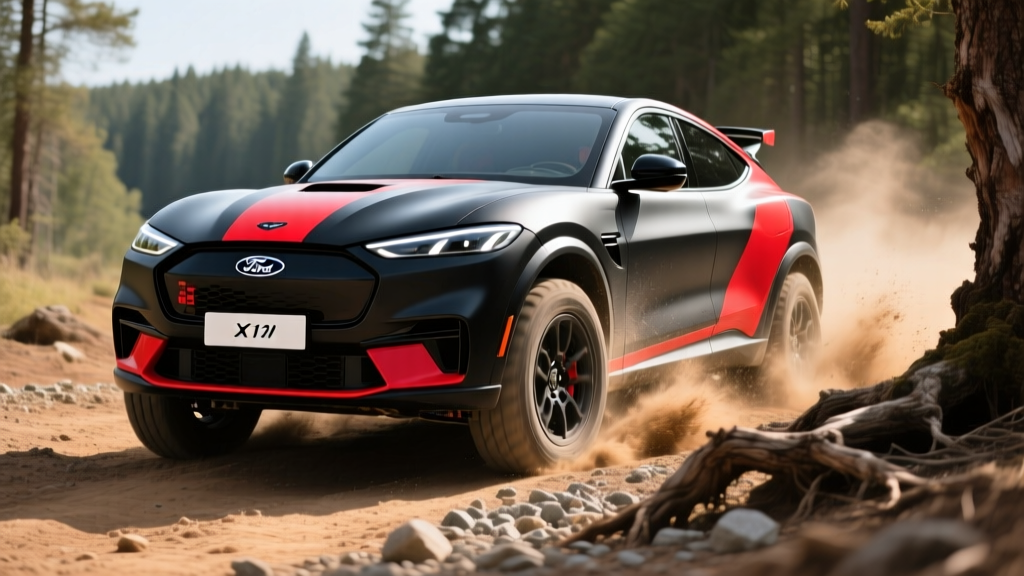
The Ford Mustang Mach-E Rally exists in a category of one: a factory-built, rally-inspired electric crossover that trades outright track performance for gravel-road swagger and daily-drivable comfort. For 2026, Ford continues the Mach-E Rally as the adventure-flavored flagship of the Mach-E lineup, packing a 91 kWh (usable) extended-range battery, dual-motor all-wheel drive, and chassis tuning that actually makes dirt roads fun rather than merely survivable. But at a starting MSRP near $59,000, buyers need to know exactly what they're getting — and what they're giving up — compared to the GT trim or rival electric crossovers.
We've analyzed the spec sheets, cross-referenced EPA data on fueleconomy.gov, and evaluated real-world ownership factors to build this buyer's guide. Here's everything you need to decide whether the Mach-E Rally earns a spot in your garage.
Quick Verdict: Who the Mach-E Rally Is For
The 2026 Mach-E Rally targets a narrow but enthusiastic buyer: someone who wants an electric daily driver with genuine light-off-road credibility, doesn't need a dedicated off-roader like a Rivian R1S, and values Ford's dealer network and BlueCruise highway assist. It's not the longest-range Mach-E (that's the rear-wheel-drive Select at 250+ miles on a smaller battery, or the Extended Range RWD pushing past 300), and it's not the quickest (the GT with the Performance Upgrade hits 0-60 in about 3.3 seconds). What the Rally delivers is a unique blend of rally-tuned suspension, 480 horsepower, protective underbody armor, and enough range for weekend adventures — provided you understand the real-world limitations.
Choose the Mach-E Rally if: You frequently drive on gravel, forest service roads, or snowy unpaved passes; you want a distinctive EV that stands apart from the sea of white crossovers; you value Ford's service network over startup brands.
Look elsewhere if: Maximum range is your top priority (consider the Mach-E Extended Range RWD); you need three rows of seating; you want the most aggressive 0-60 time (the GT Performance Upgrade is faster and cheaper).
Range, Efficiency, and Real-World Expectations
| Spec | Value |
|---|---|
| EPA Range | 265 miles |
| Battery (usable) | 91 kWh, NMC (nickel manganese cobalt) |
| Drivetrain | Dual-motor AWD (eAWD) |
| Horsepower | 480 hp |
| Torque | 634 lb-ft |
| 0–60 mph | ~3.9 seconds (Ford est.) |
| EPA Efficiency | 84 MPGe combined (approx. 40 kWh/100 mi) |
| Max DC Fast Charge | 150 kW peak |
| 10–80% DC Charge Time | ~36 minutes |
| Level 2 Home Charge Rate | 10.5 kW (~30 mi/hr) |
| Cargo (behind 2nd row) | 29.7 cu ft |
| Cargo (seats folded) | 59.7 cu ft |
| Front Trunk (Frunk) | 4.7 cu ft |
| Ground Clearance | 5.7 inches (slightly raised vs. standard Mach-E) |
| Base MSRP | $58,995 (incl. destination) |
| Battery/Powertrain Warranty | 8 years / 100,000 miles |
The EPA rates the 2026 Mach-E Rally at 265 miles on a full charge. That figure comes from the 91 kWh usable portion of the extended-range NMC battery pack. NMC (nickel manganese cobalt) chemistry offers higher energy density than LFP (lithium iron phosphate), which helps package more range into the same physical space — but it also means Ford recommends daily charging to 80–90% for longevity, reserving 100% for road trips.
EPA Sticker: 265 miles
Real-World Expectation: In mixed suburban/highway driving at 65–70 mph in moderate temperatures, expect approximately 230–245 miles before needing to charge. On sustained highway runs at 75+ mph, figure closer to 210–225 miles. In cold weather (below 30°F), range can drop 15–25%, putting realistic winter range in the 190–215 mile bracket depending on cabin heat usage and whether you precondition the battery.
Why the gap? The Rally's all-terrain tires, raised ride height, and AWD system create more rolling resistance and aerodynamic drag than the standard Mach-E. The EPA test cycle includes low-speed city driving where regenerative braking recovers energy; sustained highway speeds don't offer that benefit.
At 84 MPGe combined (roughly 40 kWh per 100 miles), the Rally is less efficient than the rear-wheel-drive Mach-E variants, which can achieve over 100 MPGe. That efficiency penalty is the direct cost of the dual-motor AWD system, heavier curb weight, and all-terrain rubber. For context, charging at the US average residential electricity rate of ~$0.16/kWh, a full 91 kWh charge costs roughly $14.56 — or about $0.06 per mile driven.
Charging Speed: DC Fast, Level 2, and the Curve Reality
The Mach-E Rally uses the CCS1 connector for DC fast charging (Ford has confirmed NACS adapter compatibility for Tesla Supercharger access). Peak charge rate is 150 kW, which is respectable but trails competitors like the Hyundai Ioniq 5 (240 kW) and Tesla Model Y (250 kW). Here's how that translates in practice:
| Charge Level | Power | Speed (approx.) | Use Case |
|---|---|---|---|
| Level 1 (120V household) | ~1.4 kW | ~3–4 miles/hour | Emergency / overnight trickle |
| Level 2 (240V home, 48A) | 10.5 kW | ~30 miles/hour | Daily home charging (7–9 hrs for full) |
| DC Fast (peak) | 150 kW | ~300 miles/hour (at peak) | Road trips; 10–80% in ~36 min |
| DC Fast (sustained avg. 10–80%) | ~95–110 kW | Varies | Average over the session, accounting for taper |
The critical number for road trips is the 10–80% time: approximately 36 minutes at a 150 kW or higher station. Ford's charge curve is moderate — the battery pulls close to peak rate between 10% and 40% state of charge, then progressively tapers. Above 80%, charging slows dramatically to protect battery health, which is why we (and virtually every EV owner) recommend charging only to 80% on road trips unless you absolutely need those final miles.
For home charging, a 48-amp Level 2 hardwired station delivers the full 10.5 kW, replenishing the 91 kWh pack in roughly 9 hours from near-empty. Most owners who plug in nightly will never need a full charge cycle. Budget $500–$1,500 for a quality Level 2 home charger (e.g., ChargePoint Home Flex, Emporia Level 2) plus $800–$2,500 for professional electrical installation, depending on whether your panel needs an upgrade to support a 60-amp circuit. Always consult a licensed electrician for final specifications.
Performance and Rally-Bred Driving Dynamics
The Rally's dual-motor powertrain produces 480 horsepower and 634 lb-ft of torque, routing power to all four wheels through Ford's eAWD system. The 0–60 mph sprint takes approximately 3.9 seconds — quick by any measure, though the GT Performance Upgrade shaves that to around 3.3 seconds with its more aggressive motor calibration.
Where the Rally separates itself from the GT is in the chassis. Ford equipped it with MagneRide adaptive dampers tuned specifically for mixed-surface driving, Michelin CrossClimate 2 all-terrain tires on 19-inch wheels, and a slightly raised ride height (5.7 inches of ground clearance vs. roughly 5.3 inches on other trims). The underbody receives additional shielding for the battery pack and motor assemblies. Ford also includes a dedicated RallySport drive mode that adjusts throttle mapping, stability control thresholds, and damper settings for loose surfaces.
On pavement, the all-terrain tires generate slightly more road noise than the standard all-season rubber, and the 0–60 time trails the GT. On gravel, snow, or washboard forest roads, the Rally is genuinely composed and confidence-inspiring in a way no other electric crossover at this price point matches. The MagneRide system soaks up impacts that would unsettle the standard Mach-E, and the eAWD system can redirect torque between axles in milliseconds to maintain traction.
Interior, Tech, and Daily Livability
Inside, the Mach-E Rally shares its cabin with the rest of the extended-range lineup: a 15.5-inch portrait-oriented touchscreen running Ford's SYNC 4A infotainment system, a 10.2-inch digital instrument cluster, and a minimalist center console with a rotary gear dial. Wireless Apple CarPlay and Android Auto are standard, as is a wireless charging pad.
The Rally adds unique interior trim with white accent stitching, perforated ActiveX seating surfaces (Ford's synthetic leather), and Rally-specific badging. Front-seat passengers enjoy 43.3 inches of legroom; rear-seat riders get 38.9 inches — competitive with the Tesla Model Y and Hyundai Ioniq 5. The 29.7 cubic feet of cargo space behind the second row expands to 59.7 cu ft with seats folded, plus the 4.7 cu ft front trunk for charging cables or small gear.
On the driver-assistance front, the Rally comes with Ford Co-Pilot360 Assist 2.0, which includes adaptive cruise control with stop-and-go, lane centering, evasive steering assist, and intersection braking. Ford's BlueCruise hands-free highway driving system is available (typically via subscription after a trial period). BlueCruise operates on pre-mapped divided highways and allows hands-off driving while the driver remains monitored by an interior camera.
SAE Automation Level: BlueCruise is a Level 2 driver-assistance system. Despite the hands-free capability on approved highways, the driver must remain attentive, keep eyes on the road, and be prepared to take over at any moment. This is not autonomous or "self-driving" technology — that designation (Level 4) applies only to fully driverless services like Waymo.
Pricing, Tax Credits, and Total Cost
| Item | Amount |
|---|---|
| Base MSRP (Rally, Extended Range AWD) | $58,995 |
| Typical as-tested (w/ equipment groups) | $61,000–$63,500 |
| Federal §30D Tax Credit (if eligible) | Up to $7,500 |
| Effective price after max credit | ~$51,495 |
The 2026 Mach-E Rally starts at $58,995 including destination charges. There's essentially one configuration — the Rally comes with the extended-range battery and eAWD as standard. Options are limited to paint color, equipment group packages (which may add features like a panoramic roof, upgraded audio, or enhanced active park assist), and accessories.
Federal tax credit eligibility under IRS §30D rules depends on several factors that change periodically:
- MSRP cap: The Mach-E qualifies as an SUV under IRS vehicle classification, so the MSRP cap is $80,000 — well above the Rally's price.
- Buyer income limits: Modified adjusted gross income (MAGI) must not exceed $150,000 (single), $225,000 (head of household), or $300,000 (married filing jointly).
- Battery sourcing requirements: The credit is split into two $3,750 halves — one for critical minerals sourcing and one for battery component manufacturing. Sourcing rules tighten annually; check fueleconomy.gov for the latest eligibility status of specific VINs.
- Point-of-sale transfer: As of 2024, buyers can transfer the credit to the dealer at purchase, reducing the purchase price directly rather than waiting for a tax refund. This applies in 2026 as well.
Because battery sourcing rules and eligible VIN lists update throughout the year, we strongly recommend verifying credit eligibility with your dealer and a tax professional before purchase. Never assume the full $7,500 applies without confirming your specific situation.
How It Compares: Rally vs. GT vs. Key Rivals
| Spec | Mach-E Rally | Mach-E GT Perf. Upgrade | Tesla Model Y LR AWD | Hyundai Ioniq 5 AWD |
|---|---|---|---|---|
| Price (base MSRP) | $58,995 | $56,995 | ~$49,990 | ~$52,600 |
| EPA Range | 265 mi | 280 mi | 311 mi | 290 mi |
| 0–60 mph | ~3.9 sec | ~3.3 sec | ~4.8 sec | ~5.1 sec |
| Horsepower | 480 hp | 480 hp | 384 hp | 320 hp |
| Max DC Charge | 150 kW | 150 kW | 250 kW | 240 kW |
| Unique Advantage | Rally-tuned chassis, gravel capability | Track/straight-line speed | Range, Supercharger network | 800V ultra-fast charging |
The Rally occupies a niche that none of these competitors directly address. If you don't need off-pavement capability, the Mach-E GT Performance Upgrade is faster, slightly cheaper, and offers marginally more range. The Model Y wins on range and charging speed (and Supercharger access, though Ford's NACS adapter narrows that gap). The Ioniq 5 charges faster thanks to its 800-volt architecture. But none of these offer rally-tuned dampers, underbody armor, and all-terrain tires from the factory.
Pros
- Genuine rally-bred suspension — MagneRide dampers excel on rough roads
- 480 hp dual-motor AWD with instant torque delivery
- Distinctive styling that stands apart from generic EV crossovers
- Ford's widespread dealer network for service and warranty work
- BlueCruise hands-free highway driving available
- Underbody shielding protects battery on rough terrain
- Practical cargo space (29.7 cu ft) and comfortable rear seats
Cons
- 150 kW peak DC charging trails Ioniq 5 (240 kW) and Model Y (250 kW)
- 265-mile EPA range is the lowest in the Mach-E lineup
- All-terrain tires generate more highway road noise than standard rubber
- Premium price — $3,000+ more than the faster GT Performance Upgrade
- Real-world winter range may dip below 200 miles
- NMC battery chemistry requires more careful charge management than LFP
- No third-row seating option
Warranty and Long-Term Ownership
Ford covers the Mach-E Rally's high-voltage battery and electric powertrain components for 8 years or 100,000 miles (whichever comes first), which aligns with the industry standard for EV traction batteries. The battery warranty guarantees against defects and excessive capacity loss — Ford defines excessive degradation as dropping below approximately 70% of original capacity within the warranty period. The basic vehicle warranty is 3 years / 36,000 miles.
NMC batteries like the one in the Rally tend to experience slightly faster calendar degradation than LFP packs, particularly if routinely charged to 100% or exposed to extreme heat. Best practice: set your daily charge limit to 80–90%, use scheduled charging to minimize time spent at high state of charge, and precondition the battery before DC fast charging in cold weather. With reasonable care, industry data suggests NMC packs retain 85–90% capacity after 100,000 miles — well within warranty coverage.
Frequently Asked Questions
What is the real-world range of the 2026 Ford Mustang Mach-E Rally?
The EPA rates it at 265 miles. In real-world mixed driving at moderate temperatures, expect 230–245 miles. Sustained highway driving at 75+ mph reduces that to roughly 210–225 miles. In cold weather below 30°F, plan for 190–215 miles depending on heating usage and battery preconditioning.
How fast does the Mach-E Rally charge at home and on the road?
On a Level 2 home charger (240V, 48 amps), it charges at 10.5 kW, adding about 30 miles per hour — a full charge takes roughly 9 hours. On a DC fast charger, it peaks at 150 kW and charges from 10% to 80% in approximately 36 minutes. Average sustained rate over that session is closer to 95–110 kW due to charge-curve tapering above 50% SoC.
Does the 2026 Mach-E Rally qualify for the $7,500 federal EV tax credit?
It can, but eligibility depends on your income (MAGI caps: $150K single / $300K married filing jointly), battery component and critical mineral sourcing (which updates periodically), and purchasing through an eligible transaction. The Rally's MSRP is well under the $80,000 SUV cap. Verify your specific eligibility at IRS.gov and with a tax professional before relying on the credit.
Is the Mach-E Rally worth buying over the GT trim?
If you regularly drive on gravel, dirt, or snow-covered unpaved roads, the Rally's MagneRide suspension, all-terrain tires, and underbody armor provide genuine capability the GT lacks. If your driving is exclusively on pavement, the GT Performance Upgrade is faster (3.3 sec 0–60), offers slightly more range (280 mi EPA), and costs less. The Rally is a lifestyle and capability choice, not a pure performance play.
Can the Mach-E Rally use Tesla Superchargers?
Yes. Ford provides a NACS adapter that enables Mach-E vehicles with CCS ports to access Tesla's Supercharger network. This significantly expands public fast-charging options, particularly in rural areas where Electrify America and other networks have sparser coverage.
What are the biggest drawbacks of the Mach-E Rally?
The 150 kW peak charging speed is the most significant limitation for road-trippers — it's meaningfully slower than the Hyundai Ioniq 5 (240 kW) or Tesla Model Y (250 kW), adding 10–15 minutes to a typical highway charging stop. The 265-mile EPA range is also the lowest in the Mach-E family, and the all-terrain tires produce noticeable road noise at highway speeds compared to standard all-season tires.