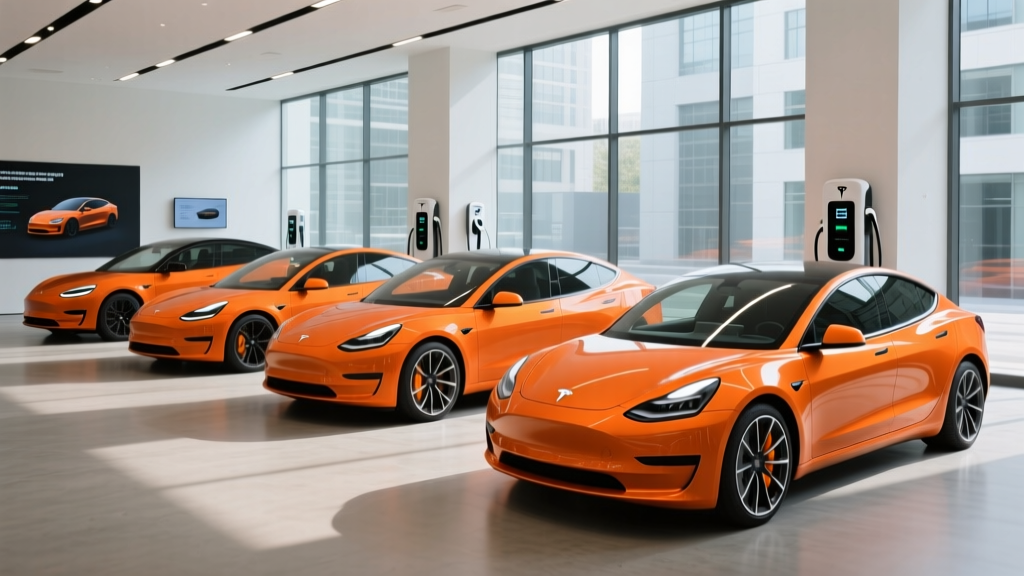
If you've been searching for an orange Tesla, you've likely discovered that Tesla's factory color palette doesn't include a standalone orange option in 2026. Unlike legacy automakers that offer dozens of paint codes per model, Tesla keeps its factory lineup tight — currently offering Pearl White, Solid Black, Midnight Silver, Deep Blue, Ultra Red, and the new Arctic White across most trims. But the orange Tesla you're envisioning is absolutely achievable, and the underlying vehicles are among the most efficient, best-charging EVs on the road.
This guide covers every current Tesla model you can wrap or paint orange, with the exact EPA range, charging curves, battery chemistry, pricing, and federal tax-credit eligibility you need to make a data-driven decision.
How to Get an Orange Tesla in 2026
Tesla has never offered a factory orange paint option in the U.S. market for the Model 3, Model Y, Model S, or Model X. Your two realistic paths are:
- Paint Protection Film (PPF) or vinyl wrap: A full-vehicle wrap in a color like Satin Chrome Orange, Candy Tangerine, or Metallic Burnt Orange typically runs $2,500–$5,500 depending on material quality and installer reputation. PPF with orange tint adds paint protection on top of color change and costs $4,000–$7,000. This is the route most Tesla owners take — it's reversible, protects the factory paint, and can be done before delivery.
- Aftermarket repaint: A professional respray in a Tesla-matched orange costs $5,000–$10,000+ and permanently alters the vehicle. This is less common and can affect resale value unless done to OEM-level quality.
Wrapping also preserves your factory paint warranty and avoids potential issues with Tesla Service recognizing modified paint during body repairs. Choose a factory color you don't mind seeing at the edges, then wrap before or shortly after delivery.
2026 Tesla Model 3: Specs, Range & Charging
The refreshed Model 3 (internally called "Highland" and now in its second production year) remains Tesla's most affordable sedan and the most likely candidate for an orange wrap given its popularity among younger buyers and customization enthusiasts.
| Spec | RWD | Long Range AWD | Performance |
|---|---|---|---|
| EPA Range | 272 mi | 341 mi | 315 mi |
| Battery (usable) | ~57.5 kWh (LFP) | ~75 kWh (NMC) | ~75 kWh (NMC) |
| Drivetrain | Rear-Wheel Drive | Dual-Motor AWD | Dual-Motor AWD |
| Horsepower | 271 hp | 346 hp | 510 hp |
| 0–60 mph | 5.8 sec | 4.2 sec | 2.9 sec |
| Max DC Fast Charge | 170 kW | 250 kW | 250 kW |
| 10–80% DC Time | ~28 min | ~25 min | ~25 min |
| Level 2 Home Rate | 11.5 kW (~44 mi/hr) | 11.5 kW (~44 mi/hr) | 11.5 kW (~44 mi/hr) |
| MPGe (combined) | 132 MPGe | 132 MPGe | 119 MPGe |
| Base MSRP | $38,990 | $44,990 | $52,990 |
The EPA estimates are useful baselines, but real-world range depends heavily on conditions. For the Model 3 Long Range AWD (EPA 341 mi): expect roughly 290–310 miles on sustained highway driving at 70–75 mph, dropping to 240–270 miles in sub-freezing temperatures due to cabin heating demand and increased battery resistance. City driving with frequent regenerative braking can push range above the EPA estimate, sometimes reaching 350+ miles in mild weather. The LFP battery in the RWD trim is heavier but can be charged to 100% daily without degradation concerns — a significant ownership advantage.
The Model 3's 250 kW peak DC charge rate on Long Range and Performance trims means you'll see roughly 170–200 miles of range added in 15 minutes at a V3 Supercharger — though the charge curve tapers significantly above 80% SoC. Plan to charge from 10–80% on road trips and skip topping off unless you need the final miles.
2026 Tesla Model Y: The Family-Favorite Orange Tesla
The Model Y continues as the best-selling vehicle in the world by volume, and its refreshed "Juniper" update brings a redesigned interior, ventilated seats, ambient lighting, and a rear entertainment screen. Its crossover proportions also make it the most popular Tesla for vinyl wraps — orange wraps on Model Y are a common sight at Tesla meets.
| Spec | RWD | Long Range AWD | Performance |
|---|---|---|---|
| EPA Range | 270 mi | 320 mi | 293 mi |
| Battery (usable) | ~57.5 kWh (LFP) | ~75 kWh (NMC) | ~75 kWh (NMC) |
| Drivetrain | Rear-Wheel Drive | Dual-Motor AWD | Dual-Motor AWD |
| Horsepower | 295 hp | 384 hp | 510 hp |
| 0–60 mph | 6.6 sec | 4.8 sec | 3.5 sec |
| Max DC Fast Charge | 170 kW | 250 kW | 250 kW |
| 10–80% DC Time | ~30 min | ~27 min | ~27 min |
| Level 2 Home Rate | 11.5 kW (~37 mi/hr) | 11.5 kW (~37 mi/hr) | 11.5 kW (~37 mi/hr) |
| MPGe (combined) | 125 MPGe | 122 MPGe | 111 MPGe |
| Cargo (rear seats up) | 30.2 cu ft | ||
| Cargo (rear seats folded) | 72.1 cu ft | ||
| Base MSRP | $44,990 | $48,990 | $54,990 |
The Model Y Long Range AWD's EPA 320 miles translates to approximately 270–290 miles of real-world highway range in moderate temperatures. In winter conditions (below 32°F), expect 230–260 miles due to the heat pump still drawing meaningful energy and the crossover's larger frontal area increasing aerodynamic drag at speed. For families using the Model Y as a daily driver with home charging, this is more than adequate for all but the longest road trips, where 250 kW Supercharging makes pit stops brief.
2026 Tesla Model S & Model X: Premium Orange Tesla Builds
The Model S and Model X remain Tesla's flagship vehicles. While less commonly wrapped in orange than the 3 and Y, a Burnt Orange or Copper Metallic wrap on a Model S Plaid is a head-turning combination. These vehicles use NMC battery chemistry across all trims and feature Tesla's most powerful powertrains.
| Spec | Model S LR | Model S Plaid | Model X LR | Model X Plaid |
|---|---|---|---|---|
| EPA Range | 402 mi | 359 mi | 335 mi | 311 mi |
| Battery (usable) | ~95 kWh (NMC) | ~95 kWh (NMC) | ~95 kWh (NMC) | ~95 kWh (NMC) |
| Horsepower | 670 hp | 1,020 hp | 670 hp | 1,020 hp |
| 0–60 mph | 3.1 sec | 1.99 sec | 3.8 sec | 2.5 sec |
| Max DC Fast Charge | 250 kW | 250 kW | 250 kW | 250 kW |
| 10–80% DC Time | ~30 min | ~30 min | ~33 min | ~33 min |
| Base MSRP | $74,990 | $89,990 | $79,990 | $94,990 |
Neither the Model S nor Model X qualifies for the federal EV tax credit under current IRS §30D rules because both exceed the $55,000 MSRP cap for sedans (Model S) and the $80,000 cap for SUVs/vans/pickups (Model X Plaid exceeds it; Model X Long Range is right at the edge — verify current pricing with your dealer). This is a critical purchasing consideration.
Federal Tax Credit & Total Pricing for Your Orange Tesla
The §30D federal EV tax credit remains a major purchase factor, but eligibility depends on MSRP caps, buyer income limits, battery component sourcing, and critical mineral requirements. Here's how each 2026 Tesla model stacks up:
| Model | Base MSRP | MSRP Cap | Income Cap (MFJ/Single) | Est. Credit | After-Credit Price |
|---|---|---|---|---|---|
| Model 3 RWD | $38,990 | $55,000 (sedan) | $300K / $150K | Up to $7,500* | ~$31,490 |
| Model 3 Long Range | $44,990 | $55,000 (sedan) | $300K / $150K | Up to $7,500* | ~$37,490 |
| Model 3 Performance | $52,990 | $55,000 (sedan) | $300K / $150K | Up to $7,500* | ~$45,490 |
| Model Y RWD | $44,990 | $80,000 (SUV) | $300K / $150K | Up to $7,500* | ~$37,490 |
| Model Y Long Range | $48,990 | $80,000 (SUV) | $300K / $150K | Up to $7,500* | ~$41,490 |
| Model S / X | $74,990+ | Varies | $300K / $150K | $0 (exceeds cap) | Full MSRP |
*Credit amount depends on battery component sourcing and critical mineral requirements, which are subject to change. The point-of-sale transfer option lets you apply the credit as an immediate discount at purchase rather than waiting for a tax refund. Always verify current eligibility on irs.gov and consult a tax professional before purchase. Wrap costs ($2,500–$5,500) are out-of-pocket and not credit-eligible.
Charging, Battery Warranty & Long-Term Ownership
Tesla's Supercharger network remains the gold standard for DC fast charging reliability, with over 25,000 V3 (250 kW) and V4 stalls in North America. All 2026 Teslas use the NACS connector natively — no adapter needed at Superchargers, and increasingly compatible with third-party networks as operators deploy NACS cables.
| Level | Power | Miles Added per Hour | Use Case |
|---|---|---|---|
| Level 1 (120V) | ~1.4 kW | ~3–5 mi/hr | Emergency/trickle |
| Level 2 (240V, 48A) | 11.5 kW | ~37–44 mi/hr | Daily home charging |
| DC Fast (V3 Supercharger) | Up to 250 kW | ~1,000 mi/hr peak | Road trips |
Warranty coverage: Tesla provides a 4-year/50,000-mile basic vehicle warranty and an 8-year battery & drive unit warranty with mileage limits varying by model: 100,000 miles for Model 3 RWD (LFP), 120,000 miles for Model 3 Long Range/Performance and Model Y, and 150,000 miles for Model S/X. The battery warranty guarantees retention of at least 70% capacity during the warranty period. Per fueleconomy.gov data, Tesla's NMC batteries typically retain 85–90% capacity after 100,000 miles in real-world use, while LFP batteries show even slower degradation curves but start with less total capacity.
LFP vs. NMC — what it means for your orange Tesla: The Model 3 RWD and Model Y RWD use lithium iron phosphate (LFP) batteries, which are heavier and less energy-dense but can be charged to 100% daily without accelerated degradation. Tesla recommends periodic 100% charges for LFP to maintain cell balancing. The Long Range and Performance trims use nickel-manganese-cobalt (NMC) chemistry, which offers more range per kilogram but benefits from daily charge limits of 80–90% for longevity. If your orange Tesla will be a daily commuter with home charging, LFP is arguably the lower-stress ownership experience.
Tech, Driver Assistance & Interior
All 2026 Teslas ship with Tesla's 15.4-inch center touchscreen (Model 3/Y) or 17-inch display (Model S/X), running the latest Tesla software with native streaming, gaming, and navigation. Key tech features include:
- Autopilot (standard): Adaptive cruise control and lane-centering — this is SAE Level 2 driver assistance, meaning you must keep hands on the wheel and eyes on the road at all times.
- Full Self-Driving Supervised ($8,000 option or $99/mo): Adds automatic lane changes, traffic light/stop sign recognition, and Navigate on Autopilot. Despite the name, FSD Supervised remains SAE Level 2 — you are the driver and are fully responsible for the vehicle.
- Sentry Mode & Dashcam: Continuous 360° recording when parked or driving.
- Over-the-air updates: Feature additions and performance improvements delivered wirelessly.
No Tesla model sold in 2026 is a self-driving vehicle. Autopilot and FSD Supervised are SAE Level 2 systems requiring continuous driver engagement. They cannot handle all road conditions, construction zones, or adverse weather without intervention. You must remain alert and ready to take over instantly.
Pros, Cons & Who Should Buy an Orange Tesla
✅ Pros
- Best-in-class Supercharger network reliability
- Industry-leading efficiency (MPGe) across lineup
- OTA updates add features over time
- LFP battery option for worry-free daily 100% charging
- Strong resale value relative to most EVs
- 250 kW DC fast charging on LR/Performance trims
- Point-of-sale tax credit transfer available
❌ Cons
- No factory orange paint — wrap adds $2,500–$5,500
- No Apple CarPlay or Android Auto
- Minimalist interior not for everyone (no physical buttons)
- FSD Supervised is expensive and still Level 2
- Ride quality firm on Performance trims
- Insurance premiums above segment average
- No traditional instrument cluster — all info on center screen
Who an orange Tesla suits best:
- Commuters (Model 3 RWD/LR): Home-charging commuters who want the lowest cost-per-mile and LFP longevity. Wrap it orange for personality.
- Families (Model Y LR AWD): Two-row families needing 30+ cu ft cargo, AWD for snow-belt states, and road-trip capability with Supercharger access.
- Performance enthusiasts (Model 3 Performance / Model S Plaid): Drivers who want sub-3-second 0–60 times with daily usability. A Satin Orange wrap on a Model S Plaid is one of the most striking EV builds on the road.
- Not ideal for: Three-row families (Model X is priced out of credit eligibility), heavy towers (Cybertruck or Rivian are better choices), or buyers who need Apple CarPlay.
Orange Tesla FAQ
Can I order a Tesla in orange from the factory?
No. Tesla does not offer a factory orange paint option in 2026 for any U.S.-market model. You'll need a vinyl wrap or PPF color-change, typically costing $2,500–$5,500.
Will wrapping my Tesla void the warranty?
A professionally applied vinyl wrap does not void Tesla's battery, powertrain, or general vehicle warranty. However, if wrap removal damages factory paint, that specific repair may not be covered. Choose a reputable installer and document pre-wrap condition.
What's the cheapest way to get an orange Tesla?
A 2026 Model 3 RWD at $38,990 MSRP, minus up to $7,500 in federal tax credit (if you meet income and sourcing requirements), brings the vehicle to ~$31,490. Add a budget vinyl wrap at ~$2,500 for an all-in cost around $34,000.
How fast does a Tesla charge at home?
On a 240V Level 2 circuit at 48 amps (11.5 kW), a Model 3 Long Range gains approximately 44 miles of range per hour — a full overnight charge from 20–80% takes roughly 4–5 hours. Installation of a NEMA 14-50 outlet or hardwired Wall Connector typically costs $500–$2,000 depending on your electrical panel capacity and run length.
Does the Model 3 or Model Y qualify for the $7,500 tax credit?
Both the Model 3 and Model Y are currently eligible for up to $7,500 under §30D, provided your modified adjusted gross income falls below $150,000 (single) or $300,000 (married filing jointly), and the vehicle meets battery sourcing requirements. The credit can be transferred at point of sale for an immediate price reduction. Always verify on irs.gov before purchasing, as sourcing rules evolve.
How does Tesla range hold up in cold weather?
Expect 20–30% range reduction in sustained sub-freezing temperatures across all Tesla models. A Model Y Long Range rated at 320 miles EPA may deliver 230–260 real-world miles in winter highway driving. Tesla's heat pump (standard on all 2026 models) helps mitigate this compared to resistive heating, but physics demands more energy for cabin warmth and battery conditioning. Preconditioning while plugged in recovers significant range.