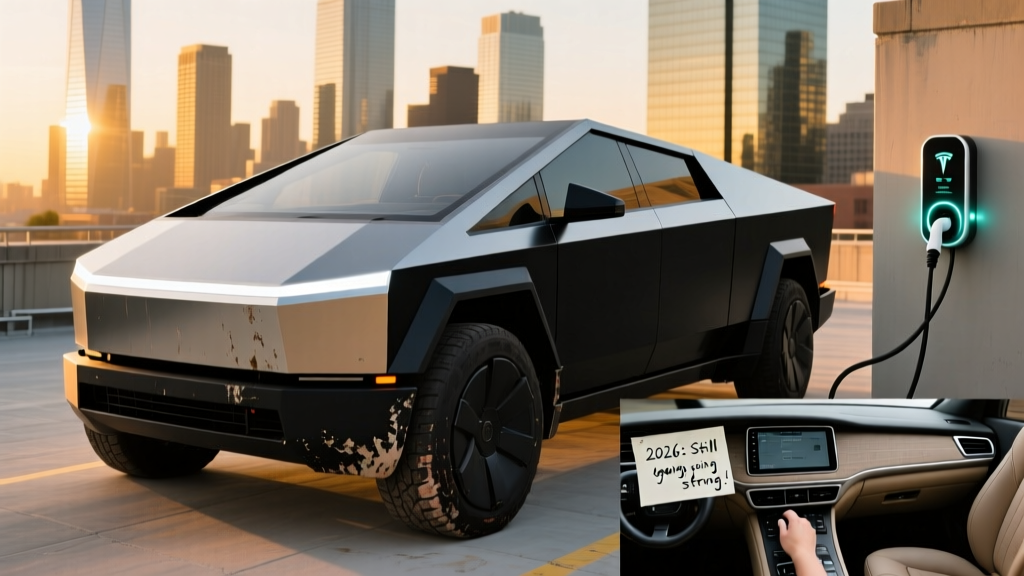
If you bought a Tesla Cybertruck when it finally launched in late 2023 or picked one up through 2025, you're now part of what we might call the "old Cybertruck" generation — the initial production run before Tesla's anticipated refresh cycles. For early adopters holding onto their 2024 and 2025 models, and for used-EV shoppers eyeing these trucks on the secondary market in 2026, the question is practical: how do these early Cybertrucks hold up in terms of range, charging, battery health, and daily usability?
This profile examines the 2024–2025 Tesla Cybertruck lineup — the Dual Motor AWD and the tri-motor Cyberbeast — with hard numbers on real-world efficiency, charging curves, and ownership economics. We'll also address how the §30D used-EV credit applies if you're buying one secondhand.
Quick Specs: The Old Cybertruck at a Glance
| Spec | Dual Motor AWD | Cyberbeast (Tri-Motor) |
|---|---|---|
| EPA Range | 340 miles | 320 miles |
| Battery Capacity (usable) | ~123 kWh (estimated) | ~123 kWh (estimated) |
| Battery Chemistry | NMC (Nickel Manganese Cobalt) | NMC |
| Max DC Fast Charge | 250 kW | 250 kW |
| 10–80% DC Charge Time | ~28 minutes | ~28 minutes |
| Level 2 Home Charge Rate | 11.5 kW (~37 mi/hr) | 11.5 kW (~37 mi/hr) |
| 0–60 mph | 4.1 seconds | 2.6 seconds |
| Horsepower | 600 hp | 845 hp |
| Drivetrain | Dual Motor AWD | Tri-Motor AWD |
| Efficiency (EPA) | ~50 MPGe / ~67 kWh/100mi | ~47 MPGe / ~72 kWh/100mi |
| Towing Capacity | 11,000 lbs | 11,000 lbs |
| Cargo Bed Length | 6 ft (72 in) | 6 ft (72 in) |
| Cargo Volume (bed + frunk) | ~67 cu ft bed / ~7 cu ft frunk | ~67 cu ft bed / ~7 cu ft frunk |
| Base MSRP (at launch) | $79,990 | $99,990 |
| Battery Warranty | 8 yr / 120,000 mi | 8 yr / 120,000 mi |
Note: Tesla has not officially published the exact usable kWh figure for the Cybertruck battery pack. The ~123 kWh estimate is derived from EPA efficiency data and observed real-world energy consumption. Battery chemistry is confirmed as NMC based on supply-chain reporting and Tesla's own battery-day disclosures for high-energy-density packs.
Real-World Range: What the EPA Number Doesn't Tell You
Dual Motor AWD: EPA 340 miles. Real-world highway (70–75 mph, mild weather): expect 280–310 miles. Cold weather (below 32°F) highway: 230–260 miles.
Cyberbeast: EPA 320 miles. Real-world highway: 260–290 miles. Cold weather highway: 215–245 miles.
The Cybertruck's angular stainless-steel body creates more aerodynamic drag than a sleek sedan, which hits efficiency hardest at highway speeds. City driving with regenerative braking recovers more energy, often yielding closer-to-EPA numbers in stop-and-go conditions.
Owners reporting on forums and through fueleconomy.gov user data consistently log combined real-world efficiency between 1.8 and 2.2 miles per kWh, depending on driving style and climate. That translates to roughly 220–270 miles from a full battery in mixed highway driving — a meaningful gap from the 340-mile sticker on the Dual Motor.
Cold weather compounds this. The Cybertruck's large battery mass takes longer to thermally condition, and cabin heating draws significant energy without a dedicated heat pump in early production models (Tesla added heat-pump optimization in software updates through 2025, but the thermal architecture was a known limitation at launch). Plan for a 25–35% range reduction in sustained sub-freezing temperatures.
Charging Speed: 250 kW Peak, But Mind the Curve
| Charging Level | Power (kW) | Rate (miles/hr added) | Notes |
|---|---|---|---|
| Level 1 (120V outlet) | ~1.4 kW | ~3–4 mi/hr | Emergency/trickle only; full charge takes 4+ days |
| Level 2 (240V, 48A) | 11.5 kW | ~37 mi/hr | Full charge in ~11 hours; standard home setup |
| DC Fast Charge (peak) | 250 kW | — | Peak only; sustained rate drops significantly above 50% SoC |
| DC Fast 10–80% | — | — | ~28 minutes at a V3/V4 Supercharger |
The Cybertruck charges at a maximum of 250 kW on Tesla's V3 and V4 Superchargers. That's competitive but not class-leading — the Hyundai Ioniq 5 and Kia EV6 push 350 kW on compatible chargers, and the Ford F-150 Lightning peaks at around 230 kW but with a flatter charge curve.
Here's where the charge curve matters: the Cybertruck hits 250 kW only briefly, typically between 15–35% state of charge (SoC). By 50% SoC, the rate drops to roughly 150–170 kW. Above 80%, it tapers to under 50 kW. This is standard NMC battery behavior — the management system slows charging to protect cell longevity — but it means the advertised 28-minute 10–80% time assumes ideal conditions: a preconditioned battery (the truck does this automatically when you navigate to a Supercharger) and an uncongested V3/V4 stall.
For home Level 2 charging, the onboard charger accepts up to 11.5 kW (48 amps on a 60-amp circuit). A full overnight charge adds roughly 37 miles of range per hour of charging, meaning an empty-to-full cycle takes about 11 hours. Most owners charging from 20–80% overnight will wake up fully replenished.
The Cybertruck uses the NACS (North American Charging Standard) connector natively — which, as of 2025, has been adopted by Ford, GM, Rivian, and most major automakers, making it the de facto standard. No adapter is needed at Tesla Superchargers, and the growing NACS-compatible third-party network (Electrify America, EVgo) now serves Cybertruck owners without CCS adapters.
Performance and Driving Dynamics
The Dual Motor AWD Cybertruck delivers 600 horsepower and a 4.1-second 0–60 mph time — genuinely quick for a 6,700-pound truck. The Cyberbeast's tri-motor setup pushes 845 hp and a 2.6-second sprint, putting it in supercar territory. Both models feature rear-wheel steering, which tightens the turning circle to a manageable 40.2 feet despite the truck's 223.7-inch overall length.
Acceleration is instantaneous and linear, as expected from electric motors. The air suspension provides up to 17 inches of ground clearance in Off-Road mode and can lower for highway efficiency. Steering is heavily assisted and somewhat numb — a common critique among reviewers — but the truck tracks confidently on the highway.
Towing is rated at 11,000 pounds for both trims. However, towing at capacity cuts range roughly in half. Multiple owners have reported 150–170 miles of range when towing a 7,000–8,000 lb trailer at highway speeds. If you tow frequently, plan your charging stops accordingly.
Interior, Tech, and Cargo Practicality
The Cybertruck's interior is minimalist to a fault. An 18.5-inch center touchscreen handles virtually all vehicle functions — climate, mirrors, glovebox, and drive-mode selection. There are no physical buttons. This appeals to Tesla loyalists but frustrates buyers who prefer tactile controls, especially for windshield wipers and turn signals (which are steering-column-mounted stalks on the Cybertruck, unlike the Model 3 refresh).
Front-row legroom measures 41.5 inches; rear legroom is 38.5 inches — adequate but not generous for a full-size truck. The rear bench fits three adults, though the sloping roofline limits headroom for taller passengers. Rear-seat comfort is a known weak point; the cushion is relatively flat and low.
Cargo practicality is mixed. The 6-foot bed is enclosed by a motorized tonneau cover (standard) and includes built-in ramps and 120V/240V outlets for powering tools or appliances — a genuine worksite advantage. The ~7 cu ft front trunk (frunk) is useful for groceries or charging cables. However, the bed's 4-foot width between wheel wells limits standard plywood-sheet loading, a real drawback for contractors.
Notable tech features include:
- Tesla Autopilot (standard): Adaptive cruise control and lane-centering — SAE Level 2, requiring constant driver supervision
- Full Self-Driving (Supervised) ($8,000 option or $99/month): Enhanced city-street navigation — still Level 2, not autonomous
- Bioweapon Defense Mode: HEPA cabin filtration
- Sentry Mode and Dashcam: Integrated security recording
- Powershare: 120V and 240V bed outlets (up to 11.5 kW continuous output for job-site or backup power)
Tesla Autopilot and FSD (Supervised) are SAE Level 2 driver-assistance systems. They do not make the Cybertruck self-driving. The driver must remain fully engaged, hands on the wheel (or torque-applied), and eyes on the road at all times. Tesla's cabin camera monitors attention and will issue warnings and eventually disengage the system if the driver is inattentive. Only Level 4 services (like Waymo robotaxis in designated geofenced areas) operate without a human driver.
Pricing, Tax Credits, and Used-CYbertruck Economics
| Trim | Original MSRP | New-Vehicle §30D Credit | Used-Vehicle §25E Credit (2026) |
|---|---|---|---|
| Dual Motor AWD | $79,990 | Not eligible (MSRP exceeds $80,000 cap) | Up to $4,000 if purchased used under $25,000* |
| Cyberbeast | $99,990 | Not eligible (MSRP exceeds $80,000 cap) | Up to $4,000 if purchased used under $25,000* |
*Per IRS §25E rules, the used-EV credit is 30% of the sale price, up to $4,000, on vehicles sold for $25,000 or less. As of early 2026, used Cybertruck prices remain well above $25,000 on the secondary market (typically $55,000–$75,000 depending on mileage and trim), making the used credit effectively unavailable for now.
When new, the Cybertruck did not qualify for the $7,500 federal §30D new-vehicle tax credit. The IRS caps eligible trucks at an $80,000 MSRP, and both the Dual Motor ($79,990 — borderline, but destination charges pushed it over) and Cyberbeast ($99,990) exceeded the threshold. Additionally, buyer income caps ($150,000 single / $300,000 joint AGI) and battery critical-mineral sourcing requirements further restrict eligibility. Always verify current-year rules at irs.gov or consult a tax professional.
For 2026 buyers looking at the used market, depreciation has been notable. Early Cybertrucks that sold above MSRP during the 2024 hype cycle have corrected significantly. As of mid-2026, used Dual Motor examples with 15,000–25,000 miles typically list between $55,000 and $65,000, while Cyberbeast models range from $70,000 to $85,000. That's steep depreciation from original pricing, which benefits used buyers but stings original owners.
Battery Health and Warranty: What to Watch in an Older Cybertruck
Tesla warranties the Cybertruck's battery and drive unit for 8 years or 120,000 miles (whichever comes first), with a guaranteed minimum of 70% capacity retention during that period. For a 2024 model in 2026, that means roughly 6 years of warranty coverage remain — substantial protection against premature degradation.
NMC batteries in Tesla vehicles have historically degraded around 5–8% in the first 30,000 miles, then plateau to a slower linear decline. Early Cybertruck owners reporting on TeslaFi and community forums show similar patterns: most 2024 models with 20,000–40,000 miles display 92–96% State of Health (SoH). No widespread battery-failure pattern has emerged as of 2026.
For used buyers, request the vehicle's battery health report through the Tesla app or a service center. Check for:
- Current SoH percentage
- Supercharging frequency (daily DC fast-charging accelerates degradation slightly)
- Whether the previous owner regularly charged to 100% (NMC batteries prefer 80% daily limits; Tesla's software recommends this)
- Any warranty service history on the battery or drive units
The 48-volt electrical architecture (a first for Tesla in the Cybertruck) has been generally reliable, though some early-production 2024 units experienced software glitches and panel-gap issues that Tesla addressed through service campaigns and over-the-air updates. The steer-by-wire system, another first, has proven robust in NHTSA complaint data with no major recalls as of early 2026.
Pros and Cons: The Old Cybertruck Scorecard
- Class-leading acceleration (2.6s Cyberbeast, 4.1s Dual Motor)
- NACS native — full Supercharger and growing third-party network access
- Powershare 240V bed outlets for job-site and backup power
- Stainless-steel exoskeleton is dent-resistant and unique
- Strong remaining warranty (6+ years on 2024 models)
- Significant used-market depreciation benefits secondhand buyers
- 11,000-lb towing capacity
- Real-world highway range falls 50–80 miles short of EPA sticker
- 250 kW peak charging trails competitors (Ioniq 5 at 350 kW)
- Rear-seat comfort and headroom are below full-size truck norms
- Bed width (4 ft between wells) won't fit flat plywood sheets
- No federal tax credit eligibility (new or used at current prices)
- Steer-by-wire and touchscreen-only controls have a steep learning curve
- Insurance premiums remain above average for the segment
- Cold-weather range loss is significant without heat-pump optimization
Who the Old Cybertruck Suits Best
Best for: Tesla ecosystem loyalists who want a truck with genuine job-site utility (Powershare outlets, 11,000-lb towing) and don't need maximum highway range. The Cybertruck excels as a daily-driver truck for tech-forward owners who charge at home and take occasional road trips within the Supercharger network. Used-market pricing in 2026 makes it more accessible than at launch.
Consider alternatives if: You need maximum rear-seat comfort for family duty (Rivian R1T or F-150 Lightning are roomier), you tow long distances frequently (range drops sharply), or you prioritize highway range above all else (the Lucid Air or a refreshed Model S offer far more miles per charge, though they aren't trucks).
Frequently Asked Questions
What is the real-world range of the 2024–2025 Cybertruck?
In mixed driving with moderate weather, expect 280–310 miles from the Dual Motor AWD and 260–290 miles from the Cyberbeast. Highway-only driving at 75 mph drops these to 270–300 and 250–280, respectively. Sub-freezing temperatures can reduce range by 25–35%.
How fast does the old Cybertruck charge at home and on the road?
On a Level 2 home charger (11.5 kW / 48A), the Cybertruck adds about 37 miles of range per hour, with a full charge taking roughly 11 hours. On a V3/V4 Supercharger, DC fast charging peaks at 250 kW with a 10–80% time of approximately 28 minutes under ideal conditions.
Does the Cybertruck qualify for any federal EV tax credit?
The Cybertruck did not qualify for the $7,500 new-vehicle §30D credit due to exceeding the $80,000 MSRP cap for trucks. The used-EV §25E credit (up to $4,000) requires a sale price of $25,000 or less — a threshold used Cybertrucks have not reached as of 2026. Always check irs.gov for current-year rules and consult a tax professional.
Is the old Cybertruck worth buying vs. the Rivian R1T or F-150 Lightning?
It depends on priorities. The Cybertruck wins on acceleration, NACS Supercharger access, and Powershare utility. The Rivian R1T offers superior interior quality, a more usable bed, and better rear-seat comfort. The F-150 Lightning provides a more traditional truck experience with competitive range (up to 320 miles EPA on Extended Range) and often lower pricing. For pure tech-forward appeal and Tesla network access, the Cybertruck is unique; for family truck duty, the R1T and Lightning are more practical.
How is battery degradation on 2024 Cybertrucks in 2026?
Most 2024 Cybertrucks with 20,000–40,000 miles show 92–96% battery State of Health, consistent with Tesla's NMC chemistry track record. The 8-year/120,000-mile battery warranty (70% minimum retention) provides strong long-term protection. Avoid examples with frequent 100% charging habits or exclusive DC fast-charge history for optimal longevity.
Can I charge a Cybertruck at non-Tesla chargers?
Yes. The Cybertruck uses the NACS connector, which is now supported at a growing number of Electrify America, EVgo, and other third-party stations that have added NACS cables. Tesla's Supercharger network remains the most reliable option, but the gap is closing as the industry standardizes on NACS.