New York has quietly become one of the most incentive-rich states for electric vehicle buyers in the country. Between the federal §30D tax credit, the NY state electric car rebate (officially the Drive Clean Rebate), utility programs from ConEdison and National Grid, and local toll/parking perks, a well-positioned buyer can stack thousands in savings. But stacking incentives only matters if the underlying ownership math works — and that means understanding real-world fuel costs, insurance premiums, maintenance savings, and the depreciation curve that has caught some early adopters off guard.
This guide walks through the total cost of owning an EV in New York over five years, using a 2026 Tesla Model Y Long Range (the state's best-selling EV) as our working example. Every number is sourced, every caveat named.
The NY State Electric Car Rebate: What's Actually Available
New York's Drive Clean Rebate is a point-of-sale discount applied directly to the purchase or lease of eligible new EVs through participating dealerships. The rebate is income-tiered and price-capped:
- Up to $2,000 for households earning below $125,000 (single) or $250,000 (joint) buying a vehicle under $60,000 MSRP
- Up to $1,000 for middle-income brackets
- $0 for high-income buyers or vehicles above the MSRP cap
- PHEVs with at least 20 miles of electric range qualify at reduced rebate levels
Federal §30D Tax Credit: The $7,500 Question
The federal EV tax credit under IRS §30D remains the single largest purchase incentive, but it is not a blanket $7,500 for every buyer or every vehicle. As of 2026, the credit is governed by a web of requirements that disqualify many popular models. Here is the full eligibility checklist per IRS guidance:
- Income caps: AGI must not exceed $150,000 (single), $225,000 (head of household), or $300,000 (married filing jointly)
- MSRP caps: Vans/SUVs/pickups ≤ $80,000; sedans/other ≤ $55,000
- Battery sourcing: Required percentage of critical minerals must be sourced from the US or free-trade-agreement partners (threshold increases annually)
- Battery component manufacturing: Required percentage of battery components must be manufactured or assembled in North America (threshold increases annually)
- Foreign entity of concern (FEOC): Vehicles with battery components or critical minerals from certain restricted foreign entities are disqualified entirely
- Point-of-sale transfer: Buyers may transfer the credit to the dealer at purchase, receiving the discount upfront rather than waiting to claim it on their tax return
- Tax liability: If not transferred at sale, the credit is non-refundable — you must owe at least $7,500 in federal tax to capture the full amount
For 2026, the FEOC restrictions have tightened significantly. Several popular models from manufacturers relying on certain overseas battery supply chains have lost partial or full eligibility compared to prior years. Always verify your specific vehicle's eligibility on the fueleconomy.gov tax credit tracker before signing a purchase agreement.
5-Year Total Cost of Ownership: EV vs. Gas in New York
To make the math concrete, we compared a 2026 Tesla Model Y Long Range (AWD, 84 kWh usable battery, NMC chemistry, EPA-estimated 320 miles range, 346 HP, 0-60 in 4.8 seconds, ~$48,990 MSRP before incentives) against a comparably equipped 2026 Toyota RAV4 Limited AWD (gas, EPA 28 MPG combined, ~$42,000 MSRP).
| Category | Tesla Model Y LR | RAV4 Limited AWD |
|---|---|---|
| Purchase Price (MSRP) | $48,990 | $42,000 |
| Federal §30D Credit (estimated) | −$7,500 | $0 |
| NY Drive Clean Rebate | −$1,000 | $0 |
| Net Purchase | $40,490 | $42,000 |
| Fuel/Energy (75,000 mi) | $5,625 | $10,045 |
| Maintenance (5 years) | $1,800 | $4,200 |
| Insurance (5 years, NY avg) | $12,500 | $9,500 |
| Depreciation (est. 5-yr) | $22,000 | $17,500 |
| Total 5-Year Cost | $82,415 | $83,245 |
The EV edges ahead on total cost — but only because the stacked incentives collapse the purchase price gap. Remove the credits and the Model Y costs roughly $10,000 more over five years. Your mileage, literally, will vary based on local electricity rates, insurance quotes, and how well the EV's resale value holds.
Charging vs. Gas: The Per-Mile Cost Reality
EV (home charging dominant): NY residential average ≈ $0.22/kWh. Model Y efficiency ≈ 28 kWh/100 mi.
EV cost: ~$0.062/mile (home) | ~$0.14/mile (public DC fast charging at $0.48/kWh avg)
Gas (RAV4 AWD): NY regular unleaded ≈ $3.75/gal. EPA 28 MPG combined.
Gas cost: ~$0.134/mile
Annual savings at 15,000 mi/yr: $585–$1,080 depending on how much you charge at home vs. publicly.
The savings hinge on home charging access. New Yorkers who rely exclusively on public DC fast charging — common in NYC apartment living — may find their per-mile cost nearly equal to gasoline. Install a Level 2 home charger (240V, 48A / 11.5 kW), and the math swings decisively in the EV's favor. Note that kW (kilowatts) measures charging power — the rate of energy delivery — while kWh (kilowatt-hours) measures battery energy capacity. You pay per kWh consumed, not per kW of charger capacity.
Maintenance Savings: Where the EV Actually Wins
| Service Item | Tesla Model Y | RAV4 Gas AWD |
|---|---|---|
| Oil changes | $0 | $600 |
| Brake pads (regen reduces wear) | $250 | $900 |
| Transmission fluid / service | $0 | $350 |
| Cabin air / HEPA filter | $200 | $180 |
| Tire rotation / replacement | $1,100 | $900 |
| Coolant / misc. fluids | $100 | $350 |
| Spark plugs / ignition | $0 | $400 |
| Washer fluid / wipers / misc | $150 | $150 |
| Total (5 years) | $1,800 | $3,830 |
EVs eliminate oil changes, spark plugs, timing belts, and most transmission service. Regenerative braking dramatically extends pad and rotor life — many EV owners report original brake pads at 80,000+ miles. The one area where EVs cost more: tires. The Model Y's heavier curb weight (~4,400 lbs) and instant torque accelerate tire wear. Budget for one extra tire set over five years compared to a lighter gas crossover.
Both the Model Y and RAV4 carry an 8-year/100,000-mile battery warranty (EV) and 5-year/60,000-mile powertrain warranty (gas), respectively. Tesla's battery warranty guarantees at least 70% capacity retention over 8 years or 120,000 miles, whichever comes first.
Insurance: The Cost Nobody Warns You About
New York EV insurance premiums run 15–35% higher than equivalent gas vehicles. The Model Y averages roughly $2,500/year in the NYC metro area versus $1,900/year for a RAV4 Limited. Why?
- Higher repair costs: EV battery packs, specialized high-voltage components, and aluminum-intensive body structures require certified technicians and OEM parts that cost more
- Total-loss thresholds: Even minor battery enclosure damage can trigger a total-loss declaration, raising insurer risk exposure
- Higher vehicle values: Insurers price comprehensive and collision coverage based on replacement cost
- Repair network limits: Fewer body shops have high-voltage certification, limiting competition on repair pricing
Shop aggressively. Tesla Insurance (available in NY) sometimes undercuts traditional carriers by 10–15% for Model Y owners. Also check whether your insurer offers an EV-specific policy — some now bundle home charger coverage and roadside assistance for battery depletion at no extra cost.
Depreciation: The Wildcard in EV Ownership Math
EV depreciation has been volatile. According to iSeeCars data, the average EV lost roughly 49% of its value over 5 years compared to ~38% for gas vehicles — driven largely by aggressive price cuts from Tesla in 2023–2024 that cratered used EV values across the market. However, the picture has stabilized in 2025–2026:
- Battery health transparency: Buyers now routinely check State of Health (SoH) reports before purchasing used EVs, creating a more rational market
- Price stabilization: New EV MSRPs have leveled off, reducing the cascading effect on used values
- Lease residual adjustments: Lessor residual values have been recalibrated downward, which means lower lease payments but also lower trade-in expectations
For our 5-year model, we estimated the Model Y depreciating ~$22,000 (45% of net purchase) versus $17,500 (42%) for the RAV4. If you plan to keep your EV 8–10 years, depreciation becomes less relevant — and the fuel and maintenance savings compound further.
Real-World Range in New York: The Cold-Weather Factor
The Model Y Long Range carries an EPA-estimated 320 miles of range from its 84 kWh (usable) NMC battery pack. In New York's climate, real-world range varies substantially:
Real-world (spring/fall, mixed driving): ~280–300 miles
Real-world (summer highway at 75 mph): ~260–280 miles
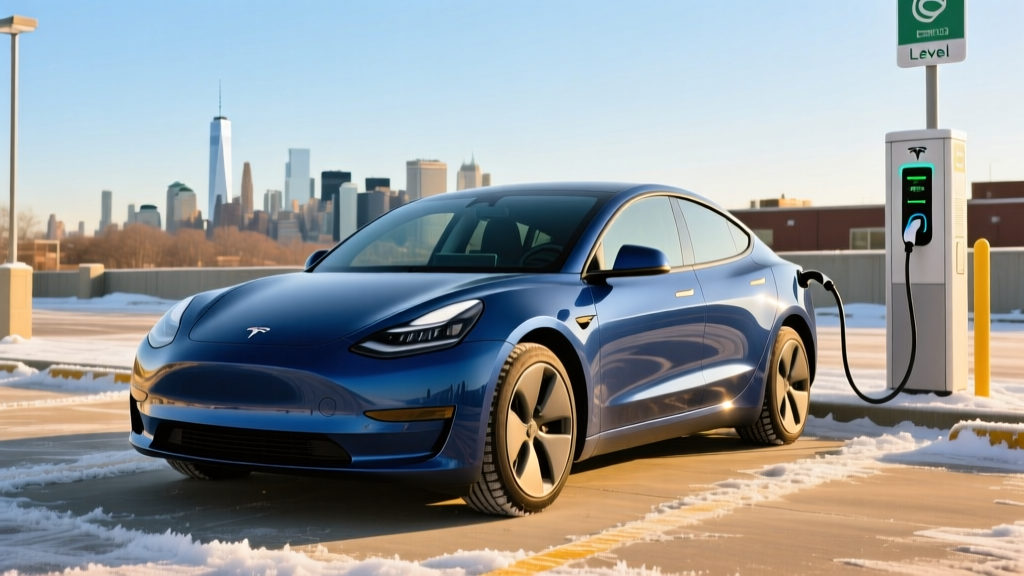
Real-world (NYC-area winter, 20–30°F): ~220–250 miles (30–35% reduction from cold battery chemistry, cabin heating load, and reduced regen efficiency)
The Model Y's standard heat pump mitigates some cold-weather range loss compared to resistive heating, but expect a meaningful drop from December through February. Preconditioning the battery while plugged in — using the Tesla app to warm the battery before departure — recovers some of that lost range and improves DC fast-charge speeds.
Charging Speed: What 250 kW Actually Means
The Model Y supports DC fast charging at up to 250 kW peak (CCS/NACS connector). Tesla quotes a 10–80% charge in approximately 25–27 minutes at a V3 Supercharger. But peak rate is not sustained rate:
- 10–30% SoC: Peak ~250 kW (fastest segment)
- 30–60% SoC: Tapers to ~150–180 kW
- 60–80% SoC: Tapers further to ~80–110 kW
- Above 80%: Drops sharply to protect battery longevity — never plan a road trip around charging past 80%
At home on a Level 2 charger (11.5 kW / 48A), expect roughly 44 miles of range added per hour of charging. A full overnight session (8 hours) adds ~350 miles of range — more than enough to replenish any day's driving. Level 1 (120V / 12A) adds only ~3–4 miles per hour and is viable only as a trickle-charge backup.
Decision Framework: Does the Math Work for You?
- You can install a Level 2 charger at home (garage, driveway, or approved building charger)
- Your household income falls under the §30D caps and your chosen vehicle qualifies for the full or partial federal credit
- You drive 12,000+ miles per year (higher mileage = faster payback on fuel savings)
- You plan to keep the vehicle 5+ years to ride out the steeper initial depreciation
- You live in an apartment without charging access and rely entirely on public infrastructure
- Your insurance quotes come in 40%+ above your current gas vehicle
- You need maximum towing capacity or regularly drive 400+ miles in winter between charges
- You plan to sell within 3 years (depreciation will likely erase your fuel savings)
Frequently Asked Questions
How much does it really cost to own an EV over 5 years in New York?
For a 2026 Tesla Model Y Long Range with stacked federal ($7,500) and state ($1,000) incentives, our analysis shows a 5-year total cost of approximately $82,400 over 75,000 miles — slightly below a comparably priced gas RAV4 at $83,200. The EV's higher insurance and depreciation are offset by lower fuel and maintenance costs, but the margin is thin and depends on your specific electricity rate, insurance quote, and home-charging access.
Do I qualify for the federal §30D tax credit?
You may qualify if your AGI is under $150,000 (single) / $300,000 (joint), your chosen EV's MSRP is under the applicable cap ($80,000 for SUVs, $55,000 for sedans), and the vehicle meets 2026 battery-sourcing and critical-mineral requirements. The FEOC restrictions have disqualified several models this year. Always check fueleconomy.gov for the specific trim you're buying, and consult a tax professional for your personal situation.
How much do I save on fuel and maintenance?
At 15,000 miles/year in New York, expect to save roughly $885/year on fuel (home charging at $0.22/kWh vs. gas at $3.75/gal) and $400–$500/year on maintenance (no oil changes, fewer brake replacements, no spark plugs). Combined, that's approximately $1,300–$1,400/year, or $6,500–$7,000 over five years — but only if you charge primarily at home.
Are EVs more expensive to insure in New York?
Yes. Expect premiums 15–35% higher than a comparable gas vehicle due to higher repair costs, specialized parts, and higher vehicle values. For a Model Y in the NYC metro area, budget approximately $2,500/year versus $1,900 for a RAV4. Shop multiple carriers and ask about EV-specific policies.
How well do EVs hold their value?
EV depreciation averaged ~49% over 5 years in recent data, compared to ~38% for gas vehicles. The gap has narrowed since 2025 as new-EV pricing stabilized and the used market matured. If you buy with incentives, hold the vehicle 7+ years, and maintain battery health (avoid habitual 100% charges; keep daily SoC between 20–80%), your effective depreciation cost improves significantly.
Can I stack the NY Drive Clean Rebate with the federal credit?
Yes. The NY Drive Clean Rebate is a state-level point-of-sale discount that stacks independently with the federal §30D tax credit. You can also layer utility rebates and local incentives on top. The key constraint is the vehicle MSRP cap — both programs have price limits, and some higher-trim EVs exceed one or both thresholds.
What about the NY state electric car rebate for used EVs?
New York's Drive Clean Rebate currently applies to new vehicle purchases and leases only. However, the federal government offers a separate used-EV credit under §25E — up to $4,000 or 30% of the sale price (whichever is lower) for EVs priced under $25,000, subject to income caps. This can make a 3-year-old Model 3 or Chevy Bolt exceptionally affordable for income-qualified buyers.