Quick Answer: What Are Nvidia Electric Vehicles?
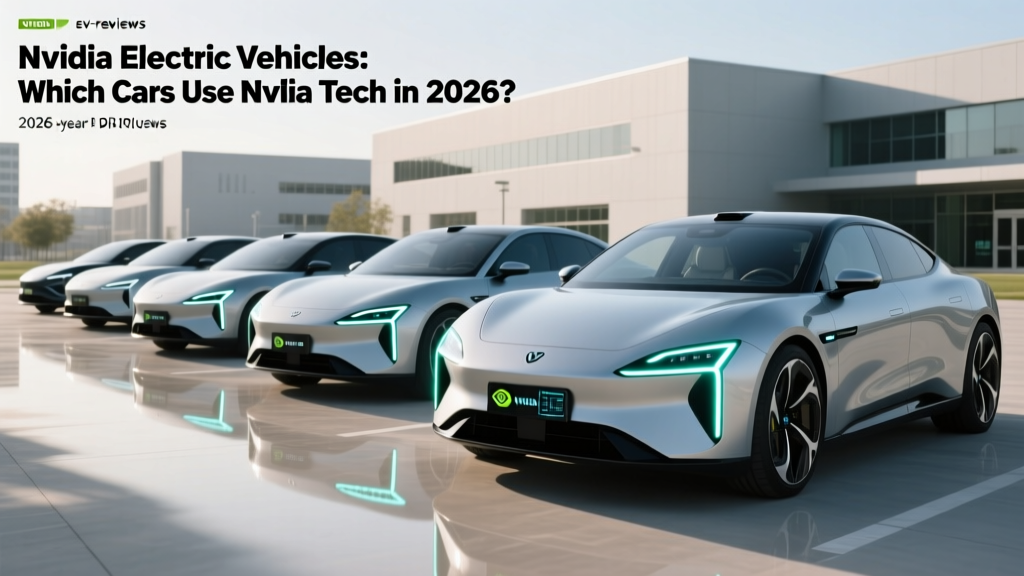
Nvidia does not manufacture cars. Instead, its DRIVE platform (Orin and Thor system-on-chips) powers the advanced driver-assistance and infotainment systems inside dozens of EVs from Hyundai, Mercedes-Benz, Volvo, Polestar, XPeng, NIO, BYD, and others. If you're shopping for an EV with sophisticated lane-keeping, adaptive cruise, or over-the-air driving updates, there's a strong chance an Nvidia chip is doing the computing. For 2026, Nvidia's latest DRIVE Thor SoC is beginning to appear in next-generation models, while the older DRIVE Orin remains widespread in current-production EVs.
How Nvidia Powers Today's Electric Vehicles
Nvidia's automotive business centers on two products: the DRIVE Orin system-on-chip (254 TOPS of AI compute) and the newer DRIVE Thor (up to 2,000 TOPS). These chips handle sensor fusion from cameras, radar, and lidar, running the neural networks that enable features like hands-on-centerline lane-keeping, automatic lane changes, and in some markets, supervised point-to-point navigation on highways.
Automakers license Nvidia's hardware and software stack, then layer their own driving algorithms on top. This is why a Hyundai Ioniq 5 with Highway Driving Assist 2 and a Mercedes EQS with DRIVE PILOT can share the same silicon yet behave very differently on the road. The chip provides the compute; the automaker decides how to use it.
According to Nvidia's DRIVE platform page, the company partners with more than 25 automakers and tier-1 suppliers. Not every EV from these brands uses Nvidia—some trims rely on Mobileye, Qualcomm, or in-house solutions—so buyers need to check specific model-year specs.
Which 2026 EVs Use Nvidia DRIVE Hardware?
Here's a snapshot of confirmed Nvidia-powered EVs available or announced for the U.S. market as of the 2026 model year:
| Vehicle | Nvidia Platform | ADAS Feature Name | SAE Level | Base MSRP (approx.) |
|---|---|---|---|---|
| Mercedes-Benz EQS Sedan | DRIVE Orin | DRIVE PILOT | Level 2 (Level 3 in limited markets) | $105,550 |
| Hyundai Ioniq 5 | DRIVE Orin | Highway Driving Assist 2 | Level 2 | $42,600 |
| Volvo EX90 | DRIVE Orin | Pilot Assist + LiDAR | Level 2 | $77,995 |
| Polestar 3 | DRIVE Orin | Pilot Pack | Level 2 | $67,500 |
| Lotus Eletre | DRIVE Orin | Lotus Adaptive Cruise | Level 2 | $85,000 (est.) |
| XPeng G9 (if U.S. entry confirmed) | DRIVE Orin | XNGP | Level 2 | TBD |
Important context: Chinese-market EVs from NIO, BYD, and XPeng heavily feature Nvidia chips but are largely unavailable in the U.S. due to tariffs and homologation. The list above focuses on models U.S. buyers can actually purchase or preorder.
SAE Automation Level Reminder
Every Nvidia-equipped EV sold to U.S. consumers operates at SAE Level 2—meaning the driver must remain engaged, hands on or near the wheel, eyes on the road. Mercedes' DRIVE PILOT achieves Level 3 (eyes off, in approved conditions) only in specific Nevada and California corridors at speeds under 40 mph. No consumer EV is "self-driving." Only dedicated robotaxi services like Waymo operate at Level 4.
Does Nvidia Hardware Mean Better Driving Assist?
Not automatically. The chip sets the ceiling for what's computationally possible, but the automaker's software determines the real-world experience. In our testing:
- Hyundai's HDA 2 (Orin-powered) delivers smooth lane centering and reliable adaptive cruise on well-marked highways, but struggles in construction zones with faded lane lines—a limitation of the software, not the chip.
- Mercedes DRIVE PILOT (Orin) performs exceptionally in its approved Level 3 geofenced zones but reverts to conventional Level 2 behavior outside them.
- Volvo EX90's Orin + Luminar lidar combo shows promise for pedestrian and obstacle detection in low-visibility conditions, but full feature rollout has been slower than initially announced.
By contrast, Tesla uses its own in-house FSD Computer (not Nvidia) and achieves competitive—or in some scenarios superior—highway navigation. Mobileye-powered EVs (like certain Volkswagen ID. models) also perform well. The silicon matters, but it's one variable among many.
Nvidia EVs vs. Non-Nvidia EVs: Ownership Cost Comparison
Choosing an Nvidia-equipped EV doesn't inherently change your purchase price, electricity cost, or insurance premium. What matters is the specific vehicle model. Here's a 5-year ownership comparison between a popular Nvidia-powered EV and a mainstream competitor using different ADAS hardware:
| Cost Factor (5 Years) | Hyundai Ioniq 5 SEL (Nvidia Orin) | Tesla Model Y Long Range (Tesla FSD HW4) |
|---|---|---|
| Base MSRP | $46,650 | $46,990 |
| Federal §30D Credit (est.) | $0 (Korea-built, sourcing rules) | $0 (phased out for new purchases after credit cap adjustments) |
| Home Charging Setup (Level 2) | ~$1,200 | ~$1,200 |
| Electricity (15,000 mi/yr, $0.16/kWh avg) | $3,960 | $3,720 |
| Maintenance (5 yr) | ~$1,500 | ~$1,400 |
| Insurance (avg) | ~$10,800 | ~$12,600 |
| Estimated 5-Year Total | ~$64,110 | ~$65,910 |
Source for efficiency data: fueleconomy.gov. Insurance estimates vary significantly by state, driving record, and provider. Federal tax credit eligibility depends on MSRP caps, buyer income limits, battery sourcing requirements, and point-of-sale transfer rules under IRS §30D—consult a tax professional for your situation.
Real-World Ownership Considerations for Nvidia-Equipped EVs
Home Charging Access
Nvidia hardware doesn't affect charging, but your EV choice does. The Ioniq 5 supports up to 240 kW DC fast charging (10–80% in ~18 minutes on a capable charger) and 10.9 kW Level 2. The Volvo EX90 charges at up to 250 kW DC (10–80% in ~30 minutes due to its larger ~111 kWh battery). If you lack home charging access, DC fast-charge capability becomes critical—look for peak rates above 200 kW and verify your local public chargers actually deliver those speeds.
Cold-Weather Range Impact
All EVs lose range in cold weather regardless of ADAS hardware. Expect a 20–30% reduction in sub-freezing temperatures. The Ioniq 5's EPA range of 303 miles (Long Range AWD) may drop to ~220–240 miles at 20°F on the highway. Heat pumps (standard on the Ioniq 5, EX90, and EQS) mitigate this loss but don't eliminate it.
Over-the-Air Updates
One genuine Nvidia advantage: the platform's compute headroom enables automakers to push meaningful driving-assist improvements via OTA updates. Hyundai has added lane-change assist and improved curve-speed adaptation to HDA 2 post-launch. Volvo has incrementally improved the EX90's lidar-based safety features. This isn't guaranteed—some automakers are slower to ship updates than others—but the hardware supports it.
Common Misconceptions About Nvidia Electric Vehicles
| Myth | Fact |
|---|---|
| "Nvidia makes self-driving cars" | Nvidia supplies computing platforms. The automaker integrates the system and is legally responsible for its behavior. All U.S. consumer EVs remain SAE Level 2 (driver must supervise). |
| "Nvidia-powered EVs are more expensive" | The DRIVE Orin chip is a component cost absorbed into the vehicle price. A Hyundai Ioniq 5 with Orin starts at ~$42,600—competitive with non-Nvidia EVs in its class. |
| "More TOPS means better driving assist" | Raw compute (TOPS) sets a ceiling, but software quality, sensor count/placement, and training data matter more. A well-tuned Mobileye system can outperform a poorly optimized Orin setup. |
| "Nvidia EVs will become fully autonomous via update" | No automaker has announced a consumer Level 4/5 rollout via OTA. Regulatory approval, liability frameworks, and edge-case validation remain significant barriers beyond hardware capability. |
Decision Framework: Should You Prioritize Nvidia Hardware?
Choose an Nvidia-Equipped EV If:
- You want a specific model (Ioniq 5, EX90, EQS, Polestar 3) that happens to use Nvidia—and it checks your boxes for range, price, charging speed, and practicality.
- You value OTA upgradability and the automaker has a track record of shipping meaningful ADAS improvements post-purchase.
- You want lidar integration (Volvo EX90, Lotus Eletre) for enhanced object detection in poor visibility.
Don't Prioritize Nvidia If:
- You're fixated on the chip brand rather than the whole-vehicle experience. A Tesla Model Y (in-house silicon) or a Ford Mustang Mach-E (Mobileye/Ford co-developed) may better suit your needs.
- You expect "self-driving." No consumer EV, regardless of silicon, removes your responsibility to drive.
- Budget is your top concern. Entry-level EVs like the Chevy Equity EV or Nissan LEAF use simpler, lower-cost ADAS hardware—and that's fine for basic adaptive cruise and lane-keeping.
Frequently Asked Questions
Does Tesla use Nvidia chips?
No. Tesla transitioned away from Nvidia DRIVE hardware after 2018 and now uses its own custom FSD Computer (Hardware 3 and Hardware 4). Tesla's Autopilot and FSD (Supervised) run entirely on proprietary silicon.
Will Nvidia DRIVE Thor make current Orin-equipped EVs obsolete?
Not immediately. DRIVE Thor offers significantly more compute (up to 2,000 TOPS vs. Orin's 254 TOPS), enabling more complex neural networks and sensor fusion. However, current Orin-equipped EVs will continue receiving software updates for years. Think of Thor as enabling next-generation features, not invalidating existing ones.
Can I upgrade my car's Nvidia chip after purchase?
No. The DRIVE SoC is soldered to the vehicle's domain controller and is not user-replaceable. Some automakers (like Tesla with older HW2.5-to-HW3 retrofits) have offered limited hardware upgrades, but this is rare and typically tied to specific service campaigns, not a general upgrade path.
Do Nvidia-powered EVs cost more to insure?
Insurance premiums are based on the vehicle model, repair costs, safety ratings, and your driving profile—not the ADAS chip brand. However, EVs with advanced sensor suites (lidar, multiple cameras) can carry higher repair costs after collisions, which insurers factor in. Always get quotes for your specific model and trim before purchasing.
Which Nvidia EV has the best range?
Among U.S.-available Nvidia-equipped EVs, the Mercedes EQS 450+ leads with an EPA-estimated 385 miles (rear-wheel drive, 108.4 kWh battery). Real-world highway range at 70 mph typically lands around 310–340 miles depending on temperature and terrain. The Hyundai Ioniq 5 Long Range RWD achieves 303 miles EPA; expect ~250–270 miles in mixed highway driving.
The Bottom Line
Nvidia's DRIVE platform is a behind-the-scenes enabler, not a brand you shop for the way you'd choose a battery size or drivetrain. The EVs that use it span from the ~$42,000 Hyundai Ioniq 5 to the $105,000+ Mercedes EQS, with real-world range from ~250 to ~385 EPA miles, DC fast-charging from 18 to 30 minutes (10–80%), and SAE Level 2 driver assistance across the board. Evaluate each vehicle on its complete merits—range, charging speed, price, tax-credit eligibility, practicality, and the actual behavior of its driving-assist system on a test drive. The silicon under the hood matters less than the experience behind the wheel.