The Quick Verdict on Model Y Cargo and Capability
The Tesla Model Y remains the benchmark compact electric SUV for a reason: it pairs usable cargo volume with a mature Supercharger network, strong efficiency, and a starting price that undercuts most rivals. For 2026, the refreshed Model Y (internally dubbed "Juniper") carries over the core dimensions buyers care about while tightening panel gaps, improving ride quality, and adding a rear touchscreen. But if you're specifically researching Tesla SUV trunk space, the numbers tell a nuanced story — the cargo area is generous on paper, yet the sloping roofline and lack of a traditional spare tire eat into practical utility for some families.
This review covers every metric that matters: real-world range versus the EPA sticker, DC fast-charge speeds and taper behavior, federal tax credit eligibility under current IRS §30D rules, and whether the Model Y still earns its best-seller status against the Hyundai Ioniq 5, Ford Mustang Mach-E, and Kia EV6.
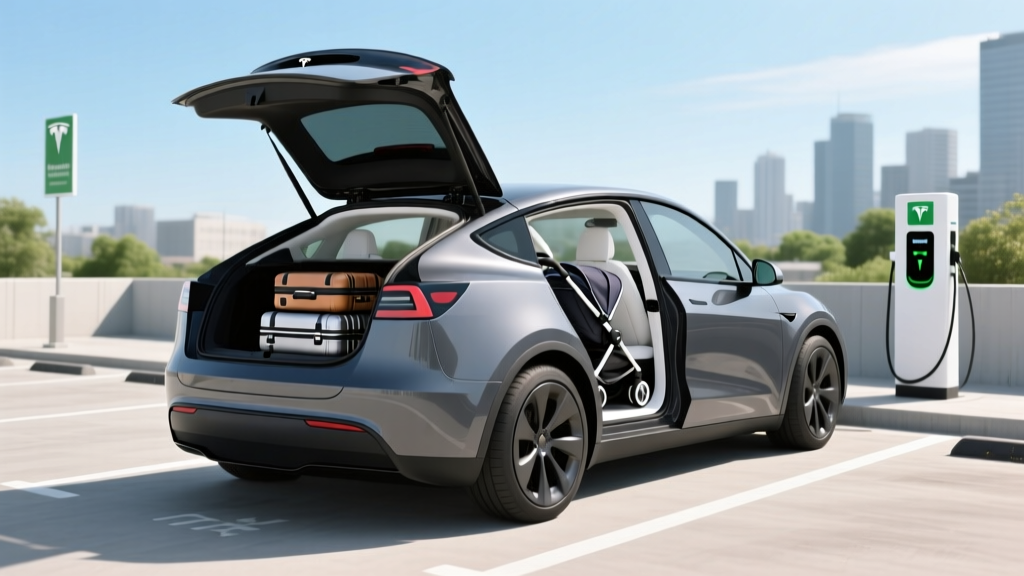
Cargo Volume: Measuring the Tesla SUV Trunk Space
Tesla lists the 2026 Model Y with up to 76.2 cubic feet of cargo volume behind the front seats (second row folded) and 30.2 cubic feet behind the second row. Those figures include the front trunk (frunk), which contributes roughly 4.1 cu ft of secure, weather-sealed storage — ideal for charging cables, a soft cooler, or groceries you want separated from the main cabin.
| Metric | Tesla Model Y | Hyundai Ioniq 5 | Ford Mustang Mach-E | Kia EV6 |
|---|---|---|---|---|
| Cargo (behind 2nd row) | 30.2 cu ft | 27.2 cu ft | 29.7 cu ft | 24.4 cu ft |
| Cargo (max, seats folded) | 76.2 cu ft | 59.3 cu ft | 59.7 cu ft | 50.2 cu ft |
| Frunk Volume | 4.1 cu ft | 0.85 cu ft | 4.7 cu ft | 0.7 cu ft |
| Rear Legroom | 41.6 in | 39.4 in | 38.1 in | 39.0 in |
| Optional 3rd Row | Yes (7-seat) | No | No | No |
The Model Y's cargo advantage is real, especially with seats folded — it offers roughly 16-26 cu ft more maximum volume than its closest rivals. However, the fastback roofline means tall items (dog crates, large boxes) may not stand upright near the liftgate. The 7-seat option adds versatility but renders the third row suitable only for small children, and it reduces behind-third-row cargo to a thin 12.8 cu ft.
Range, Efficiency, and the Real-World Gap
The 2026 Model Y Long Range AWD carries an EPA-estimated range of 320 miles on its 78.1 kWh (usable) battery pack, which uses a mix of NMC (nickel manganese cobalt) cells sourced from Panasonic's Nevada and Kansas gigafactories. The base Rear-Wheel-Drive trim uses a smaller 60 kWh LFP (lithium iron phosphate) pack with an EPA range of 268 miles.
| Trim | Battery (kWh usable) | Chemistry | EPA Range | MPGe (combined) | kWh/100 mi |
|---|---|---|---|---|---|
| Long Range AWD | 78.1 | NMC | 320 mi | 122 MPGe | 28 |
| Performance AWD | 78.1 | NMC | 298 mi | 111 MPGe | 30 |
| RWD (Base) | 60.0 | LFP | 268 mi | 128 MPGe | 26 |
Efficiency is a Tesla stronghold. At 26-30 kWh/100 mi depending on trim, the Model Y extracts more miles per kilowatt-hour than most competitors — a direct result of Tesla's thermal management system, low-drag aero (Cd 0.23), and SiC inverter technology. According to fueleconomy.gov, this efficiency advantage translates to roughly $400-$600 less annual electricity cost compared to a less efficient EV of similar weight driven 15,000 miles per year.
Charging Speed: Supercharger Network and Home Setup
The 2026 Model Y Long Range supports up to 250 kW peak DC fast charging via the native NACS (North American Charging Standard) connector — the same port now adopted by Ford, GM, Rivian, and most major automakers. On a V3 or V4 Supercharger, the 10-80% charge takes approximately 25 minutes, though the charge curve tapers significantly above 80%. Sustained average power from 10-80% is closer to 150-165 kW, not the 250 kW peak.
| Charging Level | Power / Rate | Time / Miles Added | Connector |
|---|---|---|---|
| Level 1 (120V) | ~1.4 kW | ~4 miles/hour | NACS |
| Level 2 (240V, 48A) | 11.5 kW | ~37 miles/hour; full in ~8 hrs | NACS |
| DC Fast Charge | 250 kW peak | 10-80% in ~25 min; ~175 mi in 15 min | NACS (native) |
For home charging, Tesla's Wall Connector ($420) delivers up to 11.5 kW on a 60-amp circuit, adding roughly 37 miles of range per hour of charging. Most owners charging overnight from 20% to full will wake up to a complete battery. Installation typically costs $800-$2,000 depending on panel proximity and whether a service upgrade is needed — a detail often overlooked in EV purchase budgets.
The Supercharger network remains Tesla's strongest competitive moat. With over 6,500 U.S. stations and growing, route planning via the built-in navigation is seamless, and reliability consistently outpaces Electrify America and other third-party networks in J.D. Power and PlugShare user surveys. Non-Tesla EVs now access Superchargers via the Tesla app and a Magic Dock adapter at select stations, but native NACS vehicles still enjoy the smoothest plug-and-charge experience.
Performance, Drivetrain, and Ride Quality
The 2026 Model Y lineup offers three performance tiers:
- RWD: 295 hp, single rear motor, 0-60 mph in 6.5 seconds.
- Long Range AWD: 384 hp, dual motor, 0-60 mph in 4.8 seconds.
- Performance AWD: 510 hp, dual motor with track-oriented tuning, 0-60 mph in 3.5 seconds.
The Juniper refresh brought meaningful ride improvements: retuned dampers, acoustic glass on all four doors, and a revised subframe that reduces road noise by several decibels at highway speed. The steering remains quick but somewhat numb — a Tesla hallmark. The Performance trim adds larger 21-inch wheels, red brake calipers, and a lowered suspension that sacrifices some ride comfort for cornering flatness.
Towing capacity stands at 3,500 pounds across all trims when equipped with the factory tow package ($1,000). This is adequate for a small utility trailer or a pair of dirt bikes but falls short of the Ford Mach-E's absence of a tow rating and the Rivian R1S's 7,700-lb capability if you need serious hauling.
Pricing, Trims, and Federal Tax Credit Eligibility
| Trim | Base MSRP | Federal Credit (est.) | Effective Price |
|---|---|---|---|
| RWD | $44,990 | Up to $7,500* | ~$37,490 |
| Long Range AWD | $49,990 | Up to $7,500* | ~$42,490 |
| Performance AWD | $54,990 | Up to $7,500* | ~$47,490 |
*Federal tax credit eligibility under IRS §30D depends on multiple factors current for 2026:
- MSRP Cap: SUVs must have a base MSRP at or below $80,000 — all Model Y trims qualify.
- Income Cap: Modified AGI must not exceed $150,000 (single), $225,000 (head of household), or $300,000 (joint filers).
- Battery Sourcing: The full $7,500 requires both critical-mineral and battery-component sourcing thresholds to be met. Tesla's North American battery supply chain has progressively met these thresholds, but partial credit ($3,750) may apply if only one requirement is satisfied in a given production batch. Check the DOE/Fuel Economy tax credit lookup for VIN-specific eligibility at time of purchase.
- Point-of-Sale Transfer: As of 2024, buyers can transfer the credit to the dealer at purchase, reducing the out-of-pocket price immediately rather than waiting for tax filing. Tesla supports this at checkout.
Consult a tax professional before relying on credit eligibility — income phase-outs and sourcing rules can shift with annual IRS guidance.
Technology, Driver Assistance, and Interior
The Model Y's 15.4-inch center touchscreen handles nearly every vehicle function — climate, media, navigation, vehicle settings, and even the glovebox release. The Juniper refresh adds a smaller 8-inch rear touchscreen for second-row passengers, controlling rear climate and entertainment. The minimalist interior is polarizing: no physical stalks (turn signals are steering-wheel buttons), no instrument cluster, and ventilated front seats now standard across all trims.
Tesla's Autopilot comes standard and includes adaptive cruise control, lane centering, and automatic emergency braking. The optional Full Self-Driving (Supervised) package ($8,000 or $99/month) adds city-street navigation, traffic-light recognition, and lane-change automation.
Over-the-air updates continue to add features post-purchase — a Tesla advantage. Recent additions include improved adaptive headlights, dashcam enhancements, and theater-mode streaming improvements. However, the lack of Apple CarPlay and Android Auto remains a dealbreaker for some buyers accustomed to phone-mirrored interfaces.
Warranty and Long-Term Ownership
Tesla provides a 4-year/50,000-mile limited vehicle warranty and an 8-year/120,000-mile battery and drive unit warranty for the Long Range and Performance trims (8-year/100,000-mile for the RWD). The battery warranty guarantees at least 70% capacity retention over the coverage period — a competitive but not class-leading threshold. Hyundai offers 10-year/100,000-mile battery coverage on the Ioniq 5.
Real-world degradation data from Tesla's fleet and third-party tracking (Recurrent, Tesloop) shows the NMC packs in Long Range models typically retain 88-92% capacity after 100,000 miles, with the steepest loss occurring in the first 15,000-20,000 miles before leveling off. LFP packs in the RWD model show slower initial degradation but are more sensitive to frequent 100% charges in hot climates — Tesla recommends daily charging to 100% for LFP, which is the inverse of NMC best practices (20-80% daily).
Insurance costs remain above the segment average. According to industry data, Model Y annual premiums average $2,200-$3,200 depending on state, age, and driving record — roughly 20-35% higher than an equivalent Ioniq 5 or EV6, driven by Tesla's higher repair costs and proprietary body panels.
Pros, Cons, and the Decision Framework
Pros
- Best-in-class cargo volume (76.2 cu ft max)
- Supercharger network reliability
- Strong efficiency (26-30 kWh/100 mi)
- Native NACS — no adapter needed at Tesla stations
- OTA updates add features over time
- Strong resale value relative to EV segment
- Optional 7-seat configuration (unique in class)
Cons
- Sloping roofline limits tall-item cargo utility
- No Apple CarPlay or Android Auto
- Turn-signal buttons on steering wheel take adaptation
- Higher insurance premiums vs rivals
- FSD costs $8,000 and remains Level 2
- No spare tire — repair kit only
- Third row is child-sized only
- Choose the Model Y Long Range if you prioritize cargo space, Supercharger convenience, and road-trip range — and your daily commute is under 200 miles round-trip.
- Choose the Model Y RWD if you mostly drive in-city, can charge at home nightly, and want the lowest entry price with LFP battery longevity.
- Look at the Ioniq 5 instead if you want 800V ultra-fast charging (10-80% in 18 min), physical buttons, CarPlay, and a longer battery warranty.
- Look at the Mach-E instead if you prefer a more traditional cockpit layout and need slightly more rear headroom for tall passengers.
Frequently Asked Questions
What is the real-world range of the 2026 Tesla Model Y?
The Long Range AWD achieves an EPA-estimated 320 miles, but expect roughly 275-290 miles on sustained highway trips at 70-75 mph. In freezing weather without preconditioning, range can drop to 220-250 miles. The RWD model's 268-mile EPA estimate typically yields 230-245 miles in mixed real-world use.
How fast does the Model Y charge at home and on the road?
At home on a Level 2 Wall Connector (11.5 kW), you gain about 37 miles of range per hour — a full charge takes roughly 8 hours. On a 250 kW Supercharger, the Long Range model charges from 10-80% in approximately 25 minutes, though the charge curve tapers above 60% SoC, making the last 20% disproportionately slow.
Does the Tesla Model Y qualify for the $7,500 federal tax credit?
All Model Y trims fall under the $80,000 SUV MSRP cap. Eligibility for the full $7,500 depends on your income (under $150K single / $300K joint), and the specific VIN's battery-sourcing compliance with §30D critical-mineral and component rules. Tesla's North American supply chain has largely met these thresholds for 2026, but always verify via the DOE's fueleconomy.gov lookup tool at purchase time.
Is the Model Y worth buying versus the Hyundai Ioniq 5 or Kia EV6?
The Model Y wins on cargo volume (76.2 vs 59.3 cu ft), Supercharger access, and efficiency. The Ioniq 5 wins on DC charge speed (800V architecture enables 10-80% in 18 min), battery warranty length, and CarPlay support. The EV6 offers a sportier drive and more distinctive styling. Your priority — cargo, charging speed, or interface preference — should dictate the choice.
How much trunk space does the Tesla Model Y have compared to gas SUVs?
At 30.2 cu ft behind the second row, the Model Y matches or exceeds gas compact SUVs like the Toyota RAV4 (37.5 cu ft) and Honda CR-V (39.3 cu ft) only when you count the frunk and under-floor storage. With seats folded, the Model Y's 76.2 cu ft actually surpasses the RAV4's 69.8 cu ft. However, the RAV4 and CR-V offer boxier cargo areas better suited to tall, bulky items.
What are the biggest ownership costs beyond the purchase price?
Insurance averages $2,200-$3,200 annually. Home charger installation runs $800-$2,000. Electricity costs roughly $0.13-$0.16/kWh nationally (about $0.04-$0.05 per mile), significantly less than gasoline. Tire replacement comes sooner than on gas vehicles due to the Model Y's weight (~4,400 lbs) and instant torque — budget $800-$1,200 for a set of EV-rated touring tires every 30,000-40,000 miles.