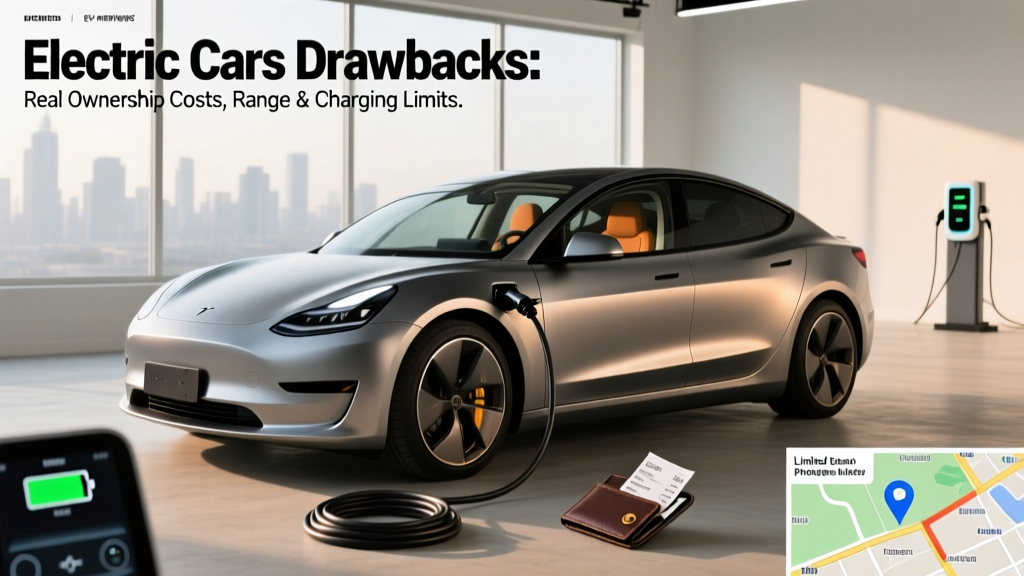
Electric vehicles offer lower fuel and maintenance costs, but they come with real trade-offs that buyers need to understand before signing a purchase agreement. The most significant electric cars drawbacks include higher upfront purchase prices, charging infrastructure gaps in rural areas, cold-weather range loss of 20-40%, longer refueling times compared to gas stations, and elevated insurance premiums averaging 15-25% above equivalent gas models. Battery degradation, while slower than many fear, still impacts long-term resale value, and home charging installation can add $1,000-$3,000 to your first-year ownership cost.
Quick Answer: Are Electric Cars Worth the Drawbacks?
For most drivers with home charging access, moderate climates, and daily commutes under 80 miles, EVs save $600-$1,200 annually on fuel and maintenance despite higher purchase prices. But if you lack home charging, regularly drive in sub-freezing temperatures, or take frequent 400+ mile road trips, a hybrid or gas vehicle may serve you better in 2026.
The Real Purchase Price Gap: EV vs Gas vs Hybrid
The sticker shock remains the first barrier. While battery costs have declined 40% since 2020, the average transaction price for a new EV in early 2026 sits around $47,000, compared to $44,000 for gas vehicles and $39,000 for hybrids. The gap narrows after federal incentives, but qualification isn't guaranteed.
| Vehicle Type | Example Model | Base MSRP | Federal Tax Credit | Effective Price |
|---|---|---|---|---|
| Battery Electric (BEV) | Tesla Model Y | $44,990 | $3,750-$7,500* | $37,490-$41,240 |
| Battery Electric (BEV) | Chevrolet Equinox EV | $33,600 | $7,500* | $26,100 |
| Hybrid (HEV) | Toyota RAV4 Hybrid | $31,900 | $0 | $31,900 |
| Plug-in Hybrid (PHEV) | Toyota RAV4 Prime | $43,690 | $3,750* | $39,940 |
| Gas Only | Honda CR-V | $32,450 | $0 | $32,450 |
*Federal §30D tax credit eligibility depends on MSRP caps ($55,000 for cars, $80,000 for SUVs/trucks), buyer income limits ($150K single/$300K joint for new vehicles), battery component sourcing requirements, and point-of-sale transfer availability. Check current rules at IRS.gov before purchasing. Credits phase out and change annually.
Range Reality: EPA Stickers vs Real-World Driving
EV range ratings from the EPA represent idealized testing conditions. Real-world range depends heavily on speed, temperature, terrain, and driving style — factors that hit EVs harder than gas vehicles.
Range Expectations: 2026 Tesla Model Y Long Range
EPA Rating: 320 miles
Real-World Highway (70 mph, 65°F): ~260-280 miles
Cold Weather (30°F, mixed driving): ~200-240 miles (30-35% loss)
Cold Weather Highway (70 mph, 20°F): ~170-200 miles (40%+ loss)
Gas vehicles also lose efficiency in cold weather and at highway speeds, but the impact is smaller — typically 10-15% range reduction. EVs suffer disproportionately because battery chemistry slows in cold temperatures, cabin heating draws significant power (unlike gas cars that use waste engine heat), and regenerative braking effectiveness drops when batteries are cold.
This matters for trip planning. A 320-mile EPA rating sounds comfortable for a 250-mile drive, but add winter conditions and highway speeds, and you're looking at a charging stop — adding 20-40 minutes to your journey.
Charging Infrastructure: Access, Speed, and Reliability
Home charging solves 80-90% of daily needs for most EV owners, but it's not universally available. Apartment dwellers, street parkers, and those with older electrical panels face real barriers.
| Scenario | Equipment | Electrical Work | Permits | Total |
|---|---|---|---|---|
| Level 2 charger, existing 240V outlet | $400-$700 | $0-$200 | $0-$100 | $400-$1,000 |
| Level 2 charger, new 240V circuit | $400-$700 | $800-$1,500 | $100-$300 | $1,300-$2,500 |
| Level 2 charger + panel upgrade | $400-$700 | $2,000-$4,000 | $200-$500 | $2,600-$5,200 |
Without home charging, you're dependent on public infrastructure. While networks like Tesla Supercharger, Electrify America, and EVgo have expanded significantly, reliability remains inconsistent. A 2025 study by J.D. Power found that 20% of public charging sessions encountered problems — broken connectors, payment failures, or chargers operating below rated power.
Charging speed also varies dramatically. A 350 kW DC fast charger sounds impressive, but most EVs can't sustain that rate. The 2026 Hyundai Ioniq 5 peaks at 240 kW and charges 10-80% in about 18 minutes under ideal conditions. But "ideal" means a warm battery (preconditioned), moderate ambient temperature, and a charger that can actually deliver its rated power. Real-world 10-80% sessions often take 25-35 minutes.
For comparison, filling a gas tank takes 3-5 minutes and adds 300-400 miles of range, every time, regardless of temperature.
Total Cost of Ownership: Where EVs Win and Lose
The financial case for EVs hinges on fuel and maintenance savings offsetting higher purchase prices and insurance premiums. Here's a realistic 5-year breakdown for a driver covering 12,000 miles annually:
| Cost Category | 2026 Chevy Equinox EV | 2026 Honda CR-V Gas | Difference |
|---|---|---|---|
| Purchase Price (after credit) | $26,100 | $32,450 | EV saves $6,350 |
| Fuel/Energy (5 years) | $3,200 | $7,800 | EV saves $4,600 |
| Maintenance (5 years) | $1,200 | $2,800 | EV saves $1,600 |
| Insurance (5 years) | $9,500 | $7,600 | EV costs $1,900 more |
| Depreciation (estimated) | $11,000 | $10,500 | EV costs $500 more |
| Total 5-Year Cost | $51,000 | $61,150 | EV saves $10,150 |
This scenario assumes home charging at $0.14/kWh national average, gas at $3.40/gallon, and that the buyer qualifies for the full $7,500 federal credit. Remove the tax credit, and the EV's 5-year savings drop to $2,650. Pay for public DC fast charging exclusively (at $0.35-$0.50/kWh), and fuel costs nearly double, eliminating most savings.
Insurance premiums run higher for EVs due to specialized repair requirements, expensive battery replacement costs, and limited actuarial data. According to Insurance Information Institute, EV insurance averages 15-25% above comparable gas models, though the gap is narrowing as EVs become more common.
Battery Degradation and Replacement Anxiety
Lithium-ion batteries lose capacity over time, but modern EV batteries degrade far slower than smartphone batteries. Most lose 1-2% capacity per year under normal use, meaning a 300-mile EV might offer 270-285 miles after 10 years.
Federal law mandates battery warranties of at least 8 years/100,000 miles, with capacity retention thresholds typically set at 70%. Manufacturers like Tesla, Hyundai, and Ford use liquid-cooled battery packs with sophisticated thermal management that extends lifespan.
The real concern is replacement cost if you keep the vehicle beyond warranty. Out-of-warranty battery replacements run $8,000-$20,000 depending on the vehicle, though failures remain rare. Most degradation is gradual, not catastrophic.
Common Misconceptions vs Facts
| Myth | Fact |
|---|---|
| "EV batteries need replacement every 5 years" | Modern EV batteries typically last 15-20 years before reaching 70% capacity. Warranty coverage is 8 years/100,000 miles minimum. |
| "Charging an EV costs as much as gas" | Home charging averages $0.14/kWh, translating to $0.04-$0.05 per mile. Gas at $3.40/gallon in a 30 MPG car costs $0.11 per mile. |
| "EVs are worse in cold weather" | EVs lose range in cold but start reliably, have no cold-start emissions, and can precondition the battery and cabin while plugged in — something gas cars can't do safely in enclosed spaces. |
| "The electrical grid can't support mass EV adoption" | Most charging happens overnight when grid demand is low. According to the Department of Energy, widespread EV adoption through 2030 would increase U.S. electricity demand by only 5-10%. |
| "EVs aren't actually better for the environment" | Even on coal-heavy grids, EVs produce fewer lifetime emissions than gas cars. On cleaner grids, the advantage grows. Battery recycling infrastructure is scaling rapidly. |
Decision Framework: Should You Buy an EV, Hybrid, or Gas Vehicle?
Choose a Battery Electric Vehicle (BEV) if:
- You have access to home or workplace Level 2 charging
- Your daily driving is under 80 miles round-trip
- You live in a moderate climate or can tolerate 20-30% winter range loss
- You qualify for federal/state tax credits that meaningfully reduce purchase price
- You plan to keep the vehicle 5+ years to recoup upfront costs through fuel savings
Choose a Plug-in Hybrid (PHEV) if:
- You have home charging but also take regular 300+ mile road trips
- You want electric-only driving for daily commutes (typically 25-40 miles) without range anxiety
- You live in an area with limited public charging infrastructure
- You want to reduce emissions without fully committing to electric-only driving
Choose a Traditional Hybrid (HEV) if:
- You lack access to any charging (home, work, or public)
- You want better fuel economy without changing your refueling habits
- Your budget doesn't accommodate EV or PHEV premiums
- You drive in extreme cold regularly and prioritize range consistency
Choose a Gas Vehicle if:
- You regularly tow heavy loads (5,000+ lbs) where EV range plummets
- You drive 20,000+ miles annually in rural areas with sparse charging
- You need the lowest possible upfront purchase price
- You plan to keep the vehicle under 3 years (insufficient time to recoup EV premium)
Frequently Asked Questions
How long does it really take to charge an EV on a road trip?
For a typical 2026 EV with 250-300 mile range, expect a 25-40 minute DC fast charging stop to go from 20% to 80% state of charge. That adds roughly 150-200 miles of range. Charging slows significantly above 80% to protect battery health, so most drivers charge to 80% and resume driving rather than waiting for a full charge.
Do EVs really save money long-term?
Yes, if you have home charging and qualify for tax credits. Over 5 years and 60,000 miles, an EV typically saves $4,000-$8,000 on fuel and maintenance compared to a gas vehicle, even accounting for higher insurance premiums. Without home charging or tax credits, the savings shrink dramatically or disappear entirely.
What happens if the battery fails after the warranty expires?
Catastrophic battery failures are rare — under 1% of EVs experience complete battery failure according to manufacturer data. More common is gradual degradation to 70-80% capacity after 10-15 years, which reduces range but doesn't strand you. Out-of-warranty replacement costs $8,000-$20,000, but most owners sell or trade the vehicle before facing this expense.
Are EVs harder to insure?
Insurance premiums average 15-25% higher than equivalent gas vehicles due to specialized repair requirements and expensive battery components. However, the gap is narrowing as EVs become more common and repair networks expand. Shop multiple insurers — some now offer EV-specific policies with competitive rates.
Can I charge an EV in an apartment or without a garage?
It's challenging but possible. Some apartments are installing Level 2 chargers in parking areas. Workplace charging is increasingly common. Public Level 2 chargers at shopping centers and libraries can supplement, though relying entirely on public charging is expensive and inconvenient. If you lack home charging access, a hybrid or PHEV may be more practical.
The Bottom Line: Honest EV Ownership in 2026
Electric vehicles aren't perfect, and the drawbacks are real — but they're also manageable for the right buyer. If you have home charging, moderate driving needs, and access to tax incentives, an EV will likely save you money and provide a superior driving experience. If you lack charging access, regularly drive in extreme cold, or need maximum flexibility for long road trips, a hybrid offers a compelling middle ground with lower upfront costs and no range anxiety.
The key is matching the vehicle to your actual driving patterns and infrastructure access, not aspirational scenarios. Test your assumptions: track your daily mileage for a month, research charging options in your area, and calculate realistic costs based on your local electricity rates and driving habits. The data will tell you whether an EV's drawbacks matter for your situation — or whether they're trade-offs you're happy to make.
For current EPA range ratings and efficiency data, consult fueleconomy.gov before purchasing, as real-world performance varies significantly by model and driving conditions.