Quick Verdict: Two Pioneers, Two Very Different Paths
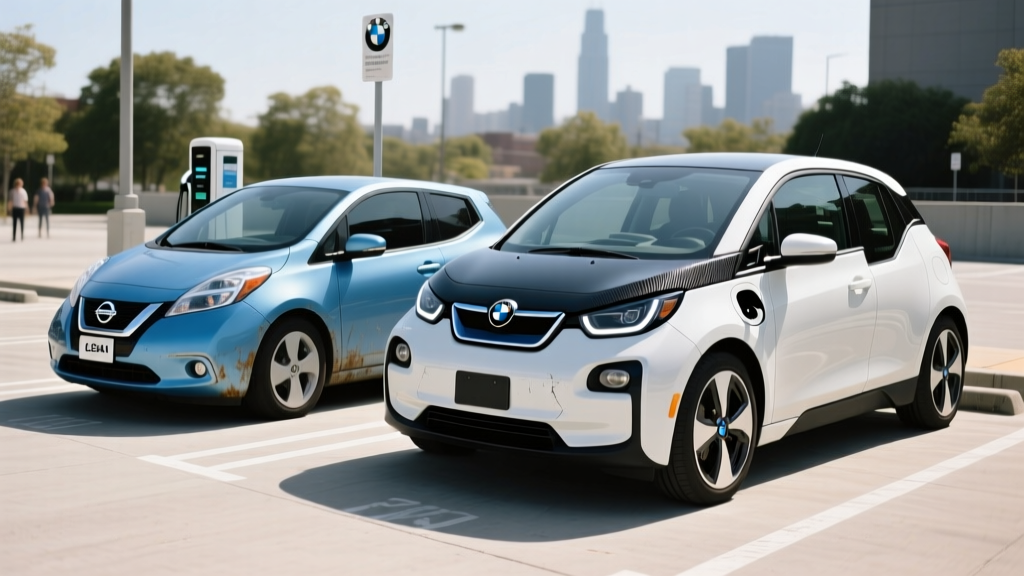
The Nissan LEAF and BMW i3 are the original mass-market electric vehicles — both launched over a decade ago and both now discontinued in the U.S. market. If you're searching for "nissan leaf v bmw i3," you're likely shopping the used EV market, where these two models offer dramatically different ownership experiences at bargain prices. The LEAF prioritizes affordability and practicality with a conventional hatchback shape, while the i3 delivers a premium, lightweight carbon-fiber city car with an optional range-extender gasoline engine. Neither supports modern DC fast-charging speeds, and both carry battery-degradation risks that demand careful pre-purchase inspection. Here's exactly what the numbers say.
Real-World Range Reality Check
Nissan LEAF (2023 SV Plus, final U.S. model year): EPA 212 miles (62 kWh pack). Expect 170–185 miles on the highway at 70 mph, and as low as 130–150 miles in sub-freezing winter conditions. The passive air-cooled battery exacerbates cold-weather range loss and accelerates long-term degradation in hot climates.
BMW i3 (2021 120 Ah, final U.S. model year): EPA 153 miles (42.2 kWh usable). Expect 125–135 miles highway, and roughly 100–110 miles in cold weather. The REx (range extender) variant adds a 2-cylinder gasoline generator that extends total range to roughly 200+ miles combined but requires fuel and oil maintenance.
Side-by-Side Spec Comparison
| Specification | 2023 Nissan LEAF SV Plus | 2021 BMW i3 120 Ah |
|---|---|---|
| EPA Range | 212 miles | 153 miles |
| Battery (usable) | 62 kWh (NMC, air-cooled) | 42.2 kWh (NMC, liquid-cooled) |
| Motor | 160 kW (214 hp), FWD | 125 kW (170 hp), RWD |
| 0–60 mph | 6.5 sec | 6.9 sec |
| DC Fast Charge (peak) | ~50 kW (CHAdeMO) | ~50 kW (CCS) |
| 10–80% DC Time | ~60 min | ~45 min |
| Level 2 Charge Rate | 6.6 kW (~22 mi/hr) | 7.4 kW (~25 mi/hr) |
| MPGe (combined) | 108 MPGe | 111 MPGe |
| kWh/100 mi | 31 kWh | 30 kWh |
| Cargo Volume | 23.6 cu ft (rear seats up) | 15.1 cu ft (rear seats up) |
| Rear Legroom | 33.5 in | 31.9 in |
| Curb Weight | 3,918 lbs | 2,961 lbs |
| Battery Warranty (new) | 8 yr / 100,000 mi | 8 yr / 100,000 mi |
| Original Base MSRP | $36,190 | $45,400 |
Battery Chemistry, Thermal Management, and Degradation
This is where the LEAF vs i3 decision often gets made — and where the LEAF carries its most significant long-term risk.
The LEAF uses an NMC (nickel-manganese-cobalt) lithium-ion pack with passive air cooling. Unlike liquid-cooled batteries, the LEAF's pack cannot actively shed heat during fast charging or in hot climates. Owners in Arizona, Texas, and the Southeast have documented measurable capacity loss — some reporting 10–20% degradation after 5–7 years and 60,000–80,000 miles. Repeated DC fast charging (especially in summer) accelerates this. Nissan's battery warranty covers capacity below 9 bars (out of 12) on the dashboard gauge, which roughly corresponds to 66% state of health.
The i3 also uses NMC chemistry but employs active liquid thermal management. BMW's system heats and cools the battery pack to maintain an optimal temperature window, resulting in significantly better long-term capacity retention. Most i3 owners report 5–10% degradation over 6–8 years — a meaningful advantage when buying used. The i3's smaller pack means less absolute range, but the battery you have today will more closely match the battery you have in five years.
Key takeaway: If you live in a hot climate or plan to DC fast-charge frequently, the i3's liquid cooling is a decisive advantage. If you're in a temperate region and charge primarily at home, the LEAF's larger pack gives more usable range despite the thermal compromise.
Charging: CHAdeMO vs CCS and the Connector Problem
Both vehicles peak at roughly 50 kW on DC fast charging — painfully slow by 2026 standards, where newer EVs pull 150–350 kW. But the connector ecosystem tells a more important story.
| Charging Level | Nissan LEAF | BMW i3 |
|---|---|---|
| Level 1 (120V, 1.4 kW) | ~5 mi/hr | ~5 mi/hr |
| Level 2 (240V) | 6.6 kW / ~22 mi/hr | 7.4 kW / ~25 mi/hr |
| DC Fast Charge | 50 kW, CHAdeMO | 50 kW, CCS |
| 10–80% DC Time | ~60 minutes | ~45 minutes |
| Full Level 2 Charge (0–100%) | ~9.5 hours | ~6 hours |
The LEAF uses CHAdeMO, a Japanese-origin DC connector that has been largely abandoned in North America. Electrify America still maintains some CHAdeMO stalls, but new installations overwhelmingly favor CCS and NACS. This means fewer public fast-charging options for LEAF owners every year. Adapters exist (CHAdeMO-to-NACS for Tesla Supercharger access), but they are expensive ($300–$500) and not universally compatible.
The i3 (2020+ models) uses CCS1, the dominant North American standard. While the industry is shifting to NACS (Tesla's connector), CCS-to-NACS adapters are widely available and supported by Tesla's Supercharger network for non-Tesla EVs. The i3 will have better public charging access for years to come.
At home, both vehicles charge overnight without issue. The i3's smaller battery fills faster — about 6 hours on a 240V Level 2 circuit versus nearly 10 hours for the LEAF. For most commuters who plug in every night, this difference is academic.
Driving Experience and Daily Practicality
The LEAF drives like a conventional compact hatchback — quiet, comfortable, and unremarkable. The 214-hp SV Plus motor provides confident highway merging, and the e-Pedal mode enables one-pedal driving with aggressive regenerative braking. Interior materials are budget-grade but durable. The 8-inch infotainment screen supports Apple CarPlay and Android Auto. ProPILOT Assist offers adaptive cruise control with lane centering — a Level 2 driver-assist system that still requires hands-on-wheel supervision.
The i3 is a fundamentally different experience. Its carbon-fiber-reinforced plastic (CFRP) passenger cell keeps curb weight under 3,000 lbs, giving it nimble, go-kart-like handling in the city. The rear-wheel-drive layout and tight 25.1-foot turning radius make it an exceptional urban runabout. The interior uses sustainable materials (eucalyptus wood, recycled textiles) that feel distinctly premium compared to the LEAF. The 10.25-inch iDrive screen is more responsive and feature-rich than Nissan's unit. However, the i3's narrow rear doors (rear-hinged "coach doors") and tight back seat make it impractical for families or regular rear-seat passengers.
Nissan LEAF Pros
- 212-mile EPA range — longest of any used compact EV under $20K
- Spacious hatchback cargo area (23.6 cu ft)
- Comfortable ride quality for daily commuting
- Low used-market prices (2021–2023 models from $14,000–$22,000)
- ProPILOT Assist adaptive cruise + lane centering
Nissan LEAF Cons
- Air-cooled battery degrades faster, especially in heat
- CHAdeMO connector is a dying standard in North America
- 50 kW DC fast charging is slow by any modern measure
- Budget interior materials and dated infotainment
- No longer in production — parts supply may tighten
BMW i3 Pros
- Liquid-cooled battery with excellent long-term health
- CCS connector — better public charging access going forward
- Lightweight CFRP construction, nimble city handling
- Premium interior with unique sustainable materials
- REx range-extender option eliminates range anxiety
BMW i3 Cons
- 153-mile EPA range is short for anything beyond city commuting
- Tight rear seat and limited cargo space (15.1 cu ft)
- Higher used prices ($18,000–$28,000 for 2019–2021 models)
- CFRP body panels are expensive to repair after collision damage
- REx variant requires gasoline, oil changes, and emissions maintenance
Used Pricing and Federal Tax Credit Eligibility
Both vehicles are available exclusively on the used market. The IRS §25E used clean vehicle credit offers up to $4,000 (30% of the sale price, capped at $4,000) for qualifying used EVs purchased from a licensed dealer. Here are the eligibility requirements:
- Vehicle price cap: Sale price must be $25,000 or less
- Buyer income cap: AGI ≤ $75,000 (single), $112,500 (head of household), $150,000 (joint)
- Vehicle age: Must be at least 2 model years old (2024 or older model year for a 2026 purchase)
- Dealer sale: Must be purchased from a licensed dealer, not a private party
- Transferable: Credit can be applied at point of sale as an immediate discount
| Cost Factor | Nissan LEAF (2022 SV Plus) | BMW i3 (2020 120 Ah) |
|---|---|---|
| Typical Used Price (2026 market) | $15,000–$19,000 | $18,000–$24,000 |
| §25E Used EV Credit (max) | Up to $4,000 | Up to $4,000 (if price ≤$25K) |
| Estimated Net Cost | $11,000–$15,000 | $14,000–$20,000 |
| Insurance (annual avg) | ~$1,300–$1,600 | ~$1,500–$1,900 |
Most 2019–2023 LEAF models fall under the $25,000 price cap and will qualify for the full $4,000 credit for income-eligible buyers. The i3's higher used prices mean some examples exceed the cap — a 2021 i3 with low miles might list at $26,000, disqualifying it. Shop carefully and negotiate to stay at or below $25,000 to preserve credit eligibility. Always confirm current IRS §25E rules with a tax professional, as incentive structures can change.
Ownership Costs and Efficiency
Both EVs are remarkably efficient. The LEAF achieves 108 MPGe combined (31 kWh/100 mi) and the i3 edges it out at 111 MPGe (30 kWh/100 mi), per fueleconomy.gov. At a national average electricity rate of $0.17/kWh, charging the LEAF costs roughly $0.053/mile and the i3 costs about $0.051/mile — both drastically cheaper than a 30-MPG gasoline car at $3.50/gallon ($0.117/mile).
Where costs diverge is maintenance and repair. The LEAF's conventional steel body is cheap to repair, and Nissan parts are widely available. The i3's CFRP structure and BMW-specific components carry premium repair costs. A fender-bender that might cost $1,500 to fix on a LEAF could run $4,000+ on an i3 if the carbon-fiber body structure is involved. Insurance reflects this: i3 premiums typically run 15–25% higher than the LEAF.
Who Should Buy Which?
Choose the Nissan LEAF if:
- You need 200+ miles of range for a longer commute or occasional road trips
- You regularly carry rear-seat passengers or bulky cargo
- You live in a temperate climate where air-cooled battery degradation is less severe
- You charge primarily at home and rarely need public DC fast charging
- Your budget is under $16,000 after the used EV credit
Choose the BMW i3 if:
- Your daily driving is under 80 miles round-trip and mostly urban
- You value premium build quality, unique design, and nimble city handling
- You live in a hot climate and want liquid-cooled battery longevity
- You want CCS connector compatibility for future public charging access
- You're considering the REx variant as a one-car solution with gas backup
Frequently Asked Questions
What is the real-world range of the Nissan LEAF and BMW i3?
The LEAF SV Plus delivers its EPA-rated 212 miles in ideal city conditions, but expect 170–185 miles on the highway and 130–150 miles in freezing weather. The i3's 153 EPA miles drops to roughly 125–135 on the highway and 100–110 in winter cold. The REx i3 variant can extend total range past 200 miles using its gasoline generator.
How fast do they charge at home and on the road?
At home on a 240V Level 2 charger, the LEAF adds about 22 miles per hour (6.6 kW) and the i3 adds about 25 miles per hour (7.4 kW). On DC fast chargers, both peak around 50 kW — the i3 reaches 10–80% in roughly 45 minutes, while the LEAF takes about 60 minutes due to its larger battery and conservative charge curve.
Does either qualify for a federal EV tax credit?
Not the new-vehicle §30D credit (both are discontinued). However, both can qualify for the IRS §25E used clean vehicle credit of up to $4,000 if the sale price is $25,000 or less, the buyer meets income caps ($75K single / $150K joint), and the vehicle is purchased from a licensed dealer. Confirm eligibility with a tax professional before purchase.
Is the LEAF's CHAdeMO connector a dealbreaker?
It's a significant and worsening limitation. New public DC fast-charging stations are overwhelmingly CCS or NACS. CHAdeMO infrastructure is shrinking, meaning fewer charging options on road trips. If you rely on public fast charging, the i3's CCS port is a meaningful advantage. If you charge at home 90%+ of the time, the connector matters less.
Which holds up better long-term — LEAF or i3 battery?
The i3's liquid-cooled battery pack demonstrably retains more capacity over time than the LEAF's air-cooled pack, especially in hot climates or with frequent DC fast charging. When buying used, request a battery state-of-health reading from the dealer or use an OBD-II scanner with a compatible app (e.g., LeafSpy for the LEAF) to check remaining capacity before purchase.
Are these EVs worth buying vs newer competitors?
At $11,000–$20,000 after credits, both represent exceptional value for budget-conscious EV buyers who primarily commute locally. However, if you can stretch to $25,000–$30,000, a used 2021–2022 Chevrolet Bolt EUV (247-mile range, CCS, liquid-cooled) or Hyundai Kona Electric (258-mile range, CCS) offers more range, faster charging, and better long-term parts support. The LEAF and i3 win on absolute lowest entry price — nothing else puts you in an EV for under $15,000 with this much range.