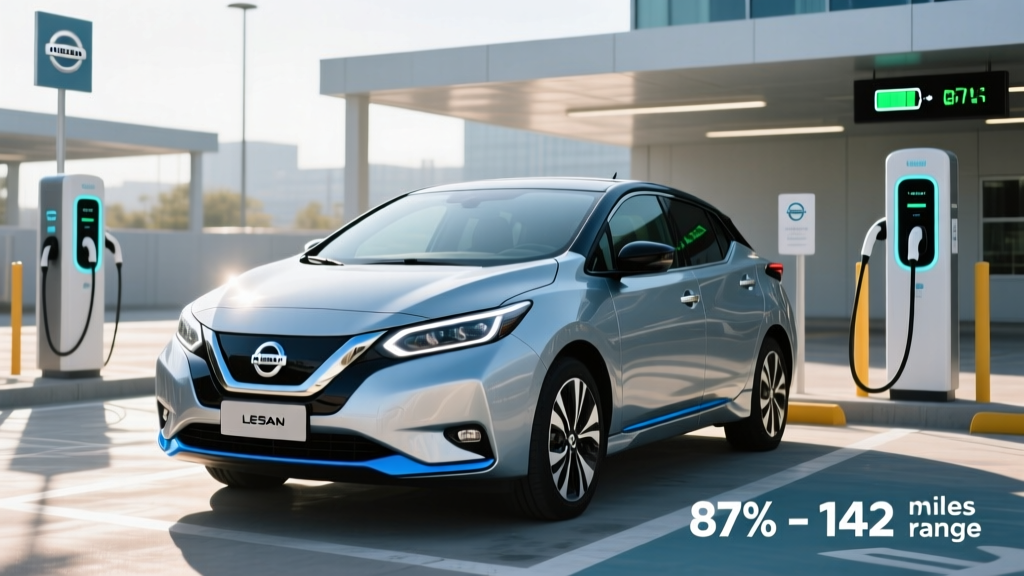
The Nissan LEAF holds a unique place in EV history as one of the first mass-market electric cars sold in the United States. But as the 2026 model year arrives with updated battery options and a refreshed design, the question many budget-conscious shoppers ask is straightforward: does the Nissan LEAF qualify for the federal EV tax credit?
The short answer is yes — but with important caveats tied to IRS §30D battery-sourcing requirements, buyer income limits, and MSRP caps. Below, we break down exactly which 2026 LEAF trims qualify, how much you can expect to save, and whether this compact EV still makes sense against a field of increasingly capable competitors.
2026 Nissan LEAF: Quick Specs at a Glance
| Specification | LEAF S (Standard) | LEAF SV Plus |
|---|---|---|
| EPA Range | 149 miles | 212 miles |
| Battery Capacity | 40 kWh (usable) | 60 kWh (usable) |
| Battery Chemistry | NMC (nickel manganese cobalt) | NMC |
| Motor Output | 147 hp / 236 lb-ft | 214 hp / 250 lb-ft |
| Drivetrain | FWD | FWD |
| 0–60 mph | ~7.9 sec | ~6.5 sec |
| Max DC Fast Charge | 50 kW (CHAdeMO) | 100 kW (CHAdeMO) |
| 10–80% DC Time | ~40 min | ~45 min |
| Level 2 Home Charge Rate | 6.6 kW (~22 mi/hr) | 6.6 kW (~25 mi/hr) |
| MPGe (Combined) | 111 MPGe | 109 MPGe |
| kWh/100 mi | 30 | 31 |
| Cargo Volume | 23.6 cu ft (rear seats up) | 23.6 cu ft |
| Rear Legroom | 33.5 in | 33.5 in |
| Base MSRP | $28,140 | $36,190 |
| Battery Warranty | 8 yr / 100,000 mi | 8 yr / 100,000 mi |
Source: fueleconomy.gov and Nissan USA specifications.
Does the Nissan LEAF Qualify for the Federal Tax Credit?
Under current IRS §30D rules, the 2026 Nissan LEAF remains eligible for up to $7,500 in federal tax credits — provided you meet all of the following requirements:
- MSRP Cap: The LEAF is classified as a passenger car, so its MSRP must not exceed $55,000. Both the S ($28,140) and SV Plus ($36,190) trims clear this bar easily, even with common option packages.
- Buyer Income Limits: Adjusted gross income must not exceed $150,000 (single), $225,000 (head of household), or $300,000 (joint filers).
- Battery Sourcing & Critical Minerals: At least a specified percentage of battery components must be manufactured or assembled in North America, and critical minerals must be sourced from the U.S. or a free-trade-agreement partner. Nissan assembles the LEAF in Smyrna, Tennessee, and has worked to localize its battery supply chain. However, exact compliance percentages shift by model year — confirm your specific VIN's eligibility at fueleconomy.gov before purchase.
- Point-of-Sale Transfer: As of 2024, buyers can transfer the credit to the dealer at purchase, reducing the upfront price directly rather than waiting to claim it on a tax return. The LEAF qualifies for this option.
Price After Tax Credit
| Trim | Base MSRP | Est. Federal Credit | Effective Price |
|---|---|---|---|
| LEAF S | $28,140 | Up to $7,500 | ~$20,640 |
| LEAF SV Plus | $36,190 | Up to $7,500 | ~$28,690 |
At roughly $20,600 after the credit, the LEAF S becomes one of the least expensive new EVs available in the U.S. market. That's a compelling proposition — but it comes with range and charging compromises that we'll unpack below.
Real-World Range: What the EPA Number Doesn't Tell You
EPA Estimate: 149 miles (S) / 212 miles (SV Plus)
Real-World Expectation:
- City/commute driving (mild weather): You'll match or slightly exceed EPA — regenerative braking in stop-and-go traffic works in the LEAF's favor. Expect 150–165 mi (S) or 215–230 mi (SV Plus).
- Sustained highway driving (70+ mph): Aerodynamic drag and the lack of a heat pump reduce efficiency. Expect ~120–135 mi (S) or ~175–190 mi (SV Plus).
- Cold weather (below 32°F): The LEAF uses resistive cabin heating rather than a heat pump, which draws heavily from the traction battery. Expect a 25–35% range reduction in freezing conditions — as low as ~100 mi for the S trim and ~145 mi for the SV Plus.
The LEAF's range is its most significant limitation in 2026. Competitors like the Chevrolet Equinox EV (319 mi EPA) and Hyundai Kona Electric (261 mi EPA) offer substantially more buffer. If your daily round-trip commute is under 60 miles and you have reliable home charging, the LEAF S is workable. For anything beyond that — or if you live in a cold climate — the SV Plus is the minimum viable choice, and even then, road trips require careful planning.
Charging Speed: The LEAF's Persistent Weakness
| Charging Level | LEAF S | LEAF SV Plus |
|---|---|---|
| Level 1 (120V, 1.4 kW) | ~4 mi/hr | ~4 mi/hr |
| Level 2 (240V, 6.6 kW) | ~22 mi/hr (full charge ~7 hr) | ~25 mi/hr (full charge ~9.5 hr) |
| DC Fast Charge (max) | 50 kW (CHAdeMO) | 100 kW (CHAdeMO) |
| 10–80% DC Time | ~40 min | ~45 min |
The LEAF's charging story has two problems that buyers must understand before signing a purchase agreement:
1. CHAdeMO connector in a CCS/NACS world. The LEAF is the last mainstream EV sold in the U.S. still using the CHAdeMO DC fast-charging standard. Nearly all public charging networks — Electrify America, EVgo, and the expanding Tesla Supercharger network (via adapters for CCS/NACS vehicles) — have standardized on CCS1 or NACS. While CHAdeMO stations still exist, their numbers are shrinking, and many new installations omit CHAdeMO connectors entirely. This is a genuine infrastructure disadvantage that will only worsen over time.
2. Modest peak charge rates. Even the SV Plus tops out at 100 kW, and the charge curve tapers significantly above 80% state of charge. In real-world testing at a 150 kW CHAdeMO station, the SV Plus sustains roughly 70–85 kW between 20–60% SoC before dropping to under 40 kW past 80%. Competitors like the Hyundai Kona Electric (peak ~100 kW on CCS) and Chevrolet Equinox EV (peak ~190 kW on CCS/NACS) charge faster and on more widely available connectors.
For home charging, the 6.6 kW onboard charger is adequate — you'll wake up to a full battery every morning. But if you rely on public DC fast charging for road trips, plan for longer stops and verify CHAdeMO availability along your route using PlugShare or the network's app.
Performance, Interior, and Technology
The LEAF SV Plus delivers 214 horsepower and 250 lb-ft of instant torque through a front-mounted AC synchronous motor. The 0–60 mph sprint takes approximately 6.5 seconds — respectable for a compact hatchback and quick enough for confident highway merging. The LEAF S, with 147 hp, is more sedate at 7.9 seconds but still offers the smooth, linear acceleration characteristic of electric drivetrains.
Ride quality is comfortable and compliant, though the steering is numb and the chassis isn't designed for spirited driving. Cabin noise isolation is adequate at city speeds but wind and tire noise become noticeable above 70 mph.
Interior Dimensions and Cargo
Passenger space is competitive for the segment. Front headroom measures 39.3 inches and rear legroom is 33.5 inches — sufficient for adults on shorter trips. The 23.6 cubic feet of cargo space behind the rear seats is generous for a compact hatchback, expanding to approximately 30 cu ft with the 60/40 split rear seats folded. A modest under-floor storage area accommodates the Level 1 charging cord.
Notably, the LEAF does not have a front trunk (frunk). The space under the hood is occupied by the power electronics and onboard charger.
Tech and Driver Assistance
The 2026 LEAF features an 8-inch (S) or available 12.3-inch (SV Plus) touchscreen with wireless Apple CarPlay and Android Auto. Nissan's ProPILOT Assist provides SAE Level 2 lane centering and adaptive cruise control — helpful for highway commutes but requiring continuous driver supervision. This is not autonomous driving; you must keep your hands on the wheel and eyes on the road.
Additional standard safety tech includes automatic emergency braking with pedestrian detection, lane departure warning, blind-spot monitoring, and rear cross-traffic alert. The LEAF earns strong marks from NHTSA, though IIHS ratings should be verified for the latest model year.
Battery Longevity, Warranty, and Degradation
Nissan provides an 8-year/100,000-mile battery capacity warranty (10 years/100,000 miles in California Air Resources Board states). The warranty covers the battery if it degrades below a specified capacity threshold — typically around 60–70% of original capacity, depending on model year terms. Read the fine print in your purchase agreement for the exact guaranteed percentage.
The LEAF's battery pack is passively cooled (air-cooled) rather than liquid-cooled, which has historically been a concern for long-term degradation — especially in hot climates or with frequent DC fast charging. Earlier-generation LEAFs (2011–2017) showed measurable capacity loss over time. Nissan has improved cell chemistry and thermal management in subsequent generations, but the absence of active liquid cooling remains a technical disadvantage compared to competitors with liquid-cooled packs (Tesla, Hyundai, GM, Ford). If you live in Phoenix, Las Vegas, or similar hot-climate markets, this is a factor worth weighing.
How the LEAF Stacks Up Against Key Competitors
| Vehicle | EPA Range | DC Fast Charge | Connector | Base MSRP | After ~$7,500 Credit |
|---|---|---|---|---|---|
| 2026 Nissan LEAF S | 149 mi | 50 kW | CHAdeMO | $28,140 | ~$20,640 |
| 2026 Nissan LEAF SV Plus | 212 mi | 100 kW | CHAdeMO | $36,190 | ~$28,690 |
| 2026 Hyundai Kona Electric | 261 mi | ~100 kW | CCS/NACS | $32,975 | ~$25,475 |
| 2026 Chevrolet Equinox EV | 319 mi | ~190 kW | NACS/CCS | $33,600 | ~$26,100 |
The LEAF S is the cheapest option on this list after the tax credit. But the Equinox EV and Kona Electric offer dramatically more range, faster charging on more widely available connectors, and liquid-cooled batteries — for only $5,000–$8,000 more out of pocket. The value gap narrows considerably once you factor in the LEAF's charging-infrastructure disadvantage and lower resale value.
Pros and Cons
Pros
- Lowest effective price of any new EV after federal tax credit (~$20,640 for S trim)
- Comfortable ride quality and easy urban maneuverability
- Generous cargo space for a compact hatchback (23.6 cu ft)
- ProPILOT Assist is a competent Level 2 highway aid
- U.S.-assembled (Smyrna, TN) — supports domestic manufacturing and tax credit eligibility
- Strong standard safety equipment suite
Cons
- CHAdeMO connector limits DC fast-charging station access and is a shrinking standard
- 149-mile range on base S trim is inadequate for most buyers outside pure city commuters
- No liquid-cooled battery — potential long-term degradation concern in hot climates
- No heat pump — significant cold-weather range loss (25–35%)
- DC fast-charge speeds lag behind competitors (50–100 kW vs. 150–200+ kW)
- No frunk; modest rear-seat legroom for taller passengers
Who Should Buy the 2026 Nissan LEAF?
Choose the LEAF S if: You need the cheapest possible new EV, your daily round-trip commute is under 50 miles, you have reliable Level 2 home charging, you rarely drive in extreme cold, and you don't plan to take frequent road trips. The post-credit price of ~$20,640 is hard to beat for a brand-new electric car with a full warranty.
Choose the LEAF SV Plus if: You want more range for moderate commutes (up to 80 miles round-trip), you value the quicker 6.5-second 0–60 time, and you're willing to accept the CHAdeMO charging limitation in exchange for a proven, comfortable, U.S.-built EV at ~$28,690 after the credit.
Look elsewhere if: You need 250+ miles of range, you road-trip regularly, you live in a region with limited CHAdeMO infrastructure, you're in a hot climate concerned about battery longevity, or you want access to the Tesla Supercharger network. The Chevrolet Equinox EV and Hyundai Kona Electric are stronger all-around choices for a few thousand dollars more.
Frequently Asked Questions
Does the Nissan LEAF qualify for the full $7,500 federal tax credit?
It can — both the S and SV Plus trims fall under the $55,000 MSRP cap for passenger cars, and Nissan assembles the LEAF in Tennessee. However, eligibility depends on battery-sourcing and critical-mineral requirements that shift by model year, as well as your personal income limits. Verify your specific vehicle's eligibility at fueleconomy.gov and consult a tax professional before relying on the credit.
Can I get the tax credit as a point-of-sale discount?
Yes. Under current IRS rules, you can transfer the §30D credit to the dealer at the time of purchase, reducing your out-of-pocket cost immediately rather than claiming it on your tax return the following year. The dealer must be registered with the IRS Energy Credits Online portal.
What is the real-world range of the 2026 Nissan LEAF?
The EPA rates the LEAF S at 149 miles and the SV Plus at 212 miles. In real-world driving, expect to match or slightly exceed those numbers in city conditions with mild weather. Highway driving at 70+ mph reduces range by roughly 10–15%, and cold weather (below freezing) can cut range by 25–35% due to the LEAF's resistive heating system and lack of a heat pump.
How fast does the LEAF charge at home?
On a 240-volt Level 2 home charger, the LEAF's 6.6 kW onboard charger adds approximately 22–25 miles of range per hour. A full charge from empty takes roughly 7 hours (S) or 9.5 hours (SV Plus) — easily accomplished overnight. A standard 120V Level 1 outlet adds about 4 miles per hour, suitable only for emergency top-ups or very low-mileage drivers.
Is the CHAdeMO connector a dealbreaker?
For many buyers, it should be a serious concern. The CHAdeMO standard has been effectively abandoned by most major charging networks for new installations. While existing CHAdeMO stations continue to operate, you'll find fewer of them on road trips, and wait times can be longer because stations typically have only one or two CHAdeMO connectors. If public DC fast charging is part of your ownership plan, a CCS- or NACS-equipped vehicle is a more future-proof choice.
How does the LEAF battery hold up over time?
The LEAF's air-cooled battery pack is more susceptible to heat-related degradation than liquid-cooled competitors, particularly in hot climates or with frequent DC fast charging. Nissan's 8-year/100,000-mile battery warranty provides a safety net, but owner reports suggest gradual capacity loss is more pronounced than in liquid-cooled packs. If longevity is a top priority, consider a vehicle with active thermal management.
Is the 2026 LEAF worth buying versus competitors?
If price-after-credit is your overriding priority and your driving needs are modest, the LEAF S at ~$20,640 is the cheapest new EV you can buy. But for most shoppers, spending $5,000–$8,000 more on a Chevrolet Equinox EV or Hyundai Kona Electric yields dramatically better range, faster and more widely compatible charging, liquid-cooled battery longevity, and higher resale value. The LEAF is a niche pick for budget-first, commute-only buyers who understand its limitations.