Quick Verdict: The Original EV Bargain Shows Its Age
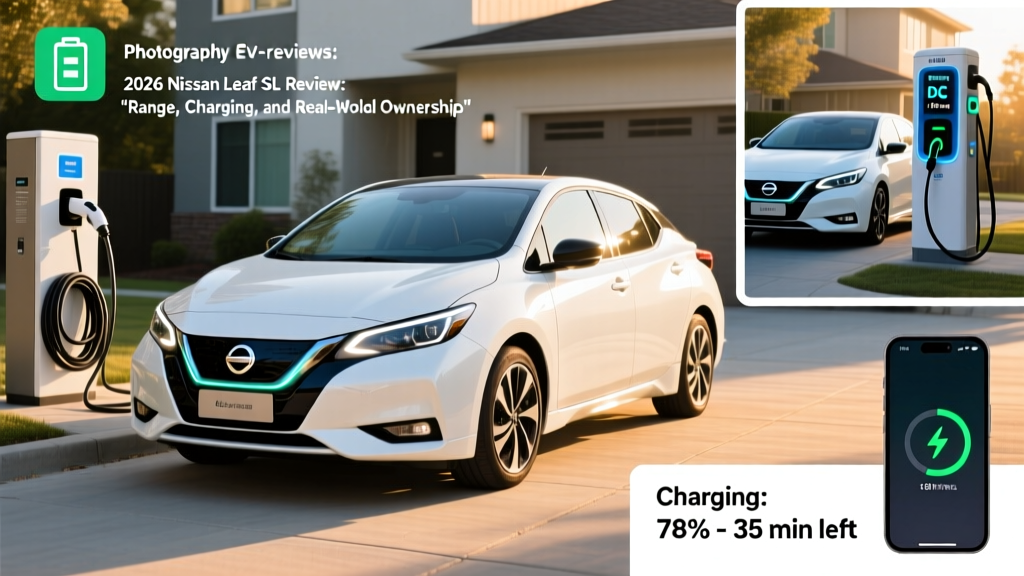
The Nissan Leaf holds a unique place in electric-vehicle history. Launched in 2011, it was the car that proved battery-electric transportation could work at scale. The 2026 Nissan Leaf SL — the top-trim model with the larger 60 kWh battery — continues that legacy as one of the most affordable long-range EVs on the US market. But affordability comes with compromises that matter more in 2026 than they did even two years ago: a CHAdeMO fast-charging connector in a market that has overwhelmingly adopted NACS, passive air-cooled battery management, and a platform that hasn't seen a full redesign since 2018.
For urban commuters with home charging access and modest daily mileage, the Leaf SL remains a practical, comfortable, and well-equipped electric hatchback. For anyone who road-trips regularly, lives in extreme climates, or needs reliable public fast-charging infrastructure, the limitations are harder to overlook.
2026 Nissan Leaf SL Specifications at a Glance
| Specification | 2026 Nissan Leaf SL (Plus Battery) |
|---|---|
| EPA Range | 212 miles |
| Battery Capacity | 60 kWh (usable), lithium-ion (NMC chemistry) |
| Drivetrain | Front-wheel drive, single motor |
| Horsepower | 214 hp |
| Torque | 250 lb-ft |
| 0-60 mph | ~6.9 seconds |
| EPA Efficiency | 111 MPGe combined (30 kWh/100 mi) |
| Max DC Fast Charge | ~50 kW (CHAdeMO) |
| Level 2 Charge Rate | 6.6 kW onboard charger |
| Cargo Volume | 23.6 cu ft (rear seats up) / 38.5 cu ft (folded) |
| Base MSRP (SL Plus) | $36,190 (before destination) |
| Battery Warranty | 8 years / 100,000 miles |
Range and Efficiency: EPA vs. Reality
The Leaf SL equipped with the larger battery pack carries an EPA-estimated 212 miles of range. That figure is derived from the EPA's standardized city and highway drive cycles, and it represents a reasonable average for mixed driving conditions.
City/commuter driving (mild weather): 210–225 miles — regenerative braking in stop-and-go traffic helps the Leaf match or slightly exceed its EPA rating.
Highway driving (70+ mph, mild weather): 170–190 miles — the Leaf's aerodynamics and single-speed reduction gear mean efficiency drops noticeably at sustained highway speeds.
Cold weather (below 32°F, mixed driving): 140–170 miles — the Leaf's passively air-cooled battery and electric resistance heater (no heat pump) result in significant range loss in winter conditions. Expect a 20–35% reduction depending on temperature and cabin-heater use.
The absence of a heat pump is one of the Leaf SL's most consequential omissions. Competitors like the Hyundai Kona Electric and Chevrolet Bolt EV use heat-pump HVAC systems (or at least more efficient thermal management), which reduces winter range penalty. If you live in the northern US or Canada, budget for real-world winter range closer to 150 miles on a full charge.
Efficiency is rated at 111 MPGe combined, which translates to approximately 30 kWh per 100 miles. That's competitive within its class, though the lighter and more thermally managed Bolt EV edges ahead at 120 MPGe combined.
Charging: The CHAdeMO Problem
Charging is where the 2026 Leaf SL faces its most significant structural disadvantage. Nissan remains one of the last automakers using the CHAdeMO DC fast-charging standard, while virtually the entire industry — led by Tesla, Ford, GM, Hyundai, Rivian, and others — has adopted the North American Charging Standard (NACS). Electrify America still maintains CHAdeMO connectors at many stations, but new infrastructure deployments overwhelmingly favor NACS and CCS.
| Charging Level | Power / Connector | Speed (Approx.) | Notes |
|---|---|---|---|
| Level 1 (120V) | ~1.4 kW / J1772 | ~5 miles per hour | Emergency / overnight trickle only |
| Level 2 (240V) | 6.6 kW / J1772 | ~25 miles per hour | Full charge in ~9 hours; home or public L2 |
| DC Fast Charge | ~50 kW peak / CHAdeMO | 10–80% in ~45 minutes | Peak rate not sustained; tapers significantly above 70% SoC |
The Leaf SL's DC fast-charging capability peaks around 50 kW — a figure that was respectable in 2019 but falls well short of modern competitors. The Hyundai Kona Electric charges at up to 100 kW (CCS), and the Chevrolet Bolt EV can reach 115 kW (CCS). On a 50 kW CHAdeMO connection, expect a 10–80% session to take roughly 40–45 minutes, and the charge curve tapers noticeably as the battery fills past 70%.
For home charging, the 6.6 kW onboard charger is adequate. Plugging into a 240V Level 2 home station (like a ChargePoint Home Flex or Emporia Level 2) will replenish the battery from empty to full in about 9 hours — perfectly suited for overnight charging. A dedicated 30-amp or 40-amp circuit is recommended; consult a licensed electrician for installation specifics, as costs vary widely based on panel capacity and conduit runs.
Performance and Driving Dynamics
The Leaf SL's 214-horsepower, front-mounted electric motor delivers the instant torque that makes EVs feel responsive around town. The 250 lb-ft of torque is available from 0 RPM, giving the Leaf brisk acceleration off the line. The 0–60 mph time of approximately 6.9 seconds is adequate for merging and passing, though it trails the Bolt EV (6.5 sec) and significantly lags performance-oriented EVs.
Ride quality is a genuine strength. The Leaf's suspension tuning prioritizes comfort, and the cabin remains well-isolated from road noise at moderate speeds. The low center of gravity from the floor-mounted battery pack contributes to composed handling, though the front-heavy weight distribution (due to the front-mounted motor and FWD layout) means you'll notice understeer if you push hard through corners.
Nissan's ProPILOT Assist comes standard on the SL trim. This is a SAE Level 2 driver-assistance system that combines adaptive cruise control with lane-centering steering. It works well on well-marked highways and in stop-and-go traffic, but it requires continuous driver supervision — hands on the wheel, eyes on the road. It is not a self-driving system. Think of it as a competent co-pilot, not a replacement for the driver.
Interior, Tech, and Practicality
The Leaf SL's interior reflects its value positioning. The top trim includes leather-appointed seats, a heated steering wheel, heated front and rear seats, and a Bose premium audio system. The 8-inch touchscreen infotainment system supports wireless Apple CarPlay and wired Android Auto, navigation, and Nissan's connected-services app for remote charging management and climate preconditioning.
Passenger space is generous for a compact hatchback:
- Front legroom: 42.1 inches
- Rear legroom: 33.5 inches
- Front headroom: 41.2 inches
- Rear headroom: 37.3 inches
These dimensions make the Leaf comfortable for four adults on moderate-length trips, though rear-seat passengers over 6 feet tall will find legroom tight compared to a crossover.
Cargo capacity measures 23.6 cubic feet behind the rear seats and 38.5 cubic feet with the 60/40 split rear seats folded. That's competitive with the Kona Electric (25.5 cu ft) and significantly more than the Bolt EV hatch (16.3 cu ft behind rear seats). There is no front trunk (frunk), as the Leaf's motor and power electronics occupy the entire engine bay.
Pricing, Tax Credits, and Value
The 2026 Nissan Leaf SL with the larger 60 kWh battery pack starts at an MSRP of approximately $36,190 (plus a $1,095 destination charge). The base Leaf S trim with the smaller 40 kWh battery (149-mile range) starts lower, but most buyers considering the Leaf for daily commuting will want the extended range of the Plus battery.
| Cost Factor | Amount |
|---|---|
| Leaf SL Plus MSRP | $36,190 |
| Destination Charge | $1,095 |
| Estimated Dealer Fees / Docs | $500–$800 (varies) |
| Federal Tax Credit (§30D) — Maximum | Up to $7,500* |
| Effective Price After Max Credit | ~$30,285 |
*Federal EV tax credit eligibility under IRS §30D depends on multiple factors that change annually:
- Buyer income caps: Modified AGI must not exceed $150,000 (single), $225,000 (head of household), or $300,000 (joint filers).
- MSRP cap: The Leaf qualifies — it is classified as a passenger car with an MSRP cap of $55,000, well above its sticker price.
- Battery sourcing requirements: A portion of the credit depends on whether critical minerals and battery components meet US-sourcing thresholds. Nissan's supply chain has historically sourced from Japan and other allied nations, but exact credit amounts (full $7,500 vs. partial $3,750) depend on the specific model year's compliance. Consult the IRS Clean Vehicle portal or a tax professional before relying on a specific credit amount.
- Point-of-sale transfer: As of 2024, eligible buyers can transfer the credit to the dealer at purchase, reducing the upfront price rather than waiting for a tax refund.
Warranty and Long-Term Battery Health
Nissan provides the following warranty coverage for the 2026 Leaf:
- Battery warranty: 8 years / 100,000 miles (capacity retention above 66% of original — that's 9 bars out of 12 on the battery health display)
- EV system warranty: 5 years / 60,000 miles
- Bumper-to-bumper: 3 years / 36,000 miles
- Powertrain: 5 years / 60,000 miles
The battery capacity warranty threshold of 66% is notably lower than competitors. Hyundai and Kia guarantee 70% retention over 10 years / 100,000 miles, and Chevrolet guarantees 60% over 8 years / 100,000 miles. In practice, Leaf batteries with the larger 60 kWh pack have demonstrated reasonable longevity, but the air-cooled thermal management system does mean the battery is more exposed to heat-related degradation in hot climates. If you live in Arizona, Texas, or the Southeast, monitor your State of Health (SoH) via the dashboard display and avoid frequent back-to-back DC fast charging in high temperatures.
Nissan's battery replacement cost, should it be needed out of warranty, has historically ranged from $6,500 to $9,000 for the larger pack — a significant expense that buyers should factor into long-term ownership calculations.
How the Leaf SL Compares
The Leaf SL's most direct competitors in 2026 include the Chevrolet Bolt EV/EUV, Hyundai Kona Electric, and the Mini Cooper SE (shorter range, lower price). Here's how they stack up on the metrics that matter:
| Metric | Nissan Leaf SL | Chevrolet Bolt EV | Hyundai Kona Electric |
|---|---|---|---|
| EPA Range | 212 mi | 259 mi | 261 mi |
| Battery (kWh) | 60 kWh | 65 kWh | 64.8 kWh |
| DC Fast Charge (kW) | ~50 (CHAdeMO) | 115 (CCS) | 100 (CCS) |
| 10–80% DC Time | ~45 min | ~30 min | ~43 min |
| 0–60 mph | 6.9 sec | 6.5 sec | 7.2 sec |
| Heat Pump | No | No (resistance) | Yes |
| Base MSRP (top trim) | ~$36,190 | ~$38,995 | ~$39,900 |
| Connector | CHAdeMO | CCS | CCS / NACS (2025+) |
The Bolt EV offers significantly more range and faster charging at a modest price premium. The Kona Electric matches or exceeds the Leaf on range and adds a heat pump for better cold-weather performance. The Leaf's advantage is its lower entry price on the base S trim and its proven, if aging, platform reliability.
- One of the lowest MSRPs for a 200+ mile EV
- Comfortable ride quality and quiet cabin
- Strong standard features on SL trim (heated everything, Bose audio, ProPILOT)
- Spacious cargo area for a compact hatchback
- Proven reliability track record on core drivetrain
- Eligible for full or partial federal tax credit
- CHAdeMO connector — shrinking public charging network
- ~50 kW max DC fast charge is slow by 2026 standards
- Air-cooled battery — worse cold-weather range and heat degradation risk
- No heat pump — significant winter range loss
- Aging platform design (2018 generation)
- Battery warranty capacity threshold (66%) trails competitors
- No frunk, no AWD option, no towing capacity
Who Should Buy the 2026 Nissan Leaf SL?
The Leaf SL makes the most sense for a specific buyer profile:
- Urban and suburban commuters with reliable home Level 2 charging who drive fewer than 100 miles round-trip daily.
- Second-car households where a gas or long-range vehicle handles road trips.
- Value-oriented buyers who want to minimize upfront cost and take advantage of the federal tax credit.
- Mild-climate residents where extreme cold or heat won't significantly impact battery health and range.
The Leaf SL is not the right choice for frequent road-trippers (the CHAdeMO connector and 50 kW charge rate make highway travel frustrating), cold-climate drivers without garage parking, or anyone who wants a modern EV platform with the latest thermal management and charging technology.
Frequently Asked Questions
What is the real-world range of the 2026 Nissan Leaf SL?
The EPA rates the Leaf SL (Plus battery) at 212 miles. In real-world city commuting with mild weather, expect 210–225 miles. Highway driving at 70+ mph drops that to roughly 170–190 miles. In freezing temperatures, plan for 140–170 miles due to the lack of a heat pump and air-cooled battery.
How fast does the Nissan Leaf SL charge?
On a Level 2 home charger (240V, 6.6 kW), the Leaf adds about 25 miles of range per hour and charges fully in approximately 9 hours. On a CHAdeMO DC fast charger, it peaks at roughly 50 kW, reaching 10–80% in about 45 minutes. This is significantly slower than competitors using CCS or NACS connectors at 100+ kW.
Does the 2026 Nissan Leaf qualify for the federal EV tax credit?
The Leaf is eligible for up to $7,500 under IRS §30D, but the actual amount depends on your income (AGI caps apply), the vehicle's MSRP (the Leaf qualifies under the $55,000 passenger-car cap), and battery-sourcing requirements that vary by model year. Check the fueleconomy.gov tax credit lookup and consult a tax professional for your specific situation. Point-of-sale transfer is available at participating dealers.
Is the Nissan Leaf SL worth buying in 2026 vs. competitors?
If your priority is lowest upfront cost for a 200+ mile EV and you charge primarily at home, the Leaf SL remains competitive — especially after the federal tax credit. However, the Bolt EV and Kona Electric offer more range, faster charging, and more modern connector ecosystems (CCS/NACS) for a modest price premium. For buyers who use public charging regularly, the CHAdeMO connector is a growing liability.
How long will the Nissan Leaf battery last?
Nissan warrants the battery for 8 years or 100,000 miles against capacity loss below 66% (9 of 12 capacity bars). Real-world data from Leaf owners suggests the 60 kWh pack retains roughly 85–90% capacity after 5 years and 60,000 miles in moderate climates. Hot climates and frequent DC fast charging accelerate degradation due to the passive air-cooling system.
Can I use Tesla Superchargers with the Nissan Leaf?
No. The Leaf uses the CHAdeMO DC fast-charging connector and cannot natively connect to Tesla's NACS Supercharger network. Adapters for CHAdeMO-to-NACS are not commercially available as of 2026. You are limited to Electrify America, EVgo, and independent CHAdeMO-equipped stations for public DC fast charging.