Quick Verdict: Two Ford EVs, Very Different Missions
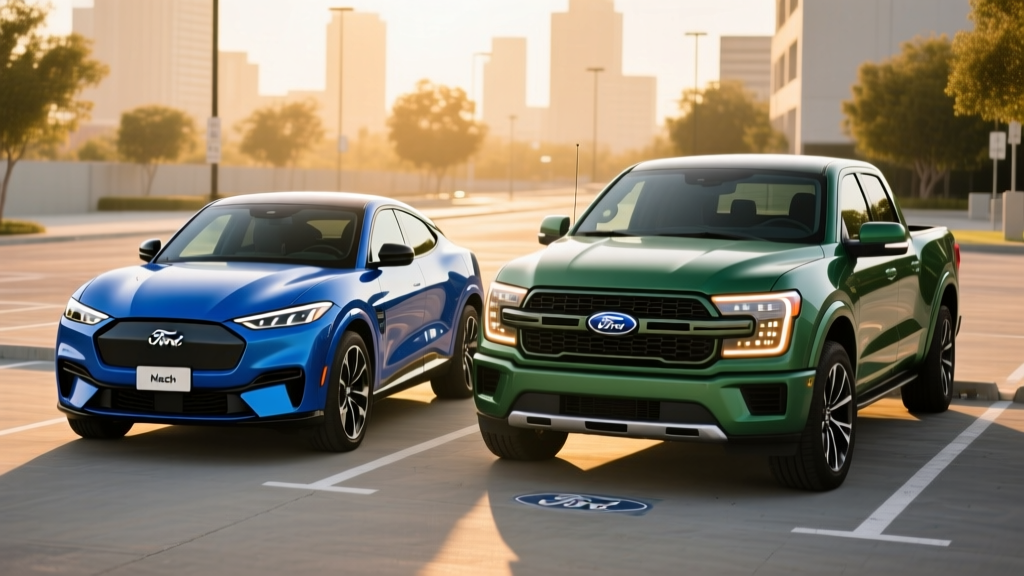
Ford's electrified lineup rests on two very different pillars. The Mustang Mach-E is a sporty, efficiency-focused electric crossover aimed at daily commuters and small families who want Tesla-rivaling tech without the Tesla badge. The F-150 Lightning is a full-size electric pickup that trades some range for genuine truck capability — towing, hauling, and worksite power via its Pro Power Onboard system.
Both share Ford's Blue Oval charging network access and similar software DNA, but their battery sizes, curb weights, and use cases diverge sharply. This review breaks down the 2026 model-year specs, real-world range expectations, charging performance, and total ownership math so you can pick the right one — or decide neither fits.
Side-by-Side Specs: Mach-E vs F-150 Lightning at a Glance
| Spec | Mustang Mach-E (Select RWD) | Mustang Mach-E (GT AWD) | F-150 Lightning (Pro Std Range) | F-150 Lightning (Lariat Ext Range) |
|---|---|---|---|---|
| EPA Range | 250 mi | 290 mi | 240 mi | 320 mi |
| Battery (usable) | 72 kWh (NMC) | 91 kWh (NMC) | 98 kWh (NMC) | 131 kWh (NMC) |
| Drivetrain | RWD single-motor | AWD dual-motor | AWD dual-motor | AWD dual-motor |
| Horsepower / Torque | 266 hp / 317 lb-ft | 480 hp / 634 lb-ft | 580 hp / 775 lb-ft | 580 hp / 775 lb-ft |
| 0–60 mph | 6.3 sec | 3.5 sec | 4.0 sec | 3.8 sec |
| Max DC Fast Charge | 150 kW | 150 kW | 150 kW | 150 kW |
| 10–80% DCFC Time | ~38 min | ~45 min | ~41 min | ~55 min |
| Level 2 Home Rate | 10.5 kW (~32 mi/hr) | 10.5 kW (~32 mi/hr) | 11.3 kW (~22 mi/hr) | 19.2 kW (~37 mi/hr)* |
| Efficiency (MPGe) | 103 MPGe combined | 90 MPGe combined | 78 MPGe combined | 70 MPGe combined |
| Base MSRP | $39,995 | $56,995 | $54,995 | $74,995 |
| Cargo Volume | 29.7 cu ft (rear) + 4.7 cu ft frunk | 29.7 cu ft (rear) + 4.7 cu ft frunk | 52.8 cu ft bed + 14.1 cu ft Mega Power Frunk | 52.8 cu ft bed + 14.1 cu ft Mega Power Frunk |
| Battery/Powertrain Warranty | 8 yr / 100,000 mi | 8 yr / 100,000 mi | 8 yr / 100,000 mi | 8 yr / 100,000 mi |
*19.2 kW Level 2 requires the optional 80A Ford Charge Station Pro and a 100-amp dedicated circuit. Standard Mobile Power Cord delivers ~3.3 kW on a 240V/30A outlet.
Real-World Range: What the EPA Sticker Doesn't Tell You
The EPA numbers above assume a mixed city/highway drive cycle at moderate temperatures. In practice, your mileage will vary — sometimes significantly.
Mach-E Select RWD: EPA 250 mi. Expect ~210–230 mi on sustained highway driving at 70+ mph; ~170–190 mi in sub-freezing winter conditions with cabin heat.
Mach-E GT AWD: EPA 290 mi. Expect ~240–260 mi highway; ~190–210 mi in cold weather.
F-150 Lightning Pro Std Range: EPA 240 mi. Expect ~190–210 mi highway unloaded; ~140–170 mi cold weather; significantly less when towing (100–130 mi with a 5,000-lb trailer).
F-150 Lightning Lariat Ext Range: EPA 320 mi. Expect ~260–280 mi highway unloaded; ~200–230 mi cold weather; ~160–200 mi towing.
The Lightning's boxy aerodynamics and 6,000+ lb curb weight punish highway efficiency. If you frequently tow, the Extended Range battery is nearly mandatory — not a luxury upgrade. The Mach-E's sleeker profile gives it a meaningful edge on road trips, though neither vehicle matches the Hyundai Ioniq 5 or Tesla Model Y on efficiency per kWh.
Charging Performance: DC Fast Charging and Home Setup
Both vehicles use the NACS (North American Charging Standard) connector for 2026, granting native access to Tesla Superchargers and the growing NACS-native public network. Ford abandoned the CCS adapter requirement that plagued early Mach-E and Lightning owners.
| Charging Level | Power (kW) | Mach-E Miles/Hour | Lightning Miles/Hour | Notes |
|---|---|---|---|---|
| Level 1 (120V household) | ~1.3 kW | ~3 mi/hr | ~2 mi/hr | Emergency/trickle only |
| Level 2 (240V/48A) | 10.5–11.5 kW | ~32 mi/hr | ~22 mi/hr | Standard home setup |
| Level 2 (240V/80A)* | 19.2 kW | ~32 mi/hr (vehicle-limited) | ~37 mi/hr | Lightning dual-charger option |
| DC Fast Charge (peak) | 150 kW | 10–80% in ~38–45 min | 10–80% in ~41–55 min | Tapers sharply above 80% |
Charging curve reality check: The 150 kW peak rate on both vehicles is sustained only between roughly 10–55% state of charge. Above 60%, the rate drops to ~80 kW; above 80%, it falls below 40 kW. If you're road-tripping and need to charge past 80%, budget an extra 20–25 minutes. Preconditioning the battery (via the FordPass app or in-nav routing to a charger) is essential for achieving peak rates — skipping it in cold weather can double your charge time.
For home charging, the Mach-E's smaller battery fills overnight easily on a 48A Level 2 circuit (~$500–$1,200 installed, assuming your panel has capacity). The Lightning's 131 kWh Extended Range pack is a different story: even at 19.2 kW, a full 10–100% charge takes over 7 hours. Many Lightning owners opt for the Ford Charge Station Pro, which requires a 100-amp dedicated circuit — potentially triggering a $1,500–$3,000 panel upgrade if your home has a 100A or 150A main service.
Pricing, Trims, and Federal Tax Credit Eligibility
Ford's EV pricing has stabilized after the volatility of 2022–2023, but tax credit eligibility remains a moving target governed by IRS §30D rules.
| Model / Trim | Base MSRP | As-Tested (Typical) | MSRP Cap Met? | Est. Credit |
|---|---|---|---|---|
| Mach-E Select RWD | $39,995 | $42,500 | Yes (SUV cap: $80,000) | Up to $7,500† |
| Mach-E Premium AWD | $48,995 | $53,000 | Yes | Up to $7,500† |
| Mach-E GT | $56,995 | $62,000 | Yes | Up to $7,500† |
| F-150 Lightning Pro Std | $54,995 | $58,500 | Yes (Truck cap: $80,000) | Up to $7,500† |
| F-150 Lightning Lariat Ext | $74,995 | $82,000 | Yes (barely) | Up to $7,500† |
| F-150 Lightning Platinum | $84,995 | $92,000 | No — exceeds $80K cap | $0 |
†Critical caveats on the $7,500 federal credit:
- Buyer income caps: Adjusted gross income must not exceed $150,000 (single), $225,000 (head of household), or $300,000 (joint filing).
- MSRP caps: Vans/SUVs/pickups: $80,000. The Lightning Platinum exceeds this — no credit.
- Battery sourcing requirements: A percentage of critical minerals and battery components must be sourced from the U.S. or free-trade-agreement partners. Ford has worked to qualify, but the exact credit amount ($3,750 for minerals + $3,750 for components) can shift annually. Verify current-year eligibility at fueleconomy.gov before purchasing.
- Point-of-sale transfer: You can transfer the credit to the dealer at purchase, reducing your out-of-pocket cost immediately — but you must still meet income requirements on your tax return or repay the credit.
The Mach-E lineup qualifies more cleanly across all trims. The Lightning's credit eligibility narrows as you climb trims — the Platinum is priced out entirely.
Driving Dynamics, Tech, and Daily Ownership
Mustang Mach-E: The GT variant's 3.5-second 0–60 time and low center of gravity make it genuinely engaging on back roads, with well-tuned one-pedal driving and strong regenerative braking. The 15.5-inch vertical SYNC 4A touchscreen is responsive, and Ford's BlueCruise (SAE Level 2 hands-free driving on approved highways) is a legitimate road-trip aid — though you must keep eyes on the road at all times. Rear seat legroom (38.9 inches) accommodates adults comfortably, and the 4.7 cu ft frunk handles charging cables or a small cooler.
F-150 Lightning: The dual-motor AWD system delivers 580 hp and a 7,700-lb max towing capacity (Extended Range with Max Trailer Tow). The 14.1 cu ft Mega Power Frunk is the party trick — it's lockable, weatherproof, and has four 120V outlets plus two USB-C ports. Pro Power Onboard (2.4 kW standard, 9.6 kW optional) turns the truck into a mobile generator, running power tools, a camper, or even backing up essential home circuits during an outage via the Ford Intelligent Backup Power system.
Notable drawbacks for both:
- Neither matches the Tesla Supercharger network's reliability or density — though NACS access has narrowed this gap significantly.
- Ford's build quality has improved but still trails Hyundai/Kia in panel gap consistency and interior material quality at these price points.
- The Mach-E's 150 kW peak charge rate feels dated against rivals like the Ioniq 5 (240 kW) and Porsche Macan EV (270 kW).
- The Lightning's weight (6,500–6,800 lbs) eats through tires faster than a gas F-150 — budget for replacement rubber every 25,000–30,000 miles.
Mach-E Pros
- Engaging handling, GT is genuinely quick
- Competitive efficiency (103 MPGe Select)
- Full tax credit eligibility across trims
- BlueCruise on 130,000+ miles of approved roads
- Reasonable home charging install cost
Mach-E Cons
- 150 kW DCFC peak lags competitors
- Rear visibility compromised by sloped roofline
- Options push GT well past $60K
- No heat pump on early builds (check model year)
Lightning Pros
- Legitimate truck capability — 7,700-lb tow, 2,235-lb payload
- Mega Power Frunk is best-in-class storage
- Pro Power Onboard for worksite/home backup
- Rides and handles far better than expected for its weight
- Quiet, refined cabin at highway speed
Lightning Cons
- Range collapses when towing (100–130 mi realistic)
- Extended Range battery needs expensive home charging setup
- Platinum trim ineligible for federal credit
- Heavy vehicle = accelerated tire wear
- 55-min 10–80% charge on Ext Range tests road-trip patience
Who Should Buy Which?
Decision Framework
Choose the Mach-E if: You commute 30–80 miles daily, want a responsive crossover for two adults and a child, prioritize efficiency and lower charging costs, and can charge at home on a standard 48A Level 2 circuit. The Select RWD at ~$32,500 after the federal credit is one of the best value-to-range ratios in the segment.
Choose the F-150 Lightning if: You need a truck for work, towing, or hauling at least a few times per month. The Pro Power Onboard system alone justifies the purchase for contractors and tradespeople. The Extended Range Lariat is the sweet spot — but only if you can install a high-amperage Level 2 charger at home and don't regularly tow more than 3,000 lbs on long trips.
Look elsewhere if: You take frequent 400+ mile road trips (consider a Tesla Model Y or Hyundai Ioniq 5 for faster charging), you need three rows of seating (look at the Kia EV9), or you tow heavy trailers over long distances (a diesel or PHEV remains more practical).
Frequently Asked Questions
What is the real-world range of the Mach-E and F-150 Lightning?
The Mach-E Select RWD delivers ~210–230 miles on highway trips and ~170–190 in freezing weather. The Mach-E GT manages ~240–260 highway. The Lightning Pro Std Range yields ~190–210 highway unloaded but drops to 100–130 miles when towing a 5,000-lb trailer. The Lightning Extended Range achieves ~260–280 highway unloaded and ~160–200 towing. Cold weather (below 32°F) reduces all figures by 15–25%.
How fast do they charge at home and on the road?
Both peak at 150 kW on DC fast chargers, reaching 10–80% in 38–45 minutes (Mach-E) or 41–55 minutes (Lightning, depending on battery size). At home on a 48A Level 2 circuit, the Mach-E adds ~32 miles per hour of charging; the Lightning adds ~22 mi/hr on standard dual-charger or ~37 mi/hr with the optional 80A Ford Charge Station Pro (requires a 100A circuit).
Do the Mach-E and F-150 Lightning qualify for the $7,500 federal EV tax credit?
Most trims do, with important caveats. All Mach-E trims fall under the $80,000 SUV MSRP cap. The Lightning qualifies up through the Lariat Extended Range ($74,995 base), but the Platinum ($84,995) exceeds the $80,000 truck cap and is ineligible. Buyer income must not exceed $150K single / $300K joint. Battery critical-mineral and component sourcing requirements also apply — verify at fueleconomy.gov before purchasing. Consult a tax professional for your specific situation.
Is the Mach-E or Lightning worth buying vs. competitors?
The Mach-E competes against the Tesla Model Y, Hyundai Ioniq 5, and Kia EV6. It wins on driving engagement and BlueCruise but loses on charging speed (150 kW vs. 240+ kW for rivals). The Lightning's only direct electric rival is the Rivian R1T, which is more expensive but more capable off-road. Against gas F-150s, the Lightning wins on fuel cost and torque but loses on towing range and upfront price. For a dedicated commuter, the Mach-E is a strong buy. For a working truck owner who can charge at home, the Lightning is transformative.
What's the biggest regret owners report?
For Mach-E owners: not spec'ing the larger battery on early orders, leading to range anxiety on road trips. For Lightning owners: underestimating the cost and complexity of home charging installation — many discover they need a panel upgrade ($1,500–$3,000) to support the 80A charger needed for the Extended Range battery. Budget for a licensed electrician assessment before committing to the purchase.