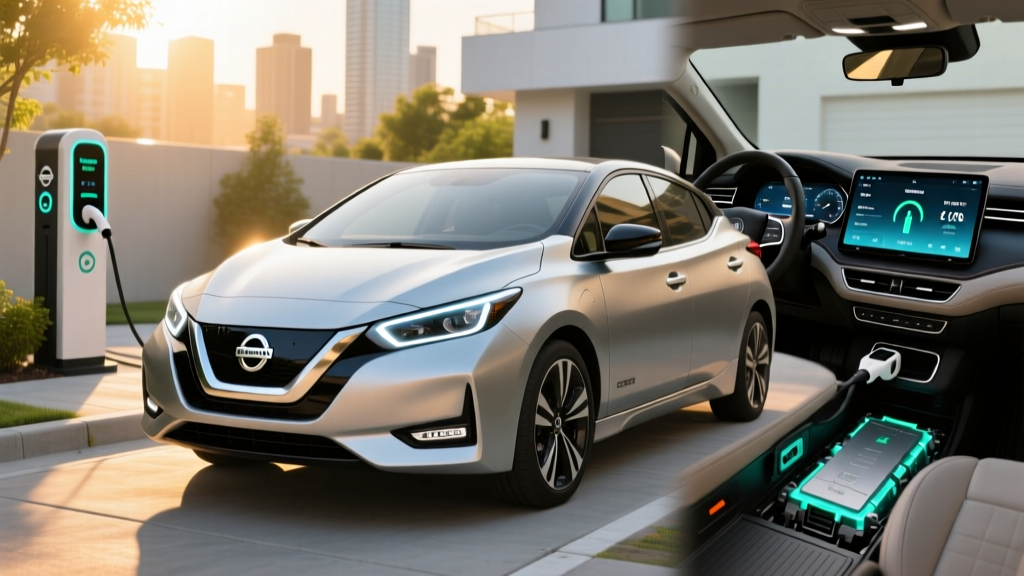
The Nissan Leaf holds a unique place in the EV market: it is the original mass-market electric car, now in its twilight years as Nissan prepares a crossover-based successor. For 2025, the Leaf soldiers on with modest updates, a sub-$30,000 starting price, and a CHAdeMO charging connector that increasingly feels like a relic. So, is the Nissan Leaf a good car for today's EV buyer? The answer depends entirely on your use case, your charging access, and how much you value a bargain over future-proofing.
This review covers the 2025 Nissan Leaf S and SV Plus trims with exact EPA data, real-world range expectations, charging speeds, ownership costs, and how it stacks up against modern competitors like the Chevrolet Bolt EV, Hyundai Kona Electric, and Volvo EX30.
Quick Verdict: Who the Leaf Is (and Isn't) For
2025 Nissan Leaf Specifications at a Glance
| Spec | Leaf S (40 kWh) | Leaf SV Plus (60 kWh) |
|---|---|---|
| EPA Range | 149 miles | 212 miles |
| Battery (Usable) | 40 kWh (NMC) | 60 kWh (NMC) |
| Motor / Drivetrain | 110 kW (147 hp) / FWD | 160 kW (214 hp) / FWD |
| 0-60 mph | ~7.9 sec | ~6.5 sec |
| MPGe (Combined) | 111 MPGe | 104 MPGe |
| kWh/100 mi | 30 | 32 |
| Max DC Fast Charge | 50 kW (CHAdeMO) | 100 kW (CHAdeMO) |
| 10-80% DC Charge Time | ~40 min | ~45 min |
| Level 2 Home Charging | 6.6 kW (~23 mi/hr) | 6.6 kW (~25 mi/hr) |
| Cargo Volume | 23.6 cu ft (rear seats up) | 23.6 cu ft (rear seats up) |
| Base MSRP | $28,140 | $36,190 |
| Battery Warranty | 8 yr / 100,000 mi | 8 yr / 100,000 mi |
Sources: EPA / fueleconomy.gov, Nissan USA
Real-World Range: What the EPA Sticker Doesn't Tell You
The Leaf's range figures are a product of its generation. The platform dates to 2010 (refreshed in 2018), and its aerodynamics, motor efficiency, and battery packaging haven't kept pace with competitors. The Hyundai Kona Electric, for comparison, achieves 261 EPA miles from a similarly sized 64.8 kWh battery — a meaningful advantage on road trips.
The Leaf also lacks a heat pump on most trims, relying on resistive cabin heating that can draw 3-5 kW in winter. This directly cuts into your traction battery, reducing range by 20-35% in freezing conditions. If you live in the northern U.S. and plan to rely on range alone (not charging) during winter commutes, budget for that loss.
One practical note: the Leaf's battery management system includes a relatively large buffer to protect its passively cooled NMC cells. You won't see the full 60 kWh available — usable capacity is closer to 56-58 kWh in the Plus model. This is actually a longevity feature, but it means you're getting fewer miles per kWh of installed capacity than newer liquid-cooled platforms.
Charging: The Leaf's Biggest Weakness in 2025
Charging is where the 2025 Leaf's age shows most clearly. Two issues matter here: the connector type and the charge rate.
CHAdeMO: A Connector on the Way Out
The Leaf uses the CHAdeMO DC fast-charging connector — a Japanese standard that has lost the format war to CCS1 and now NACS (Tesla's North American Charging Standard). As of 2025, Electrify America has largely stopped expanding CHAdeMO stalls, and many new charging stations deploy only CCS or NACS connectors. You can still find CHAdeMO chargers at many older stations, but the network is shrinking relative to CCS/NACS.
Nissan has not announced a CHAdeMO-to-NACS adapter for the Leaf (unlike Ford and Rivian, which received Tesla adapters). This means Leaf owners are increasingly limited to legacy charging infrastructure on road trips.
DC Fast Charging Speeds
| Charging Level | Leaf S (40 kWh) | Leaf SV Plus (60 kWh) |
|---|---|---|
| Level 1 (120V, 12A) | ~1.4 kW / ~4 mi/hr | ~1.4 kW / ~4 mi/hr |
| Level 2 (240V, 6.6 kW) | 6.6 kW / ~23 mi/hr | 6.6 kW / ~25 mi/hr |
| DC Fast (Peak) | 50 kW | 100 kW |
| 10-80% DC Time | ~40 min | ~45 min |
| Miles Added in 30 min DC | ~60 mi | ~90 mi |
The base Leaf S tops out at just 50 kW on DC fast charging — painfully slow by 2025 standards. The Hyundai Ioniq 5 can sustain 240 kW peaks; even the budget Chevrolet Bolt EV manages 55 kW (though it's also limited). The SV Plus improves to 100 kW peak, but that peak is brief. Because the Leaf uses passive (air-cooled) battery thermal management, sustained charge rates drop significantly as the battery warms during a session. Expect the SV Plus to average closer to 55-65 kW over a full 10-80% session, especially in warm weather or on back-to-back fast charges.
This "Rapidgate" phenomenon — named by Leaf owners — means your second or third DC fast charge on a road trip will be noticeably slower than the first. It's a direct consequence of the Leaf's passive cooling design, which prioritizes cost and simplicity over thermal performance.
Home Level 2 Charging
At home, the Leaf's 6.6 kW onboard charger is adequate. A full charge from empty takes about 7.5 hours for the SV Plus and 5.5 hours for the S on a 240V Level 2 station. Most owners who plug in nightly never need DC fast charging for daily use. If you can install a Level 2 charger at home (a 240V/30A circuit is sufficient), the Leaf works well as a daily commuter — the charging limitations only hurt on road trips.
Pricing, Trims, and Federal Tax Credit Eligibility
| Trim | MSRP | Est. After §30D Credit | Key Features |
|---|---|---|---|
| S (40 kWh) | $28,140 | ~$20,640* | 8" touchscreen, ProPILOT Assist, CHAdeMO, Apple CarPlay/Android Auto |
| SV Plus (60 kWh) | $36,190 | ~$28,690* | 212-mi range, 100 kW DC, 17" wheels, LED headlights, ProPILOT Assist |
*Estimated price assumes full $7,500 federal tax credit. Actual eligibility depends on your income, battery sourcing, and tax liability. See IRS rules below.
Does the 2025 Nissan Leaf Qualify for the Federal EV Tax Credit?
The 2025 Nissan Leaf may qualify for up to $7,500 under IRS §30D, but eligibility is not guaranteed for every buyer. Here are the key rules as of 2025:
- MSRP Cap: The Leaf is a passenger car, so the cap is $55,000. Both trims qualify.
- Income Cap: Modified AGI must not exceed $150,000 (single), $225,000 (head of household), or $300,000 (joint).
- Battery Sourcing: The $7,500 credit splits into two halves — $3,750 for critical minerals and $3,750 for battery components. Nissan's battery supply chain has shifted over recent years; consult the IRS qualified vehicles list for the current determination on the Leaf.
- Point-of-Sale Transfer: As of 2024, you can transfer the credit to the dealer at purchase, reducing your out-of-pocket cost immediately rather than waiting for tax filing.
- Final Assembly: The Leaf is assembled in Smyrna, Tennessee — satisfying the North American final assembly requirement.
Because battery sourcing requirements tighten each year under the Inflation Reduction Act, confirm the Leaf's current credit status on IRS.gov before purchasing. A tax professional can verify your personal eligibility.
Performance and Driving Experience
The Leaf SV Plus's 214-hp electric motor delivers brisk acceleration from stops, with a 0-60 mph time of approximately 6.5 seconds. Instant torque makes it feel quicker than the number suggests in city driving. The base S model's 147 hp is adequate for commuting but noticeably less punchy during highway merges.
Ride quality is comfortable and compliant — the Leaf's soft suspension absorbs bumps well, though it leans in corners more than sportier EVs. Steering is light and numb, which suits its commuter mission but won't excite anyone on a back road. The single-speed reduction gear provides smooth, linear power delivery without the hunting of a traditional transmission.
Regenerative braking in the Leaf offers two modes: a mild regen setting that feels like gentle engine braking, and the "e-Pedal" mode that provides stronger deceleration when you lift off the accelerator. However, e-Pedal in the Leaf does not bring the car to a complete stop and hold it — you still need the brake pedal at very low speeds. This is a notable difference from the one-pedal driving experience in a Chevrolet Bolt or Tesla Model 3, which can hold the car at a full stop.
Interior, Cargo, and Technology
The Leaf's interior is functional but dated. Hard plastics dominate the dashboard and door panels, and the 8-inch infotainment touchscreen (standard on both trims) uses older graphics and slower response times than competitors. Wireless Apple CarPlay is available on SV Plus; the base S requires a wired connection. Android Auto is wired across the lineup.
Passenger space is reasonable for the compact hatchback segment:
- Front legroom: 42.1 inches
- Rear legroom: 33.5 inches
- Cargo (seats up): 23.6 cu ft
- Cargo (seats folded): 38.5 cu ft
That cargo volume is competitive — the Bolt EV offers 16.3 cu ft, while the Kona Electric provides 25.8 cu ft. The Leaf's hatchback shape makes it practical for grocery runs and medium-sized loads.
On the safety-tech front, Nissan's ProPILOT Assist is a Level 2 driver-assistance system that combines adaptive cruise control with lane-centering. It works well on highways but requires you to keep hands on the wheel (it is not a hands-free system like GM's Super Cruise or Ford's BlueCruise). Automatic emergency braking, blind-spot warning, and rear cross-traffic alert are standard on all trims.
Warranty, Battery Longevity, and Ownership Costs
Nissan covers the Leaf's lithium-ion battery with an 8-year / 100,000-mile warranty against defects and excessive capacity loss (defined as dropping below 9 bars out of 12 on the battery health display, roughly equivalent to 60-65% state of health). The powertrain warranty is 5 years / 60,000 miles, and the basic vehicle warranty is 3 years / 36,000 miles.
Battery degradation has been the Leaf's historical Achilles' heel, particularly in early 2011-2017 models with passive air cooling in hot climates. The current-generation Leaf (2018+) uses improved NMC chemistry with better degradation profiles, but the passive cooling system still makes it more vulnerable to heat-related wear than liquid-cooled competitors. Owners in Arizona or Texas should monitor their battery health bar closely and avoid repeated DC fast charging in high temperatures.
Based on available long-term data, expect a 2025 Leaf SV Plus battery to retain approximately 85-90% of its original capacity after 5 years / 75,000 miles under normal use conditions. This is acceptable but trails liquid-cooled platforms from Hyundai/Kia and Tesla, which typically retain 90-95% over the same period.
Insurance costs for the Leaf are moderate — typically $1,200-$1,600 annually depending on your profile. Maintenance is minimal: no oil changes, no spark plugs, and brake pads last significantly longer thanks to regenerative braking. Cabin air filter replacement and tire rotation are your primary service items.
Leaf vs. the Competition: Is It Worth Buying?
| Attribute | Nissan Leaf SV Plus | Chevy Bolt EV (2025) | Hyundai Kona Electric |
|---|---|---|---|
| EPA Range | 212 mi | 259 mi | 261 mi |
| Base MSRP | $36,190 | ~$28,785 | ~$32,975 |
| DC Fast Charge (Peak) | 100 kW (CHAdeMO) | 55 kW (CCS→NACS adapter avail.) | 100+ kW (CCS→NACS) |
| Battery Cooling | Passive (air) | Passive (air) | Liquid |
| Connector Future-Proof | No (CHAdeMO) | Yes (NACS transition) | Yes (NACS transition) |
Choose the Leaf If:
- You want the lowest-possible new EV price (base S at $28,140)
- Your commute is under 60 miles round-trip
- You charge exclusively at home on Level 2
- You rarely take road trips over 150 miles
- You value a comfortable, soft-riding hatchback
Skip the Leaf If:
- You need DC fast charging for road trips
- You want NACS/CCS connector compatibility
- You live in a hot climate and worry about battery degradation
- You want more than 212 miles of range
- You want modern infotainment and a fresh platform
Pros and Cons
✓ Pros
- Among the cheapest new EVs in the U.S. at $28,140
- Comfortable ride quality for daily commuting
- Assembled in Tennessee (supports domestic manufacturing)
- ProPILOT Assist standard on all trims
- Decent cargo space (23.6 cu ft)
- Simple, proven powertrain with low maintenance costs
✗ Cons
- CHAdeMO connector — shrinking public network
- Passive battery cooling — slower sustained charging, heat degradation risk
- Base 40 kWh model has only 149 miles of EPA range
- DC fast charging limited to 50-100 kW peak
- No heat pump on most trims (winter range penalty)
- Dated interior materials and infotainment system
- e-Pedal does not hold at complete stop
Frequently Asked Questions
What is the real-world range of the 2025 Nissan Leaf?
The Leaf SV Plus is EPA-rated at 212 miles, but expect 180-195 miles in real-world highway driving at 70 mph, and 150-170 miles in freezing weather. The base S model (149 EPA miles) delivers roughly 120-135 miles in mixed driving. Your results will vary based on speed, temperature, terrain, and climate-control use.
How fast does the Nissan Leaf charge?
On a Level 2 home charger (240V, 6.6 kW), the SV Plus adds about 25 miles of range per hour, reaching a full charge in roughly 7.5 hours. On DC fast charging, the SV Plus peaks at 100 kW via CHAdeMO, reaching 10-80% in about 45 minutes — though sustained rates average lower due to passive battery cooling. The base S model is limited to 50 kW DC.
How much does the Leaf cost after the federal tax credit?
If you qualify for the full $7,500 §30D credit, the Leaf S drops to approximately $20,640 and the SV Plus to approximately $28,690. Eligibility depends on your income (under $150K single / $300K joint), the vehicle's battery sourcing compliance, and your tax liability. The credit can now be transferred at point of sale to reduce your purchase price directly. Verify current eligibility on IRS.gov.
Is the Nissan Leaf worth buying over the Chevrolet Bolt or Hyundai Kona Electric?
For pure budget buyers who charge at home and don't road-trip, the Leaf S at $28,140 is compelling — it's one of the cheapest new EVs available. But the Bolt EV offers 259 miles of range for less money, and the Kona Electric provides 261 miles plus liquid-cooled battery management and a CCS/NACS connector. If you can spend a few thousand more, both competitors are more future-proof. The Leaf's main remaining advantage is its low entry price and comfortable ride.
Will the Nissan Leaf be discontinued?
Nissan has confirmed it is developing a next-generation electric crossover to replace the Leaf, likely based on the CMF-EV platform (similar to the Ariya). The current Leaf is expected to end production within the next couple of model years. If you buy a 2025 Leaf, know that it's a legacy product — which affects long-term parts support, resale value, and charging compatibility.
Does the Nissan Leaf qualify for the federal EV tax credit?
It may qualify for up to $7,500 under §30D, depending on battery component and critical mineral sourcing compliance (which changes annually), your income, and the MSRP cap (the Leaf passes). The Leaf is assembled in Tennessee, meeting the final-assembly requirement. Always check the IRS qualified clean vehicles list before purchasing, as sourcing rules can shift a vehicle's eligibility mid-year.