If you have been searching for pictures of the Nissan Leaf, you are likely trying to decide whether this pioneering electric hatchback still holds up in an increasingly crowded EV market. The 2026 Nissan Leaf continues as one of the most affordable new electric vehicles available in the United States, starting under $29,000 before incentives. But pictures only tell part of the story — what matters more is how this EV performs in the real world regarding range, charging speed, and daily usability.
We have spent time analyzing the 2026 Leaf's specifications, cross-referencing EPA data from fueleconomy.gov, and evaluating its position against newer competitors. Here is everything you need to know before you buy.
2026 Nissan Leaf at a Glance: Key Specifications
| Specification | Leaf S (40 kWh) | Leaf SV Plus (60 kWh) |
|---|---|---|
| EPA Range | 149 miles | 212 miles |
| Battery Capacity (usable) | 40 kWh (NMC) | 60 kWh (NMC) |
| Horsepower | 147 hp | 214 hp |
| 0–60 mph | ~7.9 sec | ~6.5 sec |
| Drivetrain | FWD | FWD |
| Max DC Fast Charge | 50 kW (CHAdeMO) | 100 kW (CHAdeMO) |
| 10–80% DC Charge Time | ~40 min | ~45 min |
| Level 2 Home Charging | 6.6 kW (~22 mi/hr) | 6.6 kW (~25 mi/hr) |
| EPA Efficiency | 123 MPGe / 27 kWh/100mi | 111 MPGe / 30 kWh/100mi |
| Cargo Volume | 23.6 cu ft (rear seats up) | 23.6 cu ft (rear seats up) |
| Base MSRP | $28,140 | $36,190 |
Real-World Range: What the EPA Numbers Don't Show
The Leaf uses an NMC (nickel manganese cobalt) lithium-ion battery pack. Unlike some competitors that have adopted LFP (lithium iron phosphate) chemistry for better longevity and cold resilience at lower energy density, Nissan has stuck with NMC for its proven track record and packaging efficiency. The Leaf also lacks a heat pump — it relies on resistive cabin heating, which is a significant contributor to cold-weather range loss. This is a notable omission for buyers in northern climates.
For city commuters with predictable routes and home charging, the Leaf's range is more than adequate. But if your routine includes frequent 150+ mile highway stretches or you live where winters are harsh, the real-world range contraction matters.
Charging Speed and the CHAdeMO Challenge
Charging is where the 2026 Leaf's age shows most clearly. While the broader EV industry has largely standardized on either CCS1 or the Tesla NACS connector, the Leaf persists with CHAdeMO for DC fast charging. This has real-world consequences:
| Charging Level | Power / Rate | Leaf S (40 kWh) | Leaf SV Plus (60 kWh) |
|---|---|---|---|
| Level 1 (120V household) | ~1.4 kW | ~4 mi/hr | ~4 mi/hr |
| Level 2 (240V home) | 6.6 kW | ~22 mi/hr (full in ~7 hr) | ~25 mi/hr (full in ~10 hr) |
| DC Fast (CHAdeMO) | 50 kW (S) / 100 kW (SV Plus) | 10–80% in ~40 min | 10–80% in ~45 min |
Understanding kW vs kWh: kW (kilowatts) measures the rate of power delivery — how fast energy flows into the battery. kWh (kilowatt-hours) measures total energy capacity — the size of the "tank." A 100 kW charger delivering power to a 60 kWh battery is like filling a 15-gallon tank with a high-flow pump.
The SV Plus peaks at 100 kW but does not sustain that rate. The charge curve tapers significantly above 60% state of charge (SoC), and the CHAdeMO connector itself limits the available infrastructure. According to the PlugShare network map, CHAdeMO-equipped stations are declining as operators prioritize CCS and NACS. In many regions, finding a functioning CHAdeMO charger on a road trip requires advance planning.
For home charging, the 6.6 kW onboard charger is adequate. Plugging in overnight on a Level 2 home station replenishes the SV Plus battery fully in roughly 10 hours — fine for daily commuters who charge while sleeping.
Design, Interior, and What Pictures of the Nissan Leaf Reveal
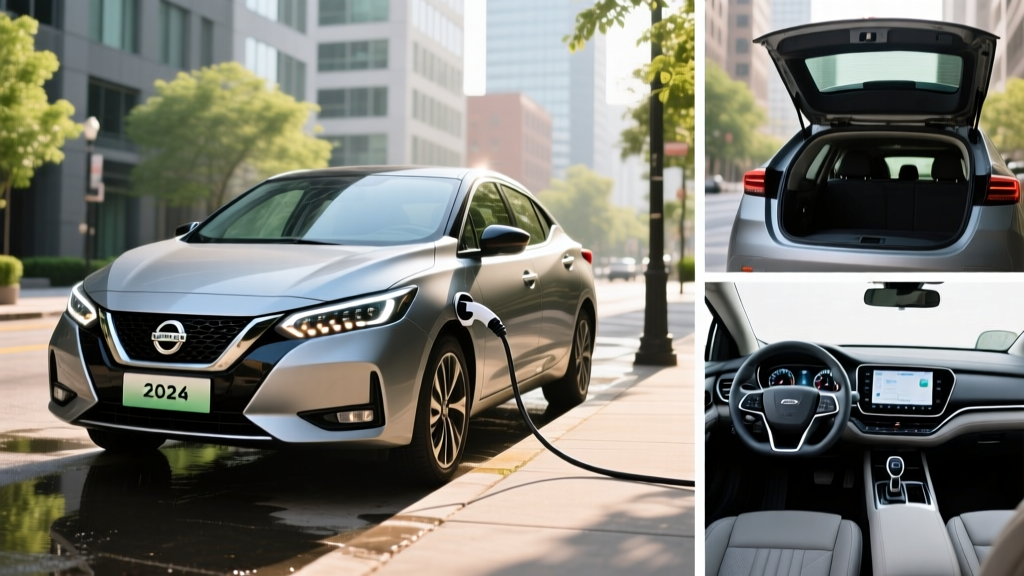
Looking at pictures of the Nissan Leaf, you see a conventional five-door hatchback that does not shout "electric vehicle." The V-motion grille, floating roof design, and boomerang-shaped LED headlights give it a modern but conservative appearance. Nissan refreshed the exterior for the 2025 model year with a slightly bolder front fascia and updated wheel designs, and those changes carry into 2026.
Inside, the cabin is functional if not luxurious. Key interior dimensions:
- Front legroom: 42.1 inches
- Rear legroom: 33.5 inches
- Cargo behind rear seats: 23.6 cu ft
- Cargo with rear seats folded: 38.5 cu ft
- Infotainment: 8-inch touchscreen (SV Plus), Apple CarPlay/Android Auto standard
- Driver assist: Nissan ProPILOT Assist (adaptive cruise + lane centering, SAE Level 2)
The ProPILOT Assist system is a competent Level 2 driver-assistance feature — meaning it handles steering and speed on highways but requires the driver to remain fully engaged. It is not autonomous driving. The system is smooth and predictable, though it lacks the lane-change capability of some competitors' systems.
One thing pictures of the Nissan Leaf cannot convey: the cabin materials are hard-plastic-heavy in the lower trims, and rear-seat space is tighter than in crossover competitors like the Hyundai Kona Electric or Chevrolet Equinox EV. The Leaf is a hatchback, and its footprint reflects that.
Pricing, Trims, and Federal Tax Credit Eligibility
| Trim | Base MSRP | Est. Federal Credit (§30D) | Effective Price (if eligible) |
|---|---|---|---|
| Leaf S (40 kWh) | $28,140 | Up to $3,750* | ~$24,390 |
| Leaf SV Plus (60 kWh) | $36,190 | Up to $3,750* | ~$32,440 |
*Federal tax credit amounts depend on battery component and critical mineral sourcing requirements under IRS §30D rules. The Leaf, assembled in Tennessee with Japanese-sourced battery cells, has historically qualified for a partial credit (typically $3,750 rather than the full $7,500) due to critical mineral sourcing requirements. Credit eligibility also depends on buyer income caps ($150,000 single / $300,000 joint AGI) and the vehicle's MSRP falling under the $55,000 cap for sedans/hatchbacks. Always consult a tax professional and verify current-year eligibility before purchase. The credit can now be transferred to the dealer as a point-of-sale discount under current rules.
At under $25,000 effective price for the S trim, the Leaf remains one of the cheapest new EVs in America. However, the partial credit and the CHAdeMO limitation reduce its value proposition compared to CCS/NACS-equipped competitors that qualify for the full $7,500.
How Does the Leaf Compare to Key Competitors?
The 2026 Leaf competes against a wave of newer, more capable EVs. Here is how it stacks up on the dimensions buyers care about most:
| Attribute | Nissan Leaf SV Plus | Hyundai Kona Electric | Chevrolet Equinox EV |
|---|---|---|---|
| EPA Range | 212 mi | 261 mi | 319 mi |
| Max DC Charge | 100 kW (CHAdeMO) | 100+ kW (CCS/NACS) | 150+ kW (CCS/NACS) |
| Base MSRP | $36,190 | ~$33,000 | ~$33,000 |
| Connector | CHAdeMO | NACS (2025+) | CCS/NACS adapter |
| Heat Pump | No | Yes | Yes |
The Leaf falls short on range, charging infrastructure compatibility, and cold-weather efficiency. Where it wins is simplicity, Nissan dealer network breadth, and the low entry price of the S trim. If you can charge at home and your commute is under 80 miles round-trip, the Leaf's limitations are manageable. For road trips or apartment dwellers reliant on public charging, the CHAdeMO connector is a genuine liability in 2026.
Battery Warranty and Long-Term Ownership
Nissan provides an 8-year/100,000-mile battery capacity warranty on the Leaf, covering the pack if it degrades below approximately 70% of original capacity (represented as 9 out of 12 bars on the dashboard capacity gauge). The powertrain warranty covers 5 years/60,000 miles.
Historically, Leaf battery degradation has been a concern, particularly with the earlier passively-cooled battery packs that suffered accelerated wear in hot climates. The current-generation Leaf uses an improved thermal management approach, though it still lacks active liquid cooling — another area where competitors have pulled ahead. Owners in Arizona or Texas should monitor their State of Health (SoH) bars closely during summer months.
Battery replacement, should it be needed out of warranty, typically ranges from $6,500 to $9,000 depending on pack size and labor. This is a cost worth factoring into long-term ownership calculations, particularly for buyers planning to keep the vehicle past the 100,000-mile mark.
Pros and Cons
Pros
- One of the lowest-priced new EVs in the US
- Comfortable ride and quiet cabin at city speeds
- Simple, intuitive controls and infotainment
- Strong Nissan dealer network for service
- Adequate cargo space for a hatchback (23.6 cu ft)
- ProPILOT Assist is a solid Level 2 system
Cons
- CHAdeMO connector limits public charging access
- No active liquid battery cooling
- No heat pump — poor cold-weather efficiency
- Range trails competitors significantly
- Only partial federal tax credit eligibility
- Rear seat is tight for adults on longer trips
Who Should Buy the 2026 Nissan Leaf?
Choose the Leaf if: You are a budget-conscious commuter with reliable home Level 2 charging, your daily driving stays under 80 miles, you live in a moderate climate, and you want the lowest possible entry price into new EV ownership.
Look elsewhere if: You take regular road trips, rely on public DC fast charging, live in extreme cold or heat, need rear-seat space for adults, or want a vehicle with maximum future-proofing (NACS/CCS connector, heat pump, active battery cooling).
The 2026 Nissan Leaf is a vehicle defined by its trade-offs. It offers remarkable affordability and simplicity but at the cost of charging compatibility, range, and thermal technology that competitors now include as standard. For the right buyer — a home-charging commuter on a budget — it remains a rational, practical choice. For everyone else, the EV market has moved on.
Frequently Asked Questions
What is the real-world range of the 2026 Nissan Leaf?
The Leaf SV Plus is EPA-rated at 212 miles, but real-world mixed driving yields roughly 180–195 miles in moderate weather. Highway driving at 70+ mph drops that to 160–175 miles. In winter, expect 120–140 miles on the highway. The base S trim (149 miles EPA) delivers roughly 110–130 miles in cold conditions.
How fast does the Nissan Leaf charge at home and on DC fast chargers?
On a Level 2 home charger (240V, 6.6 kW), the SV Plus gains about 25 miles of range per hour and fully charges in roughly 10 hours. On a DC fast charger, the SV Plus peaks at 100 kW (CHAdeMO) and reaches 10–80% in approximately 45 minutes. However, CHAdeMO stations are increasingly scarce compared to CCS and NACS networks.
How much does the 2026 Nissan Leaf cost after tax credits?
The Leaf S starts at $28,140 MSRP and may qualify for up to $3,750 in federal tax credits under IRS §30D, bringing the effective price to approximately $24,390 for eligible buyers. The SV Plus starts at $36,190, dropping to roughly $32,440 with the partial credit. Eligibility depends on buyer income, battery sourcing, and MSRP caps — verify with a tax professional.
Does the Nissan Leaf qualify for the full $7,500 federal EV tax credit?
No. Due to battery critical mineral sourcing requirements under current IRS §30D guidelines, the Leaf has historically qualified for $3,750 (half credit). Buyer income limits ($150K single / $300K joint) and the $55,000 MSRP cap for hatchbacks also apply. The credit can be applied as a point-of-sale reduction at participating dealers.
Is the Nissan Leaf worth buying over competitors in 2026?
It depends on your use case. If you prioritize the lowest purchase price and have home charging, the Leaf S at ~$24,390 after credits is hard to beat. But competitors like the Hyundai Kona Electric and Chevrolet Equinox EV offer more range, faster charging on modern connector networks (NACS/CCS), heat pumps for cold weather, and in some cases full $7,500 credit eligibility. For most buyers without strict budget constraints, those alternatives are the stronger long-term choice.
Why does the Nissan Leaf still use CHAdeMO instead of CCS or NACS?
Nissan was an early adopter of the CHAdeMO standard (developed jointly with Japanese automakers) for the Leaf's 2011 debut. Retooling the platform for a different connector would require significant engineering investment in a vehicle that is expected to be redesigned or replaced in the coming years. This legacy decision means 2026 Leaf owners face a shrinking public charging ecosystem.