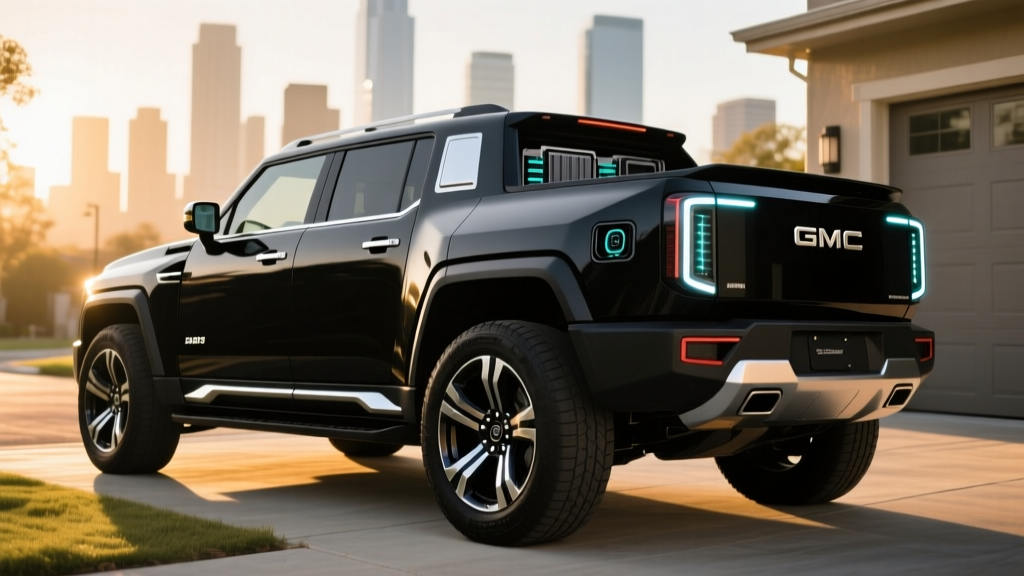
The GMC Hummer EV is one of the most polarizing electric vehicles on the road: a 9,000-pound, 1,000-horsepower supertruck that can crab-walk diagonally and hit 60 mph in roughly 3 seconds. But behind the spectacle lies a serious ownership question. With MSRPs stretching past $100,000 on Edition 1 and 3X trims, many buyers are turning to leasing as a way to access the Hummer EV without absorbing the full depreciation hit. If you're researching a GMC Hummer EV lease, this guide breaks down exactly what it costs to own one over five years — including federal tax credits, fuel savings, insurance premiums, and the resale-value realities that make leasing particularly attractive for this specific truck.
2026 GMC Hummer EV: The Specs That Matter for Your Wallet
Before calculating ownership costs, you need the hardware baseline. The 2026 GMC Hummer EV Pickup (3X trim) carries a massive 246 kWh Ultium battery pack (NMC chemistry) — the largest in any production passenger vehicle. Here's the spec sheet that drives every cost calculation downstream:
| Spec | Value |
|---|---|
| EPA Range | 329 miles (real-world highway: ~270–290 mi; cold weather: ~230–250 mi) |
| Battery Capacity | 246 kWh usable (NMC lithium-ion, Ultium platform) |
| Peak DC Fast Charge | 350 kW (10–80% in ~35 min; tapers significantly above 80%) |
| Level 2 AC Charge Rate | 11.5 kW (~27 mi/hr added) |
| Horsepower | 830 hp (3-motor e4WD) |
| 0–60 mph | ~3.0 seconds (Watts to Freedom mode) |
| EPA Efficiency | 47 MPGe combined (~71 kWh/100 mi) |
| Starting MSRP (2X) | ~$99,995 |
| Starting MSRP (3X) | ~$119,995 |
| Battery/Powertrain Warranty | 8 years / 100,000 miles |
The Case for Leasing the Hummer EV: Depreciation Is the Elephant
Leasing a Hummer EV isn't just about lower monthly payments — it's a strategic hedge against EV depreciation uncertainty. Here's why leasing makes outsized sense for this particular truck:
EV depreciation remains steeper than gas trucks. Industry data from sources like iSeeCars and Kelley Blue Book show that full-size electric pickups have depreciated 30–45% over three years, compared to 20–30% for comparable gas trucks like the Ford F-150 or Ram 1500. The Hummer EV's six-figure MSRP amplifies this: a 40% drop on $120,000 means losing $48,000 in value over three years. When you lease, that depreciation risk sits with GM Financial, not you.
The $7,500 tax credit works differently in a lease. Under IRS §30D rules, the federal EV tax credit is technically available only to the purchaser. However, in a lease arrangement, the leasing company (the legal owner) may receive the credit and may pass savings on through a reduced capitalized cost — effectively lowering your monthly payment. This is known as the "lease loophole," and while it's not guaranteed, many manufacturers have structured lease deals to capture this benefit. Critically, the point-of-sale transfer option (which lets buyers apply the credit as an immediate down-payment reduction) applies only to purchases, not leases. Confirm with your GMC dealer whether the $7,500 is factored into the lease cap cost before signing.
Technology moves fast. Solid-state batteries, faster-charging architectures, and next-gen ADAS are all on near-term horizons. A 36-month lease lets you upgrade without the friction of selling a depreciated six-figure EV.
Do You Qualify for the Federal §30D EV Tax Credit?
If you're purchasing (not leasing) the Hummer EV, the IRS §30D clean vehicle credit offers up to $7,500 — but eligibility is far from automatic. The Hummer EV's price alone puts it in a complicated position. Here's the full checklist:
- MSRP Cap: Trucks, SUVs, and vans must have an MSRP at or below $80,000. The Hummer EV 2X starts at ~$99,995 and the 3X at ~$119,995 — both exceed the cap, meaning the Hummer EV Pickup does not qualify for §30D when purchased new.
- Buyer Income Limits: Modified adjusted gross income (MAGI) must not exceed $300,000 (joint filers), $225,000 (head of household), or $150,000 (individual).
- Battery Sourcing: At least 60% of critical minerals and 60% of battery components must be sourced from the U.S. or free-trade-agreement partners (for the full $7,500; $3,750 if only one threshold is met).
- Final Assembly: Vehicle must undergo final assembly in North America (the Hummer EV is built at Factory ZERO in Detroit — this requirement is met).
- Point-of-Sale Transfer: Eligible buyers can transfer the credit to the dealer at purchase for an immediate price reduction — but only if all above criteria are satisfied.
The bottom line: The GMC Hummer EV Pickup fails the MSRP cap test. At nearly $100K and above, it is not eligible for the §30D federal purchase credit. This is a critical factor that makes leasing potentially more attractive — because in a lease, the MSRP cap does not apply to the lessee in the same way, and the leasing entity may still benefit from commercial clean vehicle credits under §45W. Always consult a tax professional and verify current-year rules at IRS.gov, as incentive structures evolve.
5-Year Total Cost of Ownership: Hummer EV vs. Gas Supertruck
To understand what a Hummer EV lease or purchase truly costs, we need to model five years of ownership — roughly 75,000 miles. Below is a side-by-side comparison against a gas-powered rival: the 2026 Ram 1500 TRX (702 hp supercharged V8, ~$95K MSRP, 10 MPG combined).
| Cost Category | GMC Hummer EV 3X | Gas Supertruck (Ram TRX equivalent) |
|---|---|---|
| Purchase/Lease (5-yr net) | $52,000 (lease payments, est. $850/mo × 36 mo + $21K residual buyout option or walk-away) | $58,000 (loan payments + interest on ~$95K) |
| Fuel / Electricity | $7,350 (home charging at $0.14/kWh, ~53,000 kWh total) | $26,250 (10 MPG, $3.50/gal, 7,500 gallons) |
| Insurance (5 years) | $18,000 (~$3,600/yr avg) | $13,500 (~$2,700/yr avg) |
| Maintenance | $2,500 (tire rotations, cabin air filter, wiper fluid, brake inspection) | $7,500 (oil changes, transmission fluid, spark plugs, belt service, brake pads) |
| Depreciation (if purchased) | ~$48,000 (40% over 3 yrs on $120K) | ~$28,500 (30% over 3 yrs on $95K) |
| Estimated 5-Year Total (lease scenario) | ~$79,850 | ~$105,250 |
Charging Cost vs. Gas: The $/Mile Reality
The Hummer EV's 71 kWh/100 mi efficiency sounds punishing — and it is, by EV standards. But compared to a gas truck getting 10 MPG, the math still favors electrons:
| Scenario | Hummer EV | Gas Truck (10 MPG) |
|---|---|---|
| Home charging (Level 2, $0.14/kWh) | $0.099/mile | — |
| Public DC fast charging ($0.40/kWh avg) | $0.284/mile | — |
| Gasoline ($3.50/gallon) | — | $0.350/mile |
| Annual cost (15,000 mi, 80% home / 20% DCFC) | $2,058 | $5,250 |
At 80% home charging and 20% public fast charging (a realistic split for a truck owner taking road trips), the Hummer EV costs roughly $0.14/mile blended for energy. The gas truck costs $0.35/mile. Over 15,000 annual miles, that's a $3,192/year fuel savings — or $15,960 over five years.
The caveat: if you cannot charge at home and rely entirely on public DC fast chargers at $0.40/kWh or more, the Hummer EV's energy cost jumps to $0.28/mile — still cheaper than gas, but the savings shrink dramatically. Home Level 2 charging is essential to capturing the EV cost advantage with a battery this large.
Maintenance Savings: Fewer Parts, But Watch the Tires
Electric vehicles eliminate oil changes, transmission fluid service, spark plug replacements, timing belt inspections, and exhaust system maintenance. The Hummer EV's regenerative braking also dramatically reduces brake pad wear — many EV owners report original brake pads lasting 100,000+ miles.
| Service | Hummer EV | Gas Truck |
|---|---|---|
| Oil changes (~$80 each, every 7,500 mi) | $0 | $800 |
| Transmission fluid service | $0 | $300 |
| Spark plugs / ignition service | $0 | $400 |
| Brake pad replacement | $0 (regen braking preserves pads) | $600–$1,000 |
| Tire replacement (heavy EV eats tires faster) | $2,400 (2 sets of 35" all-terrains) | $1,600 (1.5 sets) |
| Cabin air filter, wipers, fluid | $400 | $400 |
| Coolant / misc. service | $200 | $500 |
| Total Maintenance | ~$3,000 | ~$4,000–$4,500 |
The Hummer EV's 9,000-pound curb weight and instant 830 hp torque are brutal on tires. Budget for tire replacement every 25,000–35,000 miles — roughly twice the frequency of a lighter vehicle. At $300+ per tire for the 35-inch Goodyear Wrangler Territory MTs, that's a meaningful recurring cost that partially offsets other maintenance savings.
Insurance: The Line Item That Bites Back
EV insurance premiums are typically 15–30% higher than equivalent gas vehicles, and the Hummer EV sits at the extreme end. Based on 2026 rate surveys, expect annual premiums of $3,200–$4,200 depending on your state, driving record, and coverage level — compared to $2,400–$3,000 for a gas supertruck.
Why the premium?
- Repair costs: EV battery packs are expensive to replace after collision damage. The Hummer EV's 246 kWh Ultium pack could cost $30,000–$40,000+ to replace, and insurers price this risk into premiums.
- Specialized labor: High-voltage system repairs require certified EV technicians, which are still scarce in many regions.
- Vehicle weight: At 9,000+ pounds, the Hummer EV causes more damage to other vehicles in multi-vehicle collisions, raising liability exposure.
- Performance: 830 hp and a 3-second 0–60 time classify this as a high-performance vehicle regardless of powertrain.
Shop quotes from EV-friendly insurers (Progressive, State Farm, and GEICO all have growing EV underwriting data) before committing. Some insurers offer discounts for ADAS-equipped vehicles — the Hummer EV includes GM's Super Cruise (a Level 2 hands-free system on compatible highways), which may qualify you for a 5–10% discount with select carriers.
State, Local, and Utility Incentives: Stack What You Can
While the Hummer EV misses the federal §30D credit due to its MSRP, you may still qualify for regional incentives that meaningfully reduce ownership cost:
- California (CVRP): Up to $2,000 rebate for qualifying EVs — but income caps and MSRP limits may apply. Check energy.ca.gov for current eligibility.
- Colorado: State EV tax credit up to $5,000 for vehicles under certain price thresholds — the Hummer EV likely exceeds these. Verify at colorado.gov.
- Utility rebates: Many utilities (PG&E, ConEdison, Xcel Energy, Austin Energy) offer $500–$1,500 rebates for home Level 2 charger installation, plus time-of-use rates that slash charging costs to $0.06–$0.08/kWh overnight.
- HOV lane access: States like California, Colorado, and Virginia offer single-occupant HOV lane access for EVs — a non-monetary but high-value perk for commuters.
Incentive amounts, eligibility, and availability vary by jurisdiction and change frequently. Always confirm with your state energy office, utility provider, and a tax professional before relying on specific incentive amounts.
Depreciation and Resale: Why Leasing Shines Here
The Hummer EV's depreciation trajectory is the strongest argument for leasing. Based on 2024–2025 used EV market data, high-priced electric trucks have seen steep value drops:
- Year 1: 15–20% depreciation (typical for new vehicles, EV or gas)
- Year 2: Cumulative 25–35% depreciation
- Year 3: Cumulative 35–45% depreciation for EVs in the $100K+ segment
On a $120,000 Hummer EV 3X, a 40% three-year depreciation means a residual value of roughly $72,000 — a $48,000 loss. Compare that to a gas Ram TRX at $95,000 with ~30% depreciation over the same period (~$28,500 loss). The EV loses nearly $20,000 more in absolute dollars.
In a lease, the leasing company absorbs this risk. Your lease payment already prices in the expected depreciation (the difference between the negotiated cap cost and the residual value). If the used EV market softens further, you simply return the truck at lease-end and walk away. If it strengthens, you can exercise the purchase option at the (now favorable) residual price.
FAQ: GMC Hummer EV Lease and Ownership Questions
What's a typical monthly lease payment for the 2026 GMC Hummer EV?
Based on current market listings and GM Financial structures, expect lease payments of $800–$1,200/month for a 36-month term with 10,000 miles/year, depending on trim (2X vs. 3X), negotiated cap cost, money factor, and whether the dealer applies any lease cash or credit pass-through. A $10,000–$15,000 due-at-signing amount is typical.
Can I get the $7,500 federal tax credit on a Hummer EV lease?
Not directly. The §30D credit applies to purchasers, and the Hummer EV exceeds the $80,000 MSRP cap regardless. However, in a lease, the leasing company may qualify for the commercial clean vehicle credit (§45W) and pass savings through a reduced cap cost. Ask your dealer explicitly how the credit is handled in the lease structure.
How much does it cost to charge a Hummer EV at home?
With a 246 kWh battery and a national average electricity rate of $0.14/kWh, a full 0–100% charge costs roughly $34.44 at home. Most owners charge from 20–80% daily, costing about $20.66 per session. Annual home charging cost for 15,000 miles is approximately $1,470.
Does the Hummer EV qualify for any tax credits at all?
The Hummer EV Pickup does not qualify for the §30D new clean vehicle credit due to its MSRP exceeding $80,000. The Hummer EV SUV variant also exceeds the cap. However, commercial buyers may access §45W credits, and some state/utility incentives may still apply. Consult a tax professional for your specific situation.
Is the Hummer EV reliable enough for daily driving?
The Hummer EV's Ultium platform is proven across multiple GM vehicles, and the 8-year/100,000-mile battery warranty provides long-term coverage. However, the truck's sheer size (226 inches long, 96 inches wide with mirrors) makes it impractical for tight urban parking, older garages, and narrow driveways. Daily usability depends heavily on your environment.
How does the Hummer EV handle cold weather range?
Expect 25–30% range loss in sustained sub-freezing temperatures, dropping the effective range from 329 miles (EPA) to roughly 230–250 miles. The Hummer EV's massive battery means absolute range remains substantial even with losses, but efficiency drops to ~90+ kWh/100 mi in cold conditions. Always precondition the battery while plugged in before driving or fast charging in cold weather.
Should I buy or lease the Hummer EV?
Leasing is the financially safer play for most buyers: it eliminates depreciation risk, may capture some tax-credit pass-through, and lets you exit after 36 months. Buying makes sense only if you plan to keep the truck 7+ years, can absorb the depreciation, have confirmed access to home charging, and value ownership equity over flexibility. Given the MSRP-cap exclusion from §30D, leasing's relative advantage is even stronger for the Hummer EV than for cheaper EVs.