Quick Verdict: The Nissan Leaf's Longevity Story in 2026
The Nissan Leaf holds a unique place in EV history. As one of the first mass-market battery-electric vehicles, it has accumulated more real-world mileage data than almost any other EV on the road. That data tells a clear story about Nissan Leaf life expectancy: with proper care, the Leaf's battery pack typically retains 70–85% of its original capacity after 100,000 miles, translating to a usable vehicle lifespan of 150,000 to 200,000 miles before battery replacement economics become a serious consideration.
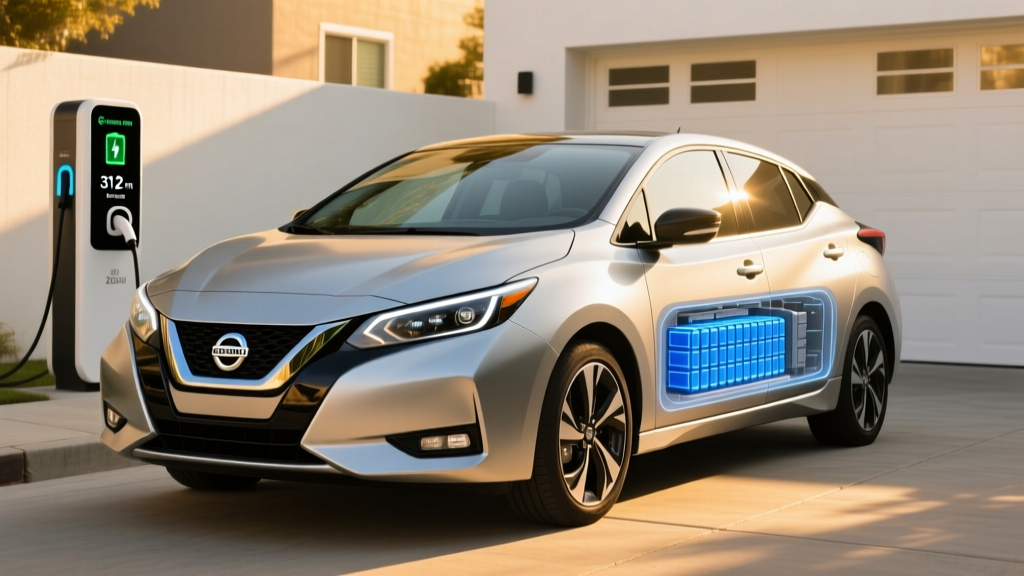
For 2025–2026 model years, Nissan continues to offer the Leaf in two battery configurations: the standard 40 kWh pack (Leaf S) and the larger 60 kWh pack (Leaf SV Plus). Both use passive air cooling rather than liquid thermal management — a design choice that directly impacts long-term battery health, particularly in hot climates. Understanding this is essential before you buy.
| Spec | Leaf S (40 kWh) | Leaf SV Plus (60 kWh) |
|---|---|---|
| EPA Range | 149 miles | 212 miles |
| Battery Capacity | 40 kWh usable | 60 kWh usable |
| Battery Chemistry | NMC (Lithium-ion) | NMC (Lithium-ion) |
| Thermal Management | Passive air cooling | Passive air cooling |
| Motor Output | 147 hp / 236 lb-ft | 214 hp / 250 lb-ft |
| 0–60 mph | ~7.9 sec | ~6.5 sec |
| Drivetrain | FWD | FWD |
| Max DC Fast Charge | 50 kW (CHAdeMO) | 100 kW (CHAdeMO) |
| Level 2 Charge Rate | 6.6 kW | 6.6 kW |
| EPA Efficiency | 111 MPGe (30 kWh/100mi) | 109 MPGe (31 kWh/100mi) |
| Cargo Volume | 23.6 cu ft (rear seats up) | 23.6 cu ft (rear seats up) |
| Base MSRP (2025) | ~$28,140 | ~$36,190 |
Real-World Range: What the EPA Sticker Doesn't Tell You
EPA Estimate: 149 mi (40 kWh) / 212 mi (60 kWh)
Real-World Expectation: 120–140 mi highway (40 kWh) / 175–195 mi highway (60 kWh). In freezing temperatures (below 32°F), expect a 25–35% reduction, dropping the 60 kWh model to roughly 140–160 miles.
The Leaf's range figures are honest for mixed city driving in moderate temperatures. City efficiency benefits heavily from regenerative braking — the Leaf's e-Pedal system allows near one-pedal driving and recaptures energy that would otherwise be lost. On the highway at 70–75 mph, aerodynamic drag and the lack of a heat pump (the Leaf uses resistive cabin heating) reduce range noticeably.
Cold weather is the Leaf's Achilles heel. Without a heat pump, cabin heating draws directly from the traction battery at rates of 3–5 kW, which can consume 15–25% of your battery on a 30-minute winter commute. According to fueleconomy.gov, the 60 kWh Leaf achieves 109 MPGe combined, but real-world winter MPGe can dip into the low 80s.
Battery Degradation and Nissan Leaf Life Expectancy
This is the question that defines the Leaf ownership experience. The Leaf's passively cooled battery pack is the most debated aspect of its engineering. Here's what long-term data reveals:
Degradation by Mileage (Typical Observed Ranges)
- 50,000 miles: 90–95% State of Health (SoH) — minimal noticeable loss
- 100,000 miles: 75–88% SoH — range reduction becomes measurable (10–25 mi loss on 60 kWh)
- 150,000 miles: 65–80% SoH — noticeable range drop; some owners consider replacement
- 200,000+ miles: Below 65% SoH is common; battery replacement or retirement likely
These figures vary dramatically based on climate. Leaf owners in Phoenix or Las Vegas consistently report faster degradation than those in Portland or Minneapolis. Sustained battery temperatures above 95°F accelerate lithium-ion cell wear. Frequent DC fast charging — especially to 100% SoC — also compounds heat stress. The CHAdeMO connector's 50–100 kW charge rates generate significant thermal load in a pack with no active cooling.
Nissan's Battery Warranty
Nissan covers the Leaf battery with an 8-year/100,000-mile warranty against capacity loss below 9 bars out of 12 on the battery health gauge (roughly 70% capacity retention). This is competitive with industry standards but worth noting: the threshold is relatively generous at 70%, meaning you could lose 30% of your range and still fall within warranty parameters. For reference, most competitors guarantee 70% retention as well, though some (like Hyundai) warrant to the same threshold over 10 years.
Battery Replacement Cost
If your Leaf's battery degrades beyond useful capacity outside of warranty, expect a replacement to cost between $6,500 and $9,000 for the 40 kWh pack and $8,500 to $12,000 for the 60 kWh pack (parts and labor). Some third-party shops offer refurbished packs at lower prices. This cost is a critical factor in the Leaf's total life expectancy economics — it often exceeds the vehicle's resale value at 150,000+ miles.
Charging Speed and Connector Reality
| Charging Level | Power / Connector | Speed (Miles of Range/Hour) | Notes |
|---|---|---|---|
| Level 1 (120V) | 1.4 kW / J1772 | ~4–5 mi/hr | Overnight adds ~40–50 mi |
| Level 2 (240V) | 6.6 kW / J1772 | ~22–25 mi/hr | Full charge in 7–11 hours |
| DC Fast (40 kWh) | 50 kW / CHAdeMO | ~100 mi in 40 min (10–80%) | Peak rate not sustained |
| DC Fast (60 kWh) | 100 kW / CHAdeMO | ~140 mi in 45 min (10–80%) | Tapers significantly above 80% |
The Leaf's use of the CHAdeMO DC fast-charging standard is increasingly a liability. The North American market has consolidated around NACS (Tesla's connector, now adopted by Ford, GM, Hyundai, and others) and CCS1. CHAdeMO stations are becoming rarer — Electrify America has largely phased them out of new installations, and most new public charging networks prioritize NACS and CCS.
For home charging, the 6.6 kW onboard charger is adequate. A full Level 2 charge from empty takes roughly 7 hours (40 kWh) or 11 hours (60 kWh). If you install a 32-amp or 40-amp Level 2 home charger (which delivers the full 6.6 kW the Leaf can accept), you'll wake up to a full battery every morning — the ideal ownership pattern that minimizes DC fast-charging heat stress and maximizes battery life.
Critical charging insight: The Leaf's lack of active battery cooling means consecutive DC fast charges in warm weather will trigger "rapidgate" — Nissan's thermal protection that severely throttles charge speed to prevent cell damage. On a road trip with multiple fast-charge stops, your second and third stops may take 50–80% longer than the first.
Performance, Interior, and Technology
The Leaf SV Plus's 214 hp and 250 lb-ft of torque deliver respectable acceleration — 0–60 mph in roughly 6.5 seconds. The standard 147 hp Leaf S is more sedate at 7.9 seconds. Both are front-wheel drive with a single-speed reduction gear. The instant torque delivery makes the Leaf feel quicker in city driving than its numbers suggest, though highway passing power in the base model is modest.
Interior Space
- Front legroom: 42.1 inches
- Rear legroom: 33.5 inches (tight for tall adults on long trips)
- Cargo (seats up): 23.6 cu ft
- Cargo (seats folded): 38.5 cu ft
- No frunk: The Leaf has no front trunk; charging hardware occupies that space
Technology and Driver Assists
The 2025–2026 Leaf comes equipped with an 8-inch touchscreen, Apple CarPlay, Android Auto, and Nissan's ProPILOT Assist — a Level 2 driver-assistance system combining adaptive cruise control with lane-centering. ProPILOT is competent for highway commuting but requires hands-on-wheel supervision at all times. It is not a self-driving system.
Nissan Safety Shield 360 is standard across trims and includes automatic emergency braking, blind-spot warning, rear cross-traffic alert, lane departure warning, and rear automatic braking. These features are well-calibrated and not overly intrusive.
Notable drawback: The Leaf still uses a foot-operated parking brake in some trims and lacks the more modern electronic parking brake found in competitors. The infotainment system is functional but dated compared to the 12–15 inch screens in the Hyundai Ioniq 5 or Tesla Model 3.
Pricing, Tax Credits, and Ownership Economics
| Trim | Base MSRP | Federal Credit Potential | Effective Price |
|---|---|---|---|
| Leaf S (40 kWh) | ~$28,140 | Up to $3,750* | ~$24,390 |
| Leaf SV Plus (60 kWh) | ~$36,190 | Up to $3,750* | ~$32,440 |
*Federal §30D credit amount depends on battery component and critical mineral sourcing requirements. The Leaf's Japan-assembled battery has historically qualified for a partial credit ($3,750), not the full $7,500. Income caps apply: $150K single / $300K joint filers. MSRP must be under $55,000 (cars). Verify current eligibility at irs.gov. Point-of-sale transfer available at participating dealers.
The Leaf's pricing positions it as one of the most affordable new EVs available. However, the partial tax credit is a meaningful disadvantage compared to competitors like the Chevrolet Equinox EV or Hyundai Kona Electric, which may qualify for larger credits depending on current sourcing rules.
5-Year Ownership Cost Considerations
- Charging cost: At $0.13/kWh national average, the 60 kWh Leaf costs roughly $0.04/mile to fuel — about 60–70% less than a comparable gas car at $3.50/gallon
- Maintenance: Minimal — no oil changes, brake pads last 80,000+ miles with regen, cabin air filter every 15,000 miles
- Insurance: Typically 10–15% higher than equivalent gas compacts
- Depreciation: The Leaf depreciates faster than Tesla or Hyundai EVs, partly due to CHAdeMO obsolescence concerns and air-cooled battery perception
Who Should Buy the Nissan Leaf — and Who Shouldn't
Pros
- Low entry price — one of the cheapest new EVs in the US
- Proven reliability with 13+ years of real-world data
- Comfortable ride quality and quiet cabin at city speeds
- Strong regenerative braking (e-Pedal) for city commuting
- Low running costs with home charging
- Comprehensive standard safety features (Safety Shield 360)
Cons
- CHAdeMO connector — shrinking public charging access
- Passive air cooling — faster degradation in hot climates, rapidgate on road trips
- No heat pump — significant winter range loss
- Modest DC fast-charge speeds (50–100 kW peak)
- Tight rear legroom (33.5 in) for a compact hatchback
- Dated infotainment and interior materials vs. newer competitors
The Leaf is ideal for: Budget-conscious commuters who can charge at home, live in temperate climates, and drive fewer than 80 miles round-trip daily. If your routine is home → work → home with Level 2 charging overnight, the Leaf's limitations rarely surface. It's a strong second car or apartment-friendly EV if you have reliable charging access.
The Leaf is not ideal for: Frequent road-trippers (CHAdeMO scarcity and slow charging make long trips frustrating), hot-climate residents (Arizona, Texas, Florida — accelerated battery degradation is well-documented), or families needing rear-seat space for teenagers and car seats simultaneously.
How the Leaf Compares to Key Competitors
| Attribute | Nissan Leaf SV Plus | Hyundai Kona Electric | Chevrolet Equinox EV |
|---|---|---|---|
| EPA Range | 212 mi | 261 mi | 319 mi (3RS) |
| Battery | 60 kWh, NMC, air-cooled | 64.8 kWh, NMC, liquid-cooled | 85 kWh, NMC, liquid-cooled |
| DC Fast Charge | 100 kW (CHAdeMO) | 100+ kW (CCS/NACS) | 150+ kW (NACS) |
| Thermal Mgmt | Passive air | Liquid active | Liquid active |
| Heat Pump | No | Yes (standard) | Yes (standard) |
| Base MSRP | ~$36,190 | ~$32,975 | ~$33,600 |
| Tax Credit | Up to $3,750 | Up to $7,500* | Up to $7,500* |
*Credit amounts subject to IRS §30D sourcing and income requirements. Verify at irs.gov.
The competitive picture is challenging for the Leaf. The Kona Electric offers more range, liquid-cooled battery longevity, a heat pump, CCS/NACS charging access, and a potentially larger tax credit — often at a lower MSRP. The Equinox EV provides 300+ miles of range and full NACS compatibility. The Leaf's primary remaining advantage is nameplate familiarity and occasional dealer discounting that can push transaction prices below $30,000.
Frequently Asked Questions
How many miles can a Nissan Leaf last before the battery needs replacement?
Most Leaf owners report the battery remains functional (above 65% capacity) to 150,000–200,000 miles. Climate is the biggest variable: hot-state Leafs degrade faster. At 200,000 miles, expect roughly 60–75% of original range, which may still be adequate for short commutes but limits highway usability.
Does the Nissan Leaf qualify for the $7,500 federal EV tax credit?
As of current IRS §30D rules, the Leaf typically qualifies for a partial credit of up to $3,750, not the full $7,500. This is because its battery components and critical minerals do not fully meet the domestic sourcing thresholds. Buyer income caps ($150K single / $300K joint) and the $55,000 MSRP cap for cars also apply. Always verify at irs.gov before purchasing, as sourcing rules update periodically.
Is the CHAdeMO connector a dealbreaker in 2026?
It depends on your charging habits. If you charge at home 90%+ of the time, CHAdeMO's declining public availability matters less. But for road trips or apartment dwellers relying on public DC fast charging, CHAdeMO is a serious limitation. New public stations overwhelmingly deploy NACS and CCS; CHAdeMO stalls are not being replaced when they fail.
Should I buy a used Nissan Leaf?
A used Leaf can be an exceptional value — often $8,000–$15,000 for a 2018–2022 model with 40–60 kWh battery. The critical step is checking the battery health gauge on the dashboard (look for 11 or 12 bars out of 12). A Leaf with 12 bars and 40,000 miles is a strong buy. Avoid Leafs from Arizona/Nevada with low bar counts. Used Leafs under $25,000 may also qualify for the used EV tax credit (up to $4,000 or 30% of sale price) under §25E.
What can I do to maximize my Leaf's battery life?
Five practices make a measurable difference: (1) Charge to 80% for daily use, reserving 100% for trips. (2) Avoid DC fast charging when possible — use Level 2 at home. (3) Park in shade or a garage in hot weather. (4) Precondition the cabin while plugged in to reduce battery draw. (5) Avoid letting the battery sit at very low (<10%) or very high (100%) SoC for extended periods.