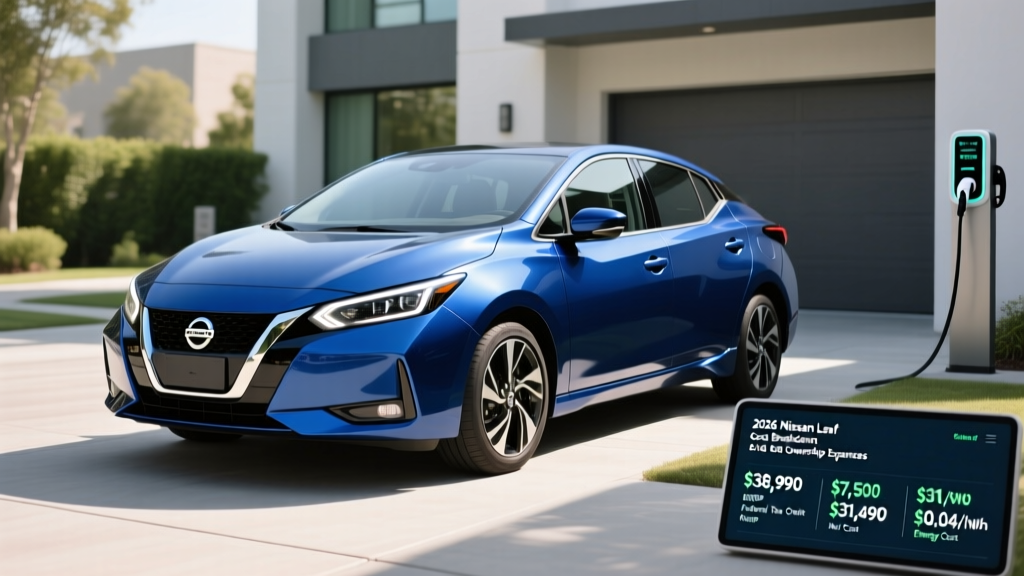
The Nissan Leaf remains one of the most affordable new electric vehicles on the U.S. market, but understanding the true Nissan Leaf cost requires looking past the sticker price. Between federal tax credit eligibility, home charging setup, insurance premiums, and the realities of its CHAdeMO charging connector, the Leaf's financial picture is more nuanced than its budget-friendly MSRP suggests. This profile breaks down every number you need before signing a purchase agreement.
2026 Nissan Leaf Pricing by Trim
Nissan continues the Leaf in two trims for the 2026 model year, maintaining the same dual-battery strategy that has defined the model since its 2018 refresh. The entry-level S trim targets urban commuters, while the SV Plus delivers the range most buyers actually want.
| Trim | Battery | EPA Range | MSRP | Est. Federal Credit | Effective Price* |
|---|---|---|---|---|---|
| S | 40 kWh (NMC) | 149 mi | $28,140 | Up to $3,750 | ~$24,390 |
| SV Plus | 60 kWh (NMC) | 212 mi | $36,140 | Up to $3,750 | ~$32,390 |
*Effective price assumes full credit eligibility via point-of-sale transfer under IRS §30D. Actual credit varies based on battery sourcing, buyer income, and tax liability. Destination charges (~$1,095) not included.
One critical detail buyers often miss: the Leaf's battery cells are manufactured in Smyrna, Tennessee, but the critical-mineral and battery-component sourcing requirements under the Inflation Reduction Act have reduced the Leaf's maximum federal credit from the full $7,500 to approximately $3,750 in recent determinations. This reflects the partial battery-component and critical-mineral compliance. Always verify current eligibility on the IRS clean vehicle credits page before purchase, as sourcing rules tighten annually.
Federal Tax Credit Eligibility: What You Actually Qualify For
IRS §30D Requirements for the 2026 Nissan Leaf
- MSRP cap: $55,000 for sedans/hatchbacks — Leaf qualifies (max MSRP ~$37,235 with destination)
- Buyer income cap: AGI must not exceed $150,000 (single), $225,000 (head of household), or $300,000 (joint)
- Battery sourcing: Critical minerals and component thresholds increase yearly; Leaf currently qualifies for partial credit (~$3,750)
- Point-of-sale transfer: You can transfer the credit to the dealer at purchase, reducing your out-of-pocket cost immediately — no need to wait for tax filing
- Final assembly: Must be in North America — Leaf is assembled in Smyrna, TN ✓
The point-of-sale transfer option, available since 2024, is a genuine advantage for Leaf buyers. If you qualify for the $3,750 credit, the dealer applies it as a down-payment reduction at signing. You do not need to wait until April to realize the savings. However, if your federal tax liability is lower than the credit amount, the point-of-sale transfer still works — the IRS does not claw it back from the buyer, though the dealer assumes that risk.
Real-World Range: Beyond the EPA Sticker
2026 Nissan Leaf Range Reality Check
Leaf S (40 kWh): EPA 149 miles — Expect 120–135 miles highway at 70 mph; 100–115 miles in freezing temperatures with cabin heat.
Leaf SV Plus (60 kWh): EPA 212 miles — Expect 175–195 miles highway at 70 mph; 145–165 miles in sub-30°F conditions.
The Leaf SV Plus's 212-mile EPA rating is adequate for most commutes and errands but falls short of the 250–300+ mile range now common among competitors like the Hyundai Kona Electric (261 mi) and Chevrolet Equinox EV (315 mi). The Leaf's lack of active battery thermal management — it relies on passive air cooling — means range suffers more noticeably in extreme heat and cold compared to liquid-cooled rivals.
In sustained 90°F+ summer driving, expect 5–10% range loss as the battery management system limits power output to protect cell health. In winter, the resistive cabin heater (no heat pump is offered) draws heavily from the traction battery, compounding the chemistry's natural cold-weather capacity reduction. For a 40-mile round-trip commute with errands, the SV Plus handles this comfortably year-round. For 100+ mile one-way trips, you'll need to plan charging stops carefully.
Charging Speed: The Leaf's Biggest Compromise
| Charging Level | Power / Rate | Time (10–80% or Full) | Connector |
|---|---|---|---|
| Level 1 (120V household) | ~1.4 kW | ~40 hrs (full, 60 kWh) | J1772 |
| Level 2 (240V home/public) | 6.6 kW onboard charger | ~9.5 hrs (full, 60 kWh); ~25 mi/hr | J1772 |
| DC Fast Charge (S trim) | 50 kW peak (CHAdeMO) | ~40 min (10–80%) | CHAdeMO |
| DC Fast Charge (SV Plus) | 100 kW peak (CHAdeMO) | ~30 min (10–80%) | CHAdeMO |
Charging is where the Leaf's cost advantage gets complicated. The SV Plus peaks at 100 kW on DC fast charging — acceptable but far behind the 150–250+ kW rates of modern competitors. More critically, the Leaf uses the CHAdeMO connector, which has been effectively abandoned by the broader U.S. charging industry in favor of CCS1 and Tesla's NACS. Electrify America, EVgo, and most newer networks have minimal or no CHAdeMO stalls. Tesla Superchargers require a third-party adapter (availability and reliability remain inconsistent).
This means Leaf owners are largely restricted to older CHAdeMO-equipped stations, which are increasingly sparse. For home-only charging (Level 2 at 6.6 kW), this is irrelevant — you wake up with a full battery every morning. But for road trips or apartment dwellers without home charging, the CHAdeMO limitation is a genuine daily friction point that no amount of savings fully offsets.
The 6.6 kW onboard Level 2 charger is also below the 11.5 kW standard in many competitors. A full charge from empty on Level 2 takes roughly 9.5 hours for the 60 kWh pack — fine for overnight charging, but slower than rivals that can replenish in 5–7 hours on the same 48-amp home circuit.
Performance, Efficiency, and Drivetrain
| Spec | S (40 kWh) | SV Plus (60 kWh) |
|---|---|---|
| Horsepower | 147 hp | 214 hp |
| Torque | 236 lb-ft | 250 lb-ft |
| 0–60 mph | ~7.9 sec | ~6.5 sec |
| Drivetrain | FWD (single motor) | FWD (single motor) |
| MPGe (combined) | 111 MPGe | 104 MPGe |
| kWh/100 mi | 30 kWh | 32 kWh |
| Top Speed | ~90 mph (governed) | ~98 mph (governed) |
The SV Plus's 214 hp and 6.5-second 0–60 time make it genuinely quick off the line — torque is instant, and the Leaf pulls confidently through 50 mph before the single-speed reduction gearing runs out of steam. The S trim's 147 hp is adequate for city driving but feels strained during highway merges at full load.
Efficiency is a Leaf strong suit. At 111 MPGe combined (S trim), it converts electricity to miles with minimal waste. The EPA's fueleconomy.gov data confirms the Leaf among the most efficient EVs per kWh consumed. For owners paying $0.14/kWh at home, that translates to roughly $0.042 per mile — compared to $0.12–$0.16/mile for a 30-MPG gas car at $3.50/gallon.
Interior, Cargo, and Technology
The Leaf's cabin is functional rather than premium. Cloth seating is standard on the S; the SV Plus adds SofTex-trimmed seats, a leather-wrapped steering wheel, and an 8-inch touchscreen with wireless Apple CarPlay and wired Android Auto. Nissan's ProPILOT Assist (adaptive cruise + lane centering) is standard on SV Plus — a Level 2 SAE driver-assist system that requires continuous driver supervision and is not autonomous driving.
| Dimension | Measurement |
|---|---|
| Cargo Volume (rear seats up) | 23.6 cu ft |
| Cargo Volume (rear seats folded) | 55.7 cu ft |
| Rear Legroom | 33.5 in |
| Front Legroom | 42.1 in |
| Curb Weight (SV Plus) | ~3,933 lbs |
Cargo space is competitive for a compact hatchback — 23.6 cubic feet behind the rear seats handles groceries, gym gear, and carry-on luggage easily. The 55.7 cu ft maximum with seats folded is less than the Kona Electric (58.3 cu ft) but adequate for most two-person households. There is no frunk (front trunk); the space under the hood houses the motor and power electronics.
Notable tech drawbacks: no over-the-air software updates, no vehicle-to-load (V2L) capability, no heat pump, and the aging CHAdeMO port. The 8-inch display is small by 2026 standards, and the digital instrument cluster is a 7-inch unit that feels dated next to the 12+ inch screens in competitors.
Battery Warranty and Longevity
Nissan provides an 8-year/100,000-mile lithium-ion battery capacity warranty (10 years/100,000 miles in California and states adopting CARB standards). The warranty guarantees the battery will retain at least 9 bars out of 12 on the capacity gauge — roughly 70–75% of original capacity. The basic vehicle warranty is 3 years/36,000 miles, with a 5-year/60,000-mile powertrain warranty.
The Leaf's passively cooled battery has historically shown faster degradation than liquid-cooled competitors, particularly in hot climates (Arizona, Texas, Southern California). Owners in these regions report 10–15% capacity loss within the first 3–4 years of frequent DC fast charging and high-ambient-temperature driving. This is improving with newer cell chemistry, but thermal management remains the Leaf's Achilles' heel for long-term battery health. If you live in a mild climate and charge primarily on Level 2 at home, degradation should be well within warranty thresholds.
Who Should Buy the Nissan Leaf — and Who Shouldn't
Buy the Leaf SV Plus if:
- You have reliable Level 2 home charging and a commute under 80 miles round-trip
- You want the lowest possible new-EV purchase price after tax credit (~$32,000 effective)
- You prioritize efficiency and low per-mile operating costs over road-trip capability
- You live in a mild climate where passive battery cooling isn't a major degradation risk
Look elsewhere if:
- You regularly drive 150+ miles between charges or take frequent road trips (CHAdeMO scarcity is a real problem)
- You live in a hot climate and plan to keep the car 8+ years (thermal management concerns)
- You need AWD, towing, or premium interior materials
- You want access to Tesla Superchargers or the growing NACS charging ecosystem
Leaf vs. Key Competitors: Cost Comparison
| Vehicle | MSRP | EPA Range | DC Fast kW | Connector | Est. Tax Credit |
|---|---|---|---|---|---|
| Nissan Leaf SV Plus | $36,140 | 212 mi | 100 kW | CHAdeMO | ~$3,750 |
| Hyundai Kona Electric SEL | $34,975 | 261 mi | 100+ kW | NACS | Up to $7,500 |
| Chevy Equinox EV LT | $34,900 | 315 mi | 150 kW | NACS | Up to $7,500 |
| Volkswagen ID.4 S | $40,790 | 206 mi (RWD) | 175 kW | NACS | Up to $7,500 |
The Leaf's price advantage narrows considerably once competitors' full $7,500 tax credits are applied. A Kona Electric with the full credit lands near $27,475 — below the Leaf's ~$32,390 effective price — while offering 49 more miles of range and NACS connector access to Tesla Superchargers. The Leaf makes the strongest financial case for buyers who find attractive dealer discounts or who value Nissan's dealer network and ProPILOT standard equipment.
Frequently Asked Questions
What is the real-world range of the 2026 Nissan Leaf?
The Leaf S delivers an EPA-estimated 149 miles; the SV Plus delivers 212 miles. In real-world highway driving at 70 mph, expect 120–135 miles (S) and 175–195 miles (SV Plus). In freezing weather with cabin heat, subtract another 15–25%, bringing the SV Plus down to approximately 145–165 miles.
How fast does the Nissan Leaf charge at home and on DC fast chargers?
On a Level 2 home charger (240V, 32-amp circuit), the Leaf charges at 6.6 kW, adding roughly 25 miles of range per hour — a full charge takes about 9.5 hours for the 60 kWh SV Plus. On DC fast chargers, the SV Plus peaks at 100 kW (CHAdeMO), achieving a 10–80% charge in approximately 30 minutes. The S trim peaks at 50 kW, taking about 40 minutes for 10–80%.
How much does the Nissan Leaf cost after tax credits?
The Leaf S starts at $28,140 MSRP and drops to approximately $24,390 after the estimated $3,750 federal credit. The SV Plus starts at $36,140 and drops to roughly $32,390. These figures assume full eligibility under IRS §30D income limits and current battery-sourcing determinations. State and utility incentives may reduce the cost further — check AFDC's incentive database for local programs.
Does the 2026 Nissan Leaf qualify for the federal EV tax credit?
Yes, partially. The Leaf qualifies for approximately $3,750 under §30D, reflecting partial compliance with battery-component and critical-mineral sourcing requirements. Eligibility also depends on buyer income (AGI caps: $150K single / $300K joint) and the vehicle's MSRP (must be under $55,000 for cars — the Leaf qualifies). The credit can be transferred to the dealer at point of sale.
Is the Nissan Leaf worth buying in 2026 vs. competitors?
The Leaf is worth considering if you prioritize a low entry price, have home charging, commute under 80 miles daily, and rarely road-trip. However, the CHAdeMO connector's declining infrastructure support, the lack of a heat pump, passive battery cooling, and a partial tax credit make it harder to recommend over the Hyundai Kona Electric or Chevrolet Equinox EV — both of which offer more range, NACS/Supercharger access, and potentially a full $7,500 credit.
What are the biggest pros and cons of the Nissan Leaf?
Pros
- Lowest starting MSRP of any new EV hatchback in the U.S.
- Strong efficiency — 111 MPGe combined (S trim)
- ProPILOT Assist standard on SV Plus (adaptive cruise + lane centering)
- Spacious hatchback cargo area (23.6 cu ft / 55.7 cu ft folded)
- Proven, widely serviced platform with extensive Nissan dealer network
Cons
- CHAdeMO connector — shrinking public charging access
- No active battery thermal management — faster degradation in hot climates
- No heat pump — significant winter range loss
- Slower DC fast charging than competitors (100 kW peak vs 150–250 kW)
- Only partial federal tax credit (~$3,750 vs $7,500 for rivals)
- Dated interior tech (8-inch screen, no OTA updates, no V2L)
For the cost-conscious buyer with home charging and a predictable commute, the 2026 Nissan Leaf SV Plus delivers solid value — especially when dealer incentives stack on top of the federal credit. But the charging-connector reality and partial credit eligibility mean the Leaf's cost advantage is smaller than the MSRP alone suggests. Test-drive it alongside the Kona Electric and Equinox EV before committing.