Quick Verdict: The Leaf Leases Well, But Know Its Limits
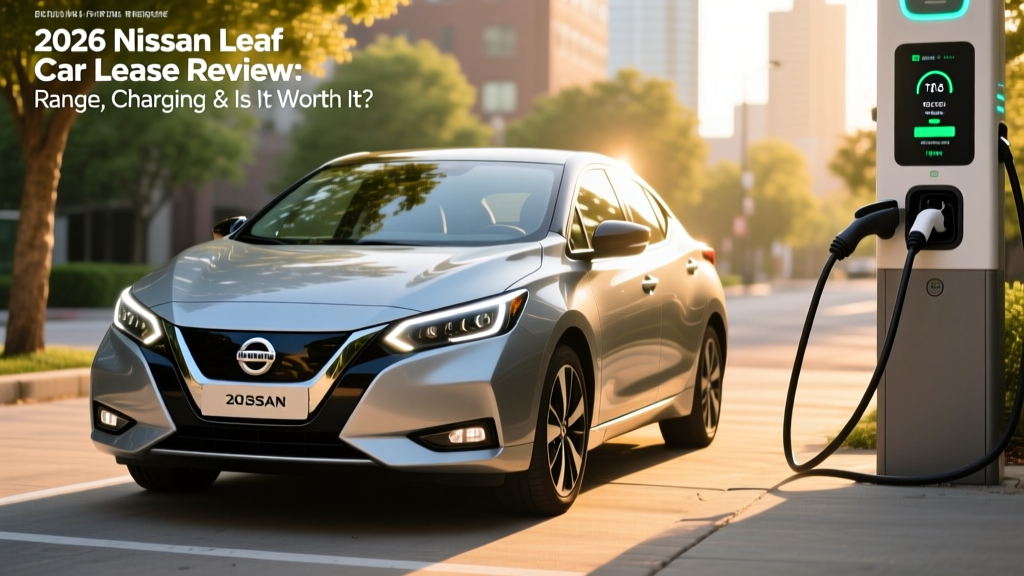
The 2026 Nissan Leaf remains one of the most affordable new electric vehicles you can drive off a lot, and a nissan leaf car lease can make that entry price even more approachable. With a starting MSRP of $28,140 and eligibility for the full $7,500 federal tax credit (which can be applied as a point-of-sale rebate on qualifying leases), the Leaf undercuts most competitors by thousands. But before you sign, you need to understand what you're getting — and more importantly, what you're giving up.
The Leaf is a solid urban commuter with acceptable highway manners, but its CHAdeMO DC fast-charging connector is a legacy standard that's losing ground to NACS and CCS at public charging stations nationwide. If your daily driving stays under 100 miles and you can charge at home, the Leaf is a bargain. If you road-trip regularly or rely on public fast charging, look elsewhere.
Range, Battery, and Efficiency
| Spec | Leaf S (40 kWh) | Leaf SV Plus (60 kWh) |
|---|---|---|
| Battery Capacity (usable) | 39 kWh | 59 kWh |
| Chemistry | NMC (Nickel Manganese Cobalt) | NMC |
| EPA Estimated Range | 149 miles | 212 miles |
| Combined MPGe | 111 MPGe | 109 MPGe |
| Efficiency (kWh/100 mi) | 30 kWh | 31 kWh |
| Battery Warranty | 8 yr / 100,000 mi | 8 yr / 100,000 mi |
Nissan uses NMC lithium-ion cells, which offer higher energy density than LFP (lithium iron phosphate) but are more sensitive to sustained high state-of-charge. For longevity, Nissan recommends keeping the battery between 20% and 80% for daily use — a practice made easier by the car's programmable charge-limit setting. The 8-year/100,000-mile battery warranty covers capacity loss below 9 bars (out of 12) on the battery health gauge, which roughly corresponds to 66% original capacity. That's a lower retention threshold than some competitors who guarantee 70%.
Charging Speed: The Leaf's Biggest Compromise
| Charging Level | Power / Rate | Time / Miles Added |
|---|---|---|
| Level 1 (120V household) | ~1.4 kW | ~3–4 miles per hour |
| Level 2 (240V home/public) | 6.6 kW (onboard charger) | ~22–25 miles per hour; full charge in ~9.5 hr (60 kWh) |
| DC Fast Charge (CHAdeMO) | Peak 100 kW (SV Plus) / 50 kW (S) | 10–80% in ~45 min (SV Plus); ~60 min (S) |
Here's where the Leaf diverges from the modern EV mainstream. While competitors like the Hyundai Kona Electric and Chevrolet Equinox EV use the CCS or NACS connectors and can peak at 150–190 kW on DC fast chargers, the Leaf still uses the CHAdeMO connector — a Japanese standard that Electrify America, Tesla Superchargers, and most newer networks have abandoned or never supported.
In practice, this means you'll find fewer compatible public fast chargers each year. CHAdeMO stations still exist — particularly older ChargePoint and EVgo locations — but the infrastructure is trending strongly toward NACS and CCS. For a lease that runs 36 months, this may not be a dealbreaker if you charge at home nightly. But it's a real limitation worth acknowledging.
The 6.6 kW onboard Level 2 charger is adequate for overnight home charging. A full charge of the 60 kWh battery takes about 9.5 hours — plan on plugging in when you get home and waking up to a full battery. If you're installing a home Level 2 charger, budget $500–$1,500 for a quality 32A–48A unit plus $800–$2,500 for professional electrician installation (more if your panel needs an upgrade to 200A service).
Performance and Drivetrain
The 2026 Leaf is a front-wheel-drive hatchback — no AWD option is available.
- Leaf S (40 kWh): 147 horsepower, 236 lb-ft torque, 0–60 mph in ~7.4 seconds
- Leaf SV Plus (60 kWh): 214 horsepower, 250 lb-ft torque, 0–60 mph in ~6.5 seconds
The SV Plus has genuinely punchy acceleration thanks to instant electric torque, making highway merging and city stoplight launches confident. The S trim is adequate for commuting but feels noticeably slower when loaded with passengers. Ride quality is comfortable and compliant — Nissan tuned the suspension for comfort over sportiness. Road noise is well-managed at city speeds but becomes noticeable above 65 mph.
Regenerative braking is adjustable via the e-Pedal mode, which enables near one-pedal driving in stop-and-go traffic. However, the Leaf's regen doesn't bring the car to a complete hold at very low speeds the way a Tesla or Hyundai Ioniq 5 does — you'll still need the friction brake for final stops.
Interior, Cargo, and Technology
The Leaf is a compact hatchback, and its dimensions reflect that positioning:
- Passenger volume: 92.4 cu ft
- Cargo (rear seats up): 23.6 cu ft
- Cargo (rear seats folded): 38.5 cu ft
- Front legroom: 42.1 inches
- Rear legroom: 33.5 inches
The cargo area is generous for the segment — 23.6 cubic feet beats the Hyundai Kona Electric (25.5 cu ft is close) and significantly outpaces sedans like the Tesla Model 3's trunk. There's no frunk (front trunk); the space under the hood houses power electronics.
Infotainment: The SV Plus features an 8-inch touchscreen with wireless Apple CarPlay and wired Android Auto, built-in navigation, and a 6-speaker audio system. The interface is functional but dated compared to the 12–15 inch screens in newer rivals. There's no over-the-air (OTA) software update capability for major feature additions.
Driver Assistance (ProPILOT Assist): Nissan's ProPILOT Assist is a Level 2 driver-assistance system combining adaptive cruise control and lane-centering steering. It works well on marked highways but requires continuous driver supervision — hands must remain on the wheel. It does not handle stoplights, construction zones, or complex intersections. This is not autonomous driving; it's a convenience feature that reduces fatigue on longer commutes.
Pricing, Lease Deals, and Federal Tax Credit
| Trim | Base MSRP | Est. Lease (36 mo / 12k mi/yr)* | Federal Credit Eligible? |
|---|---|---|---|
| Leaf S | $28,140 | ~$199–$259/mo | Yes — up to $7,500 |
| Leaf SV Plus | $36,140 | ~$289–$359/mo | Yes — up to $7,500 |
*Lease estimates vary by dealer, region, credit tier, and current Nissan incentives. Verify with your local dealer.
The Nissan Leaf qualifies for the full $7,500 federal EV tax credit under IRS §30D rules, as the vehicle is assembled in North America (Smyrna, Tennessee) and meets battery component and critical mineral sourcing thresholds for 2026. However, eligibility depends on your personal situation:
- Income caps: Modified AGI must not exceed $150,000 (single), $225,000 (head of household), or $300,000 (joint filers)
- MSRP cap: The Leaf's MSRP is well under the $55,000 cap for cars (no issue here)
- Point-of-sale transfer: As of 2024+, you can transfer the credit to the dealer at purchase, effectively reducing the drive-off price by $7,500 — this applies to purchases, and on qualifying leases, the lessor can pass the credit through as a capitalized cost reduction (Source: IRS.gov)
- Battery sourcing: Nissan sources battery materials that meet 2026 critical-mineral and component thresholds, but these rules tighten annually — confirm current-year eligibility at purchase
For a nissan leaf car lease, the tax credit benefit typically flows through the leasing company (Nissan Motor Acceptance Corporation) and is applied as a cap-cost reduction, lowering your monthly payment. Ask the dealer explicitly how the credit is applied to your lease structure.
Pros, Cons, and Who Should Lease the Leaf
Pros
- Lowest entry price among 200+ mi EVs (SV Plus)
- Full $7,500 federal tax credit eligible
- Spacious hatchback cargo area (23.6 cu ft)
- Comfortable ride quality for daily commuting
- ProPILOT Assist included on SV Plus
- Strong lease incentives from Nissan frequently available
Cons
- CHAdeMO connector — shrinking public charging network
- Modest DC fast-charge speed (100 kW peak, ~45 min 10–80%)
- Base S trim's 149-mile range is limiting
- No AWD or towing capability
- Dated infotainment with small 8-inch screen
- No frunk; no OTA major updates
- Battery warranty threshold (66%) is below some competitors (70%)
Who the Leaf Suits Best
Ideal for: Urban and suburban commuters who drive under 80 miles daily, have access to home Level 2 charging, and want the lowest possible monthly payment on a new EV. The Leaf is an excellent second car or dedicated city runabout.
Not ideal for: Frequent road-trippers, those without home charging access, drivers in very cold climates where range loss compounds the modest battery size, or anyone who needs AWD for snow/terrain.
Leaf vs. Key Competitors: Is It Worth the Lease?
| Spec | Nissan Leaf SV Plus | Hyundai Kona Electric | Chevrolet Equinox EV 2LT |
|---|---|---|---|
| EPA Range | 212 mi | 261 mi | 319 mi |
| Starting MSRP | $36,140 | $32,975 | $33,600 |
| DC Fast Connector | CHAdeMO | CCS (NACS adapter avail.) | CCS (NACS adapter avail.) |
| Peak DC Charge | 100 kW | 100 kW | 150 kW |
| 10–80% Time | ~45 min | ~43 min | ~30 min |
| Horsepower | 214 hp | 201 hp | 213 hp |
| $7,500 Fed Credit | Yes | No (Korea assembly) | Yes |
The Leaf's ace is the tax credit. The Hyundai Kona Electric, despite superior range and a modern CCS/NACS-compatible connector, doesn't qualify for the $7,500 credit because it's assembled in South Korea. That $7,500 gap makes the Leaf effectively cheaper out-of-pocket for eligible buyers, even though the Kona is the better-engineered EV on paper.
The Chevrolet Equinox EV offers far more range (319 miles) and faster charging, and it does qualify for the credit. If you can stretch the budget or find a competitive Equinox lease, it's the more future-proof choice. But the Leaf's lower MSRP means lower lease payments even before incentives.
Frequently Asked Questions
What is the real-world range of the 2026 Nissan Leaf?
The SV Plus is EPA-rated at 212 miles. In real-world highway driving at 70 mph, expect 170–190 miles. In cold weather below 30°F, plan for 140–160 miles. The base S trim delivers roughly 120–135 miles in similar mixed conditions against its 149-mile EPA rating.
How fast does the Leaf charge at home and on DC fast chargers?
On a Level 2 home charger (240V), the 6.6 kW onboard charger adds about 22–25 miles per hour, fully recharging the 60 kWh battery in roughly 9.5 hours. On DC fast charge (CHAdeMO), the SV Plus peaks at 100 kW and reaches 10–80% in approximately 45 minutes. Charge speed tapers significantly above 80% — a full 0–100% DC charge takes over 70 minutes.
Does the Nissan Leaf qualify for the $7,500 federal EV tax credit?
Yes, the 2026 Leaf qualifies for the full $7,500 credit under IRS §30D, as it's assembled in Tennessee and meets battery sourcing requirements. However, you must fall under the income caps ($150K single / $300K joint) to claim it. On a lease, the credit typically flows through the leasing company as a cap-cost reduction. Consult a tax professional for your specific situation.
Is leasing the Leaf better than buying?
Leasing makes sense if you want the lowest monthly payment and don't plan to keep the car long-term. The Leaf's relatively modest range and aging CHAdeMO connector make it a car you may want to upgrade from in 3 years rather than own for 8–10. Leasing also shields you from EV depreciation risk, which has been significant for the Leaf historically. However, buying and applying the $7,500 credit as a point-of-sale rebate makes the effective purchase price very compelling (~$20,640 for the S trim).
Can I use Tesla Superchargers with the Nissan Leaf?
No. Tesla Superchargers use the NACS connector (or CCS with Tesla's Magic Dock adapter at select stations). The Leaf uses CHAdeMO, which is not compatible with any Tesla Supercharger or adapter currently available. Your DC fast-charging options are limited to CHAdeMO-equipped public stations.
What happens to the battery after the lease ends?
When your lease expires (typically 36 months), you return the vehicle. You bear no responsibility for battery degradation or replacement. Nissan inspects the vehicle for excess wear and mileage overages. This is one advantage of leasing an EV — you don't carry long-term battery risk.
Is the Nissan Leaf a good EV for a first-time EV buyer?
Yes, with caveats. If you have reliable home charging and a predictable commute, the Leaf is an affordable, low-stress introduction to EV ownership. The main adjustment will be learning to plan around the 212-mile (or 149-mile) range envelope and understanding that public fast-charging options are narrower than with NACS/CCS vehicles. If your lifestyle involves frequent long trips or apartment living without charging access, consider a PHEV or a longer-range EV with CCS/NACS instead.