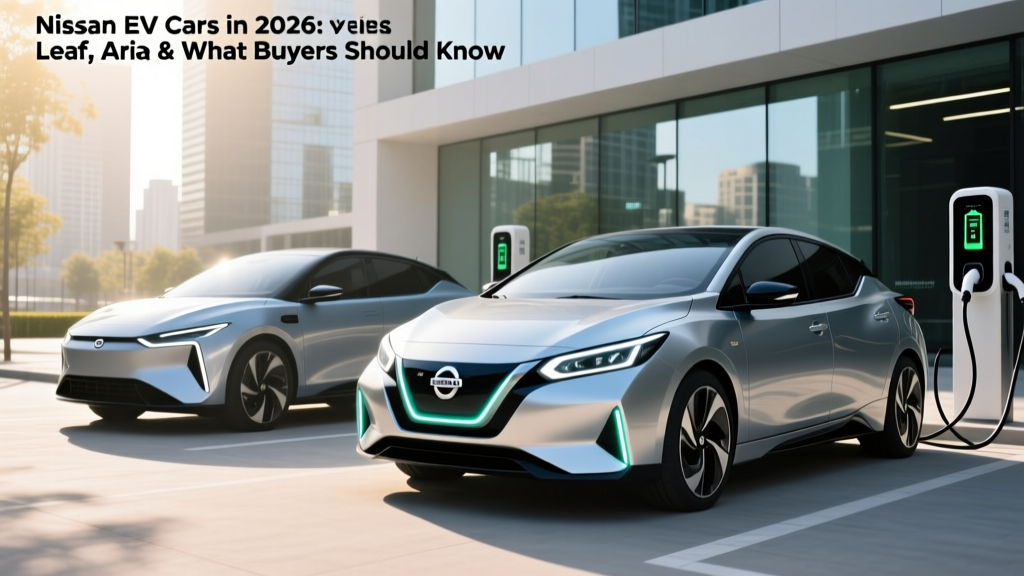
If you're researching Nissan EV cars in 2026, you have two primary options: the redesigned Nissan Leaf (a compact hatchback starting under $30,000) and the Nissan Ariya (a midsize crossover with up to 304 miles of EPA range). Both use the NACS charge port for Tesla Supercharger access, and the Ariya qualifies for partial or full federal tax credits depending on your income and the vehicle's battery-sourcing compliance. The Leaf is the budget-friendly commuter pick; the Ariya is the family road-tripper. Below, we break down exact specs, real-world range expectations, ownership costs, and how they compare to gas and hybrid alternatives so you can decide which Nissan EV fits your driving pattern.
Quick Answer: Which Nissan EV Should You Buy?
Buy the Leaf if you need an affordable daily commuter under $30K with ~200 miles of range and mostly home charging. Buy the Ariya if you need 300+ miles of range, fast DC charging (130 kW peak), crossover cargo space, and AWD availability. Consider a Nissan PHEV or gas Rogue if you lack reliable home charging or frequently drive 400+ miles in cold climates.
2026 Nissan EV Lineup: Leaf vs Ariya at a Glance
Nissan's EV strategy in 2026 centers on two distinct models. The Leaf returned for a full redesign (moving to the CMF-EV platform and NACS port), while the Ariya continues with minor battery and software refinements. Here's how they stack up spec-for-spec.
| Spec | 2026 Nissan Leaf | 2026 Nissan Ariya |
|---|---|---|
| Body Style | Compact Hatchback | Midsize Crossover SUV |
| Base MSRP | ~$28,990 | ~$39,590 |
| EPA Range (Max) | ~212 mi | ~304 mi (Venture+) |
| Battery (Usable) | ~52 kWh (LFP) | ~91 kWh (NMC) |
| Drivetrain | FWD | FWD or e-4ORCE AWD |
| Horsepower | ~174 hp | 214–389 hp |
| 0-60 mph | ~7.5 sec | 4.8–7.6 sec |
| Peak DC Fast Charge | ~100 kW | ~130 kW |
| 10–80% DC Charge | ~32 min | ~35 min |
| Level 2 Charge Rate | 7.2 kW | 7.2 kW |
| Charge Port | NACS (native) | NACS (native) |
| Efficiency (MPGe) | ~123 MPGe combined | ~97–109 MPGe combined |
| Cargo Volume | ~23 cu ft | ~22.8 cu ft (behind 2nd row) |
| Battery Warranty | 8 yr / 100,000 mi | 8 yr / 100,000 mi |
Sources: fueleconomy.gov, Nissan USA. Figures reflect top-range trims where noted; base trims may have lower range and power.
Real-World Range: What the EPA Sticker Doesn't Tell You
Range Reality Check
Leaf (EPA 212 mi): Expect ~175–190 mi on mixed highway driving at 70 mph. In freezing temperatures (below 32°F), range can drop to ~140–155 mi due to battery resistance and cabin heating load. The Leaf uses an LFP battery, which holds up well over time but is more sensitive to cold-weather range loss.
Ariya Venture+ (EPA 304 mi): Expect ~250–275 mi on sustained highway trips at 70 mph. Cold-weather highway range drops to ~200–220 mi. The Ariya's larger NMC battery and available heat pump (standard on most trims) help mitigate winter losses compared to the Leaf.
Neither Nissan EV offers class-leading efficiency. The Ariya's heavier curb weight (~4,900 lbs for AWD trims) and wider tires reduce MPGe compared to rivals like the Hyundai Ioniq 5 or Tesla Model Y. If you regularly drive 250+ miles between charges in cold climates, the Ariya AWD with its heat pump is the safer bet — but plan charging stops conservatively.
Charging Speed and Network Access
Both 2026 Nissan EV cars come equipped with the NACS (North American Charging Standard) port natively, meaning direct access to Tesla Supercharger stalls without an adapter. This is a significant improvement over the older Leaf's CHAdeMO connector, which had limited DC fast-charging infrastructure.
| Charging Level | Power | Leaf (mi/hr added) | Ariya (mi/hr added) |
|---|---|---|---|
| Level 1 (120V household) | ~1.4 kW | ~4 mi/hr | ~3 mi/hr |
| Level 2 (240V home/public) | 7.2 kW | ~22 mi/hr | ~20 mi/hr |
| DC Fast Charge | Leaf: 100 kW peak / Ariya: 130 kW peak | 10–80% in ~32 min | 10–80% in ~35 min |
Charging curve reality: Neither Nissan EV sustains peak charge rates for the full session. The Ariya peaks at ~130 kW between 10–30% SoC, then tapers to ~80 kW by 60%, and drops below 50 kW past 80%. This means the advertised "10–80% in 35 minutes" assumes optimal battery preconditioning and a charger capable of delivering 130+ kW. In practice, expect 38–45 minutes on typical 150 kW Electrify America or Supercharger stalls, especially if the battery is cold.
Home charging cost: A Level 2 home charger installation (40A circuit, 240V) typically costs $800–$2,000 including equipment, electrician labor, and permits, depending on panel proximity. A full Ariya charge at the US average electricity rate of ~$0.17/kWh costs roughly $15.50, yielding a fuel cost of about $0.05/mile — compared to ~$0.12/mile for a 28 MPG gas crossover at $3.40/gallon.
Nissan EV Ownership Costs vs Gas and Hybrid
The upfront price of Nissan EV cars is only part of the equation. Let's compare 5-year total cost of ownership for the Ariya against its gas sibling, the Nissan Rogue, and the Rogue PHEV variant (where available).
| Cost Factor (5 yr / 75,000 mi) | Ariya (EV) | Rogue (Gas) | Rogue PHEV |
|---|---|---|---|
| Purchase Price (base) | $39,590 | $29,490 | $36,990 |
| Federal Tax Credit (§30D) | Up to $7,500* | $0 | Up to $7,500* |
| Net Purchase (after credit) | ~$32,090 | $29,490 | ~$29,490 |
| Fuel/Energy Cost | ~$3,750 (home charging) | ~$9,000 (28 MPG avg) | ~$5,200 (mixed) |
| Maintenance | ~$1,200 | ~$3,500 | ~$2,800 |
| Insurance (avg) | ~$9,500 | ~$7,500 | ~$8,200 |
| Estimated Depreciation | ~$16,000 | ~$12,000 | ~$14,500 |
| Total 5-Year Cost | ~$62,540 | ~$61,490 | ~$60,190 |
* §30D credit eligibility depends on buyer income caps ($150K single / $300K joint), vehicle MSRP caps ($55K SUVs / $80K vans & trucks), and battery critical-mineral sourcing requirements. Verify current-year rules at irs.gov and confirm with a tax professional. Point-of-sale transfer available at participating dealers.
The takeaway: The Ariya's fuel and maintenance savings (~$6,550 over 5 years vs gas) are substantial but partially offset by higher insurance premiums and steeper depreciation. If you qualify for the full $7,500 credit and charge primarily at home, the Ariya's 5-year cost becomes competitive with the gas Rogue. Without the credit or without home charging, the gas or PHEV alternative wins on economics.
Federal Tax Credit Eligibility for Nissan EVs
Tax credit eligibility for Nissan EV cars is not automatic. The IRS §30D clean vehicle credit has several requirements that change periodically:
- MSRP Cap: SUVs (Ariya) must be under $80,000 MSRP; cars (Leaf) under $55,000. Both qualify.
- Buyer Income Cap: AGI must not exceed $150,000 (single), $225,000 (head of household), or $300,000 (joint filing).
- Battery Sourcing: A percentage of critical minerals and battery components must be sourced from the US or free-trade-agreement countries. This threshold increases annually and may reduce or eliminate the credit for some model years.
- Point-of-Sale Transfer: You can transfer the credit to the dealer at purchase to reduce the sale price directly, rather than waiting to claim it on your tax return.
Always verify the current sourcing-compliance status of the specific Nissan EV trim you're buying on the IRS clean vehicle credit page before signing a purchase agreement. Dealers should have the latest eligibility data.
Common Misconceptions About Nissan EVs
| Myth | Fact |
|---|---|
| "The Leaf still uses CHAdeMO and can't Supercharge." | The 2026 redesigned Leaf uses NACS natively and charges at Tesla Superchargers without an adapter. |
| "Nissan EV batteries degrade quickly." | The older air-cooled Leaf batteries (pre-2025) had notable degradation issues. The current generation uses liquid-cooled thermal management, and Nissan provides an 8-year/100,000-mile battery warranty covering capacity below 70%. |
| "You can't road-trip an EV." | The Ariya's 304-mile range and NACS Supercharger access make road trips practical, though charging stops add 30–40 minutes every 200–250 miles on the highway. |
| "EVs cost more to insure." | Often true — EV insurance averages 15–25% higher than gas equivalents due to repair costs and battery replacement value. Shop quotes before buying. |
| "I need a special electrical panel for home charging." | Not always. A Level 2 charger needs a dedicated 40A/240V circuit. Many 200A home panels can accommodate this. Older homes with 100A panels may need a $1,500–$3,000 panel upgrade — consult a licensed electrician. |
Decision Framework: Which Nissan EV Fits Your Life?
Choose the Nissan Leaf if:
- Your daily commute is under 80 miles round-trip
- You have reliable Level 2 home charging
- Your budget is under $32,000 after incentives
- You want the lowest cost-per-mile EV for city/suburban driving
- You rarely take trips exceeding 180 miles one-way
Choose the Nissan Ariya if:
- You need 280+ miles of real-world range for road trips
- You want AWD for snow or mountain driving (e-4ORCE trims)
- You need crossover cargo space for family gear
- You want faster DC charging for highway corridor travel
- You qualify for the §30D tax credit to offset the higher MSRP
Choose a gas or hybrid alternative if:
- You live in an apartment or lack access to reliable home or workplace charging
- You regularly drive 400+ miles in sub-freezing weather between charge stops
- You don't qualify for the federal tax credit (income above caps)
- Upfront cost is a primary concern and you drive fewer than 10,000 miles/year (fuel savings won't offset the premium)
First-Time EV Buyer Essentials
If this is your first EV purchase, here are the practical realities Nissan dealers may not emphasize:
1. Home charging is non-negotiable for convenience. Relying solely on public DC fast charging costs 2–3x more per mile than home Level 2 charging and adds significant time to your week. Budget $800–$2,000 for a Level 2 home installation before taking delivery.
2. Preconditioning matters. Both the Leaf and Ariya support battery preconditioning when you set a DC fast-charger as your navigation destination. This warms the battery to optimal temperature and can shave 5–10 minutes off your charge time — especially critical in cold weather.
3. Plan for 80% charges on road trips. Charging from 80–100% at a DC fast charger is painfully slow due to the charge curve taper. Set your departure plan around 80% SoC stops to minimize total trip time.
4. Check your electrical panel. Before committing to an EV, have an electrician assess your home panel capacity. A 200A panel with spare breaker slots handles a Level 2 charger easily. A 100A panel or one with no spare slots may require an upgrade.
5. Insurance quotes first. Get insurance estimates on the exact Nissan EV trim before purchasing. EV premiums can surprise first-time buyers — the Ariya AWD may cost $200–$400 more per year to insure than a gas Rogue AWD.
Frequently Asked Questions
Does Nissan still make the Leaf?
Yes. The Nissan Leaf was fully redesigned for the 2026 model year on a new platform with a NACS charge port, liquid-cooled LFP battery, and approximately 212 miles of EPA range. It remains one of the most affordable new EVs on the US market.
Is the Nissan Ariya a good EV for road trips?
The Ariya Venture+ with 304 miles of EPA range and NACS Supercharger access is practical for road trips, but expect to stop every 200–250 highway miles for 30–40 minutes of DC fast charging. In cold weather, reduce that to ~170–200 miles between stops.
Do Nissan EVs qualify for the $7,500 tax credit?
Both the Leaf and Ariya can qualify, but eligibility depends on your income, the vehicle's MSRP, and current battery-sourcing compliance rules. The credit amount may be reduced if sourcing thresholds aren't fully met. Always verify on irs.gov before purchasing.
How long do Nissan EV batteries last?
Nissan warranties its EV batteries for 8 years or 100,000 miles against capacity loss below 70%. Modern liquid-cooled batteries (unlike older air-cooled Leafs) typically retain 85–90% capacity after 100,000 miles based on industry degradation data for similar chemistries.
Can I charge a Nissan EV at a Tesla Supercharger?
Yes. The 2026 Leaf and Ariya both use the NACS charge port natively, which is the same connector used at Tesla Supercharger stations. No adapter is required.
Is Nissan ProPILOT self-driving?
No. Nissan ProPILOT Assist is an SAE Level 2 driver-assistance system. It provides lane centering and adaptive cruise control, but the driver must remain fully engaged, keep hands on the wheel, and monitor the road at all times. It is not autonomous driving.
What Nissan EVs Can't Do
- Neither the Leaf nor Ariya offers over 310 miles of EPA range — less than competitors like the Hyundai Ioniq 5 (310+ mi) or Tesla Model Y (320+ mi).
- DC fast charging peaks at 100–130 kW, which is slower than 800V competitors charging at 200–350 kW.
- The Leaf does not offer AWD, limiting its appeal in heavy snow regions.
- Neither model has a frunk (front trunk), reducing total cargo utility.