The Bottom Line on the Nissan Ariya Electric
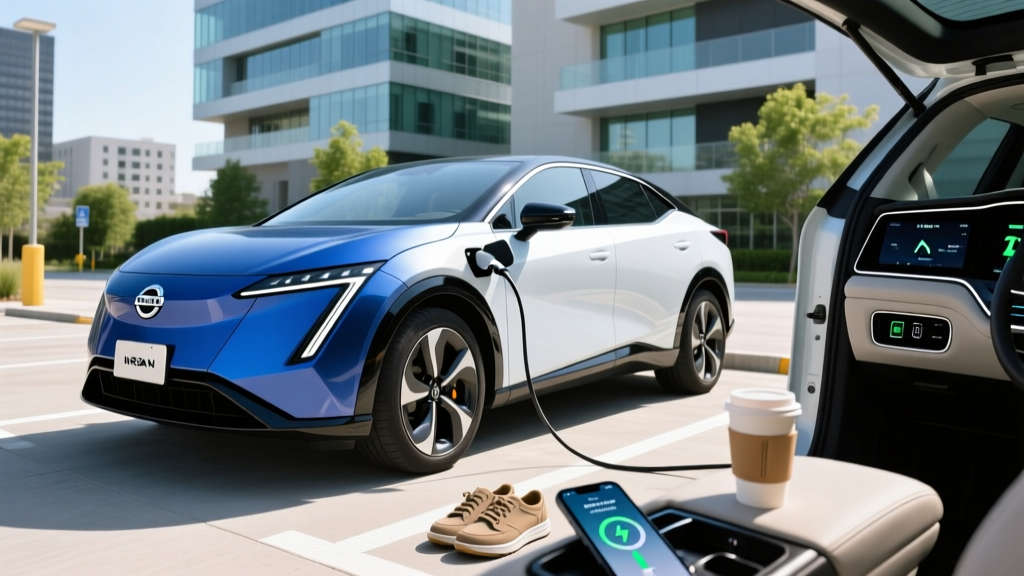
The Nissan Ariya electric SUV delivers up to 304 miles of EPA range (Venture+ trim with the 87 kWh usable battery), peaking at 130 kW DC fast charging (10–80% in roughly 35 minutes), with a starting MSRP around $39,770 before incentives. It's a comfortable, well-built crossover that prioritizes refinement over raw performance. However, its DC charge rate trails rivals like the Hyundai Ioniq 5 and Tesla Model Y, making it better suited to buyers with reliable home Level 2 charging than frequent road-trippers.
Range and Efficiency: EPA vs. the Real World
The Ariya comes in two battery sizes. The base Engage trim uses a 63 kWh (usable) battery, while all other trims step up to an 87 kWh pack. Both use NMC (nickel-manganese-cobalt) lithium-ion chemistry, which offers higher energy density than LFP but requires more careful long-term state-of-charge management to minimize degradation.
| Trim | Drivetrain | Battery (usable kWh) | EPA Range | MPGe (combined) | 0–60 mph |
|---|---|---|---|---|---|
| Engage | FWD | 63 | 216 mi | 95 | 7.5 sec |
| Venture+ | FWD | 87 | 304 mi | 98 | 7.6 sec |
| Evolve+ | FWD | 87 | 289 mi | 95 | 7.4 sec |
| Empower+ | FWD | 87 | 289 mi | 95 | 7.4 sec |
| Platinum+ e-4ORCE | AWD | 87 | 267 mi | 90 | 4.8 sec (389 hp) |
Real-World Range Expectations
EPA sticker: 304 mi (Venture+ FWD)
Highway driving (70–75 mph): Expect 240–265 mi in mild weather
Cold weather (below 30°F): Expect 200–230 mi — the Ariya lacks a heat pump on most trims, meaning cabin heating draws directly from the traction battery, causing 20–30% range loss
Combined daily driving: 270–290 mi is achievable with moderate speeds and regenerative braking set to B-mode
According to fueleconomy.gov, the Venture+ achieves 98 MPGe combined (roughly 34 kWh/100 mi). That's competitive with the Ford Mustang Mach-E Extended Range but slightly behind the Ioniq 5's 114 MPGe. If your commute is under 60 miles round-trip, even the 63 kWh Engage will handle multiple days between charges.
Charging Speeds and Infrastructure
This is where the Ariya requires honest expectations. Nissan equipped it with a CCS1 connector and a peak DC fast-charge rate of 130 kW. That's functional but not class-leading — the Hyundai Ioniq 5 peaks at 240 kW and the Tesla Model Y at 250 kW on V3 Superchargers.
| Level | Power | Miles Added Per Hour | Notes |
|---|---|---|---|
| Level 1 (120V) | ~1.4 kW | ~4 mi/hr | Emergency/trickle only |
| Level 2 (240V, 32A) | 7.2 kW | ~22 mi/hr | Full charge in ~12 hr (87 kWh) |
| Level 2 (240V, 48A) | 11.5 kW | ~35 mi/hr | Requires hardwired EVSE; full charge ~8 hr |
| DC Fast (peak) | 130 kW | N/A | 10–80% in ~35 min; tapers sharply above 80% |
Charge curve reality: The Ariya hits 130 kW only between roughly 15–40% state of charge. Above 60%, it drops to around 70–80 kW, and above 80% it falls below 30 kW. This means a 10–80% session takes about 35 minutes, but pushing to 95% adds another 25 minutes. Plan road-trip stops accordingly — charge to 80% and move on.
For home charging, a 48-amp Level 2 wallbox on a 60-amp circuit is the practical sweet spot. Expect to pay $800–$1,500 for a quality EVSE (ChargePoint Home Flex, Emporia Level 2, or Wallbox Pulsar Plus) and $500–$2,000 for electrician installation depending on panel proximity and whether a 200-amp service upgrade is needed. A licensed electrician should always confirm your panel capacity before installation.
Ariya vs. Gas Crossover: The True Cost of Ownership
Let's compare the Ariya Venture+ ($43,770 MSRP before incentives) against a well-equipped gas crossover like the Toyota RAV4 XLE ($32,500 MSRP, ~28 MPG combined) over five years and 75,000 miles.
| Category | Nissan Ariya Venture+ | Toyota RAV4 XLE (Gas) |
|---|---|---|
| Purchase Price | $43,770 | $32,500 |
| Federal Tax Credit (§30D)* | Up to $7,500 (see eligibility) | $0 |
| Effective Purchase | ~$36,270 | $32,500 |
| Fuel/Energy (75k mi) | ~$3,100 (home charging at $0.14/kWh) | ~$9,400 (gas at $3.50/gal, 28 MPG) |
| Maintenance (5 yr) | ~$600 (cabin filter, wipers, tires) | ~$2,800 (oil, filters, brakes, fluids) |
| Insurance (5 yr avg) | ~$9,500 | ~$7,800 |
| 5-Year Total | ~$49,470 | ~$52,500 |
*Federal §30D tax credit eligibility depends on buyer income caps ($150K single / $300K joint), vehicle MSRP caps ($80K for SUVs), battery critical-mineral sourcing, and North American assembly rules. The Ariya is built in Japan, which may affect eligibility under current sourcing requirements. Always verify with a tax professional and the IRS clean vehicle credit page for the latest rules. Point-of-sale transfer is available at participating dealers if eligible.
The Ariya breaks even on total cost within roughly four years if you charge primarily at home. Public DC fast charging at $0.40–$0.50/kWh narrows the gap significantly — at those rates, your energy cost jumps to roughly $7,500 over 75,000 miles. Home charging access is the single biggest financial variable.
Common Misconceptions About the Ariya
| Myth | Fact |
|---|---|
| "The Ariya charges as fast as any other EV." | At 130 kW peak, it's roughly half the speed of an Ioniq 5 or Model Y on DC fast chargers. Plan longer stops. |
| "304 miles of range means I'll always get 304 miles." | Highway, cold weather, and hills reduce range by 15–30%. Expect 200–265 mi in demanding conditions. |
| "The battery will need replacing in a few years." | Nissan warranties the battery for 8 years/100,000 miles against dropping below 9 capacity bars (~65–70% capacity). Real-world NMC degradation is typically 8–12% over 100K miles. |
| "I can't road-trip without a Tesla." | The Ariya uses CCS1, compatible with Electrify America, EVgo, and ChargePoint DC networks. Coverage is broad on interstates, though reliability varies by station. |
| "The Ariya qualifies for the full $7,500 tax credit for everyone." | Eligibility depends on income, MSRP caps, battery sourcing, and assembly location. Verify before purchasing. |
First-Time EV Buyer: What You Need to Know
If the Ariya is your first EV, here's what matters beyond the spec sheet:
- Install Level 2 home charging before delivery. Relying on Level 1 (120V) means adding only ~4 miles per hour of charging — inadequate for a 87 kWh battery unless your daily driving is under 20 miles.
- Set charge limits. For NMC batteries, daily charging to 80% prolongs lifespan. Use the Ariya's built-in charge limiter or EVSE scheduling. Charge to 100% only before long trips.
- Precondition the battery. When navigating to a DC fast charger, the Ariya warms the battery for optimal charge acceptance. This matters especially in cold weather — without preconditioning, your first 10 minutes at the charger may be painfully slow.
- Understand regenerative braking. The Ariya's e-Pedal mode provides strong regen but doesn't come to a complete stop in all scenarios. Keep your brake foot ready.
- ProPILOT Assist is Level 2, not self-driving. It combines adaptive cruise and lane centering, but you must keep hands on the wheel and eyes on the road at all times per NHTSA guidelines.
SAE Automation Level: Level 2
Nissan ProPILOT Assist 2.0 (available on Empower+ and Platinum+) allows limited hands-off driving on pre-mapped highways, but the driver must remain attentive and ready to take over immediately. This is not autonomous driving — it is an advanced driver-assistance system requiring continuous supervision.
Decision Framework: Is the Ariya Right for You?
Choose the Nissan Ariya If:
- You have access to home Level 2 charging (garage or driveway with 240V circuit access)
- Your daily driving is under 80 miles round-trip, with occasional 200–250 mile road trips
- You prioritize ride comfort, cabin quietness, and build quality over maximum charge speed
- You want a mainstream-brand EV with a conventional dealership service network
- You value the available ProPILOT Assist 2.0 hands-off highway feature for commuting
Look Elsewhere If:
- You road-trip frequently and need 20-minute DC fast-charge stops (consider Ioniq 5, Model Y, or EV6)
- You live in an apartment or condo without charging access and rely entirely on public infrastructure
- You live in a consistently cold climate where the lack of a heat pump (most trims) will cost you 25%+ of range every winter
- You need a third row or more than 22.8 cu ft of cargo space behind the rear seats
- You require the maximum federal tax credit and the Ariya's Japan-built, sourced-battery status disqualifies it in the current tax year
Warranty, Reliability, and Long-Term Ownership
Nissan backs the Ariya with a 3-year/36,000-mile basic warranty and a 5-year/60,000-mile powertrain warranty. The lithium-ion battery carries an 8-year/100,000-mile warranty against dropping below 9 out of 12 capacity bars on the dashboard display (approximately 65–70% of original capacity). This is industry-standard, though some competitors like Hyundai offer 10-year/100,000-mile battery coverage.
Replacement cost for an 87 kWh Ariya battery pack, if out of warranty, currently ranges from $12,000 to $18,000 including labor, based on Nissan parts pricing and independent EV shop estimates. However, data from older Nissan LEAF packs suggests NMC batteries typically retain 85–90% capacity at 100,000 miles when properly managed (avoiding chronic 100% charges and extreme heat exposure).
Insurance premiums for the Ariya average $1,800–$2,200/year depending on trim, location, and driving record — roughly 15–25% higher than a comparable gas crossover, per industry data. Get quotes before purchasing; the gap varies significantly by insurer and state.
Frequently Asked Questions
Does the Nissan Ariya support NACS (Tesla connector)?
No. The Ariya uses the CCS1 connector natively. You can use a CCS-to-NACS adapter at Tesla Superchargers that have been opened to non-Tesla vehicles through the "Open Supercharging" program, but you'll need to purchase the adapter separately (~$200–$250 from authorized suppliers).
How much does it cost to charge the Ariya at home?
At the US average residential rate of ~$0.16/kWh (per EIA data), a full 87 kWh charge costs roughly $13.90 and adds about 280 real-world miles. That's approximately $0.05 per mile, compared to $0.12–$0.15 per mile for a 28 MPG gas crossover at $3.50/gallon.
Can I tow with the Nissan Ariya?
The Ariya e-4ORCE (AWD) is rated for 1,500 lbs of towing capacity. FWD trims are not rated for towing. Keep in mind that towing will reduce range by 30–50% depending on trailer weight and terrain.
Does the Ariya have a frunk (front trunk)?
No. The Ariya does not have a front trunk. All cargo space (22.8 cu ft behind rear seats, 59.5 cu ft with seats folded) is in the rear hatch area. This is a notable omission compared to the Mustang Mach-E and Ioniq 5.
What's the difference between ProPILOT Assist 1.0 and 2.0?
ProPILOT 1.0 (standard on most trims) requires hands on the steering wheel at all times. ProPILOT 2.0 (Empower+ and Platinum+) allows hands-off driving on pre-mapped divided highways at speeds up to 60 mph, but requires eyes-on attention monitored by an interior camera. Neither system is self-driving — both are SAE Level 2 driver-assist features.
Is the Nissan Ariya eligible for the federal EV tax credit?
Eligibility under IRS §30D depends on several factors including your adjusted gross income, the vehicle's battery sourcing compliance, and MSRP caps. Because the Ariya is manufactured in Japan, it may face limitations under the North American assembly and critical-mineral sourcing requirements that change annually. Confirm eligibility with your tax advisor and the IRS clean vehicle credit page before relying on the credit in your purchase decision.