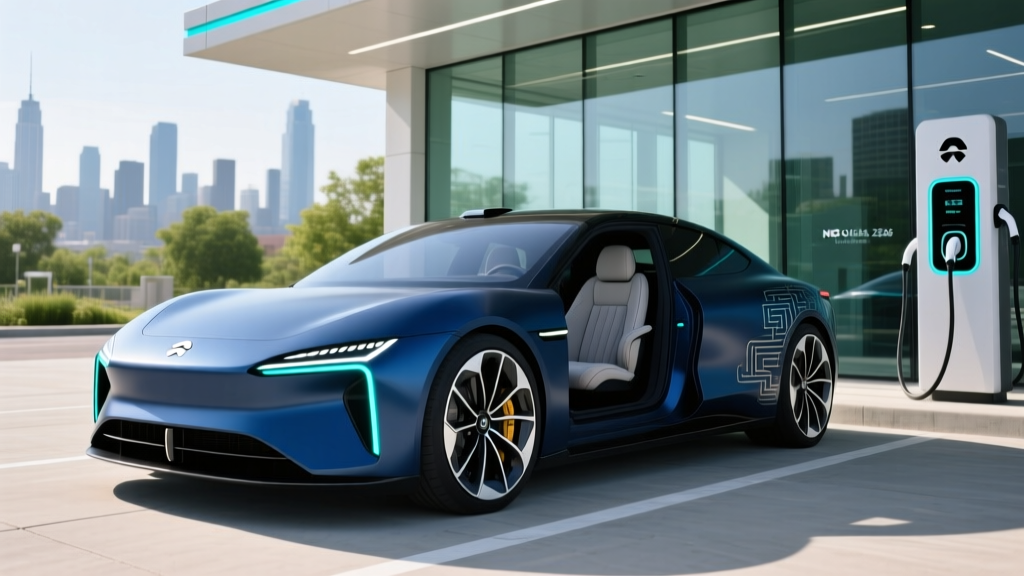
NIO has been teasing an entry into the United States market for years, and as of early 2026, the Chinese luxury EV maker remains in a holding pattern. Despite expanding aggressively across Europe — including Norway, Germany, the Netherlands, and Denmark — NIO has not announced a firm date, pricing, or model lineup for US sales. That hasn't stopped American EV enthusiasts from closely watching the brand's battery-swap technology, semi-autonomous driving suite, and premium sedan and SUV lineup available overseas.
This article examines what a US launch would actually look like: projected EPA range estimates based on WLTP figures from European models, battery and charging specifications, anticipated pricing, tax credit eligibility under IRS §30D rules, and whether NIO's unique value proposition — particularly its battery-as-a-service (BaaS) model and swap stations — could survive the transition to American roads and regulations. If you've been searching for clarity on NIO USA availability, this is the most comprehensive, data-grounded assessment available.
NIO's Current Global Lineup: What Could Come Stateside
NIO's product portfolio in 2026 spans sedans, SUVs, and a wagon, all built on the company's NT2.0 platform with support for its proprietary battery-swap architecture. The most likely candidates for a US launch, based on market fit and NIO's own statements at past NIO Day events, include:
- ET7 — A premium executive sedan competing with the Tesla Model S, BMW i5, and Mercedes EQE
- EL7 (ES7 in China) — A mid-size luxury SUV positioned against the BMW iX and Audi Q8 e-tron
- ET5 / ET5 Touring — A compact luxury sedan/wagon targeting the Tesla Model 3 and BMW i4 buyer
- EL8 (ES8 in China) — A three-row flagship SUV, though its large footprint may complicate US crash-test homologation
NIO also sells the ONVO L60 sub-brand (budget-oriented) and the ultra-premium Firefly hatchback in select markets, but these are less likely initial US entrants due to brand-positioning and regulatory timelines.
Projected Range, Battery, and Efficiency: ET7 Deep Dive
Since NIO vehicles are not yet EPA-certified for US sale, official EPA range figures do not exist. However, we can project US estimates using WLTP data from European-spec models, applying the typical 15–20% reduction factor that separates the more generous WLTP standard from the stricter EPA test cycle.
WLTP Range: ~441 miles (710 km) | Projected EPA Range: ~350–370 miles
Highway real-world expectation: ~290–320 miles at sustained 70+ mph speeds
Cold-weather (below 32°F) expectation: ~250–280 miles with heat pump active
Note: NIO's 150 kWh semi-solid-state battery pack, available in China via swap, claims over 620 miles WLTP — projecting to ~500+ miles EPA. This pack is not currently offered in Europe and its US availability is unconfirmed.
| Spec | 75 kWh Pack | 100 kWh Pack |
|---|---|---|
| Battery Chemistry | LFP (CATL) | NMC (CATL) |
| Usable Capacity | ~75 kWh | ~100 kWh |
| Projected EPA Range | ~260–280 mi | ~350–370 mi |
| Drivetrain | Dual-Motor AWD | Dual-Motor AWD |
| Horsepower | 644 hp (combined) | 644 hp (combined) |
| 0–60 mph | 3.8 sec | 3.8 sec |
| Projected MPGe | ~95 MPGe combined | ~102 MPGe combined |
| Efficiency | ~35 kWh/100 mi | ~33 kWh/100 mi |
The dual-motor powertrain is standard across all ET7 trims — there is no single-motor RWD option. The front induction motor produces 241 hp and the rear permanent-magnet motor delivers 403 hp, yielding a combined 644 hp and 627 lb-ft of torque. This is firmly in performance-sedan territory, though the ET7's ~5,070-lb curb weight means it prioritizes effortless highway passing over track-day agility.
Charging Speed: DC Fast, Level 2, and the Battery-Swap Wildcard
Charging infrastructure compatibility is where NIO's US ambitions face their most complex engineering challenge. The ET7 and EL7 sold in Europe use the CCS2 connector standard. A US-spec vehicle would need either the CCS1 connector (currently standard for non-Tesla EVs) or NACS (the Tesla-designed connector now adopted by Ford, GM, Rivian, Volvo, and others for 2025+ models).
| Charge Level | Rate | Speed / Time |
|---|---|---|
| DC Fast Charge (Peak) | Up to 127 kW (75 kWh) / ~140 kW (100 kWh) | 10–80% in ~34 minutes (100 kWh pack) |
| Level 2 (AC Home/Wallbox) | Up to 7 kW (single-phase) / 11 kW (three-phase, EU) | ~25–32 miles per hour of charging (US single-phase) |
| Level 1 (120V Outlet) | ~1.4 kW | ~4–5 miles per hour |
| Battery Swap | N/A — full pack exchange | ~3–5 minutes at a NIO Power Swap station |
Here's the honest assessment: NIO's DC fast-charging speeds are below class-leading competitors. The Hyundai Ioniq 5 peaks at 350 kW on an 800V architecture; the Tesla Model S can accept over 250 kW; even the BMW i5 reaches 205 kW. NIO's 900V-capable platform (introduced on the ET9 flagship sedan in China) supports faster charging, but the volume-selling ET7 and EL7 in Europe still use a 400V architecture that caps real-world DC charging around 127–140 kW.
The charge curve also matters. NIO's pack charges briskly from 10–50% SoC but tapers significantly above 80%, as is typical for NMC chemistry. Expect the last 20% to add roughly 15–18 additional minutes at a DC station.
The battery-swap technology is NIO's ace — a fully automated station that exchanges your depleted pack for a charged one in under five minutes. NIO operates over 2,700 swap stations globally (as of late 2025), but none are in the United States. Building swap infrastructure in the US would require significant real estate, permitting, electrical grid connections, and capital investment. Without it, NIO loses its most differentiated feature for American buyers.
Pricing, Trims, and Federal Tax Credit Eligibility
NIO does not sell vehicles in the US, so there is no official MSRP. European pricing, however, gives us a reliable baseline. In Germany, the ET7 starts at approximately €69,900 (~$76,000 USD at early-2026 exchange rates) for the 75 kWh version, with the 100 kWh pack adding roughly €10,000.
| Trim / Config | Est. US MSRP | §30D Credit Eligible? |
|---|---|---|
| ET7 75 kWh (LFP) | ~$68,000–$72,000 | Unlikely — China-manufactured, sourcing rules |
| ET7 100 kWh (NMC) | ~$78,000–$82,000 | Unlikely — exceeds $55K sedan MSRP cap |
| EL7 100 kWh (NMC, SUV) | ~$75,000–$80,000 | Unlikely — China-manufactured, sourcing rules |
Under current IRS §30D rules, the $7,500 federal EV tax credit requires vehicles to meet all of the following:
- Final assembly in North America — NIO vehicles are manufactured in China (Hefei)
- MSRP caps: $55,000 for sedans; $80,000 for SUVs/vans/pickups
- Battery component sourcing: increasing percentages must be manufactured or assembled in North America
- Critical minerals sourcing: increasing percentages must be sourced from the US or FTA partners
- Buyer income caps: $150K single / $225K head of household / $300K joint
- FEOC exclusion: vehicles with battery components from a "foreign entity of concern" (which includes many Chinese suppliers) are disqualified
NIO's unique Battery-as-a-Service (BaaS) model — where you buy the car without the battery and pay a monthly subscription (~€169/month in Europe for the 75 kWh pack) — could theoretically lower the purchase MSRP below the §30D sedan cap. However, the IRS has not issued guidance on how BaaS pricing interacts with the MSRP cap calculation, and the FEOC/manufacturing-origin disqualifications would still apply.
Interior, Cargo, Tech, and Driver Assistance
The ET7's cabin is where NIO makes its strongest case as a luxury contender. The interior features:
- 12.8-inch AMOLED center display with NOMI AI assistant (an animated, voice-activated robot orb on the dashboard)
- 10.2-inch digital instrument cluster behind the steering wheel
- Enhanced Head-Up Display (AR-HUD) with augmented-reality navigation overlay
- Nappa leather seats with heating, ventilation, and massage (front and rear)
- 23-speaker Dolby Atmos 7.1.4 sound system
- Ambient lighting with 256 colors and cascade effects
Cargo and passenger space:
- Front legroom: ~41.5 inches | Rear legroom: ~38.5 inches (competitive with BMW 5 Series)
- Trunk volume: ~17.7 cu ft (sedan) — no frunk due to front motor and HVAC packaging
- EL7 SUV cargo: ~20.1 cu ft behind second row; ~54 cu ft with seats folded
Driver Assistance — NIO NAD (NIO Autonomous Driving):
NIO's NAD system, including its NOP+ (Navigate on Pilot Plus) highway and urban assisted driving, is an SAE Level 2 driver-assistance system. The driver must remain attentive, keep hands available, and be prepared to take over at any time. Despite NIO's heavy sensor suite — including a roof-mounted LiDAR unit, 7 cameras, 5 millimeter-wave radars, and an NVIDIA Orin-X chip — this is not self-driving. NIO's branding sometimes blurs this line, but the legal and operational responsibility remains with the human driver at all times.
The sensor hardware is genuinely impressive and among the most comprehensive in any production vehicle. However, NIO's ADAS software is optimized for Chinese and, increasingly, European road conditions. US-spec mapping, traffic-sign recognition, and driving-behavior calibration would need extensive validation before launch.
The Biggest Pros and Cons of a NIO US Launch
✅ Potential Pros
- Battery-swap technology eliminates charging wait (if infrastructure is built)
- 150 kWh semi-solid-state pack option offers 500+ projected EPA miles
- Premium interior quality rivaling Mercedes and BMW at lower projected pricing
- Standard dual-motor AWD with 644 hp across all trims
- LiDAR-equipped ADAS hardware is future-proof
- BaaS model could lower upfront purchase cost significantly
❌ Significant Cons
- Not available in the US — no announced launch date as of 2026
- DC fast charging peaks at ~140 kW — well behind 800V competitors
- Zero federal tax credit eligibility under current §30D rules
- No US service centers, parts supply, or swap stations
- Chinese manufacturing triggers FEOC disqualification for credits
- Brand recognition near zero among US car buyers
- US crash-test validation (NHTSA/IIHS) not yet conducted
NIO vs. Key Competitors: Is It Worth the Wait?
If NIO ever launches in the US, it would enter an already crowded luxury EV segment. Here's how the ET7 stacks up against vehicles you can actually buy today:
| Vehicle | EPA Range | Peak DC kW | 0–60 mph | Base MSRP | §30D Credit |
|---|---|---|---|---|---|
| NIO ET7 (projected) | ~350–370 mi | ~140 kW | 3.8 sec | ~$72,000 | No |
| Tesla Model S LR | 402 mi | 250 kW | 3.1 sec | $79,990 | No (over MSRP cap) |
| BMW i5 eDrive40 | 295 mi | 205 kW | 5.5 sec | $70,200 | Partial (sourcing dependent) |
| Mercedes EQE 350+ | 305 mi | 170 kW | 6.2 sec | $74,900 | Partial |
| Hyundai Ioniq 6 LR AWD | 316 mi | 350 kW | 5.1 sec | $49,600 | Yes (if sourcing met) |
The ET7's projected range advantage over the BMW i5 and Mercedes EQE is meaningful, but the Tesla Model S still leads in both range and charging speed. And the Hyundai Ioniq 6 offers 800V ultra-fast charging at a price $20,000+ lower than the projected NIO — with tax credit eligibility.
Who Would a US-Spec NIO Actually Suit?
Decision Framework
Wait for NIO if:
- You want battery-swap convenience and live in an area where NIO might build swap stations (major metro areas first)
- You value the semi-solid-state 150 kWh battery option for 500+ mile road trips
- You're drawn to the NOMI AI companion and NIO's tech-forward cabin experience
- You're not in a rush — a US launch is realistically 2028 or later
Buy a competitor now if:
- You need a luxury EV in the next 12 months with established service infrastructure
- You want federal tax credit eligibility (look at Hyundai, Tesla Model 3, Ford, GM products)
- You prioritize DC fast-charging speed for frequent road trips (800V platforms from Hyundai/Kia/Porsche)
- You want NHTSA/IIHS safety ratings before purchasing
Frequently Asked Questions
Is NIO selling cars in the United States in 2026?
No. As of early 2026, NIO does not sell any vehicles in the US market. The company has focused its international expansion on Europe (Norway, Germany, Netherlands, Denmark, Sweden) and has not announced a US launch date, dealership network, or US-spec vehicle lineup.
Why hasn't NIO entered the US market?
Several factors: US-China trade tensions and potential tariffs on Chinese-manufactured vehicles; the high cost of building a service and charging (or swap) network from scratch; the need for US-specific crash testing and homologation (NHTSA/IIHS); and the challenge of competing against established luxury brands with loyal followings and existing infrastructure.
Would NIO vehicles qualify for the $7,500 federal EV tax credit?
Under current IRS §30D regulations, almost certainly not. The credit requires North American final assembly, battery components not sourced from Foreign Entities of Concern (FEOC — which includes many Chinese battery makers like CATL), and compliance with critical-mineral sourcing rules. NIO's Chinese manufacturing and supply chain would disqualify it unless the company fundamentally restructures its production footprint.
How does NIO's battery swap work, and would it come to the US?
NIO's Power Swap stations are fully automated drive-in bays that robotically exchange your depleted battery pack for a fully charged one in approximately 3–5 minutes. You can own the battery outright or subscribe via BaaS (Battery as a Service) for a monthly fee. Whether NIO would invest in US swap infrastructure is uncertain — each station costs an estimated $500,000–$700,000 to build and requires grid connection, permitting, and real estate.
What is NIO's battery warranty?
In Europe, NIO provides a 10-year / 200,000 km (~124,000 mile) battery warranty covering defects and capacity degradation below 70% State of Health (SoH). US warranty terms would depend on market-specific regulations and competitive positioning, but the European terms are generous compared to the US industry standard of 8 years / 100,000 miles.
What NIO model would be best for the US market?
The EL7 (mid-size SUV) would likely have the best US fit given American preference for SUVs, with its projected ~320-mile EPA range, spacious cargo area, and competitive pricing against the BMW iX. The ET7 sedan is compelling but competes in a segment where the Tesla Model S and upcoming competitors from BMW and Mercedes are entrenched.
Sources: European-spec NIO vehicle data from NIO's official European press materials. EPA range projections are estimates based on WLTP-to-EPA conversion factors validated by fueleconomy.gov published data. Federal tax credit rules per IRS §30D guidance. All projected US specifications are estimates and subject to change if NIO announces a US launch. NIO vehicles are not currently available for purchase in the United States.