Quick Verdict: Nio's Battery Swap System Explained
Nio doesn't just sell electric SUVs and sedans — it sells an ecosystem built around battery swapping. A Nio Power Swap Station can exchange a depleted pack for a fully charged one in roughly 3 to 5 minutes, eliminating the 20–40 minute wait at a DC fast charger. For 2026, Nio operates over 2,800 swap stations globally (with continued expansion across China and select European markets), supporting its current lineup including the ET7 sedan, ES6/EL6 SUV, ET5, and the flagship ET9.
This review examines Nio's power swap technology through the lens of the 2026 Nio ET7 — the brand's technology flagship — while explaining how the swap network affects real-world range, charging strategy, cost of ownership, and whether this model of EV infrastructure makes sense for buyers outside China.
The 2026 Nio ET7 with the 100 kWh NMC pack carries a CLTC rating of ~700 km (~435 mi). On the more conservative WLTP cycle, expect roughly 580 km (~360 mi). In real-world highway driving at 70 mph with climate control, plan for approximately 290–320 miles. In cold weather (below 30°F / -1°C), reduce that by 20–30%, yielding roughly 210–250 miles before you'll want to swap or plug in.
Note: Nio vehicles sold outside the US do not carry EPA range ratings. The figures above are derived from WLTP data and real-world testing conversions.
2026 Nio ET7: Specifications at a Glance
| Specification | ET7 Standard (75 kWh) | ET7 Long Range (100 kWh) | ET7 Ultra Long Range (150 kWh) |
|---|---|---|---|
| Battery Capacity | 75 kWh usable | 100 kWh usable | 150 kWh (semi-solid-state) |
| Chemistry | LFP (cathode) | NMC 811 | Semi-solid-state (NMC-based) |
| WLTP Range | ~445 km / 277 mi | ~580 km / 360 mi | ~1,000 km / 621 mi (CLTC est.) |
| Real-World Highway Range | ~210 mi | ~290–320 mi | ~450–480 mi |
| Drivetrain | Dual-motor AWD | Dual-motor AWD | Dual-motor AWD |
| Horsepower | 644 hp (480 kW) | 644 hp (480 kW) | 644 hp (480 kW) |
| 0–60 mph | 3.8 seconds | 3.8 seconds | ~3.9 seconds |
| Max DC Fast Charge | ~130 kW | ~180 kW | ~130 kW (semi-solid limits) |
| 10–80% DC Charge Time | ~30 min | ~25–30 min | ~45+ min |
| Level 2 Home Charge (AC) | 7 kW (~25 mi/hr) | 11 kW (~37 mi/hr) | 7 kW (~23 mi/hr) |
| Battery Swap Time | ~3–5 minutes (Gen 3/4 station) | ||
| Length × Width × Height | 199.6 × 78.0 × 58.7 in | ||
| Cargo Volume | ~18.0 cu ft (trunk) + small frunk | ||
| Base MSRP (China) | ~¥378,000 (~$52,000) | ~¥428,000 (~$59,000) | ~¥528,000 (~$73,000) — subscription avail. |
| European MSRP (EL7/ET7) | €69,000–€85,000 depending on battery/subscription | ||
| Battery Warranty | Unlimited years/miles (owned) or covered under BaaS subscription | ||
| Vehicle Warranty | 6 years / 150,000 km (~93,000 mi) | ||
How Nio Power Swap Stations Work
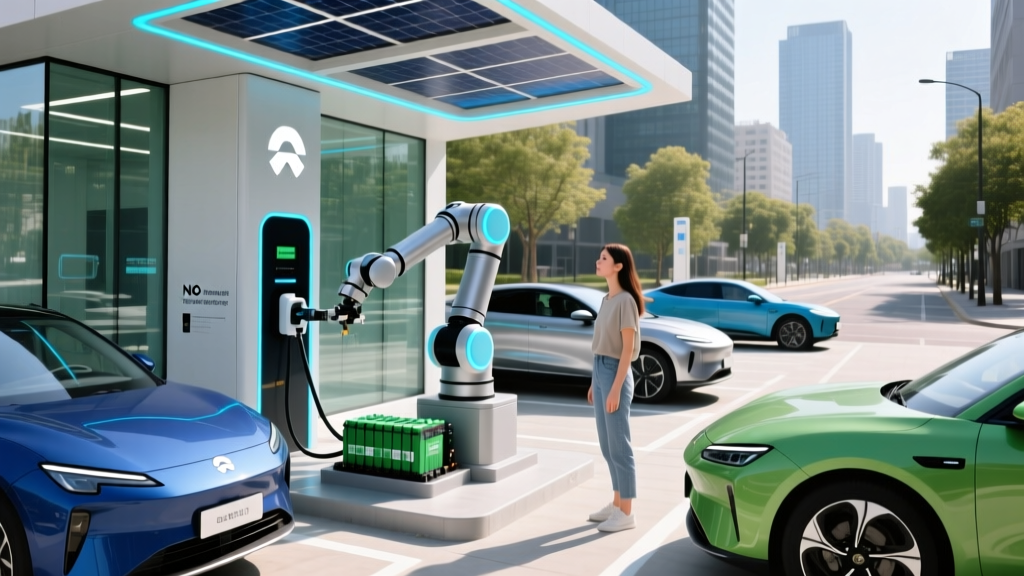
A Nio Power Swap Station is a fully automated, drive-in facility that physically removes your depleted battery pack and installs a fully charged one. The process:
- Drive in: You pull into the swap bay (similar to an automatic car wash). The system aligns the vehicle.
- Automated exchange: The station's robotic system unbolt the depleted pack from the vehicle's skateboard platform and lower it into the station's charging rack.
- Fresh pack installed: A pre-charged battery (typically at 90%+ SoC) is raised and bolted into place.
- System check: The car's BMS (battery management system) handshakes with the new pack, and you drive out.
Total time: 3 to 5 minutes for a Generation 3 or 4 station. Older Gen 2 stations take roughly 5–8 minutes.
Each station stores between 13 (Gen 3) and 23 (Gen 4) battery packs, charging them continuously. Nio's fourth-generation stations, introduced in 2024 and expanding through 2026, support ultra-fast swap cycles and can service up to 480 swaps per day.
Why Battery Swapping Matters for Ownership
The swap model fundamentally changes three aspects of EV ownership:
- Range flexibility: Need more range for a road trip? Swap your 75 kWh LFP pack for a 100 kWh NMC or even a 150 kWh semi-solid-state pack on a temporary basis, then swap back.
- Battery degradation anxiety eliminated: Because you don't own a specific physical battery (under the BaaS subscription model), you're never worried about long-term degradation reducing your car's value.
- Upgradability: As Nio introduces higher-capacity or faster-charging packs, your existing vehicle can use them — no new car purchase required.
Charging Speeds: Swap vs. Plug-In Comparison
| Method | Power / Rate | Time to Add ~200 mi | Availability |
|---|---|---|---|
| Battery Swap (Gen 4) | N/A (physical exchange) | ~3–5 minutes | Nio swap stations (2,800+ globally) |
| DC Fast Charge (100 kWh pack) | Peak ~180 kW | ~25–30 min (10–80%) | Public CCS/CHAdeMO networks |
| DC Fast Charge (75 kWh LFP) | Peak ~130 kW | ~30 min (10–80%) | Public CCS/CHAdeMO networks |
| Level 2 Home (11 kW) | 11 kW / ~37 mi/hr | ~8 hours (full charge) | Home / workplace |
| Level 2 Home (7 kW) | 7 kW / ~25 mi/hr | ~11 hours (full charge) | Home / destination |
| Level 1 (120V) | ~1.4 kW / ~5 mi/hr | ~40+ hours | Standard outlet |
Charging curve reality: The ET7's 100 kWh NMC pack peaks at ~180 kW only between roughly 10–30% SoC. From 30–60%, it sustains around 120–140 kW. Above 80%, the rate tapers sharply to protect cell longevity — expect ~40–50 kW. This is why the 10–80% metric matters more than peak kW claims.
Pricing, Battery-as-a-Service (BaaS), and Tax Credit Eligibility
Nio offers two purchase structures that significantly affect the sticker price:
Option 1: Full Purchase (Battery Included)
You buy the vehicle and battery outright. The 2026 ET7 100 kWh starts at approximately ¥428,000 in China (~$59,000 USD). In European markets (sold as ET7/EL7), pricing ranges from €69,000 to €85,000 depending on trim and battery.
Option 2: Battery-as-a-Service (BaaS) Subscription
You purchase the vehicle without the battery, reducing the upfront cost by roughly ¥70,000–¥128,000 (~$10,000–$18,000) depending on pack size. You then pay a monthly subscription:
- 75 kWh pack: ~¥728/month (~$100/month)
- 100 kWh pack: ~¥1,128/month (~$155/month)
- 150 kWh pack: ~¥1,980/month (~$275/month) — typically short-term rental
The BaaS model makes the ET7's entry price highly competitive, but you'll pay continuously for the battery indefinitely. Over 8 years, the 100 kWh subscription totals roughly $14,900 — comparable to the cost differential of buying the pack outright.
| Configuration | Approx. Price (USD) | US Federal §30D Credit | Effective Price |
|---|---|---|---|
| ET7 75 kWh (full purchase, China) | ~$52,000 | Not eligible (not sold in US) | ~$52,000 |
| ET7 100 kWh (full purchase, China) | ~$59,000 | Not eligible (not sold in US) | ~$59,000 |
| ET7 100 kWh (Europe, full purchase) | ~€79,000 (~$86,000) | Not eligible (not sold in US) | Varies by EU country incentives |
| ET7 BaaS 75 kWh (vehicle only, China) | ~$42,000 + $100/mo | Not eligible | ~$42,000 + subscription |
As of 2026, Nio does not sell vehicles in the United States. The ET7, ES6, ET5, and ET9 are available in China and select European markets (Norway, Germany, Netherlands, Sweden, Denmark). Therefore, the IRS §30D Clean Vehicle Credit — which requires a vehicle to be purchased new in the US from a participating manufacturer, subject to MSRP caps ($55,000 sedans / $80,000 SUVs/trucks), buyer income limits ($150K single / $300K joint), and critical mineral/battery sourcing requirements — does not apply to any Nio model.
If Nio enters the US market in the future, eligibility would depend on meeting all §30D criteria at that time. Always verify current rules at irs.gov.
Who the Nio ET7 (and Swap Ecosystem) Suits Best
- You live in China or a supported European market with nearby swap stations
- You want the fastest "refueling" experience available in any EV (~3 min swap)
- You drive long distances regularly and want flexible battery sizing
- You want to avoid battery degradation risk (BaaS model)
- You value premium sedan comfort with tech-forward features
- You're in the US (Nio is not available)
- You prefer a traditional ownership model with no recurring battery fees
- Your area has no swap stations and limited DC fast-charging infrastructure
- You need an SUV with maximum cargo space (consider Nio ES8 or competitors)
- You want EPA-certified range figures and US safety ratings (NHTSA/IIHS)
Standout Technology and Notable Drawbacks
- 3–5 minute battery swap — the fastest EV "refueling" available anywhere
- Flexible battery sizing — use a 75 kWh pack daily, rent a 150 kWh pack for road trips
- 150 kWh semi-solid-state option — among the highest-capacity packs in any production EV
- Premium interior — Nappa leather, 7.1.4 Dolby Atmos sound, NOMI AI assistant, 12.8" AMOLED center display
- Strong performance — 644 hp, 3.8-second 0–60 in a luxury sedan
- Lidar-equipped ADAS — Nio's Adam supercomputer with 4× Nvidia Orin chips (1,016 TOPS), lidar, and 33 perception sensors for its NOP+ (Navigate on Pilot Plus) Level 2 driver-assist
- BaaS eliminates battery degradation risk for resale value
- Not available in the US — no announced US launch timeline as of 2026
- Swap station coverage limited outside China; Europe has only a few dozen stations
- BaaS subscription adds ongoing cost — $100–$155/month indefinitely
- No EPA range rating — CLTC figures are optimistic; WLTP and real-world are lower
- Heavy vehicle — ~5,200 lb curb weight affects tire wear and handling dynamics
- 150 kWh pack swap availability limited — fewer stations stock the semi-solid-state pack
- Charging speed lags competitors — 180 kW peak vs. 250+ kW for Hyundai Ioniq 5 / Kia EV6, 350 kW for Porsche Taycan
NOP+ Driver Assistance — Level 2, Not Self-Driving
Nio's NOP+ (Navigate on Pilot Plus) is a Level 2 driver-assistance system. It provides adaptive cruise control, lane centering, automated lane changes, and highway on/off-ramp navigation. However, the driver must remain fully engaged, hands on or near the wheel, eyes on the road at all times. This is not autonomous driving. Nio's system is comparable to Tesla Autopilot, Ford BlueCruise, and GM Super Cruise in capability level — not to Waymo or Zoox Level 4 robotaxi services.
Frequently Asked Questions
What is the real-world range of the Nio ET7?
With the 100 kWh NMC pack, expect approximately 290–320 miles of real-world highway range in moderate temperatures. In cold weather (below 30°F), reduce that by 20–30% to roughly 210–250 miles. The 75 kWh LFP pack delivers roughly 210 miles highway, and the 150 kWh semi-solid-state pack can reach 450–480 miles under favorable conditions.
How fast does the Nio ET7 charge via plug-in?
The 100 kWh pack peaks at ~180 kW on DC fast charging, achieving a 10–80% charge in roughly 25–30 minutes. The 75 kWh LFP pack peaks at ~130 kW with a similar 10–80% time of ~30 minutes. Home Level 2 charging at 11 kW adds roughly 37 miles of range per hour. Battery swapping, of course, bypasses charging entirely — 3 to 5 minutes for a full pack exchange.
How much does a Nio Power Swap cost?
Under the BaaS subscription model, swaps are included in your monthly fee — you swap as often as needed. For full-purchase owners, Nio historically offered a certain number of free swaps per month (policies vary by market and promotional period). Paid swaps in China typically cost roughly ¥1–1.8/kWh, making a full 100 kWh swap approximately ¥100–180 (~$14–25 USD).
Does the Nio ET7 qualify for the US federal EV tax credit?
No. Nio does not sell vehicles in the United States as of 2026, so the IRS §30D Clean Vehicle Credit is not applicable. US buyers interested in the §30D credit (up to $7,500, subject to MSRP, income, and battery-sourcing requirements) should consult irs.gov for eligible vehicles.
Is Nio's battery swap better than DC fast charging?
For time savings, absolutely — a 3–5 minute swap beats a 25–40 minute DC fast charge session. However, swap stations are far less ubiquitous than DC chargers. Nio has ~2,800 stations globally (mostly in China), while CCS/CHAdeMO fast chargers number in the hundreds of thousands worldwide. The swap model excels where station density is high; elsewhere, plug-in charging remains essential.
Can I upgrade my Nio's battery later?
Yes — this is one of the swap ecosystem's key advantages. If you purchased a 75 kWh pack, you can temporarily or permanently upgrade to 100 kWh or even 150 kWh at a swap station (subject to availability and pricing). This future-proofs the vehicle in a way that fixed-battery EVs cannot match.
What happens if a swap station has no charged batteries?
Nio's app shows real-time battery availability at each station. During peak travel periods (Chinese holidays, for example), popular routes can see stations depleted of charged packs. Nio has been expanding station capacity (Gen 4 stations hold 23 packs) and deploying mobile swap vans for high-demand events, but occasional waits are possible.
Is Nio's Swap Model the Future — or a Niche?
Nio's Power Swap Stations represent the most compelling alternative to traditional EV charging infrastructure. The 3–5 minute swap is genuinely transformative for daily usability and road-trip convenience. The flexible battery model — smaller pack for commuting, larger for road trips — is elegant and practical.
The challenge is scale. Outside China, swap station deployment has been slow. Europe has a handful of stations in Norway, Germany, and the Netherlands — far too few to rely on exclusively. And Nio's absence from the US market means the vast majority of English-language EV buyers simply cannot access this technology today.
For buyers in supported markets with dense swap coverage, the ET7 paired with Nio's ecosystem offers an ownership experience no competitor can match: near-instant "refueling," zero battery degradation anxiety, and upgradeable range. For everyone else, the ET7 remains a compelling but hard-to-reach luxury EV — one that charges conventionally at respectable but not class-leading speeds, and whose most innovative feature requires infrastructure that may never reach your neighborhood.
Sources: Nio official ET7 specifications, IRS Clean Vehicle Credit (§30D).