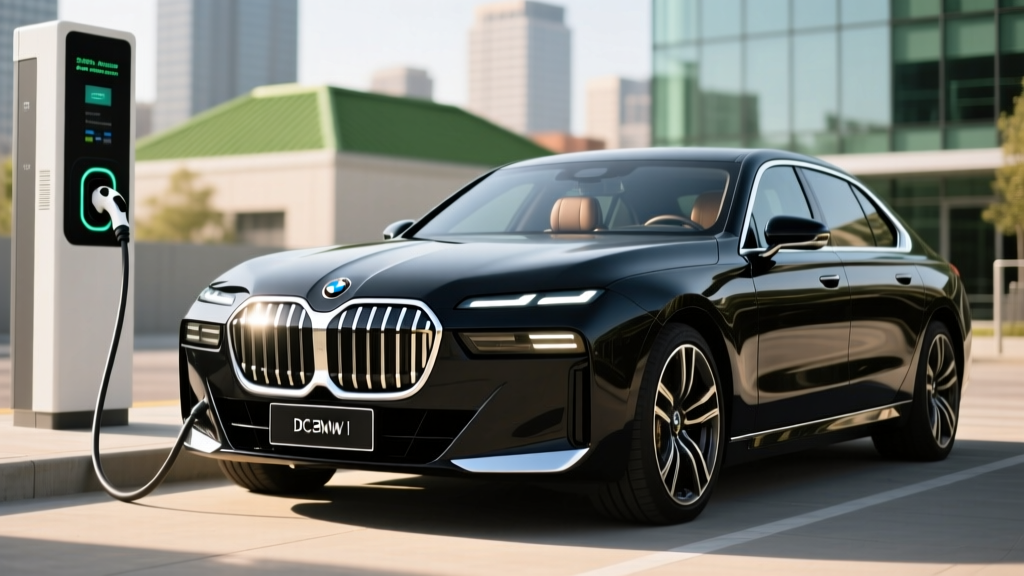
The BMW i7 is the Bavarian automaker's flagship electric sedan — a full-size luxury hauler that attempts to prove a 6,000-pound executive cruiser can also be a legitimate daily-driver EV. For 2026, the i7 lineup continues with the xDrive60 dual-motor variant and the high-performance M70, both riding on BMW's CLAR platform with a massive battery pack stuffed into the floor. But does the real-world range justify the six-figure price, and how does charging actually work on road trips? We break down every number that matters.
2026 BMW i7 at a Glance: Key Specifications
| Specification | i7 xDrive60 | i7 M70 |
|---|---|---|
| EPA Range | 318 miles (20" wheels) | 295 miles (21" wheels) |
| Battery (Usable) | 101.7 kWh (NMC) | 101.7 kWh (NMC) |
| Powertrain | Dual-motor AWD | Dual-motor AWD |
| Horsepower | 536 hp | 650 hp |
| 0–60 mph | 4.5 seconds | 3.5 seconds |
| DC Fast Charge (Peak) | 195 kW | 195 kW |
| 10–80% DCFC Time | ~34 minutes | ~34 minutes |
| Level 2 Charge Rate | 11 kW (~30 mi/hr) | 11 kW (~30 mi/hr) |
| MPGe (Combined) | 82 MPGe | 77 MPGe |
| Efficiency | 41 kWh/100 mi | 43 kWh/100 mi |
| Cargo Volume | 17.7 cu ft (trunk) | 17.7 cu ft (trunk) |
| Rear Legroom | 41.9 inches | 41.9 inches |
| Base MSRP | $125,175 | $169,695 |
| Battery Warranty | 8 yr / 100,000 mi | 8 yr / 100,000 mi |
Real-World Range: What the EPA Number Doesn't Tell You
EPA Sticker: 318 miles
Expected Highway (70 mph, 72°F): ~265–280 miles
Expected Highway (70 mph, 30°F): ~225–245 miles
City / Mixed Commute: ~295–310 miles
Source: EPA fueleconomy.gov; real-world estimates based on large-luxury EV testing patterns and BMW's aerodynamic profile (Cd 0.24).
The i7 xDrive60's EPA-estimated 318 miles is respectable for a sedan of this mass (5,660 lbs curb weight). However, the physics of pushing a large luxury car at sustained highway speeds takes a toll. On flat interstate runs at 70 mph in moderate temperatures, expect roughly 265–280 miles before you're hunting for a charger. In cold weather — say, a January drive from Chicago to Milwaukee — the battery's internal resistance increases and cabin heating draws significant energy, compressing range to roughly 225–245 miles.
The i7's heat pump (standard equipment) mitigates some cold-weather loss by scavenging waste heat from the drivetrain rather than relying solely on resistive heating. Owners in northern climates will still see a 20–25% range reduction in sub-freezing conditions, which is consistent with most NMC-equipped luxury EVs in this class. According to EPA data on fueleconomy.gov, the xDrive60 achieves 82 MPGe combined (41 kWh/100 mi), which is efficient for its weight but still trails the lighter Mercedes EQS sedan.
For daily commuting under 80 miles round-trip, the i7's real-world range is essentially a non-issue — you'll charge at home overnight and never think about it. Road trips require more planning, particularly given the charging-curve behavior discussed below.
Charging Speed and Infrastructure: DC Fast, Level 2, and Home Setup
The i7 uses BMW's fifth-generation eDrive architecture with a peak DC fast-charge rate of 195 kW via CCS1 connector. That number represents the peak, not the sustained rate — and understanding the charge curve is essential for trip planning.
| Charging Level | Power (kW) | Speed (Approx.) | Notes |
|---|---|---|---|
| Level 1 (120V) | ~1.4 kW | ~4 miles/hour | Emergency/trickle only; full charge in ~72 hours |
| Level 2 (240V, 48A) | 11 kW (onboard limit) | ~30 miles/hour | Full charge in ~10.5 hours; ideal for overnight |
| DC Fast Charge | Up to 195 kW peak | ~180 mi in 15 min (10–40% SoC) | Tapers significantly above 60% SoC |
DC fast-charging reality: The i7 hits its 195 kW peak between roughly 10–35% state of charge (SoC), then begins tapering. From 35–60%, expect sustained rates around 120–140 kW. Above 80% SoC, the charge rate drops sharply to protect the NMC cells, falling below 50 kW. The published 10–80% time of approximately 34 minutes is accurate under optimal conditions (battery preconditioned, ambient temp 60–80°F, functional 350 kW-rated station).
BMW's navigation system includes automatic battery preconditioning when a DC fast charger is set as your destination — the pack is warmed to its ideal charging temperature before you arrive. This is critical: showing up at a Electrify America or EVgo station with a cold battery can add 10–15 minutes to your session as the car first warms the cells before accepting peak power.
For home charging, the i7's 11 kW onboard charger means you'll need a 48-amp Level 2 circuit (hardwired, 60-amp breaker) to achieve maximum Level 2 speed. At 11 kW, the i7 recovers roughly 30 miles of range per hour, meaning a full 0–100% charge takes about 10.5 hours. Most owners will arrive home at 30–40% SoC and wake up fully charged — this is the ownership experience that makes large-battery EVs practical. Installation costs for a home Level 2 setup typically run $800–$2,500 depending on panel capacity and run length; homes with 100-amp service panels may require a $2,000–$4,000 panel upgrade to support a dedicated 60-amp EV circuit.
Performance and Driving Dynamics
The i7 xDrive60's dual-motor all-wheel-drive powertrain produces 536 horsepower and 549 lb-ft of torque, delivering a 0–60 mph time of 4.5 seconds. For a sedan that weighs nearly three tons, that's genuinely quick — and the instantaneous electric torque makes highway merging and passing effortless. The M70 variant cranks output to 650 hp and drops the 0–60 to 3.5 seconds, putting it in sports-car territory despite its executive-sedan proportions.
BMW's adaptive two-axle air suspension is standard across the i7 lineup, providing a genuinely plush ride that isolates occupants from road imperfections. The available rear-wheel steering (Integral Active Steering) reduces the turning circle and adds agility at low speeds — a meaningful feature for a car with a 126.6-inch wheelbase. Regenerative braking is adjustable through three levels, though BMW does not offer true one-pedal driving to a complete stop like some competitors. The adaptive recuperation mode uses radar and navigation data to automatically adjust regen based on traffic and upcoming intersections, which works well in practice once you trust the system.
Interior, Technology, and Cargo
The i7's cabin is where BMW justifies its flagship pricing. The curved display setup pairs a 12.3-inch digital instrument cluster with a 14.9-inch central touchscreen running BMW iDrive 8.5 (upgraded to iDrive 9 for the 2026 model year). The system is responsive and visually polished, though the reduction in physical buttons compared to previous BMW generations means more reliance on touchscreen and voice control for climate and seat adjustments.
The available 31.3-inch 8K Theater Screen for rear passengers is the i7's most dramatic tech feature — a ceiling-mounted display that drops down to transform the rear cabin into a mobile cinema, complete with built-in Amazon Fire TV integration and 5G connectivity. It's a $3,000+ option that's genuinely impressive for chauffeured use or family road trips with children.
Cargo space is the i7's practicality weak point. The trunk offers 17.7 cubic feet — adequate for luggage but less than the EQS sedan's 22 cu ft and far behind any SUV. There is no front trunk (frunk); BMW uses that space for drivetrain components and electronics. Rear-seat legroom is a generous 41.9 inches, and the available Executive Lounge rear seating package adds heated, ventilated, and massaging outboard rear seats with a fixed center console.
Pricing, Tax Credits, and Ownership Costs
| Trim | Base MSRP | Typical As-Tested | Federal Tax Credit |
|---|---|---|---|
| i7 xDrive60 | $125,175 | $135,000–$148,000 | $0 (exceeds MSRP cap) |
| i7 M70 | $169,695 | $175,000–$195,000 | $0 (exceeds MSRP cap) |
Here is the critical tax-credit reality for the i7: it does not qualify for the federal §30D new clean vehicle credit. Under current IRS rules, sedans must have an MSRP at or below $55,000 to be eligible. The i7 starts at $125,175 — more than double the cap. This is not a battery-sourcing or income-limit issue; it's a straightforward price disqualification. The IRS publishes the full §30D eligibility rules, and the MSRP cap is one of the most rigid requirements.
Buyers should also budget for ownership costs beyond the purchase price. Insurance for the i7 averages $3,800–$5,200 annually depending on location and driving record, reflecting the vehicle's value and repair costs for its aluminum-intensive structure and sensor array. BMW includes 3 years/36,000 miles of complimentary scheduled maintenance and 4 years/50,000 miles of limited warranty coverage. The high-voltage battery carries an 8-year/100,000-mile warranty against defects and capacity loss below 70% of original capacity — a standard benchmark for luxury EVs.
Electricity costs to "fuel" the i7 are substantially lower than gasoline equivalents. At the national average residential electricity rate of ~$0.16/kWh, fully charging the 101.7 kWh pack costs approximately $16.27. Over 15,000 annual miles at 41 kWh/100 mi, annual home-charging cost is roughly $984. A comparable BMW 740i (gasoline) at 25 MPG combined and $3.50/gallon fuel would cost ~$2,100 annually — a savings of about $1,100 per year with the i7, though this must be weighed against the i7's significantly higher purchase price and lack of tax credit.
BMW i7 vs. Key Competitors: Is It Worth Buying?
The i7 competes in a narrow but growing segment of full-size electric luxury sedans. Its most direct rivals are the Mercedes-Benz EQS (340-mile EPA range, starting ~$105,550), the Lucid Air Pure (419-mile EPA range, starting ~$78,900), and the Porsche Taycan (283-mile EPA range for the 4S, starting ~$103,800). Each makes a different argument:
- Mercedes EQS: Longer range, lower starting price, more cargo space (22 cu ft hatchback), but less engaging driving dynamics and polarizing exterior design.
- Lucid Air: Class-leading range and efficiency, lower price, but less established dealer/service network and a less opulent rear-seat experience.
- Porsche Taycan: Sharper handling, faster sustained charging (up to 270 kW on 800V architecture), but significantly less rear-seat space and range.
- Seriously quiet, refined cabin at highway speed
- Air suspension delivers excellent ride quality
- 31.3" Theater Screen is a unique luxury feature
- 318-mi EPA range is adequate for most use cases
- Strong straight-line performance (4.5s to 60)
- BMW dealer network for service/parts
- No federal tax credit (MSRP far exceeds $55K cap)
- 17.7 cu ft trunk trails EQS hatchback and any SUV
- 195 kW peak DC charging trails Porsche/Lucid/Audi
- No frunk for additional cargo flexibility
- High insurance and repair costs
- Heavy reliance on touchscreen for basic controls
The i7 is the right choice if you prioritize BMW's driving character, want a traditional luxury sedan silhouette (not the EQS's one-box shape), and value BMW's established dealer and service infrastructure. It's the wrong choice if maximum range, maximum cargo, or tax-credit eligibility are your top priorities.
Who Should Buy the 2026 BMW i7?
- Executive commuters with home charging and sub-80-mile daily drives who want a premium, quiet sedan for the workday
- Luxury sedan loyalists transitioning from the BMW 7 Series or Mercedes S-Class who want electric without sacrificing ride quality or rear-seat comfort
- Tech-forward families who'll use the Theater Screen on road trips and appreciate the i7's safety suite (standard Driving Assistant Professional with highway assist)
- Buyers who need maximum cargo flexibility (get an iX or EQS SUV instead)
- Price-sensitive shoppers (the Lucid Air offers more range at $45K less)
- Frequent long-distance road trippers in regions with sparse DC fast-charging infrastructure
Frequently Asked Questions
What is the real-world range of the BMW i7?
The EPA rates the i7 xDrive60 at 318 miles, but real-world highway driving at 70 mph in moderate temperatures typically yields 265–280 miles. In cold weather (below 32°F), expect 225–245 miles. City and mixed driving with regenerative braking recovers closer to the EPA estimate at 295–310 miles.
How fast does the BMW i7 charge?
On a DC fast charger, the i7 peaks at 195 kW and charges from 10–80% in approximately 34 minutes under optimal conditions. At home on a Level 2 charger (11 kW), it adds about 30 miles of range per hour, fully charging overnight in roughly 10.5 hours.
Does the BMW i7 qualify for the federal EV tax credit?
No. Under current IRS §30D rules, new electric sedans must have an MSRP at or below $55,000 to qualify. The i7 starts at $125,175, making it ineligible regardless of buyer income or battery sourcing. Some state-level incentives may still apply — check your state's energy office for local rebates.
How much does it cost to own a BMW i7 over 5 years?
Beyond the $125K+ purchase price, budget roughly $4,500/year for insurance, ~$1,000/year for home electricity, and $0 for scheduled maintenance during the first 3 years (included by BMW). Over 5 years and 75,000 miles, fuel savings versus a gasoline 7 Series offset approximately $5,500 of the i7's premium, but depreciation on a six-figure luxury EV remains significant — expect 50–55% value retention at the 5-year mark based on current luxury EV trends.
Is the BMW i7 worth buying over the Mercedes EQS or Lucid Air?
The i7 wins on driving dynamics, rear-seat luxury technology (Theater Screen), and BMW's dealer network. The EQS wins on range (340 mi EPA), cargo versatility (hatchback), and a lower starting price. The Lucid Air wins on range (419 mi EPA) and value. Your priority ranking among those factors should determine the winner — there's no universally "best" choice in this segment.
What is the BMW i7's battery warranty?
BMW covers the i7's high-voltage battery for 8 years or 100,000 miles (whichever comes first), guaranteeing it will retain at least 70% of its original capacity. The standard vehicle limited warranty covers 4 years or 50,000 miles.