NIO's June 2025 Delivery Numbers: A Snapshot of Momentum
NIO reported 21,209 vehicle deliveries for June 2025, a figure that reflects both the maturation of its premium lineup and the rapid ramp-up of its mass-market ONVO sub-brand. For US-based EV shoppers tracking NIO's long-rumored North American entry, these numbers matter—not as a buying signal today, but as a data point on the company's production scale, battery-swap infrastructure, and global ambition.
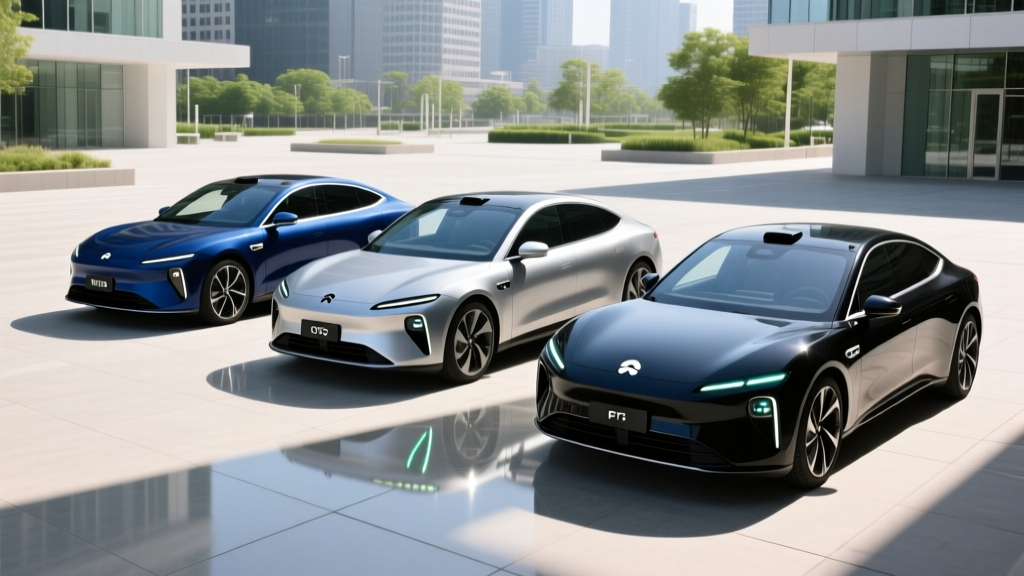
This profile breaks down the key models driving NIO's June 2025 deliveries—the flagship EL8 SUV, the ET7 sedan, and the volume-chasing ONVO L60—with a hard look at specs, real-world range expectations, charging performance, and the tax-credit landscape. If and when these vehicles arrive in the US, here's what the numbers tell us.
| Spec | EL8 (Flagship SUV) | ET7 (Sedan) | ONVO L60 (Midsize SUV) |
|---|---|---|---|
| Battery (usable) | 100 kWh / 150 kWh (semi-solid) | 75 kWh / 100 kWh / 150 kWh | 60 kWh (LFP) / 85 kWh (NMC) |
| Chemistry | NMC (CATL) / Semi-solid-state | NMC / Semi-solid-state | LFP (standard) / NMC (long-range) |
| CLTC Range | Up to 900 km (150 kWh) | Up to 1,050 km (150 kWh) | 555 km (60 kWh) / 730 km (85 kWh) |
| EPA Est. Range (projected) | ~310 mi (100 kWh) / ~400 mi (150 kWh) | ~280 mi (100 kWh) / ~370 mi (150 kWh) | ~230 mi (60 kWh) / ~295 mi (85 kWh) |
| Drivetrain | Dual-motor AWD | Dual-motor AWD | RWD / AWD |
| Horsepower | 644 hp | 644 hp | 295 hp (RWD) / 490 hp (AWD) |
| 0-60 mph | ~4.1 sec | ~3.8 sec | ~6.5 sec (RWD) / ~4.9 sec (AWD) |
| Max DC Fast Charge | ~180 kW (100 kWh pack) | ~180 kW (100 kWh pack) | ~170 kW (85 kWh pack) |
| 10-80% DC Time | ~30 min | ~30 min | ~28 min (85 kWh) |
| Level 2 Home Charge | 11 kW (~30 mi/hr) | 11 kW (~32 mi/hr) | 7 kW (~22 mi/hr) / 11 kW optional |
| Length / Wheelbase | 199.6" / 118.5" | 198.3" / 121.3" | 189.8" / 113.0" |
| Cargo Volume | ~25 cu ft (rear seats up) | ~16 cu ft (trunk) | ~21 cu ft (rear seats up) |
| Base MSRP (China) | ¥498,000 (~$68,500) | ¥378,000 (~$52,000) | ¥149,900 (~$20,600, BaaS) |
| Battery Warranty | 10 yr / unlimited km (BaaS) | 10 yr / unlimited km (BaaS) | 8 yr / 160,000 km |
Note: CLTC is China's testing cycle and yields higher range figures than the US EPA cycle. EPA estimates above are projected based on typical CLTC-to-EPA conversion ratios (~70-75% of CLTC). Official EPA numbers will be published on fueleconomy.gov only if these models receive US certification.
Real-World Range: What the Sticker Won't Tell You
EPA Projected Range vs. Real-World Expectation
EL8 (100 kWh): EPA proj. ~310 mi → Expect ~255-275 mi highway; ~220-240 mi in sub-40°F conditions.
ET7 (100 kWh): EPA proj. ~280 mi → Expect ~240-260 mi highway; ~200-220 mi in cold weather.
ONVO L60 (85 kWh): EPA proj. ~295 mi → Expect ~250-270 mi highway; ~210-230 mi in cold weather.
NIO's headline-grabbing 150 kWh semi-solid-state battery pack (supplied by WeLion) delivers extraordinary CLTC range figures—over 620 miles for the ET7. But the semi-solid packs are extremely expensive (adding roughly $30,000+ to the vehicle cost in China), produced in limited quantities, and primarily available through NIO's battery-rental program rather than outright purchase. Most buyers in June 2025 opted for the 75 kWh or 100 kWh NMC packs.
For US buyers, the practical takeaway: the 100 kWh NMC pack is the sweet spot for range and value, but real-world highway driving at 70+ mph will consume 15-20% more energy than the EPA sticker suggests. Cold-weather range loss of 25-30% is typical for NMC chemistry without an aggressive heat-pump preconditioning strategy—something NIO's thermal management system does include, though its effectiveness in sub-zero conditions hasn't been validated in North American testing.
Charging Speed and Battery-Swap: NIO's Dual Strategy
NIO's charging story is inseparable from its battery-swap infrastructure. In China, NIO operates over 2,400 Power Swap stations as of mid-2025, allowing a depleted battery to be exchanged for a fully charged one in roughly 3-5 minutes. This is a genuine differentiator—but it depends entirely on station density, which doesn't exist outside China and parts of Europe.
| Charging Method | Power (kW) | Rate (mi/hr added) | 10-80% Time | Notes |
|---|---|---|---|---|
| Level 1 (120V, 12A) | ~1.4 kW | ~3-4 mi/hr | N/A (days) | Emergency/trickle only |
| Level 2 (240V, 48A) | 11 kW | ~28-32 mi/hr | ~9-10 hours (100 kWh) | Home overnight charge |
| DC Fast Charge | Peak ~180 kW | ~450-550 mi/hr (peak) | ~30 min | Tapers significantly above 80% |
| Battery Swap (China) | N/A | Full pack in ~5 min | ~5 min (full) | Requires NIO Power Swap station |
The ~180 kW peak DC fast-charge rate is competitive but not class-leading. The Hyundai Ioniq 5 and Kia EV6 hit 240+ kW on 800V architectures, achieving 10-80% in roughly 18 minutes. NIO's 30-minute 10-80% time is acceptable for road trips but noticeably slower than the 800V benchmark. The charge curve is relatively flat through 60% SoC, then tapers hard past 80%—a common NMC behavior to protect cell longevity.
For US buyers, battery swap is the wildcard. NIO has hinted at bringing swap stations to North America, but regulatory, zoning, and infrastructure hurdles make widespread deployment unlikely before 2028 at the earliest. Plan on conventional DC fast charging and home Level 2 as your primary methods.
Performance and Driving Dynamics
NIO's premium models don't disappoint on paper. The ET7's dual-motor AWD system delivers 644 hp and a 3.8-second 0-60 mph time—putting it squarely in Tesla Model S and Porsche Taycan territory for straight-line acceleration. The EL8, despite its larger SUV footprint, manages 4.1 seconds thanks to the same powertrain.
The ONVO L60 takes a different approach: as a mass-market competitor to the Tesla Model Y, it prioritizes efficiency over outright speed. The single-motor RWD variant (295 hp, ~6.5 sec 0-60) is the volume seller, while the dual-motor AWD (490 hp, ~4.9 sec) is the enthusiast option.
All NIO models feature standard air suspension on the premium line (EL8, ET7) and adaptive damping, contributing to a ride quality that Chinese and European reviewers consistently rate above the Tesla benchmark. The ET7's 121.3-inch wheelbase delivers exceptional rear-seat legroom (~40 inches), though the fastback roofline cuts into rear headroom slightly.
Pricing, Tax Credits, and the US Availability Question
Here's where the June 2025 delivery data collides with US market reality: NIO does not currently sell vehicles in the United States. The company has publicly discussed a North American entry, potentially under the ONVO sub-brand, but no timeline, pricing, or regulatory certification has been announced as of early 2026.
| Model | China MSRP (with battery) | Projected US MSRP (est.) | §30D Tax Credit Eligibility |
|---|---|---|---|
| ET7 (100 kWh) | ¥428,000 (~$58,800) | $62,000-$68,000 | Unlikely — battery sourcing rules (§30D) require non-Chinese critical minerals |
| EL8 (100 kWh) | ¥498,000 (~$68,500) | $72,000-$80,000 | Exceeds SUV MSRP cap ($80,000); unlikely on sourcing |
| ONVO L60 (85 kWh) | ¥179,900 (~$24,700, with battery) | $32,000-$38,000 | Unlikely — same battery sourcing barriers |
The IRS §30D federal tax credit imposes strict requirements that would almost certainly disqualify NIO vehicles in their current form:
- MSRP Cap: Sedans must be ≤$55,000; SUVs/pickups ≤$80,000. The ET7 might qualify on price; the EL8 is borderline.
- Buyer Income Cap: AGI ≤$150,000 (single) / $300,000 (joint). This applies regardless of the vehicle.
- Battery Component Sourcing: Increasingly strict percentages of battery components must be manufactured or assembled in North America. NIO's CATL and WeLion batteries are China-sourced.
- Critical Minerals: A growing percentage of critical minerals must be sourced from the US or FTA partners. Chinese-mined lithium, cobalt, and graphite would not qualify.
- Foreign Entity of Concern (FEOC): Vehicles with battery components from a FEOC (which includes many Chinese state-linked suppliers) are disqualified entirely starting 2024-2025.
Bottom line: even if NIO launches in the US, buyers should not expect the $7,500 federal tax credit to apply. Consult a tax professional and check the latest IRS guidance before making purchase assumptions.
Interior, Tech, and Standout Features
NIO's interior execution is a genuine strength. The ET7 and EL8 feature:
- NOMI AI companion: A dashboard-mounted robotic "head" that serves as the voice assistant interface—gimmicky in concept, but reviewers note it's surprisingly effective for navigation, climate, and media commands.
- 12.8" AMOLED center display with NIO's Banyan OS—responsive, well-designed, though app ecosystem outside China is unproven.
- 7.1.4 Dolby Atmos audio (23 speakers on ET7) — among the best factory audio systems in any EV at this price point.
- Standard NIO Aquila Super Sensing: 33 sensors including a roof-mounted LiDAR unit, enabling the NIO NOP+ (Navigate on Pilot Plus) driver-assist system.
- Battery-as-a-Service (BaaS): In China, buyers can purchase the vehicle without the battery (reducing upfront cost by ~$10,000-$15,000) and subscribe to a battery-rental plan (~$140-$230/month depending on pack size). This model's viability in the US is uncertain.
Driver-Assist Level: SAE Level 2
NIO's NOP+ is a Level 2 driver-assistance system. It handles highway lane-keeping, adaptive cruise, and automated lane changes under specific conditions, but the driver must remain fully engaged and hands-on (or eyes-on, depending on jurisdiction). It is not self-driving. NIO has tested Level 4 robotaxi prototypes in China, but production vehicles sold to consumers operate at Level 2 only.
Who Should Watch NIO — and Who Should Look Elsewhere
Watch NIO if:
- You're tracking the premium EV sedan/SUV market for future competition and pricing pressure on Tesla, BMW, and Mercedes.
- You're based in Europe (NIO sells in Norway, Germany, Netherlands, and expanding) and can access current models.
- Battery-swap technology interests you as a long-term ownership flexibility play.
- The ONVO L60's sub-$25,000 China pricing signals the kind of affordable EV competition that could eventually reach the US.
Look elsewhere if:
- You need to buy an EV in the US in 2026. NIO is not available, and no launch date has been confirmed.
- Federal tax credit eligibility is important to your purchase math.
- You need proven North American service infrastructure and parts availability.
- You prioritize 800V-class ultra-fast charging (18-minute 10-80%) over battery-swap flexibility.
Biggest Pros and Cons
Pros
- Battery-swap ecosystem eliminates degradation anxiety and enables 5-minute "refueling" (where stations exist)
- 150 kWh semi-solid pack offers best-in-class range potential (~370-400 mi EPA projected)
- Premium interior materials and audio quality rival $80K+ European competitors
- ONVO L60 signals aggressive mass-market pricing that could disrupt the segment
- Standard LiDAR across the lineup — most competitors charge extra or omit it entirely
- Air suspension standard on premium models; ride quality rated above Tesla Model S/Y
Cons
- Not available in the US — no confirmed launch timeline
- ~180 kW peak DC charge rate trails 800V competitors (Hyundai, Kia, Porsche at 240-350 kW)
- Federal §30D tax credit almost certainly inapplicable due to Chinese battery sourcing
- Battery-swap infrastructure doesn't exist in North America and faces major deployment barriers
- NIO's financial sustainability remains a question (the company has posted significant operating losses)
- BaaS subscription model adds ongoing cost complexity vs. outright battery ownership
- CLTC range figures are inflated vs. EPA — real-world US range would be 25-30% lower than Chinese marketing materials suggest
What June 2025 Deliveries Signal About NIO's Trajectory
NIO's 21,209 June 2025 deliveries represent roughly 18% year-over-year growth and a monthly record for the brand at the time. The delivery mix tells a strategic story: the premium NIO brand (ET7, EL8, ES6) accounted for roughly 12,000 units, while the newer ONVO sub-brand (L60) contributed approximately 9,000 units in its early ramp phase.
For context, Tesla delivered roughly 443,000 vehicles globally in Q2 2025 (~148,000/month). BYD's pure-EV deliveries exceeded 420,000/month. NIO remains a niche player by volume, but its technology portfolio—particularly the semi-solid-state battery and swap infrastructure—positions it as an innovation leader even if production scale lags.
The June 2025 numbers also coincided with NIO's expansion of its Power Swap network into its first Southeast Asian markets and continued investment in European operations. US entry, however, remains conspicuously absent from near-term roadmaps, likely due to the tariff environment (100% US tariff on Chinese-built EVs as of 2024), FEOC sourcing restrictions, and the capital intensity of building a North American dealer and service network from scratch.
Frequently Asked Questions
What is the real-world range of NIO vehicles?
For the 100 kWh NMC pack (the most common configuration), expect approximately 255-275 miles in real-world highway driving for the EL8 and 240-260 miles for the ET7. Cold weather (below 40°F) reduces these figures by 20-30%. The 150 kWh semi-solid pack extends range substantially but is expensive and limited in availability.
How fast do NIO vehicles charge?
NIO's 100 kWh pack peaks at approximately 180 kW on DC fast chargers, achieving 10-80% in roughly 30 minutes. Home Level 2 charging at 11 kW adds about 30 miles of range per hour, requiring roughly 9-10 hours for a full charge. This is competitive but slower than 800V competitors like the Hyundai Ioniq 5 (~18 minutes, 10-80%).
Can I buy a NIO in the United States?
No. As of early 2026, NIO does not sell or deliver vehicles in the US. The company has discussed North American entry but has not announced a timeline, model lineup, or pricing for the US market. The 100% US tariff on Chinese-built EVs and battery-sourcing restrictions present significant barriers.
Does NIO qualify for the $7,500 federal EV tax credit?
Almost certainly not, even if NIO begins US sales. The IRS §30D credit requires battery components and critical minerals to be sourced from North America or FTA partners, with increasing percentages each year. NIO's CATL and WeLion battery suppliers are China-based, and FEOC restrictions further disqualify Chinese-sourced battery components. Always verify current rules at irs.gov.
What is NIO's battery-swap system and does it work outside China?
NIO's Power Swap stations can exchange a depleted battery for a fully charged one in approximately 3-5 minutes. As of mid-2025, there are over 2,400 stations in China and a small number in Europe (Norway, Germany, Netherlands). There are no swap stations in North America, and deployment faces significant regulatory and infrastructure challenges.
Is NIO's NOP+ driver assist self-driving?
No. NOP+ (Navigate on Pilot Plus) is an SAE Level 2 driver-assistance system. It can manage highway lane-keeping, adaptive cruise, and automated lane changes, but the driver must remain fully engaged and responsible for the vehicle at all times. It is not a Level 4 autonomous system like Waymo's driverless robotaxi service.
How does NIO's battery warranty work?
For BaaS (Battery-as-a-Service) subscribers in China, the battery carries a 10-year/unlimited-kilometer warranty since NIO retains ownership and handles degradation. For outright battery purchasers, the warranty is 8 years/160,000 km with a capacity retention threshold of approximately 70-80% (varies by pack). US warranty terms would be determined at launch.