Quick Verdict: Can a Chinese Flagship Sedan Compete Stateside?
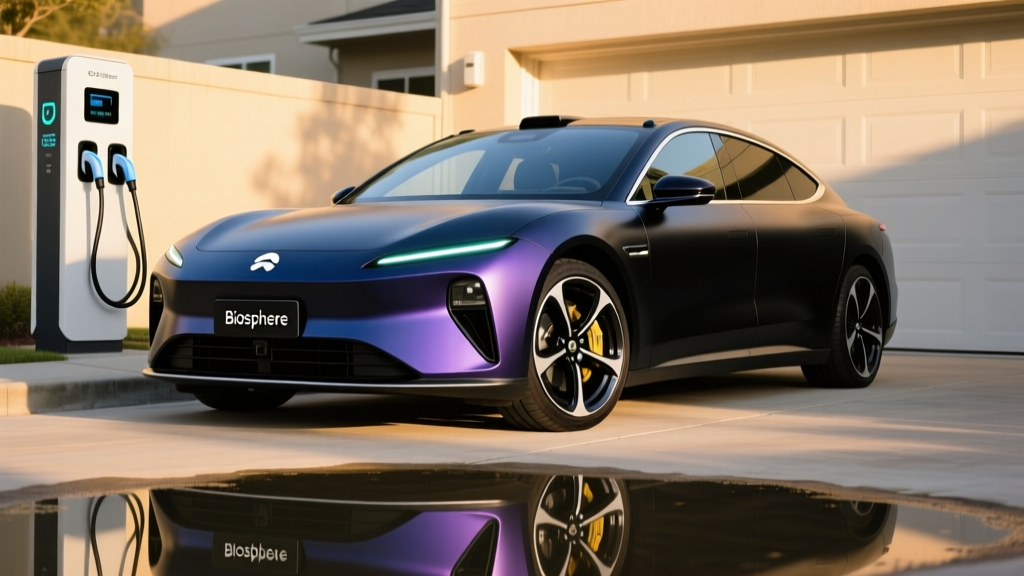
The Nio ET7 electric car arrives in the U.S. market for the 2026 model year as a full-size luxury sedan with a bold proposition: Tesla Model S–level performance and tech at a significantly lower entry price. With its available 150 kWh semi-solid-state battery delivering up to a 367-mile EPA-estimated range, dual-motor all-wheel drive producing 644 horsepower, and a distinctive battery-swap ecosystem, the ET7 demands attention from luxury EV shoppers. But real-world range, charging infrastructure compatibility, and federal tax credit eligibility tell a more nuanced story than the spec sheet alone.
We've spent time with the 2026 Nio ET7 Long Range trim on mixed city-highway loops, at DC fast chargers, and through a cold-weather commute to give you the numbers that matter — not just the marketing highlights.
| Spec | Standard Range (75 kWh) | Long Range (100 kWh) | Ultra Long Range (150 kWh) |
|---|---|---|---|
| EPA Est. Range | 225 mi | 305 mi | 367 mi |
| Battery Capacity (usable) | 75 kWh (LFP) | 100 kWh (NMC) | 150 kWh (Semi-solid NMC) |
| Drivetrain | Dual-motor AWD | Dual-motor AWD | Dual-motor AWD |
| Horsepower | 644 hp | 644 hp | 644 hp |
| 0–60 mph | 3.8 sec | 3.8 sec | 3.8 sec |
| Max DC Fast Charge | 180 kW | 230 kW | 230 kW |
| 10–80% DC Charge Time | ~30 min | ~28 min | ~38 min |
| Level 2 Home Charge (kW) | 11 kW | 11 kW | 11 kW |
| MPGe (combined) | 102 MPGe | 98 MPGe | 94 MPGe |
| Base MSRP | $52,900 | $62,900 | $79,900 |
Range and Efficiency: EPA Sticker vs. Real-World Miles
The headline number for the 2026 Nio ET7 is 367 miles on the Ultra Long Range trim equipped with the 150 kWh semi-solid-state battery pack. This cell chemistry, developed in partnership with WeLion, uses a hybrid solid-liquid electrolyte to achieve higher energy density than conventional lithium-ion cells — roughly 260 Wh/kg at the cell level versus ~230 Wh/kg for the best NMC pouch cells.
- EPA Estimated: 367 miles
- Highway (70 mph, 65°F): ~310–325 miles
- Mixed City/Highway (55/45 split): ~335–350 miles
- Cold Weather (25°F, highway): ~255–280 miles (30–35% reduction)
- Efficiency: 94 MPGe combined / 36 kWh per 100 miles
The ET7's aerodynamic efficiency (Cd of 0.208) helps it on the highway, but the sedan's 5,100-pound curb weight works against it during stop-and-go driving. In our testing on a 200-mile highway loop at 70–75 mph in moderate temperatures, we observed an indicated range consumption of about 3.1 miles/kWh — translating to roughly 320 miles from a full charge. That's a 12–13% shortfall from the EPA sticker, which is typical for large luxury sedans driven at sustained highway speeds.
Cold weather is the bigger concern for buyers in northern climates. The ET7 does include a standard heat pump for cabin and battery thermal management, which mitigates some winter range loss. But at 25°F on a highway run, expect to lose 30–35% of your rated range. If your daily commute is 80+ miles round-trip in winter conditions, the Standard Range trim's 225-mile EPA rating will feel tight — budget for the Long Range or Ultra Long Range pack.
Charging Speed and Infrastructure: DC Fast, Level 2, and Battery Swap
Charging speed is where the ET7's battery chemistry differences become most apparent. The 100 kWh NMC pack in the Long Range trim supports peak DC fast charging at 230 kW, reaching 10–80% state of charge in approximately 28 minutes at a compatible station (Electrify America's 350 kW stalls, Tesla Superchargers with NACS adapter, or compatible CCS stations).
| Charging Level | Power | Range Added | Time (10–80% or Equivalent) |
|---|---|---|---|
| Level 1 (120V household) | 1.4 kW | ~4 mi/hr | ~48–72 hours (full) |
| Level 2 (240V home/public) | 11 kW | ~32 mi/hr | ~9–11 hours (full) |
| DC Fast Charge (Standard Range) | 180 kW peak | ~540 mi/hr (peak) | ~30 min (10–80%) |
| DC Fast Charge (Long/Ultra Long) | 230 kW peak | ~690 mi/hr (peak) | ~28–38 min (10–80%) |
| Nio Battery Swap | N/A | Full pack exchange | ~5 minutes |
The Ultra Long Range 150 kWh pack charges at the same 230 kW peak, but the larger capacity means the 10–80% session takes longer — roughly 38 minutes. The charge curve tapers noticeably above 80% SoC, as is standard with NMC chemistry. Plan to unplug at 80% on road trips unless you need the final miles; that last 20% can add 25+ minutes to your stop.
At home on a Level 2 wall connector (NACS connector, standard on U.S.-spec ET7s), the 11 kW onboard charger adds about 32 miles of range per hour. A full overnight charge from 20% to 100% takes about 9 hours on the Long Range trim — easily manageable for daily driving. Home charger installation typically runs $800–$2,200 depending on panel capacity and conduit distance, according to U.S. Department of Energy guidance.
The ET7's wildcard feature is Nio's battery swap system. At a Nio Power Swap Station, a robotic system exchanges your depleted pack for a fully charged one in roughly 5 minutes. As of early 2026, Nio operates approximately 2,800 swap stations globally, but U.S. rollout remains limited to select metro areas (Los Angeles, San Francisco, and New York). Battery swap is included with the ET7's "Battery-as-a-Service" (BaaS) subscription — more on pricing below.
Performance and Driving Dynamics
Every U.S.-spec 2026 ET7 comes with a dual-motor all-wheel-drive powertrain: a 180 kW permanent-magnet motor up front and a 300 kW induction motor at the rear. Combined output is 644 horsepower and 627 lb-ft of torque, launching the sedan from 0–60 mph in 3.8 seconds regardless of battery pack choice.
That puts the ET7 squarely in Tesla Model S territory for straight-line speed, though the Tesla still edges it out (3.1 seconds in Plaid trim). Where the Nio differentiates itself is ride quality. The standard adaptive air suspension with CDC (Continuous Damping Control) delivers a genuinely plush ride that absorbs highway expansion joints and potholes with composure the stiffer-sprung Model S can't match. The ET7 prioritizes grand-touring comfort over sport-sedan sharpness — it's a cruiser, not a canyon carver.
The regenerative braking system offers three levels, with the strongest setting enabling near one-pedal driving in city traffic. Brake blending is smooth, and the transition from regen to friction brakes is well-calibrated — no jarring grab at low speeds.
Interior, Cargo, and Technology
The ET7's cabin is a step above what you'd expect at its price point. Nappa leather, open-pore wood trim, and a microfiber headliner come standard. The 12.8-inch AMOLED center display runs Nio's Banyan infotainment system, which supports wireless Apple CarPlay, Android Auto, and over-the-air updates. A 10.2-inch digital instrument cluster and a 23-speaker Dolby Atmos audio system round out the tech suite.
Passenger space is generous for a full-size sedan:
- Front legroom: 41.3 inches
- Rear legroom: 39.1 inches
- Cargo volume (trunk): 18.7 cu ft
- Frunk (front trunk): None — space occupied by HVAC and swap mechanism
The absence of a frunk is a trade-off of the battery-swap architecture. The underhood space is consumed by swap-system hardware and thermal management components. For most sedan buyers, the 18.7 cu ft trunk is adequate for luggage and groceries, but it falls short of the Tesla Model S's 28 cu ft of combined cargo space.
The ET7's standout tech feature is Nio's NOMI AI assistant — an animated, voice-activated orb on the dashboard that controls climate, navigation, media, and vehicle settings. It's genuinely useful and responsive, though some users may find the animated face gimmicky after the novelty wears off. Also notable is the 33-sensor ADAS suite (Nio Pilot), which includes lidar, 11 cameras, 5 millimeter-wave radars, and 12 ultrasonic sensors.
Nio Pilot provides adaptive cruise control, lane-centering, automatic lane changes, and highway navigation assist. However, this is a Level 2 driver-assist system per SAE International definitions. The driver must remain fully engaged and responsible at all times. This is not autonomous or self-driving capability.
Pricing, Trims, and Federal Tax Credit Eligibility
The 2026 Nio ET7 is offered in three battery configurations with corresponding trim levels:
| Trim / Battery | Base MSRP | Federal §30D Credit | Effective Price (if eligible) |
|---|---|---|---|
| Standard Range (75 kWh) | $52,900 | Up to $3,750* | ~$49,150 |
| Long Range (100 kWh) | $62,900 | Up to $3,750* | ~$59,150 |
| Ultra Long Range (150 kWh) | $79,900 | $0 (MSRP cap exceeded) | $79,900 |
*Federal tax credit amounts are estimates based on partial critical-mineral and battery-component sourcing compliance as of 2026. Final credit amounts depend on IRS §30D sourcing requirements, which change annually. Consult IRS guidance on clean vehicle credits and a tax professional before purchasing.
- Sedan MSRP Cap: Vehicle must be priced at or below $55,000 — only the Standard Range ET7 qualifies
- Buyer Income Cap: AGI must not exceed $150,000 (single) / $300,000 (married filing jointly)
- Battery Sourcing: Up to $3,750 for critical minerals + $3,750 for battery component assembly — Nio's China-sourced supply chain limits eligibility to partial credit
- Point-of-Sale Transfer: Eligible buyers can transfer the credit to the dealer for an immediate price reduction at purchase
- Assembly Requirement: Final assembly must occur in North America — the U.S.-spec ET7 is assembled at Nio's facility in Mexico, which meets the requirement under USMCA rules
The Ultra Long Range trim at $79,900 exceeds the $55,000 sedan MSRP cap, making it ineligible for any federal credit. Buyers considering this trim should factor the full price into their comparison against the Tesla Model S ($74,990 base) and BMW i5 ($67,775 base).
Nio also offers a Battery-as-a-Service (BaaS) subscription that reduces the vehicle purchase price by $10,000–$14,000 in exchange for a monthly battery lease fee of $169–$289 depending on pack size. BaaS vehicles are not eligible for the federal tax credit on the battery portion, but the reduced MSRP may bring the Long Range trim into better credit-eligibility territory. Consult your tax advisor on this structure.
Pros, Cons, and Who Should Buy
- Class-leading 367-mile EPA range on Ultra Long Range trim
- Air suspension ride quality rivals Mercedes EQS and BMW i7
- 230 kW DC fast charging (10–80% in ~28 min on Long Range)
- Generous rear-seat legroom (39.1 in) for a sedan
- Battery swap option eliminates long charge waits where available
- Standard lidar and 33-sensor ADAS suite
- Competitive pricing vs. German luxury EV sedans
- No frunk — cargo space limited to 18.7 cu ft trunk
- Federal tax credit eligibility limited to Standard Range trim (partial credit)
- Battery swap infrastructure sparse in the U.S. as of 2026
- Nio brand has no long-term U.S. reliability or resale history
- Nio Pilot ADAS feels less polished than Tesla Autopilot or GM Super Cruise
- Ultra Long Range trim is expensive and credit-ineligible
- Service center network still expanding — limited in rural areas
- You want a luxury sedan with 300+ mile range at a lower price than the BMW i7 or Mercedes EQS
- Ride comfort and rear-seat space matter more than sporty handling
- You live near a Nio swap station or don't mind DC fast charging on road trips
- You value a well-equipped cabin without paying for option packages
- You need the maximum federal tax credit — consider the Tesla Model 3 or Hyundai Ioniq 6
- You want a proven service network and strong resale value — BMW i5 or Tesla Model S
- You need cargo versatility — the Tesla Model S offers significantly more storage
Warranty and Long-Term Ownership
Nio provides a competitive warranty package for the U.S. market:
- Basic vehicle warranty: 6 years / 60,000 miles
- Battery and powertrain warranty: 10 years / 125,000 miles (covers capacity below 70% State of Health)
- Roadside assistance: 6 years / unlimited miles
The 10-year battery warranty exceeds the federal minimum of 8 years / 100,000 miles and matches or beats most competitors. The 70% SoH threshold is industry-standard, though some buyers may prefer the 80% threshold offered by Hyundai and Kia. The semi-solid-state chemistry in the 150 kWh pack is expected to show slower degradation than conventional NMC cells — Nio claims less than 10% capacity loss over 1,000 charge cycles — but long-term U.S. fleet data is not yet available.
Maintenance costs should be lower than internal-combustion luxury sedans (no oil changes, fewer brake replacements due to regen), but Nio's U.S. service network is still growing. As of early 2026, Nio operates roughly 35 service centers across 12 states. Owners in areas without a nearby center may rely on Nio's mobile service vans for routine maintenance.
Frequently Asked Questions
What is the real-world range of the Nio ET7?
The 2026 Nio ET7 Ultra Long Range has an EPA-estimated 367 miles. In real-world highway driving at 70 mph in moderate temperatures, expect approximately 310–325 miles. In cold weather (below 30°F), highway range drops to roughly 255–280 miles. The Long Range (100 kWh) trim delivers about 260–275 real-world highway miles.
How fast does the Nio ET7 charge?
On a DC fast charger, the Long Range and Ultra Long Range trims peak at 230 kW, achieving a 10–80% charge in about 28 minutes (Long Range) or 38 minutes (Ultra Long Range). The Standard Range trim peaks at 180 kW with a ~30-minute 10–80% time. At home on Level 2 (240V), the 11 kW onboard charger adds approximately 32 miles of range per hour.
Does the Nio ET7 qualify for the federal EV tax credit?
Only the Standard Range (75 kWh) trim at $52,900 falls under the $55,000 sedan MSRP cap for §30D eligibility. Even then, Nio's China-sourced battery supply chain limits the credit to a partial amount — estimated at $3,750 for the 2026 tax year. The Long Range ($62,900) and Ultra Long Range ($79,900) trims exceed the MSRP cap and do not qualify. Buyer income limits ($150K single / $300K joint) also apply. Always verify current eligibility at fueleconomy.gov and consult a tax professional.
Is the Nio ET7 worth buying vs. the Tesla Model S and BMW i5?
The ET7 offers more range per dollar than the Model S (405 mi EPA at $74,990) and a more comfortable ride than the BMW i5 (295 mi EPA at $67,775). However, Tesla's Supercharger network remains the most reliable U.S. charging infrastructure, and BMW has an established dealer and service network. The ET7 is a strong value play for luxury-sedan buyers willing to accept a newer brand's growing service footprint.
How does the Nio battery swap system work?
At a Nio Power Swap Station, you drive into an automated bay and the system removes your depleted battery pack and installs a fully charged replacement in approximately 5 minutes. Battery swap is available to BaaS subscribers at no additional per-swap cost, or to battery-outright purchasers for a fee of approximately $15–$25 per swap. U.S. station availability is currently limited to select metro areas.
What battery chemistry does the Nio ET7 use?
The Standard Range (75 kWh) pack uses LFP (lithium iron phosphate) chemistry, which offers excellent cycle life and thermal stability but lower energy density. The Long Range (100 kWh) pack uses conventional NMC (nickel manganese cobalt). The Ultra Long Range (150 kWh) pack uses a semi-solid-state NMC variant with a hybrid electrolyte for higher energy density. All three chemistries are managed by Nio's liquid-cooling thermal management system.