NIO ES9: China's Flagship Electric SUV Eyes Global Expansion
NIO's ES9 represents the pinnacle of the brand's luxury electric SUV lineup — a full-size, six-seat flagship that competes directly with the BMW iX, Mercedes EQS SUV, and Tesla Model X in markets where it's sold. As of early 2026, the NIO ES9 remains officially available in China, with NIO's European expansion ongoing. US availability has been the subject of persistent speculation but no confirmed launch timeline.
This review examines the NIO ES9's specifications, real-world driving characteristics, charging performance, and ownership economics based on confirmed manufacturer data and market reporting. Where US-specific figures like EPA range are unavailable (the ES9 is not currently sold or EPA-certified in the United States), we provide estimated equivalents based on WLTP data and comparable vehicles.
| Specification | Value |
|---|---|
| Body Style | Full-size 6-seat luxury SUV |
| Drivetrain | Dual-motor AWD |
| Horsepower | ~653 hp (combined) |
| 0-60 mph (est.) | ~3.9 seconds |
| Battery (usable) | 100 kWh (NMC) / 150 kWh semi-solid-state option |
| WLTP Range (100 kWh) | ~580 km (360 mi) |
| Est. EPA-Equivalent Range | ~310-330 mi (100 kWh pack) |
| Max DC Fast Charge | ~180-250 kW (battery-swap compatible) |
| 10-80% DC Charge Time | ~25-30 minutes (est.) |
| Level 2 Home Charge | 11 kW AC (~30-35 mi/hr) |
| Length / Width / Height | ~5,100 mm / 2,000 mm / 1,750 mm |
| Wheelbase | ~3,070 mm |
| Cargo Volume (est.) | ~35 cu ft (behind 3rd row), ~80 cu ft (folded) |
| Base Price (China) | ~¥528,000 (~$73,000 USD) |
| US Availability | Not confirmed as of 2026 |
Range and Efficiency: WLTP vs. Real-World Expectations
The NIO ES9 is offered with multiple battery configurations. The standard 100 kWh NMC (nickel-manganese-cobalt) pack delivers a WLTP-rated range of approximately 580 km (360 miles). NIO also offers its groundbreaking 150 kWh semi-solid-state battery, which pushes WLTP range beyond 900 km (560 miles) in the smaller ES8 sedan — the ES9's rating with this pack is expected to be proportionally lower due to its larger mass and frontal area.
Efficiency for a vehicle of this size and weight (curb weight exceeds 5,700 lbs) is estimated at approximately 2.0-2.3 kWh/mile (roughly 43-50 MPGe equivalent). This is typical for full-size luxury electric SUVs — the BMW iX xDrive50 achieves 86 MPGe combined, while the heavier Model X Plaid rates at 98 MPGe. The ES9's aerodynamic design and NIO's heat-pump thermal management system help mitigate efficiency losses, particularly in moderate climates.
Charging Performance and NIO's Battery-Swap Advantage
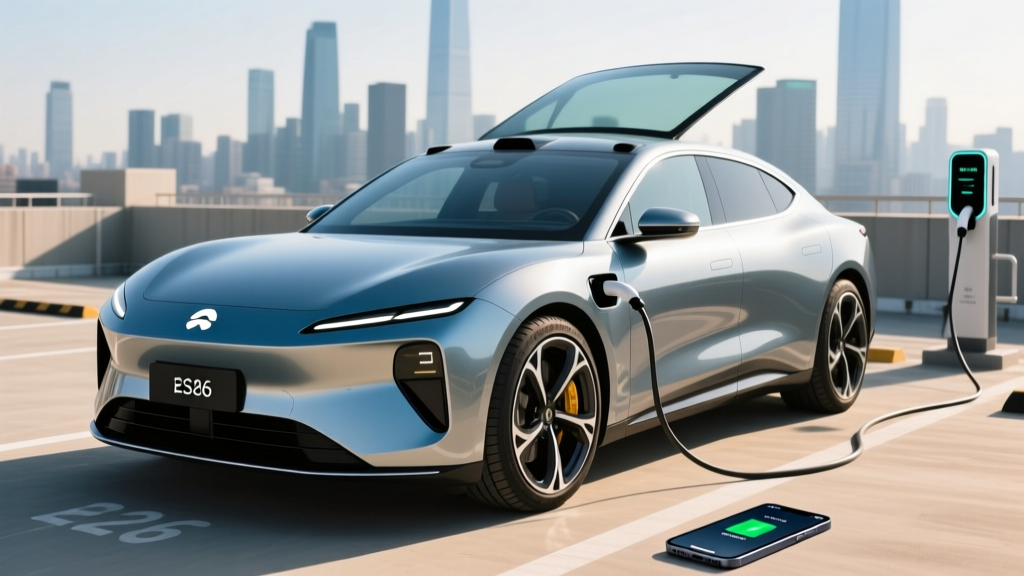
The NIO ES9 supports DC fast charging at rates up to approximately 180-250 kW depending on battery configuration and charger capability. NIO's 800V electrical architecture (introduced across its newer platforms) enables faster charging speeds than the older 400V systems.
| Charging Method | Power / Rate | Speed / Time |
|---|---|---|
| DC Fast Charge (peak) | ~180-250 kW | 10-80% in ~25-30 min |
| DC Fast Charge (sustained avg.) | ~120-150 kW | ~150-200 mi in 20 min |
| Level 2 (240V, 48A) | 11 kW AC | ~30-35 mi/hr added |
| Level 1 (120V, 12A) | ~1.4 kW | ~4-5 mi/hr added |
| Battery Swap (NIO Power Swap) | N/A | Full swap in ~3-5 min |
The charging curve matters more than peak numbers. Like most NMC-based EVs, the ES9 will sustain peak charge rates only in the 10-40% state-of-charge window, then progressively taper. Expect the 40-80% portion to take nearly as long as the 10-40% portion. This is normal physics — NMC cells require careful current management at higher states of charge to prevent lithium plating and degradation.
NIO's Battery Swap Network: This is the ES9's most distinctive feature. NIO operates over 2,700 Power Swap stations globally (concentrated in China, with growing European presence). A depleted battery can be exchanged for a fully charged one in approximately 3-5 minutes — faster than any DC fast-charge session. Swap stations also offer battery-as-a-service (BaaS) subscriptions, where buyers purchase the vehicle without the battery (reducing upfront cost by ~$15,000-20,000) and pay a monthly fee for battery access and swaps. This model is unproven in the US market, where NIO has no swap infrastructure.
Performance, Drivetrain, and Ride Quality
The ES9 uses NIO's dual-motor all-wheel-drive configuration with a combined output of approximately 653 horsepower. The permanent-magnet synchronous front motor and induction rear motor provide instantaneous torque vectoring and traction management. The 0-60 mph sprint is estimated at ~3.9 seconds — brisk for a three-row SUV weighing nearly three tons.
NIO equips the ES9 with its standard air suspension system, which provides adaptive damping and ride-height adjustment. The system can lower the vehicle at highway speeds for improved aerodynamics or raise it for rough-road clearance. Combined with NIO's CDC (Continuous Damping Control), the ES9 delivers the compliant, isolated ride quality expected in this luxury segment.
The ES9's driving dynamics prioritize comfort over sportiness — this is a chauffeur-friendly cruiser, not a corner-carver. Steering is light and precise but offers minimal feedback. Brake-by-wire regenerative braking provides adjustable deceleration levels, though NIO does not offer true one-pedal driving to a full stop in all modes (a minor omission compared to competitors like the iX and Model X).
Interior, Technology, and the NOMI Companion
The ES9's cabin seats six in a 2+2+2 configuration, with individual captain's chairs in the second row offering heating, ventilation, and massage functions. Third-row accommodation is genuinely usable for adults on shorter trips — a rarity in this segment.
Dimensions and Space:
- Second-row legroom: ~38-40 inches (est.)
- Third-row legroom: ~30-32 inches (est.)
- Cargo behind 3rd row: ~35 cu ft
- Cargo with 3rd row folded: ~80 cu ft
- No front trunk (frunk) — space occupied by HVAC and power electronics
The infotainment system centers on a 12.8-inch AMOLED touchscreen running NIO's Banyan 3.0 operating system, paired with a 10.2-inch digital instrument cluster and a 16-inch HUD (heads-up display). The system supports wireless Apple CarPlay and Android Auto, 5G connectivity, and OTA (over-the-air) updates.
NOMI: NIO's signature AI companion is a small, expressive robotic sphere mounted on the dashboard. NOMI uses facial recognition, voice commands, and contextual awareness to control vehicle functions, navigate, and interact with passengers. It's a distinctive feature that owners either love or find gimmicky — but it's undeniably memorable.
Driver Assistance: The ES9 comes equipped with NIO's Aquila super-sensing system, which includes 33 sensors: LiDAR (roof-mounted), 7x 8MP cameras, 4x surround cameras, 5x millimeter-wave radars, and 12x ultrasonic sensors. NIO's NOP+ (Navigate on Pilot Plus) provides highway navigation-guided driving with automatic lane changes, on/off-ramp handling, and speed adjustment. This is an SAE Level 2 system — the driver must remain fully engaged and supervise at all times. It is not autonomous driving.
Pricing, Tax Credits, and US Market Reality
In China, the NIO ES9 starts at approximately ¥528,000 (~$73,000 USD at current exchange rates), with higher-spec trims reaching ¥628,000+ (~$87,000 USD). The Battery-as-a-Service (BaaS) model reduces the purchase price by roughly $15,000-20,000 in exchange for a monthly battery subscription fee of approximately $150-230/month depending on pack size.
| Item | Estimated US Price |
|---|---|
| Base MSRP (100 kWh) | ~$75,000-$82,000 (est.) |
| Federal §30D Tax Credit | $0-$7,500 (eligibility uncertain — see below) |
| Effective Price After Credit | ~$67,500-$82,000 (est.) |
| BaaS Option (battery lease) | Reduces MSRP ~$15-20K; adds ~$150-230/mo |
Federal Tax Credit Eligibility (IRS §30D): Should NIO launch the ES9 in the United States, tax credit eligibility would face significant hurdles. Under current §30D rules:
- MSRP Cap: SUVs must have an MSRP at or below $80,000. The ES9's base price may exceed this threshold depending on US trim strategy.
- Income Cap: Buyer AGI must not exceed $300,000 (joint), $225,000 (head of household), or $150,000 (single).
- Battery Sourcing: Critical minerals and battery components must meet escalating domestic-content and free-trade-agreement thresholds. NIO's supply chain is heavily China-based, which would likely disqualify the ES9 from the full $7,500 credit under current FEOC (Foreign Entity of Concern) rules.
- Assembly: Final assembly must occur in North America. NIO currently manufactures exclusively in China.
Source: IRS §30D Clean Vehicle Credit guidelines. Tax rules change — consult a tax professional before purchasing.
Bottom line: Even if NIO launches the ES9 in the US, it would likely receive little or no federal tax credit due to China-based manufacturing and battery sourcing. This puts it at a significant price disadvantage against domestically assembled competitors like the Tesla Model X, Rivian R1S, and BMW iX (assembled in South Carolina from 2026).
Warranty, Reliability, and Ownership Considerations
In China, NIO offers a comprehensive warranty package:
- Vehicle warranty: 6 years / 150,000 km (~93,000 miles)
- Battery warranty: 10 years / unlimited km (for original owner with BaaS); 8 years / 160,000 km for purchased batteries
- Free roadside assistance: 6 years
- Lifetime free battery swaps: Available on some promotional packages (China only)
US warranty terms would need to be established at launch. For reference, US competitors typically offer 4-year/50,000-mile basic warranties and 8-year/100,000-mile battery warranties (federally mandated minimum for emission-related components on PHEVs, widely adopted for BEVs).
NIO's reliability record in China is generally positive, though the brand's relative youth (founded 2014, first deliveries 2018) means long-term 10+ year data is still accumulating. The battery-swap model theoretically reduces long-term battery-degradation anxiety, as owners can swap to newer, healthier packs over time.
Pros, Cons, and the Competition
- Battery-swap capability (3-5 min full "refuel") where infrastructure exists
- Premium six-seat interior with genuine third-row usability
- Advanced sensor suite (LiDAR standard) and NOP+ Level 2 assist
- Air suspension with adaptive damping
- 150 kWh semi-solid-state battery option for extreme range
- BaaS model lowers entry price and mitigates degradation risk
- Distinctive NOMI AI companion and strong OTA update cadence
- Not available in the US as of 2026 — no confirmed launch date
- Likely ineligible for US federal tax credit due to China sourcing/assembly
- No US battery-swap infrastructure (even if vehicle launches)
- Heavy (~5,700+ lbs) — efficiency suffers vs. lighter competitors
- Third-row cargo space limited when all seats occupied
- No frunk (front trunk)
- Brand recognition and service network nonexistent in North America
Key Competitors (US Market):
- Tesla Model X: ~335 mi range, ~$80K base, Supercharger access, falcon-wing doors, US-built (tax credit eligible)
- BMW iX xDrive50: ~324 mi range, ~$87K base, SC-built from 2026, refined driving dynamics
- Rivian R1S: ~352 mi (Max pack), ~$80K base, US-built, three rows, strong off-road capability
- Mercedes EQS SUV: ~305 mi range, ~$105K base, ultra-luxury, no third row standard
Who Should Consider the NIO ES9?
- You live in China or Europe where NIO has established sales and service networks
- You have access to NIO Power Swap stations on your regular routes
- You want a six-seat luxury EV with genuine third-row space and premium second-row captain's chairs
- You value the BaaS battery-lease model for lower upfront cost and long-term flexibility
- You want access to the 150 kWh semi-solid-state battery for occasional 500+ km trips
- You live in the United States (ES9 is not sold here and has no confirmed launch date)
- You need access to a proven public charging network (Tesla Supercharger, Electrify America)
- You want to maximize federal and state tax credit eligibility
- You need a locally established service network for warranty and maintenance
- You prioritize resale value and brand recognition in North America
Frequently Asked Questions
What is the real-world range of the NIO ES9?
With the 100 kWh battery, expect approximately 260-285 miles on the highway in moderate weather, dropping to 200-230 miles in cold conditions. The 150 kWh semi-solid-state pack would extend this to roughly 380-420 miles highway in moderate weather. These are estimates — the ES9 is not EPA-certified.
How fast does the NIO ES9 charge?
DC fast charging peaks at approximately 180-250 kW, with a 10-80% session taking roughly 25-30 minutes. Sustained average rates are closer to 120-150 kW. Home Level 2 charging at 11 kW adds approximately 30-35 miles of range per hour, meaning a full overnight charge (8-10 hours) restores the battery completely.
Does the NIO ES9 qualify for the US federal EV tax credit?
Almost certainly not under current rules. The ES9 is manufactured in China with a China-sourced battery supply chain, which triggers FEOC (Foreign Entity of Concern) disqualifications under §30D. Even if NIO launched the ES9 in the US, buyers should expect $0 in federal tax credits. Always verify current rules at IRS.gov.
Is the NIO ES9 available to buy in the United States?
No. As of early 2026, NIO has not announced a US launch date for the ES9 or any other vehicle. NIO has focused its international expansion on Europe (Norway, Germany, Netherlands, Denmark, Sweden). Geopolitical trade tensions, tariffs on Chinese-manufactured vehicles, and the need for a US service/charging network make a near-term US launch uncertain.
How does the battery-swap system work?
NIO Power Swap stations are drive-in facilities where automated machinery removes your depleted battery pack and installs a fully charged one in approximately 3-5 minutes. You drive away with a full "tank" without waiting for charging. In China, over 2,700 stations operate. There are no swap stations in the US, and NIO has not announced plans to build any.
Is the NIO ES9 worth buying vs. a Tesla Model X or Rivian R1S?
If you're in a market where the ES9 is sold and you have swap-station access, it's a compelling luxury six-seater with unique advantages. In the US, the Model X and R1S are far more practical choices — they're available now, eligible for tax credits (depending on trim/income), backed by established service networks, and compatible with the existing DC fast-charging infrastructure.
What is NIO's semi-solid-state battery?
NIO's 150 kWh semi-solid-state battery uses a hybrid electrolyte design (combining solid and liquid components) that enables higher energy density than conventional NMC cells. It provides significantly more range per kilogram, though at higher cost. It's available for occasional rental through the BaaS program in China, allowing standard-battery owners to rent the 150 kWh pack for long road trips.
Sources: NIO official specifications, fueleconomy.gov (for competitor EPA data), IRS §30D guidelines. US pricing and EPA figures for the ES9 are estimates — the vehicle is not currently sold or certified in the United States.