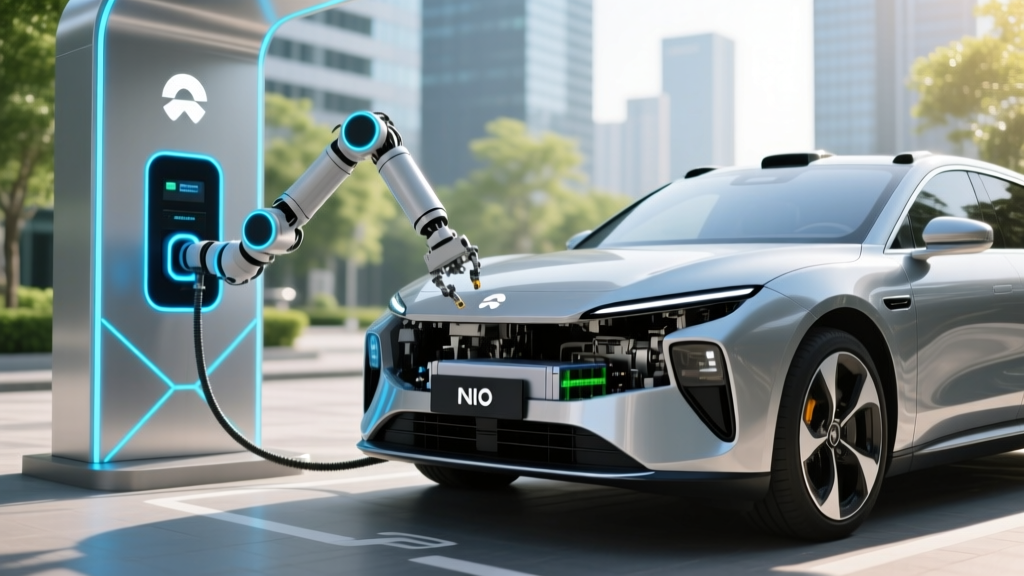
NIO's battery swap system — branded as Power Swap — is one of the most distinctive approaches to EV energy replenishment in the industry. Instead of plugging in and waiting, drivers pull into an automated station where a robotic platform removes the depleted battery and installs a fully charged one in roughly five minutes. For buyers researching NIO swap technology, the questions are practical: How fast is it really? Which NIO models support it? Does it work in the United States? And how does it stack up against conventional DC fast charging in 2026?
This guide answers those questions with exact specs, real-world caveats, and a clear-eyed assessment of where NIO's swap ecosystem stands today.
What Is NIO Battery Swap and How Does It Work?
NIO's Power Swap system is built around a standardized battery pack form factor shared across the brand's vehicle lineup. The car drives into a compact station (roughly the footprint of two parking spaces for newer Gen 4 stations), and an automated system:
- Aligns and lifts the vehicle
- Unbolts and removes the depleted battery pack from the vehicle's undercarriage
- Retrieves a pre-charged pack from an internal storage rack
- Installs and secures the charged pack
- Lowers the vehicle and completes a diagnostic handshake
The entire process takes approximately 3 minutes for Gen 4 stations and roughly 5 minutes for Gen 3 stations, according to NIO's published specifications. The driver typically remains in the vehicle during the swap.
A key technical detail: NIO's battery packs use a standardized mechanical and electrical interface across models. This means a NIO ET7 sedan and a NIO ES6 SUV can swap batteries at the same station — the packs are physically interchangeable. NIO offers three battery capacities in most markets:
- 75 kWh — Standard range, LFP chemistry (lithium iron phosphate)
- 100 kWh — Long range, NMC chemistry (nickel manganese cobalt)
- 150 kWh — Ultra-long range, semi-solid-state NMC (limited availability, primarily China)
This flexibility allows owners to use a smaller, lighter pack for daily commuting and temporarily upgrade to a 100 kWh or 150 kWh pack for long road trips — a concept NIO calls "flexible battery upgrade."
NIO Models That Support Battery Swap (2026 Lineup)
All current-generation NIO vehicles built on the NT2.0 platform support battery swapping. Here are the key specifications for the most widely available models:
| Model | Body Style | Battery Options | EPA/WLTP Range* | 0-60 mph | Drivetrain | HP |
|---|---|---|---|---|---|---|
| ET7 | Sedan | 75 / 100 / 150 kWh | ~310 mi (WLTP 100 kWh) | 3.8s | AWD dual-motor | 644 |
| ET5 | Sedan | 75 / 100 kWh | ~265 mi (WLTP 100 kWh) | 4.3s | AWD dual-motor | 483 |
| ES6 / EL6 | SUV (mid) | 75 / 100 kWh | ~290 mi (WLTP 100 kWh) | 4.5s | AWD dual-motor | 483 |
| ES8 | SUV (large, 3-row) | 75 / 100 / 150 kWh | ~280 mi (WLTP 100 kWh) | 4.9s | AWD dual-motor | 670 |
| EC7 | Coupe SUV | 75 / 100 kWh | ~300 mi (WLTP 100 kWh) | 3.8s | AWD dual-motor | 644 |
| ET9 | Flagship sedan | 100 / 150 kWh | ~340 mi (WLTP 150 kWh) | ~3.5s (est.) | AWD dual-motor | ~700 (est.) |
*Range figures are WLTP estimates for the European-spec 100 kWh pack. EPA ratings are not published for most NIO models because they are not currently sold in the United States. WLTP ranges typically run 10–15% higher than EPA equivalents. Real-world highway driving at 70+ mph reduces range by approximately 15–20%; cold weather (below 32°F) can reduce range by an additional 20–30% depending on cabin heating usage.
Swap Speed vs. DC Fast Charging: The Numbers
The core value proposition of NIO swap is time savings. Here is how a battery swap compares to conventional charging for a typical NIO ET7 with a 100 kWh pack:
| Method | Power / Process | 10–80% Time | Miles Added per 10 Min |
|---|---|---|---|
| NIO Power Swap (Gen 4) | Full pack exchange | ~3 min (full swap) | ~240 mi (full pack) |
| NIO Power Swap (Gen 3) | Full pack exchange | ~5 min (full swap) | ~240 mi (full pack) |
| DC Fast Charge (240 kW peak) | 240 kW → tapering | ~20 min | ~130 mi |
| DC Fast Charge (150 kW peak) | 150 kW → tapering | ~28 min | ~90 mi |
| Home Level 2 (11 kW) | 11 kW | ~9 hours (0–100%) | ~35 mi/hr |
Key insight on DC fast charging: NIO vehicles also support conventional DC fast charging via CCS2 (in Europe) or GB/T (in China) connectors. The ET7 and ES8 support peak charge rates up to approximately 180–240 kW depending on model year and pack configuration. However, as with all EVs, peak charge rate is not sustained — the charge curve tapers significantly above 80% State of Charge (SoC) to protect the battery. A 10–80% DC fast charge session typically takes 20–30 minutes depending on station output and battery temperature.
Preconditioning the battery (warming it to optimal temperature via the vehicle's thermal management system before arriving at a charger) is critical for achieving peak charge rates, especially in cold weather. NIO's navigation system automatically initiates preconditioning when a swap station or DC charger is set as the destination.
Where Can You Actually Use NIO Battery Swap?
This is the most critical question for prospective buyers outside China. As of early 2026, NIO's Power Swap network consists of over 2,700 stations globally, with the vast majority in mainland China. Here is the regional breakdown:
- China: ~2,500+ stations covering all major cities and expressway corridors. This is the only market with comprehensive swap coverage.
- Europe: Approximately 30–50 stations across Norway, Germany, the Netherlands, Denmark, and Sweden. Coverage is limited to specific corridors and urban areas.
- United States: NIO has not launched vehicle sales in the US as of 2026. A small number of demonstration swap stations may exist for R&D purposes, but there is no consumer-accessible swap network. NIO has periodically signaled US market entry intentions, but no firm timeline or model lineup has been confirmed.
For buyers in the US, NIO battery swap is currently a technology to watch, not a purchase option. The vehicles are not homologated for US sale, and no swap infrastructure exists for consumers.
Pricing, Battery-as-a-Service (BaaS), and Ownership Cost
NIO's pricing structure is unique because of its Battery-as-a-Service (BaaS) program. Buyers in supported markets can purchase the vehicle without the battery — reducing the upfront price significantly — and subscribe to a monthly battery rental plan.
| Component | Outright Purchase (ET7 100 kWh) | BaaS Subscription (ET7) |
|---|---|---|
| Vehicle MSRP (Europe, approx.) | €81,900 (~$89,000) | €69,900 (~$76,000) |
| Monthly Battery Fee | N/A | ~€160–289/mo depending on pack size |
| Swap Fees | Included with NIO Power subscription | Pay-per-swap or subscription plan |
| Battery Degradation Risk | Owner bears | NIO bears (swapped packs are maintained by NIO) |
Key BaaS advantages:
- Lower upfront cost (the battery is the single most expensive component of an EV)
- No long-term degradation concern — you always receive a maintained, health-checked pack at each swap
- Flexibility to upgrade to a larger pack for road trips and downgrade for daily use
Key BaaS disadvantages:
- Ongoing monthly cost that never ends (unlike owning outright)
- Higher total cost of ownership over 8–10+ years compared to outright purchase
- Resale value complexity — the vehicle is sold without a battery, which may confuse some used-car buyers
Pros and Cons of NIO Battery Swap
Pros
- ~3–5 minute "refueling" — faster than any DC fast charger
- BaaS eliminates battery degradation anxiety
- Flexible pack upgrades for road trips
- Standardized packs across all NIO models
- Vehicle also supports conventional DC fast charging
- Swap stations can serve as grid energy storage (V2G potential)
Cons
- Virtually no US availability — vehicles and stations not offered
- European swap network is sparse (30–50 stations)
- BaaS adds ongoing monthly cost that compounds over years
- Dependent on NIO's corporate viability and continued investment
- Standardized pack constrains vehicle design (flat floor, fixed dimensions)
- Not compatible with other brands' charging ecosystems
Who Is NIO Battery Swap Actually For?
Best suited for:
- Urban drivers in China with access to dense swap station networks who lack home charging — swap replaces the need for overnight charging entirely
- High-mileage commercial drivers (ride-hailing, delivery) where downtime at a charger represents lost income
- European NIO owners in Norway or Germany near a swap corridor who value time savings
- Buyers who want battery flexibility — the ability to run a lighter 75 kWh pack daily and swap to 100 kWh for vacations is genuinely useful
Not suited for:
- US-based buyers — NIO does not sell vehicles or operate swap stations in the US
- Rural drivers far from swap station coverage — conventional charging or a different EV brand is more practical
- Cost-minimizing buyers — BaaS subscription costs add up; outright purchase and home Level 2 charging is cheaper long-term for most owners
NIO Swap vs. Competitors: How Does It Compare?
NIO is the only major automaker currently operating a consumer battery swap network at scale. However, the concept isn't unique:
- Amperex Technology (CATL) announced its own swap station concept (EVOGO) for multiple vehicle brands, but deployment remains limited as of 2026.
- Ample operates commercial battery swap stations for fleet vehicles (delivery vans, Uber/Lyft drivers) in select US and international cities, using modular battery packs compatible with specific models.
- Tesla experimented with battery swap for the Model S in 2013 but abandoned it in favor of the Supercharger network.
- Conventional DC fast charging (Tesla Supercharger, Electrify America, Ionity) remains the dominant fast-replenishment method globally, with 350 kW+ chargers becoming common and 10–80% times dropping to 15–20 minutes for 800V-architecture vehicles like the Hyundai Ioniq 5, Porsche Taycan, and Lucid Air.
The fundamental trade-off: swap is faster and eliminates battery degradation risk (under BaaS), but requires massive capital expenditure for station buildout and locks the owner into a single brand's ecosystem. DC fast charging is slower but benefits from open standards (CCS, NACS) and a rapidly expanding multi-brand network.
Frequently Asked Questions
How long does a NIO battery swap actually take?
Gen 4 Power Swap stations complete a full battery exchange in approximately 3 minutes. Gen 3 stations take roughly 5 minutes. This includes vehicle alignment, pack removal, new pack installation, and system diagnostics. The driver remains seated in the vehicle throughout.
Can I still charge a NIO normally with a plug?
Yes. All NIO vehicles support conventional charging in addition to battery swap. In European markets, NIO uses the CCS2 connector for DC fast charging and Type 2 for AC Level 2 charging. Peak DC charge rates reach approximately 180–240 kW depending on the model and battery configuration. Home Level 2 charging at 11 kW adds roughly 35 miles of range per hour.
Does battery swap damage the car or void the warranty?
No. Battery swap is designed as a primary replenishment method by NIO, and the mechanical interface is engineered for thousands of swap cycles. NIO's battery warranty covers 8 years or 160,000 km (approximately 100,000 miles) with a capacity retention threshold of 70–80% depending on market. Under BaaS, the battery is NIO's responsibility, and degradation is managed across the swap fleet.
Will NIO come to the United States?
NIO has expressed interest in US market entry and has maintained a small US presence for autonomous driving R&D (via its San Jose office). However, as of early 2026, no NIO vehicle is available for US consumer purchase, no US-spec models have been announced, and no swap station network exists for US consumers. Tariffs on Chinese-manufactured vehicles (currently 100% under 2024–2025 trade policy) and §30D tax credit sourcing restrictions present significant barriers to a near-term US launch.
Is NIO's BaaS subscription worth it?
It depends on ownership duration and driving patterns. For a 3–5 year ownership period with high mileage, BaaS can be cost-competitive because you avoid battery depreciation and degradation risk. Beyond 6–7 years, the cumulative monthly fees (€160–289/month) typically exceed the cost of outright battery ownership. BaaS also makes the most sense if you regularly use swap stations — if you primarily charge at home, the subscription provides less value.
What happens if I swap and get a degraded battery?
NIO maintains and monitors every battery in its swap fleet. Packs that fall below health thresholds are retired from circulation and replaced. Each swapped battery undergoes diagnostic checks during the station cycle. In practice, owners report receiving packs in good condition, though the specific State of Health (SoH) of any given pack may vary slightly. Under BaaS, this is entirely NIO's responsibility.
Sources: NIO Official, IRS §30D Clean Vehicle Credit. Range and efficiency figures based on WLTP estimates published by NIO for European-spec models. US availability and pricing subject to change.