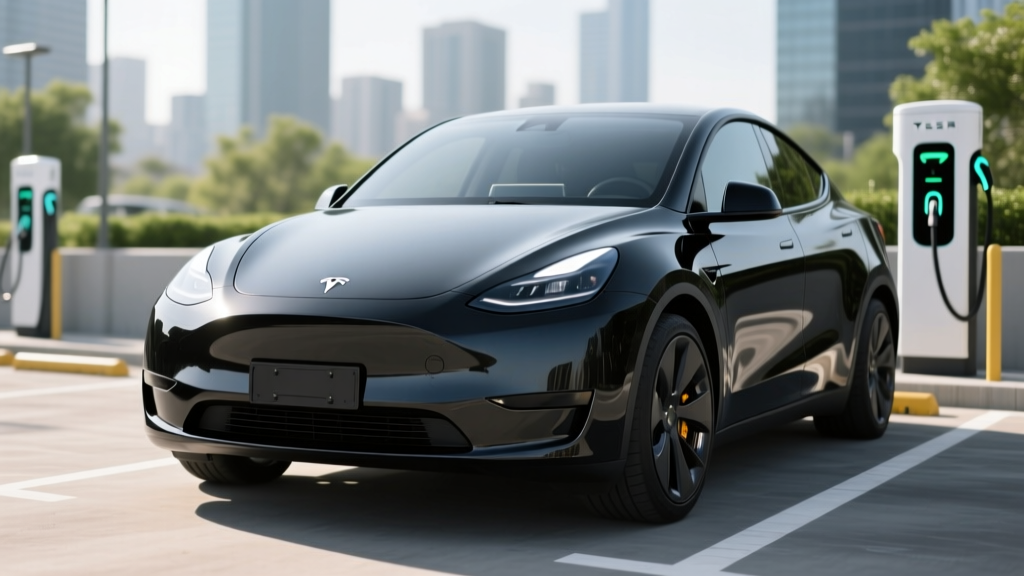
The Tesla Model Y remains one of the best-selling electric vehicles in the United States for a reason that goes well beyond its badge. For buyers evaluating an electric crossover, Tesla Model Y storage space is often the deciding factor — this is a vehicle that swallows luggage, groceries, camping gear, and dog crates with a versatility that few EV rivals can match. But cargo volume alone doesn't tell the full ownership story. This review examines the Model Y's real-world range, charging speeds, pricing after federal incentives, and how its practicality stacks up against the Hyundai Ioniq 5, Ford Mustang Mach-E, and Kia EV6 in the 2026 model year.
2026 Tesla Model Y at a Glance: Core Specs
Before getting into cargo dimensions, here's the spec-sheet snapshot every buyer needs. Figures below reflect the 2026 Model Y lineup as published by Tesla and the EPA. The Juniper refresh introduced in early 2025 carries forward with minor trim adjustments for 2026.
| Specification | Long Range RWD | Long Range AWD | Performance |
|---|---|---|---|
| EPA Range | 320 mi | 300 mi | 285 mi |
| Battery (usable) | ~75 kWh (NMC) | ~75 kWh (NMC) | ~75 kWh (NMC) |
| Drivetrain | Rear-Wheel Drive | Dual-Motor AWD | Dual-Motor AWD |
| Horsepower | 346 hp | 384 hp | 456 hp |
| 0–60 mph | 5.8 sec | 4.8 sec | 3.5 sec |
| Max DC Fast Charge | 250 kW | 250 kW | 250 kW |
| 10–80% DCFC Time | ~25 min | ~25 min | ~25 min |
| Level 2 Home Charging | 11.5 kW (~44 mi/hr) | 11.5 kW (~44 mi/hr) | 11.5 kW (~44 mi/hr) |
| MPGe (combined) | 122 MPGe | 115 MPGe | 111 MPGe |
| Efficiency | 27 kWh/100 mi | 29 kWh/100 mi | 30 kWh/100 mi |
| Base MSRP | $44,990 | $47,990 | $52,490 |
Note on battery chemistry: Tesla's Long Range and Performance trims use Nickel Manganese Cobalt (NMC) cathode chemistry, chosen for its higher energy density. The Standard Range RWD variant (when available) has historically used Lithium Iron Phosphate (LFP) cells, which trade some energy density for longer cycle life and a 100% daily-charge recommendation. Always confirm chemistry on your specific VIN before purchase.
Tesla Model Y Storage Space: Cargo, Frunk, and Passenger Dimensions
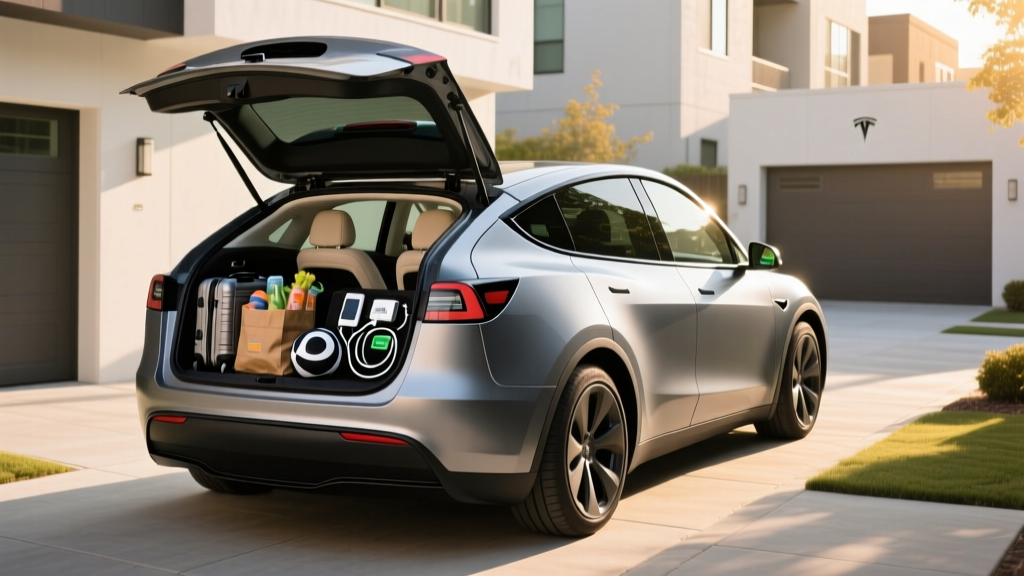
The Model Y's liftback design is the secret to its cargo dominance. Unlike the Model 3 sedan's traditional trunk opening, the Model Y's rear hatch opens wide to reveal a tall, rectangular load bay that accommodates bulky items upright — think large dog crates, standing floor lamps, or stacked moving boxes.
Behind the Second Row (5-Seat Configuration)
With all five seats in use, the Model Y provides 30.2 cubic feet of cargo volume behind the rear seatback. That's competitive with midsize gas crossovers like the Honda CR-V and comfortably ahead of most electric rivals. The load floor is flat, and the rear seatbacks split 60/40 for long-item pass-through.
Maximum Cargo (Rear Seats Folded)
Fold the rear seats flat and the Model Y opens up to 76.2 cubic feet of total cargo volume. This figure places it squarely at the top of the compact-to-midsize electric crossover segment. You can fit a full-size mattress at an angle, multiple large suitcases for airport runs, or a week's worth of camping gear for a family of four.
The Front Trunk (Frunk)
The Model Y's front trunk adds approximately 4.1 cubic feet of enclosed storage. It's best suited for charging cables, a soft-sided cooler, or a gym bag — not a second full suitcase. The frunk is latched electronically via the touchscreen or the Tesla app, which is convenient but means you'll want to keep a manual release tool accessible in case of a 12V battery failure.
Sub-Trunk and Hidden Compartments
Lift the rear cargo floor panel and you'll find a deep sub-trunk well — roughly 2.5 cubic feet of additional hidden storage. This is ideal for stowing the included mobile connector, tire-inflation kit, or items you'd rather keep out of sight. Combined with the main cargo area and frunk, the Model Y's total enclosed storage approaches 83 cubic feet when seats are folded.
Passenger Space
| Dimension | Front | Rear |
|---|---|---|
| Headroom | 40.7 in | 38.7 in |
| Legroom | 41.8 in | 38.4 in |
| Shoulder Room | 56.4 in | 54.0 in |
Rear legroom at 38.4 inches is adequate for adults on longer trips, though taller passengers (6'2"+) may find the sloping roofline limits headroom compared to the boxier Hyundai Ioniq 5 or Kia EV9. The flat floor (no transmission tunnel hump) makes the middle rear seat more usable than in many crossovers.
Optional Third Row
Tesla offers a third-row seat option that increases seating to seven, but it's best understood as occasional-use space for small children. With the third row deployed, cargo space behind it shrinks to roughly 12 cubic feet — enough for a few grocery bags but not luggage. Most buyers are better served by the five-seat layout with its vastly superior cargo flexibility.
Real-World Range: What to Actually Expect
EPA sticker: 300 miles
Real-world highway (70–75 mph, mild weather): ~260–275 miles
Real-world city/mixed driving: ~280–295 miles
Cold weather (below 30°F, highway): ~210–240 miles (20–30% reduction)
The Model Y's heat pump helps mitigate winter range loss compared to EVs without one, but cold air density, cabin heating, and battery resistance still take a measurable toll. Preconditioning the battery while plugged in before departure recovers some of this loss.
Efficiency is where the Model Y continues to shine. At 27–30 kWh per 100 miles depending on trim, it's among the most energy-efficient vehicles in its class. That efficiency directly translates to lower charging costs — at a national average of $0.16/kWh for home electricity, a full charge costs roughly $12–$13 and covers about 250 real-world miles.
Charging Speed: DC Fast Charging and Home Level 2
The Model Y charges via Tesla's proprietary NACS connector, which has become the de facto North American standard — Ford, GM, Rivian, Hyundai, and others have adopted NACS for their 2025+ models. This gives Model Y owners access to the Tesla Supercharger network, widely regarded as the most reliable DC fast-charging network in the US.
| Charging Level | Power / Voltage | Speed (Miles Added per Hour) | Notes |
|---|---|---|---|
| Level 1 (120V household) | ~1.4 kW | ~4–5 mi/hr | Emergency/trickle only; overnight adds ~50 mi |
| Level 2 (240V home Wall Connector) | 11.5 kW | ~44 mi/hr | Full charge in ~7–8 hours; ideal daily solution |
| DC Fast Charge (V3 Supercharger) | Up to 250 kW | ~1,000 mi/hr peak | 10–80% in ~25 min; tapers above 80% |
| DC Fast Charge (V4 Supercharger) | Up to 250 kW+ (cable-limited) | Similar to V3 for Model Y | Future V4 stalls may deliver higher sustained rates to compatible vehicles |
Understanding the charge curve: The Model Y peaks at 250 kW only at low states of charge (roughly 10–30%). As the battery fills, the charge rate tapers — by 60% SoC you're typically seeing 100–120 kW, and above 80% it drops further to protect battery longevity. This is why Tesla (and every EV manufacturer) quotes 10–80% times rather than 0–100%. On a road trip, plan your stops around the 10–80% window for the fastest experience.
Home charging setup: The Tesla Wall Connector ($420) on a 60-amp circuit delivers the full 11.5 kW (48 amps continuous). Installation costs vary widely — expect $500–$1,500 for a straightforward install near your electrical panel, or $2,000–$4,000+ if a panel upgrade or long conduit run is needed. A licensed electrician should assess your panel capacity before committing.
Pricing, Trims, and Federal Tax Credit Eligibility
The 2026 Model Y lineup starts at $44,990 for the Long Range RWD and tops out at $52,490 for the Performance trim (before destination fees and options). Here's how the pricing breaks down alongside federal incentive eligibility under IRS §30D rules:
| Trim | Base MSRP | §30D Credit Eligibility | Est. Price After Credit |
|---|---|---|---|
| Long Range RWD | $44,990 | Up to $7,500 (if sourcing & income requirements met) | ~$37,490 |
| Long Range AWD | $47,990 | Up to $7,500 (if sourcing & income requirements met) | ~$40,490 |
| Performance | $52,490 | Up to $7,500 (if sourcing & income requirements met) | ~$44,990 |
Critical §30D eligibility requirements (2026):
- MSRP cap: SUVs/crossovers must have an MSRP at or below $80,000 — all Model Y trims qualify.
- Buyer income caps: Modified AGI must not exceed $150,000 (single), $225,000 (head of household), or $300,000 (joint filers).
- Battery sourcing: A percentage of critical minerals and battery components must be sourced from the US or free-trade-agreement countries. Tesla has progressively shifted supply chains to meet these thresholds, but the exact credit amount ($3,750 or $7,500) depends on current-year compliance percentages. Verify on fueleconomy.gov before purchasing.
- Point-of-sale transfer: As of 2024+, eligible buyers can transfer the credit to the dealer at purchase, reducing the out-of-pocket price immediately rather than waiting for a tax refund.
Tax credit eligibility can change with supply-chain shifts and IRS guidance updates. Consult a tax professional and check the latest IRS clean vehicle credits page before finalizing your order.
Technology, Driver Assistance, and Ownership Experience
The Model Y's cabin is defined by its 15.4-inch center touchscreen, which handles everything from navigation and media to climate controls and vehicle settings. The Juniper refresh (introduced 2025) brought a ventilated front-seat option, ambient lighting, a rear-seat touchscreen, and improved suspension tuning for a noticeably smoother ride than pre-refresh models.
Autopilot and Full Self-Driving (Supervised)
Tesla Autopilot and FSD (Supervised) are Level 2 driver-assistance systems. The driver must remain fully engaged — hands on or near the wheel, eyes on the road — at all times. These systems do not make the vehicle self-driving. Only Level 4 services like Waymo operate without a human driver in defined areas.
Standard Autopilot includes Traffic-Aware Cruise Control and Autosteer (lane centering). The optional FSD (Supervised) package adds automatic lane changes, traffic-light and stop-sign recognition, and more assertive navigation on city streets. FSD capability is a $8,000 add-on or $99/month subscription as of 2026 — and it remains a supervised system, not a replacement for an attentive driver.
Battery and Powertrain Warranty
Tesla covers the Model Y's battery and drive unit for 8 years or 120,000 miles (Long Range/Performance), whichever comes first, with a minimum 70% capacity retention threshold during that period. The vehicle limited warranty is 4 years or 50,000 miles. This is in line with or slightly better than most competitors, though Hyundai's 10-year/100,000-mile battery warranty remains the segment benchmark.
How the Model Y Compares: Storage Space vs. Key Rivals
| Attribute | Tesla Model Y (LR AWD) | Hyundai Ioniq 5 (Limited AWD) | Ford Mustang Mach-E (ER AWD) | Kia EV6 (GT-Line AWD) |
|---|---|---|---|---|
| Max Cargo (rear seats folded) | 76.2 cu ft | 59.3 cu ft | 59.7 cu ft | 50.2 cu ft |
| Cargo Behind 2nd Row | 30.2 cu ft | 27.2 cu ft | 29.7 cu ft | 24.4 cu ft |
| Frunk | 4.1 cu ft | 0.85 cu ft | 4.7 cu ft | 0.7 cu ft |
| EPA Range | 300 mi | 290 mi | 290 mi | 282 mi |
| Max DCFC | 250 kW | 238 kW | 150 kW | 238 kW |
| 10–80% Time | ~25 min | ~20 min | ~38 min | ~18 min |
| Starting MSRP (AWD) | $47,990 | $52,200 | $48,995 | $52,900 |
76.2 cu ft max cargo dominates the segment. The liftback hatch design makes loading bulky items dramatically easier than the Ioniq 5's hatch or the Mach-E's liftback.
The EV6's 800V architecture enables 10–80% in roughly 18 minutes at a compatible 350 kW charger, the fastest in this group — though 350 kW stations remain less common than 250 kW Superchargers.
Who Should Buy the Tesla Model Y?
- You need maximum cargo versatility — frequent hauling of large items, pet crates, or family road-trip luggage
- You value access to the Supercharger network for reliable cross-country travel
- You want a proven, energy-efficient EV with strong resale value and a large service network
- You prefer over-the-air updates that continuously add features
- You want the fastest possible DC charging (Kia EV6/Hyundai Ioniq 5 with 800V)
- You prefer physical buttons and knobs over a touchscreen-only interface
- You need best-in-class rear headroom for tall passengers (Ioniq 5 is roomier back there)
- You want a 10-year battery warranty (Hyundai/Kia)
Pros and Cons
- Best-in-class cargo volume (76.2 cu ft) with practical liftback design
- Excellent efficiency: 27–30 kWh/100 mi keeps charging costs low
- Supercharger network access — the most reliable public charging in the US
- Strong performance across all trims (3.5–5.8 sec 0–60)
- Continuous OTA updates improve the vehicle post-purchase
- Competitive pricing for the segment, especially after §30D credit
- Touchscreen-only interface frustrates some drivers (no physical volume knob or climate dials)
- Rear headroom compromised by sloping roofline vs. boxier competitors
- Third-row option is child-only and severely limits remaining cargo
- FSD (Supervised) is expensive and remains Level 2 — not autonomous
- Repair costs and insurance premiums can be higher than segment average
- DCFC peak of 250 kW trails 800V rivals at compatible chargers
Frequently Asked Questions
What is the real-world range of the Tesla Model Y?
The EPA rates the 2026 Model Y Long Range AWD at 300 miles. In real-world highway driving at 70–75 mph in mild temperatures, expect 260–275 miles. In cold weather (below 30°F), range can drop to 210–240 miles. The RWD Long Range variant's 320-mile EPA rating yields roughly 280–295 real-world miles in mixed conditions.
How fast does the Model Y charge at home and on the road?
At home on a 240V Level 2 Tesla Wall Connector (11.5 kW), the Model Y adds about 44 miles of range per hour — a full overnight charge takes 7–8 hours. On a V3 Supercharger (250 kW DC), it charges from 10–80% in approximately 25 minutes, though charging slows significantly above 80% due to the battery management system tapering current to protect cell longevity.
How much does the Model Y cost after the federal tax credit?
If you qualify for the full $7,500 §30D credit (meeting income, battery-sourcing, and MSRP requirements), the Long Range RWD drops from $44,990 to roughly $37,490. The Long Range AWD falls to ~$40,490 and the Performance to ~$44,990. Credit eligibility depends on your tax situation and current IRS sourcing rules — verify before ordering.
Does the Tesla Model Y qualify for the federal EV tax credit?
Yes, the Model Y qualifies under §30D as of 2026 — its MSRP is under the $80,000 SUV cap, and Tesla has worked to meet battery-sourcing requirements. However, buyer income limits ($150K single / $300K joint) and evolving critical-mineral sourcing rules mean not every buyer will receive the full $7,500. Check the IRS clean vehicle credits page for the latest details.
Is the Model Y worth buying over the Ioniq 5 or Mach-E?
If cargo space, Supercharger access, and energy efficiency are your top priorities, the Model Y is the strongest choice in the segment. If you prefer faster peak DC charging (800V architecture), more rear-seat headroom, or physical controls, the Ioniq 5 and EV6 are compelling alternatives. The Mach-E offers comparable cargo space behind the second row but trails in maximum volume and DCFC speed.
How much Tesla Model Y storage space is available with seats up vs. folded?
With all five seats in use, you get 30.2 cubic feet behind the rear row — enough for 4–5 large suitcases. Fold the 60/40 rear seats and the space expands to 76.2 cubic feet. The 4.1-cubic-foot frunk and ~2.5-cubic-foot sub-trunk well add useful enclosed storage on top of those figures.