The Nikola Tesla Induction Motor: The Backbone of the EV Revolution
When you hear "Nikola Tesla induction motor," you might picture a 19th-century inventor tinkering with copper coils. But the AC induction motor Tesla patented in 1888 is alive and well in 2026, quietly powering some of the most capable electric vehicles on the road. The company that bears his name — Tesla, Inc. — helped reintroduce the world to this elegant piece of engineering, and today, induction motors remain a critical technology in the EV powertrain landscape.
This guide explains what an induction motor is, why it matters for EV buyers, how it compares to permanent magnet synchronous motors (PMSMs), and which 2026 EVs still rely on Tesla's original invention to move you down the road.
What Is an AC Induction Motor and Why Does It Matter?
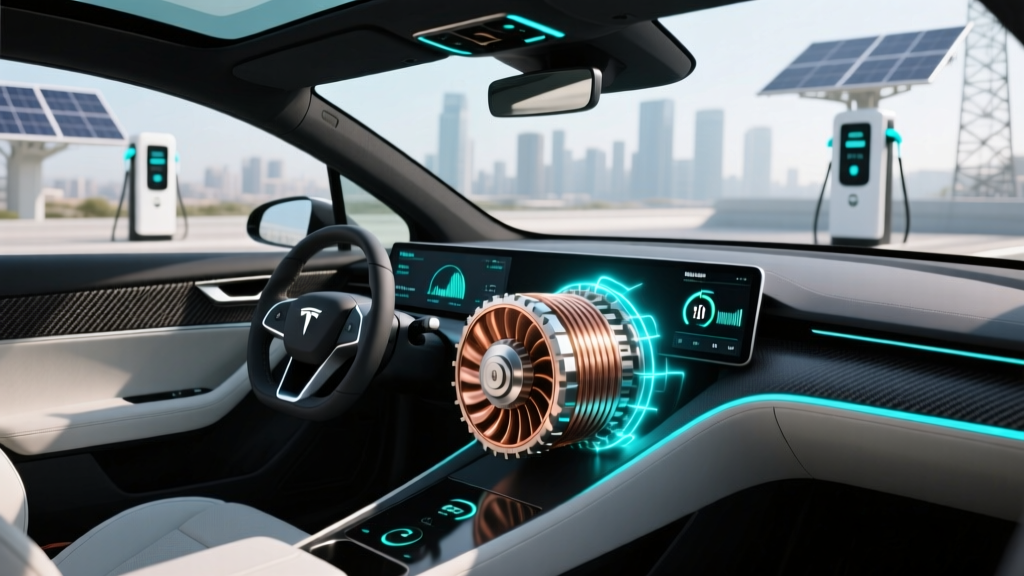
An AC induction motor (also called an asynchronous motor) works on a principle Nikola Tesla pioneered: a rotating magnetic field in the stator induces a current in the rotor, causing it to spin — without any physical electrical connection to the rotor itself. There are no permanent magnets in the rotor, no brushes, and no commutator. This makes the motor rugged, simple to manufacture, and capable of extremely high RPMs.
In an EV context, the induction motor offers several engineering advantages:
- No rare-earth magnets: Induction motors don't require neodymium or dysprosium, sidestepping supply-chain risks and price volatility tied to permanent magnet materials.
- Natural freewheeling: When de-energized, an induction motor produces zero cogging torque — meaning it creates no magnetic drag. This is why it's the preferred choice for secondary motors in dual-motor AWD setups that disconnect on the highway.
- High-RPM power: Induction motors can sustain peak power to higher rotational speeds than many PMSMs, which is useful for high-speed passing and track use.
- Durability: With fewer heat-sensitive components in the rotor, induction motors tolerate sustained high-load operation well.
The tradeoff? Induction motors are generally less efficient at low loads and partial throttle — the exact conditions that dominate city driving and EPA range testing. That's where permanent magnet motors have an edge.
Induction vs. Permanent Magnet Motors: The 2026 EV Landscape
Most 2026 EVs use one of three motor configurations. Understanding these helps explain range, performance, and efficiency differences between models:
| Motor Type | Efficiency (Low Load) | Efficiency (High Load) | Rare Earths | Common Placement | Example Vehicles |
|---|---|---|---|---|---|
| AC Induction (Asynchronous) | Lower | High | None | Front motor (AWD disconnect) | Tesla Model S, Model X, some Rivian R1T/R1S |
| Permanent Magnet Synchronous (PMSM) | Higher | High | Required | Primary drive motor | Tesla Model 3/Y (rear), Hyundai Ioniq 5, BMW i4 |
| Externally Excited Synchronous (EESM) | High | High | None | Primary drive motor | BMW iX, Renault Megane E-Tech |
The trend in 2026 is clear: PMSMs dominate the primary-drive role for maximum efficiency, while induction motors serve as secondary "boost and disconnect" motors in AWD configurations. BMW has carved a niche with EESM technology, eliminating rare earths without the low-load penalty of induction motors. According to the U.S. Department of Energy, motor efficiency improvements of even 2-3% translate directly into measurable range gains over the EPA test cycle.
Which 2026 EVs Use the Nikola Tesla Induction Motor Design?
While pure induction-only drivetrains have become rare, the technology persists in high-value roles. Here's where you'll find induction motors in the 2026 model year:
Tesla Model S (Dual Motor & Plaid)
The 2026 Tesla Model S continues to pair a front AC induction motor with a rear permanent magnet motor. The front induction unit disconnects magnetically during light-load highway cruising, reducing drag and boosting efficiency. In Plaid trim, a tri-motor setup uses a carbon-sleeved rotor permanent magnet design on the rear axle while retaining the front induction motor for AWD traction and torque vectoring.
Rivian R1T and R1S (Dual-Motor Variants)
Rivian's dual-motor R1T pickup and R1S SUV use a combination of motor types across their lineup. The front motor in certain configurations uses induction-style technology for its disconnect capability, allowing the truck to freewheel in efficient driving modes.
Legacy Reference: Early Tesla Roadster and Model S (Original)
The original 2008 Tesla Roadster and early Model S used purely induction-based drivetrains — a direct homage to Nikola Tesla's invention. Those vehicles proved the concept, but the industry has since evolved toward hybrid motor configurations that combine the best of both worlds.
Real-World Impact: How Motor Choice Affects Your EV
Motor type isn't just an engineering footnote — it shapes your ownership experience in tangible ways:
An EV with a PMSM primary motor will typically achieve 2-5% better EPA range than an equivalent induction-only drivetrain under city and mixed driving. On the highway at sustained 75 mph, the gap narrows because induction motors operate efficiently at high loads. In cold weather (below 32°F), both motor types lose efficiency due to battery chemistry limitations — the motor type becomes less of a factor than battery thermal management and cabin heating demands.
Performance: Induction motors can deliver explosive peak power without risk of demagnetizing permanent magnets. Tesla's Plaid models use this advantage for sustained high-speed runs. However, for instant low-end torque in daily driving, PMSMs respond slightly faster due to their pre-existing magnetic field.
Maintenance and Longevity: Both motor types are essentially maintenance-free compared to internal combustion engines. Neither uses brushes, and both have far fewer moving parts than a gas powertrain. Induction motors have a slight edge in thermal resilience during repeated hard acceleration, as there are no magnets to overheat and lose field strength.
Supply Chain and Cost: Induction motors cost less to produce and insulate automakers from rare-earth price shocks. This is why they remain popular as secondary motors — you get AWD capability without doubling your rare-earth material requirements.
Charging, Battery, and Drivetrain Specs: 2026 Model S as a Reference
Since the Tesla Model S remains the most prominent production EV using a front induction motor in 2026, here's a spec snapshot of the dual-motor Long Range variant to illustrate how this technology packages in a real vehicle:
| Specification | Value |
|---|---|
| EPA Estimated Range | 402 miles |
| Real-World Highway Range (75 mph) | ~330-350 miles |
| Real-World Cold Weather Range (20°F) | ~280-310 miles |
| Battery Capacity | ~100 kWh (usable), NMC chemistry |
| Peak DC Fast Charge Rate | 250 kW (V3 Supercharger) |
| 10-80% DC Fast Charge Time | ~30 minutes |
| Level 2 Home Charging Rate | 11.5 kW (~34 miles/hr at 48A) |
| Motor Configuration | Front: AC Induction / Rear: Permanent Magnet |
| 0-60 mph | 3.1 seconds |
| Horsepower | 670 hp (combined) |
| Drivetrain | AWD (Dual Motor) |
| Efficiency | 120 MPGe combined / 28 kWh/100mi |
| Cargo Volume | 28 cu ft (rear) + 3.1 cu ft (frunk) |
| Base MSRP | $74,990 |
| Federal Tax Credit (§30D) | Up to $7,500 (subject to income & sourcing rules) |
| Battery Warranty | 8 years / 150,000 miles (70% capacity retention) |
The EPA 402-mile estimate assumes a mix of city and highway driving at moderate temperatures. Expect ~330-350 miles on a flat 75-mph highway run, and as low as ~280-310 miles in sub-freezing conditions where battery resistance increases and cabin heating draws significant energy. Preconditioning the battery before fast charging can recover some of this deficit by warming the cells to optimal temperature.
Data sourced from fueleconomy.gov and Tesla's official specifications page.
Federal Tax Credit and Pricing: What You'll Actually Pay
The 2026 Tesla Model S Long Range starts at $74,990 before incentives. Federal tax credit eligibility under IRS §30D is nuanced:
- MSRP Cap: Sedans must be priced at or below $55,000 to qualify. The Model S exceeds this cap, meaning it does not qualify for the $7,500 federal credit in most configurations.
- Income Cap: Even for eligible vehicles, buyers must have an adjusted gross income at or below $150,000 (single), $225,000 (head of household), or $300,000 (joint).
- Battery Sourcing: Credit amounts depend on critical mineral and battery component sourcing requirements that change annually.
- Point-of-Sale Transfer: For vehicles that do qualify, the credit can now be transferred to the dealer at purchase, reducing your out-of-pocket cost immediately.
For the latest eligibility rules, consult the IRS clean vehicle credit page or speak with a tax professional. State and local incentives may also apply independently of federal rules.
Pros and Cons of Induction Motor EVs
Advantages
- No rare-earth dependency — lower supply-chain risk
- Zero magnetic drag when disconnected — ideal for AWD efficiency
- Excellent high-RPM sustained power delivery
- Superior thermal resilience under repeated hard acceleration
- Lower manufacturing cost for secondary motor applications
Drawbacks
- Lower efficiency at light loads vs. permanent magnet motors
- Slightly reduced EPA range in city-dominant driving cycles
- Heavier per unit of torque compared to PMSMs
- Rarely used as sole drive motor in modern EVs — limited to specific models
- Less instant torque response than PMSMs from a standstill
Who Should Care About Induction Motor Technology?
The Nikola Tesla induction motor matters most to these EV buyers:
- Performance enthusiasts: If you plan to track your EV or make repeated high-speed runs, the induction motor's thermal headroom is a genuine advantage.
- AWD efficiency seekers: Dual-motor EVs that use a front induction motor can disconnect that axle entirely, giving you AWD grip when needed and RWD efficiency on the highway.
- Supply-chain-conscious buyers: If minimizing rare-earth material usage is part of your purchasing criteria, induction motors (and EESMs) reduce that dependency.
- Long-term ownership planners: Induction motors are among the most durable electric motor designs ever created — Nikola Tesla's 1888 patent still holds up in 2026.
Frequently Asked Questions
Do any 2026 EVs use only induction motors?
Pure induction-only drivetrains are essentially extinct in new 2026 EVs. The efficiency advantage of permanent magnet motors at low loads makes them the default primary drive motor. However, the front motor in many dual-motor AWD EVs (including the Tesla Model S and Model X) remains an AC induction design for its disconnect capability.
Is an induction motor less reliable than a permanent magnet motor?
No. Induction motors are arguably more reliable because they have no permanent magnets that can degrade from excessive heat over decades of use. Both motor types routinely outlast 200,000+ miles with zero maintenance.
Why did Tesla switch from all-induction to mixed motor setups?
The original Tesla Roadster and early Model S used induction motors exclusively. As battery costs dropped and efficiency became the primary range lever, Tesla adopted permanent magnet rear motors for better city and mixed-cycle efficiency while retaining front induction motors for AWD disconnect. This hybrid approach maximizes range without sacrificing all-weather capability.
Does the motor type affect regenerative braking?
Both motor types support regenerative braking effectively. However, permanent magnet motors can generate regen torque even at very low speeds due to their inherent magnetic field, which contributes to smoother one-pedal driving feel in many EVs.
What's the future of induction motors in EVs?
Induction motors will likely persist as secondary/front motors in AWD configurations for the foreseeable future. Their zero-drag disconnect capability is difficult to replicate with permanent magnet designs. However, externally excited synchronous motors (EESMs) from BMW and Renault are emerging as a potential replacement that offers both high efficiency and rare-earth-free operation.