Genesis is preparing a significant pivot for its best-selling SUV. The 2027 Genesis GV70 EREV (Extended-Range Electric Vehicle) represents the luxury brand's entry into the range-extender segment — a powertrain layout that pairs a battery-electric drive system with a small onboard gasoline generator. Think of it as the architecture popularized by the BMW i3 REx and the Chevrolet Volt, now applied to a premium compact SUV competing with the BMW X3, Mercedes-Benz GLC, and Audi Q5.
As of early 2026, Genesis has confirmed the GV70 EREV is in development, with production expected to begin in late 2026 for the 2027 model year. Full EPA certification figures are not yet published. What follows is a comprehensive preview based on confirmed powertrain details, Genesis's global EREV platform announcements, and comparable segment data. All specs marked as preliminary are subject to change before launch.
What Is an EREV, and Why Is Genesis Building One?
An Extended-Range Electric Vehicle (EREV) is distinct from a plug-in hybrid (PHEV). In a PHEV, both the electric motor and the gasoline engine can drive the wheels. In an EREV, only the electric motor turns the wheels. The gasoline engine acts solely as a generator, recharging the battery when it depletes below a threshold. This gives the driver a pure-EV experience for daily commuting with the security of a gas generator for longer trips — no range anxiety, no dependence on charging infrastructure for road trips.
Genesis's decision to pursue EREV architecture for the GV70 reflects a practical calculation: luxury SUV buyers want electric refinement for daily driving but often lack reliable home charging or take frequent long-distance trips where DC fast-charging infrastructure remains inconsistent. The EREV bridges that gap without requiring the massive (and expensive) 100+ kWh battery packs found in full BEVs like the GV70 Electrified.
Estimated Range and Efficiency
Expected EPA electric-only range: ~200–240 miles (based on projected battery sizing and comparable EREVs)
Total range (electric + generator): ~450–500+ miles estimated
Real-world note: Electric-only range will vary significantly with temperature and driving style. Expect ~160–190 miles of usable electric range in highway driving at 70+ mph, and potentially 30–40% reduction in sub-freezing winter conditions due to cabin heating demands and battery chemistry limitations. The range-extender engine will automatically activate when the battery reaches its buffer threshold, so you will never be stranded — but your "electric-only" commuting envelope shrinks in cold weather.
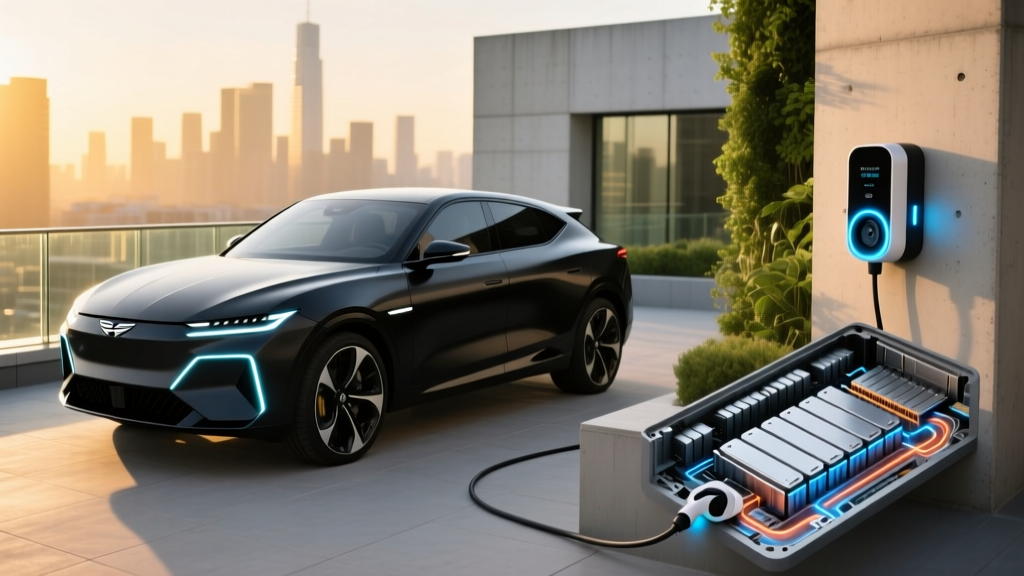
Genesis has indicated the GV70 EREV will use a battery pack in the 30–40 kWh usable range — substantially larger than typical PHEV batteries (which tend to offer 15–25 kWh) but smaller than full BEV packs (75–100+ kWh). This sizing targets the sweet spot: enough electric range for 80%+ of daily driving while keeping vehicle weight, cost, and charging times reasonable.
For efficiency metrics, expect an MPGe rating in the range of 80–95 MPGe during electric-only operation, with the gasoline generator delivering roughly 28–32 MPG combined when operating as a range extender. These are preliminary estimates based on comparable EREV powertrains and will be confirmed when the EPA publishes official figures closer to launch.
Battery, Chemistry, and Powertrain Details
| Spec | Detail (Preliminary) |
|---|---|
| Powertrain Type | EREV (series hybrid — electric motor drives wheels, gas engine generates electricity) |
| Battery Capacity | ~30–40 kWh usable (estimated) |
| Battery Chemistry | Likely NMC (nickel manganese cobalt) for energy density; LFP possible for base trim |
| Electric Motor Output | ~250–300 hp (estimated), single or dual-motor configurations possible |
| Range-Extender Engine | Small-displacement turbocharged gasoline generator (likely 1.5L–2.0L) |
| Drivetrain | AWD expected (dual-motor) standard; RWD possible for base trim |
| 0–60 mph | ~5.5–6.5 seconds (estimated, electric-only mode) |
| EPA Electric Range | ~200–240 miles (estimated, pending certification) |
| Total System Range | ~450–500+ miles (estimated) |
| EPA MPGe (Electric) | ~80–95 MPGe (estimated) |
| Generator Fuel Economy | ~28–32 MPG combined (estimated) |
| Base MSRP | ~$52,000–$55,000 (estimated) |
| Battery/Powertrain Warranty | Expected 10 yr / 100,000 mi (Genesis standard for electrified powertrains) |
The choice between NMC and LFP chemistry will matter for buyers. NMC (nickel manganese cobalt) offers higher energy density — more range per kilogram — which is critical in an EREV where battery space competes with the generator and fuel tank. LFP (lithium iron phosphate) is cheaper, more durable over thousands of charge cycles, and tolerates regular 100% charging without degradation concerns, but it's heavier and less energy-dense. If Genesis offers LFP in a base trim, it would trade a small amount of electric range for lower cost and potentially longer battery lifespan.
Charging Speed: DC Fast Charging and Home Level 2
Charging is where EREV architecture offers a distinct advantage over full BEVs for many buyers: the battery is smaller, so it charges faster and costs less to fill.
| Charging Level | Power / Rate | Estimated Time |
|---|---|---|
| Level 1 (120V household) | ~1.4 kW | ~2–3 miles of range per hour; full charge in ~24–30 hours |
| Level 2 (240V home/public) | ~7.2–11 kW | ~20–30 miles of range per hour; full charge in ~4–5 hours |
| DC Fast Charging | ~100–150 kW peak (estimated) | 10–80% in ~20–25 minutes (estimated) |
Because the battery is 30–40 kWh rather than 80–100 kWh, even a modest DC fast-charge rate yields quick 10–80% sessions. A 35 kWh battery charging at an average of 100 kW (accounting for charge-curve taper above 80%) reaches 80% in roughly 20–25 minutes. This is meaningfully faster than large-battery BEVs, which often require 30–40 minutes for the same 10–80% session despite higher peak kW rates.
For daily use, most EREV owners will charge at home on Level 2 overnight and rarely, if ever, use DC fast charging — the gas generator handles longer trips. Home charging installation for a Level 2 circuit typically runs $500–$2,000 depending on panel capacity and wiring distance, per U.S. Department of Energy guidance.
Interior, Cargo, and Technology
The GV70 EREV is expected to share the current-generation GV70's interior architecture, which means one of the most well-executed luxury cabins in the compact SUV segment. Expect the following based on the current GV70 platform:
- Cargo volume: ~28–29 cu ft behind rear seats; ~56–57 cu ft with rear seats folded (EREV battery placement may slightly reduce underfloor storage vs. ICE variant)
- Rear legroom: ~37.2 inches
- Front legroom: ~41.3 inches
- Infotainment: 12.3-inch widescreen display with Genesis's latest UX, wireless Apple CarPlay/Android Auto, over-the-air updates
- Digital cluster: 12.3-inch 3D digital instrument cluster (on higher trims)
- Fingerprint authentication: Driver profile recognition via fingerprint reader on the dash
- ADAS: Highway Driving Assist II (SAE Level 2), requiring hands-on-wheel supervision — this is not autonomous driving
Highway Driving Assist II is a Level 2 driver-assistance system. The driver must remain attentive, keep hands on the steering wheel, and be prepared to take over at any moment. It does not make the GV70 EREV a self-driving vehicle.
One EREV-specific tech feature to watch for: a dedicated "EV priority" driving mode that intelligently manages when the range-extender engine activates. Smart systems can use navigation data to save battery charge for city driving (where electric operation is most efficient) and run the generator on highway segments (where the engine operates at its most efficient RPM). This type of predictive energy management is a hallmark of well-engineered EREVs.
Pricing, Trims, and Federal Tax Credit Eligibility
Pricing for the 2027 GV70 EREV is not yet official. Based on the current GV70 lineup ($46,000–$67,000) and the premium associated with electrified powertrains, expect the following preliminary pricing structure:
| Trim | Est. MSRP | §30D Credit Potential | Est. After Credit |
|---|---|---|---|
| Standard (AWD) | ~$52,000–$55,000 | Up to $7,500* | ~$44,500–$47,500 |
| Premium / Sport | ~$58,000–$63,000 | Up to $7,500* | ~$50,500–$55,500 |
| Prestige / Top Trim | ~$65,000–$68,000 | Up to $7,500* | ~$57,500–$60,500 |
*Federal tax credit eligibility under IRS §30D depends on multiple requirements that change frequently. See checklist below.
- Vehicle MSRP cap: SUVs must have an MSRP of $80,000 or less (GV70 EREV should qualify)
- Buyer income cap: AGI ≤ $150,000 (single), $225,000 (head of household), $300,000 (joint)
- Battery sourcing: Critical minerals and battery components must meet phased-in domestic/FAT sourcing thresholds — this is the requirement most likely to affect eligibility for a Hyundai/Genesis product
- Point-of-sale transfer: Eligible buyers can transfer the credit to the dealer at purchase for an immediate price reduction, rather than waiting for a tax refund
- EREV classification: EREVs qualify under §30D as plug-in electric vehicles, provided they meet minimum battery capacity (≥7 kWh) and other requirements — the GV70 EREV's ~30–40 kWh battery should easily clear this threshold
Credit rules are subject to legislative change. Consult a tax professional and check irs.gov for current-year requirements before purchasing.
How It Compares: GV70 EREV vs. the Competition
The GV70 EREV occupies a unique position. No direct EREV competitor currently exists in the U.S. luxury compact SUV segment. Buyers will cross-shop it against both PHEVs and full BEVs:
| Model | Type | Electric Range | Total Range | Est. Price |
|---|---|---|---|---|
| 2027 Genesis GV70 EREV | EREV | ~200–240 mi | ~450–500 mi | ~$52,000+ |
| BMW X3 xDrive50e | PHEV | ~35–40 mi | ~400 mi | ~$58,000+ |
| Mercedes GLC 350e | PHEV | ~35–40 mi | ~380 mi | ~$59,000+ |
| Genesis GV70 Electrified | BEV | 236 mi (EPA) | 236 mi | ~$67,000+ |
| BMW iX3 (if available) | BEV | ~250 mi | 250 mi | ~$60,000+ |
The GV70 EREV's key advantage is electric-only range that dwarfs PHEVs (200+ miles vs. 35–40 miles) while eliminating the range ceiling that limits BEVs. A BMW X3 PHEV owner must switch to gas after ~38 electric miles; a GV70 EREV owner can complete most commutes and errands purely on electricity for an entire day before the generator activates.
- 200+ miles of electric-only range covers most daily driving without using gas
- No range anxiety — gas generator provides 450+ total miles
- Smaller battery = faster charging, lower replacement cost, lighter vehicle
- Genesis luxury interior and build quality
- Expected 10-year/100,000-mile powertrain warranty
- Eligible for §30D tax credit (if sourcing requirements met)
- Two systems to maintain (electric powertrain + gasoline generator = oil changes, spark plugs, fuel system)
- Less electric range than a full BEV for all-electric committed drivers
- Generator adds weight, complexity, and noise when activated
- Higher base price than gas-only GV70
- Tax credit eligibility uncertain until battery sourcing confirmed
- Specs are preliminary — final numbers may differ at launch
Who Should Consider the GV70 EREV?
The 2027 Genesis GV70 EREV targets a specific buyer profile:
- The luxury commuter with road-trip habits: You want silent, smooth electric driving for your 30–60 mile daily commute but take 400-mile weekend trips where charging infrastructure is sparse or unreliable.
- The apartment dweller or street-parker: You may not have consistent access to home charging. An EREV lets you charge when convenient and run on gas when you can't — without the tiny 35-mile electric range of a conventional PHEV.
- The EV-curious luxury buyer: You're interested in electric propulsion but not ready to commit to a full BEV due to range concerns, cold-weather driving, or towing needs.
This is not the right vehicle for someone who wants zero gasoline use, has reliable home and workplace charging, and primarily drives within 200 miles. That buyer is better served by a full BEV like the Genesis GV70 Electrified, BMW iX, or Tesla Model Y.
Warranty and Long-Term Ownership
Genesis offers one of the strongest warranties in the luxury segment. The current GV70 Electrified carries a 10-year/100,000-mile battery and powertrain warranty, and the EREV variant is expected to match or exceed this coverage. The battery warranty typically guarantees the pack will retain at least 70% of its original capacity over the warranty period.
One ownership advantage of EREV architecture: the smaller battery is significantly cheaper to replace out of warranty than a 100 kWh BEV pack. While a full BEV battery replacement can cost $12,000–$20,000+, a 30–40 kWh EREV battery replacement would likely fall in the $5,000–$8,000 range — a meaningful reduction in worst-case long-term cost risk.
The gasoline generator will require standard ICE maintenance: oil changes, coolant service, and eventual spark plug replacement. However, because the generator operates at relatively constant RPM (unlike a conventional engine that cycles through a wide RPM range under varying loads), wear may be lower than a traditional powertrain. Expect service intervals similar to a generator or range-extender engine in other applications.
Frequently Asked Questions
What is the real-world range of the 2027 Genesis GV70 EREV?
Genesis has not yet published EPA-certified figures. Based on projected battery sizing of 30–40 kWh and comparable EREV platforms, expect approximately 200–240 miles of electric-only range under EPA test conditions. In real-world highway driving at 70+ mph, plan for roughly 160–190 electric miles. In cold weather (below 32°F), electric-only range could drop to 140–170 miles due to battery efficiency loss and cabin heating demands. The gasoline generator extends total range to an estimated 450–500+ miles regardless of conditions.
How fast does the GV70 EREV charge?
DC fast charging is expected to peak around 100–150 kW, delivering a 10–80% charge in approximately 20–25 minutes. On a Level 2 home charger (240V, 7.2–11 kW), a full charge should take 4–5 hours. The smaller battery means faster and cheaper charging sessions compared to full BEVs.
Does the 2027 GV70 EREV qualify for the federal EV tax credit?
EREVs are eligible under IRS §30D as plug-in electric vehicles, provided they meet battery capacity (≥7 kWh), MSRP ($80,000 SUV cap), buyer income, and battery/component sourcing requirements. The GV70 EREV's large battery easily clears the capacity threshold, and its MSRP should fall under the cap. However, battery-sourcing rules are the wildcard — Hyundai Motor Group has been working to localize battery supply chains, but final eligibility depends on the specific battery cells used at launch. Always verify current-year rules before purchasing.
Is the GV70 EREV worth buying over a PHEV or full BEV?
If your priority is maximum electric range without range anxiety, the EREV offers a compelling middle ground. It provides 5–6× the electric range of a comparable PHEV (200+ miles vs. 35–40 miles) while eliminating the range limitation of a full BEV. The trade-off is maintaining two powertrain systems. If you have reliable home charging and drive under 200 miles daily, a full BEV may be simpler and cheaper to own. If you want some electric capability but prioritize simplicity, a PHEV may suffice. The EREV is the "best of both" play for specific use cases.
When will the 2027 Genesis GV70 EREV be available?
Genesis has confirmed EREV development for the GV70 line, with production expected to begin in late 2026 for the 2027 model year. U.S. deliveries would likely follow in early-to-mid 2027. Final specifications, pricing, and EPA certification will be published closer to launch.
Will the GV70 EREV have a frunk (front trunk)?
Unlikely. The range-extender gasoline engine and generator will occupy the front compartment that would otherwise house a frunk in a full BEV. Cargo capacity will be primarily in the rear cargo area, which is expected to match or slightly trail the ICE GV70's ~28.9 cu ft due to battery packaging.
This article covers a vehicle that has been announced but is not yet available for purchase. All specifications, pricing, and performance figures are preliminary estimates based on available information and comparable platforms. Final EPA-certified data and MSRP will be confirmed by Genesis prior to launch. Check genesis.com for official updates.