Quick Answer: Nikola EV Driving Modes
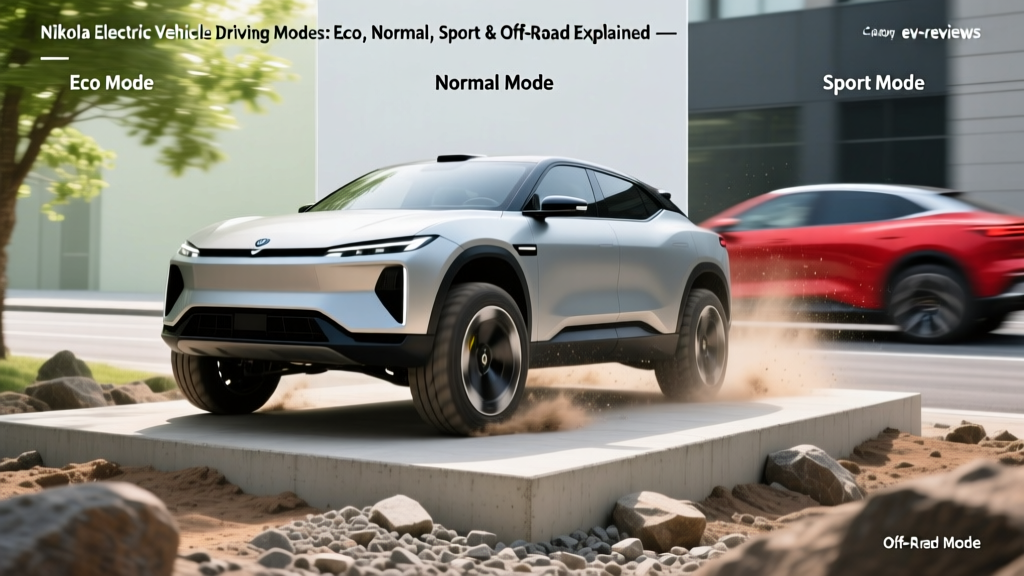
Nikola's production electric trucks — primarily the Tre BEV (battery-electric cabover) and the Two (day-cab sleeper with fuel-cell option) — offer selectable drive modes that adjust throttle mapping, regenerative braking aggressiveness, and top-speed governors. In the Tre BEV, drivers typically toggle between Eco (max regen, capped speed for urban efficiency), Normal (balanced throttle and regen for mixed duty cycles), and a higher-output performance setting for highway merging. A dedicated Off-Road or low-speed maneuvering mode adjusts traction control thresholds for yard and construction-site use. Note: Nikola's lineup is focused on Class 8 commercial trucks — there is no Nikola consumer pickup or SUV currently in production as of 2026.
What Driving Modes Actually Change in a Nikola EV
In any heavy-duty electric truck, drive modes don't change the motor's peak hardware output — they change how the software delivers it. On the Tre BEV, which uses a single or dual-motor e-axle producing up to 645 hp (480 kW) and 1,850 lb-ft of torque at the wheels, the modes alter three parameters:
- Throttle map: How aggressively the motor responds to pedal input.
- Regenerative braking level: How much kinetic energy is recaptured on deceleration (measured in kW of negative torque).
- Speed governor and traction-control thresholds: Top-speed limits and wheel-slip tolerance.
This is fundamentally different from a diesel truck, where switching modes might alter transmission shift points and turbo boost. In an EV, the motor's full torque is available from 0 RPM — modes simply shape how the driver accesses it and how much energy returns to the 753 kWh (usable) battery pack.
Mode-by-Mode Breakdown
| Mode | Throttle Response | Regen Level | Best Use Case | Range Impact |
|---|---|---|---|---|
| Eco | Muted, linear | Maximum (up to ~350 kW recapture) | Urban drayage, stop-and-go port runs | +10–15% range vs. Normal |
| Normal | Balanced | Moderate (~200 kW) | Mixed highway/regional haul | Baseline (EPA-rated equivalent) |
| Sport / Power | Aggressive, immediate | Reduced (~100 kW) | Highway merging, grade climbing | −8–12% range |
| Off-Road / Yard | Low-speed, high-torque | Minimal | Construction sites, rail yards, unpaved lots | Minimal (low-speed use) |
Real-World Range and Efficiency: What the Modes Mean for Your Route
The Nikola Tre BEV carries a massive 753 kWh usable battery (NMC lithium-ion chemistry) and has an EPA-estimated range of approximately 330 miles in its longest-range configuration. But as with any EV, real-world range varies significantly based on payload, terrain, temperature, and — critically — drive mode selection.
EPA Estimate: ~330 miles (unladen, flat terrain, moderate speed)
Real-World Expectation: 220–280 miles loaded at 65 mph highway in Normal mode; up to 310+ miles in Eco mode on urban drayage cycles with heavy regen recapture; as low as 150–180 miles in cold weather (below 20°F) with full payload and Sport mode.
For fleet operators, the Eco mode's aggressive regen is the single biggest efficiency lever in stop-and-go duty cycles. Every braking event recaptures energy that a diesel truck would waste as heat through friction brakes. In port drayage operations where trucks average 15–25 mph with frequent stops, Eco mode can extend effective range by 30–50 miles compared to Normal mode — a meaningful difference when your depot charger is a 150 kW DC unit adding roughly 70–90 miles per hour of charging.
Cost Breakdown: Nikola Tre BEV vs. Diesel Class 8
The decision to spec a Nikola Tre BEV over a diesel day cab isn't just about tailpipe emissions — it's about total cost of ownership (TCO) over a 5–7 year fleet cycle. Here's how the numbers compare for a regional-haul duty cycle (~60,000 miles/year):
| Cost Factor | Nikola Tre BEV | Diesel Class 8 (e.g., Freightliner Cascadia) |
|---|---|---|
| Purchase Price (MSRP) | ~$400,000–$450,000 (before incentives) | ~$160,000–$200,000 |
| Federal §45W Commercial Clean Vehicle Credit | Up to $40,000 (GVWR > 14,000 lbs) | $0 |
| State Incentives (e.g., CARB HVIP in California) | $60,000–$150,000+ (varies by district and fleet size) | $0 |
| Effective Purchase Price | ~$210,000–$350,000 | $160,000–$200,000 |
| Energy/Fuel Cost per Mile | ~$0.14–$0.22/mi (at $0.12–$0.18/kWh commercial rate) | ~$0.55–$0.75/mi (at $4.00–$5.00/gal diesel, 6.5 mpg) |
| Annual Energy/Fuel (60k mi) | ~$8,400–$13,200 | ~$33,000–$45,000 |
| Maintenance per Mile | ~$0.06–$0.10 (no oil, no DEF, fewer brake replacements) | ~$0.15–$0.22 |
| 5-Year Fuel/Energy Savings | $100,000–$175,000 savings for the EV | |
The upfront price gap is real, but when federal §45W commercial credits, state voucher programs, and fuel savings are stacked, the Tre BEV can reach TCO parity with diesel within 3–5 years on high-utilization routes. The drive mode you select daily directly affects that timeline: running Eco mode on urban routes maximizes regen and minimizes electricity cost per mile.
Comparing to Gas and Hybrid Trucks: Where EV Modes Differ
If you're evaluating a Nikola Tre BEV against a conventional diesel or a hybrid-electric Class 8 (such as the Freightliner eCascadia or a PHEV drayage truck), the role of drive modes is distinctly different:
| Factor | Nikola Tre BEV (Full EV) | Diesel Class 8 | Hybrid/PHEV Class 8 |
|---|---|---|---|
| Drive Mode Effect on Range | High (10–15% swing via regen) | Low (2–4% via shift mapping) | Moderate (EV-only range varies) |
| Regen Braking in Eco Mode | Up to 350 kW recapture | None (engine brake only) | Moderate (limited battery capacity) |
| Torque Delivery | Instant, 1,850 lb-ft from 0 RPM | Ramp-up, peak at ~1,200 RPM | Combined, varies by state of charge |
| Cold-Weather Range Loss | 30–40% (battery heating demand) | 5–10% (idling, DEF) | 15–25% (smaller battery, engine backup) |
| Refuel/Recharge Time | 3–5 hours (150 kW DC); 10–12 hours (Level 2 AC) | 15–20 minutes (diesel fill) | 20 min diesel + 2–4 hours plug-in |
The key takeaway: in a diesel, drive modes are a minor efficiency tweak. In a full EV like the Tre BEV, your mode selection is a primary operational decision that directly impacts whether you complete your route or need a mid-shift top-up.
Common Misconceptions About Nikola EVs and Drive Modes
| Myth | Fact |
|---|---|
| "Nikola makes electric pickups for consumers." | Nikola's production lineup is exclusively Class 8 commercial trucks (Tre BEV, Tre FCEV, Two). The consumer Badger pickup was canceled in 2020. There is no Nikola consumer vehicle in 2026. |
| "Sport mode drains the battery twice as fast." | Sport/Power mode reduces range by roughly 8–12%, not 50%. The larger range killers are high sustained speed, heavy payload, and cold temperatures. |
| "Off-Road mode is for trail driving." | In a Class 8 context, Off-Road/Yard mode adjusts traction control for low-grip surfaces like gravel lots, rail yards, and construction sites — not recreational off-roading. |
| "You can't use regen braking in Sport mode." | Regen is reduced, not eliminated. You still recapture energy on deceleration — just at a lower kW threshold to allow more coasting and aggressive acceleration. |
| "Eco mode makes the truck dangerously slow." | Eco mode softens the throttle tip-in but doesn't limit peak power. You still have full 645 hp available if you floor the pedal — it just requires more pedal travel to get there. |
Real-World Ownership Considerations for Fleet Buyers
Depot Charging Infrastructure
The Tre BEV's 753 kWh battery requires serious charging infrastructure. At a 150 kW DC depot charger, a full 10–80% charge takes approximately 3.5–4 hours. Most fleet operators install 150–350 kW DC chargers at their depots, with electrical infrastructure costs running $50,000–$150,000 per charger including transformer upgrades, switchgear, and utility interconnection. Utility demand charges can add $5,000–$15,000/month for a multi-charger depot.
Climate and Route Planning
Cold-weather operations demand careful mode and preconditioning management. Below 20°F, battery internal resistance increases and the thermal management system draws power to maintain pack temperature. Fleet operators in northern climates should:
- Precondition the battery while still plugged in at the depot (reduces range loss by 10–15%).
- Default to Eco mode on cold days to maximize regen recapture.
- Plan routes with a 30% range buffer in winter vs. summer.
Insurance and Regulatory
Commercial EV insurance premiums are currently 10–20% higher than equivalent diesel trucks, reflecting higher repair costs for battery and e-axle components. However, CARB's Advanced Clean Fleets rule and similar regulations in states like New York, New Jersey, and Washington are mandating zero-emission truck phase-ins — making the Tre BEV a regulatory compliance tool as much as a cost-saving one.
Decision Framework: Which Mode to Run and When to Buy
Choose the Nikola Tre BEV if:
- Your routes are under 250 miles round-trip with predictable depot return.
- You operate in a state with strong zero-emission truck incentives (CA, NY, NJ, WA).
- Your duty cycle is urban or regional drayage where Eco-mode regen maximizes savings.
- You can invest in depot charging infrastructure or access a shared charging hub.
Stick with diesel or consider the Tre FCEV (fuel-cell) if:
- Your routes exceed 400 miles daily with no mid-route charging.
- You operate in extreme cold climates without adequate depot heating.
- Your fleet lacks access to utility capacity for high-power depot chargers.
- You need 15-minute refueling for multi-shift, high-utilization operations (FCEV option).
Mode selection per route type:
- Port drayage (stop-and-go): Eco mode — max regen, lowest cost per mile.
- Regional highway (60–65 mph cruise): Normal mode — balanced efficiency and responsiveness.
- Mountain grades or heavy merge lanes: Sport/Power mode — full torque availability.
- Yard spotting, construction sites: Off-Road/Yard mode — traction control optimization.
Frequently Asked Questions
Does the Nikola Tre BEV have an Off-Road mode?
Yes, the Tre BEV offers a low-speed maneuvering or Off-Road/Yard mode that adjusts traction control and torque delivery for unpaved surfaces, rail yards, and construction sites. It is not designed for recreational off-road use — it's a commercial tool for low-grip work environments.
How much range do I lose in Sport mode?
Expect roughly 8–12% range reduction compared to Normal mode. On a truck rated for 330 miles, that's approximately 25–40 miles of lost range. The bigger range factors are sustained highway speed (70+ mph), payload weight, and ambient temperature.
Can I change drive modes while moving?
Yes. Nikola's drive mode selector can be adjusted while the truck is in motion, similar to selecting a different gear range in a diesel. The transition is seamless — the software remaps throttle and regen in real time.
Does Eco mode limit top speed?
Eco mode typically governs top speed to around 55–60 mph in many fleet configurations, though this is often fleet-configurable via Nikola's telematics platform. If your route requires sustained 65+ mph highway operation, Normal or Sport mode is more appropriate.
What is the battery warranty on the Nikola Tre BEV?
Nikola offers a battery warranty covering defects and capacity retention below a specified threshold (typically 70–80% of original capacity) for a period aligned with industry standards for Class 8 trucks — generally 5 years or 300,000+ miles, whichever comes first. Exact terms vary by model year and purchase agreement; confirm current terms with your Nikola dealer or fleet representative.
Is the Nikola Tre BEV eligible for federal tax incentives?
Yes, but under the §45W Commercial Clean Vehicle Credit, not the consumer §30D credit. Qualifying commercial vehicles over 14,000 lbs GVWR can receive up to $40,000 in federal credits. Additional state incentives (like California's HVIP vouchers) can stack on top. Consult the IRS §45W guidance and your tax professional for eligibility specifics.