If you're shopping for an electric vehicle in the Empire State, the headline number isn't the sticker price — it's what you actually pay after stacking the New York State electric car rebate with federal tax credits, utility incentives, and five years of lower operating costs. New York remains one of the most incentive-rich states for EV buyers in 2026, but navigating the eligibility rules requires precision. Miss a cap or misread an income limit, and you could leave thousands on the table.
This guide walks through the real math: purchase incentives, five-year total cost of ownership, charging versus gas, maintenance savings, the insurance premium reality, and depreciation trends. We'll use a popular 2026 model — the Hyundai Ioniq 5 SEL (MSRP ~$45,500, 77.4 kWh NMC battery, 304 mi EPA range) — as our working example throughout.
Federal Tax Credit: The $7,500 Question in 2026
The IRS §30D Clean Vehicle Credit remains the single largest purchase incentive for qualifying EVs, offering up to $7,500. However, "up to" is doing heavy lifting. The credit is split into two $3,750 halves, each tied to specific battery-sourcing requirements that tighten annually.
- Income caps: Modified AGI ≤ $300,000 (married filing jointly), ≤ $225,000 (head of household), ≤ $150,000 (single)
- MSRP caps: ≤ $80,000 for vans/SUVs/pickups; ≤ $55,000 for sedans and other body styles
- Critical minerals requirement ($3,750): A percentage of battery minerals must be sourced from the US or a free-trade-agreement country — threshold increases annually
- Battery components requirement ($3,750): A percentage of battery components must be manufactured or assembled in North America — threshold increases annually
- FEOC exclusion: Vehicles with battery components or critical minerals from a Foreign Entity of Concern (primarily China, Russia, North Korea, Iran) are disqualified entirely
- Point-of-sale transfer: Buyers can transfer the credit to the dealer at purchase, reducing the sale price immediately rather than waiting to claim it on their tax return
- Tax liability: The credit is non-refundable — if transferred at POS, the dealer assumes the liability; if claimed on taxes, you must owe at least that much in federal tax
For our 2026 Hyundai Ioniq 5 SEL example, the vehicle qualifies for the full $7,500 when sourced correctly, bringing the effective price from $45,500 to $38,000 before state incentives. Always verify eligibility on the IRS page and with your tax professional — rules shift, and a trim-level change or mid-year sourcing update can alter qualification.
New York State Electric Car Rebate: Drive Clean Incentive
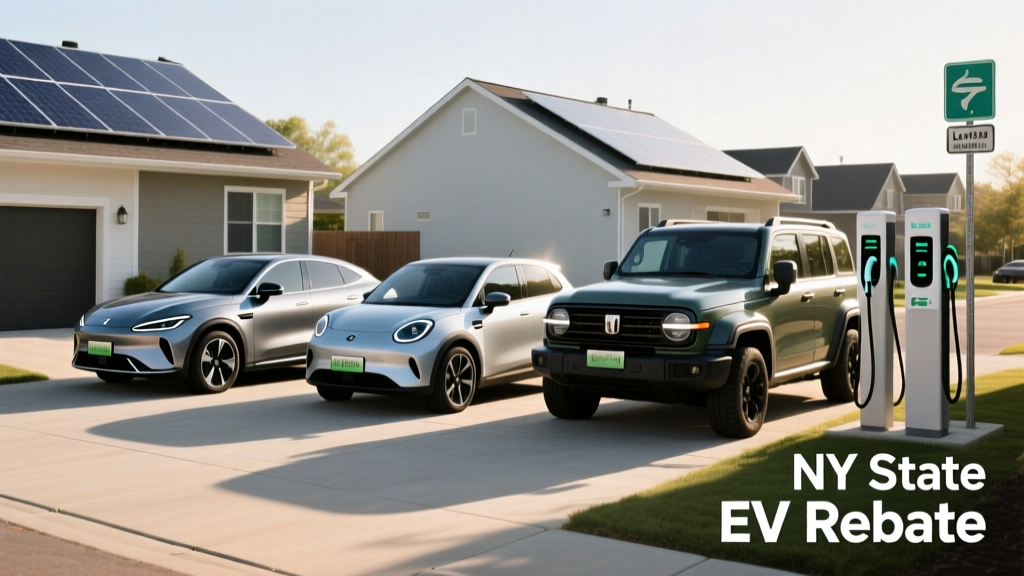
New York's Drive Clean Rebate (officially the New York State Electric Car Rebate program administered through NYSERDA) provides a point-of-sale rebate on new eligible EVs. The rebate amount is tiered based on the vehicle's MSRP and the buyer's household income, with enhanced amounts for lower-income households.
For a middle-income household purchasing a $45,500 Ioniq 5, the state rebate has historically ranged in the $1,000–$2,000 tier. Combined with the $7,500 federal credit, that's potentially $8,500–$9,500 off the effective purchase price — a meaningful reduction that narrows the gap with a comparably equipped gas crossover like the Toyota RAV4.
Additional New York Incentives
- Utility charger rebates: Many NY utilities offer $500–$1,000 toward Level 2 home charger purchase and installation
- HOV lane access: Eligible EVs receive Clean Pass stickers for HOV lane use on Long Island Expressway and other designated corridors
- Reduced registration fees: Some municipalities offer lower registration costs for zero-emission vehicles
- MV-250 credit: New York's alternative fuels vehicle credit (up to $1,000) may apply to certain plug-in models — check current Form IT-250 eligibility
5-Year Total Cost of Ownership: EV vs. Gas Crossover
Purchase price is just the starting line. The true cost comparison lives in five years of fueling, insuring, maintaining, and eventually selling the vehicle. Below is a detailed TCO breakdown comparing our 2026 Ioniq 5 SEL (after incentives) against a similarly equipped 2026 Toyota RAV4 XLE AWD (MSRP ~$34,000, 30 MPG combined).
| Cost Category | 2026 Ioniq 5 SEL (EV) | 2026 RAV4 XLE AWD (Gas) | 5-Year Difference |
|---|---|---|---|
| Purchase Price (after incentives) | $36,500* | $34,000 | +$2,500 |
| Fuel/Energy (60,000 mi) | $3,600 | $7,500 | −$3,900 |
| Maintenance | $1,200 | $3,200 | −$2,000 |
| Insurance (5 years) | $9,500 | $7,500 | +$2,000 |
| Depreciation (estimated) | $14,000 | $11,500 | +$2,500 |
| Total 5-Year Cost | $64,800 | $63,700 | +$1,100 |
*Assumes $45,500 MSRP − $7,500 federal credit − $2,000 state rebate + $500 destination/fees. Actual prices vary by dealer, incentives, and negotiation.
The takeaway: after incentives, the EV reaches near cost-parity over five years, with the residual gap largely dependent on depreciation assumptions and insurance premiums. Extend ownership to seven or eight years, and the EV typically pulls ahead as gas and maintenance costs compound while the purchase price is long-sunk.
Charging vs. Gas: The Per-Mile Math
The fuel savings are where EV ownership delivers its most consistent advantage — but only if you can charge at home at residential electricity rates. Public DC fast charging erodes much of the savings.
| Fueling Scenario | Rate Assumption | Cost per Mile |
|---|---|---|
| Home charging (Level 2, NY avg residential) | $0.22/kWh, 3.5 mi/kWh | $0.063 |
| Public DC fast charging (Electrify America, etc.) | $0.45/kWh, 3.5 mi/kWh | $0.129 |
| Gas (RAV4, 30 MPG combined) | $3.75/gallon | $0.125 |
At home in New York (average residential rate ~$0.22/kWh in 2026), the Ioniq 5 costs roughly 6.3 cents per mile to fuel. The RAV4 at 30 MPG and $3.75/gallon costs 12.5 cents per mile. Over 12,000 miles annually, that's $756/year for the EV at home versus $1,500/year for gas — a $744 annual savings.
However, if you rely primarily on public DC fast chargers at $0.45–$0.55/kWh, your per-mile cost rises to $0.13–$0.16, potentially exceeding gas. This is why home charging access is the single biggest predictor of EV ownership satisfaction and cost savings. New York City apartment dwellers without garage access face a genuine structural disadvantage here.
Cold-Weather Efficiency Loss
New York winters matter. Expect the Ioniq 5's 304-mile EPA range to drop to roughly 220–250 miles in sustained sub-freezing temperatures due to cabin heating demands and reduced battery efficiency. The heat pump on the Ioniq 5 mitigates this better than resistive heating, but a 20–25% winter range penalty is realistic. Factor this into your commute planning — a 100-mile daily round trip is still easily covered, but a 200-mile trip requires more buffer in January than in July.
Maintenance Savings: Fewer Parts, Less Wear
EVs eliminate the most routine and costly maintenance items in a gas vehicle. There are no oil changes, no spark plugs, no timing belts, no transmission fluid, and no exhaust system to corrode. Regenerative braking significantly extends brake pad life — many EV owners report original brake pads at 80,000+ miles.
| Maintenance Item | EV (5-Year Cost) | Gas Vehicle (5-Year Cost) |
|---|---|---|
| Oil changes | $0 | $500–$750 |
| Brake pads/rotors | $0–$200 | $600–$1,000 |
| Transmission fluid/service | $0 | $200–$400 |
| Air filters (engine) | $0 | $100–$150 |
| Coolant flush | $0–$100 | $150–$250 |
| Tire rotation/replacement | $800–$1,200 | $700–$1,000 |
| Cabin air filter | $100–$150 | $100–$150 |
| Total Estimated | $1,000–$1,550 | $2,350–$3,700 |
The one area where EVs spend more: tires. EVs are heavier (the Ioniq 5 is ~4,500 lbs) and deliver instant torque, which accelerates tire wear. Budget for tire replacement every 30,000–40,000 miles rather than the 50,000+ miles typical for gas crossovers. EV-specific tires (like the Michelin Pilot Sport EV or Hankook iON evo) are optimized for lower rolling resistance and noise but carry a premium of $200–$300 per set over standard all-seasons.
The Hyundai battery warranty covers the 77.4 kWh NMC pack for 10 years/100,000 miles, retaining at least 70% of original capacity. Hyundai's powertrain warranty is similarly 10 years/100,000 miles, providing substantial protection against catastrophic battery failure during typical ownership.
Insurance: The Hidden EV Cost Premium
Here's the reality most incentive calculators omit: EVs cost more to insure. Industry data consistently shows EV premiums running 15–25% higher than comparable gas vehicles. For the Ioniq 5 versus the RAV4, expect to pay roughly $300–$500 more annually in New York.
Why the premium?
- Higher repair costs: EV body repair requires high-voltage-certified technicians, and battery pack damage in a collision often results in a total-loss declaration rather than repair
- Higher vehicle value: Even after incentives, the insured value is based on the pre-incentive MSRP, and replacement parts (especially battery modules) are expensive
- Specialized labor: Fewer body shops have EV-certified technicians, limiting competition and raising labor rates
- Total-loss frequency: Insurers are more likely to total a damaged EV because battery integrity cannot always be verified post-collision
Mitigation strategies: shop multiple insurers (Geico, Progressive, State Farm, and Tesla Insurance where available quote differently for EVs), ask about EV-specific discounts, and consider higher deductibles to offset the premium. Some insurers now offer "green vehicle" discounts that partially offset the EV surcharge.
Depreciation: EVs Are Stabilizing, but Gaps Remain
EV depreciation has been volatile. In 2023–2024, a wave of Tesla price cuts cascaded through the used EV market, depressing resale values across all brands. By 2026, the market has largely stabilized, but EVs still depreciate somewhat faster than the most popular gas crossovers.
Key factors affecting EV resale value:
- Battery health perception: Used buyers are cautious about battery degradation, even though most modern packs retain 90%+ capacity at 60,000 miles
- Tax credit resets: Each new federal credit cycle resets the effective new-vehicle price, pressuring used prices downward
- Technology obsolescence: Charging speed and range improvements in newer models make older EVs feel dated faster than gas cars
- Brand matters: Tesla, Hyundai/Kia, and Ford EVs have held value better than luxury EVs from Jaguar, Audi, and Mercedes, which can lose 50%+ in three years
For our Ioniq 5 example, expect approximately 50–55% value retention at 5 years/60,000 miles versus roughly 55–60% for the RAV4. That translates to a $2,000–$3,000 depreciation gap over five years. However, if you plan to drive the vehicle for 8–10 years, depreciation becomes less relevant as both vehicles approach their floor values.
Putting It Together: Is a New York EV Purchase Worth It in 2026?
- You can install a Level 2 home charger (garage, driveway, or workplace access)
- Your household income is within §30D caps and you qualify for both federal and state incentives
- Your daily driving is under 200 miles, or you're comfortable planning DC fast-charge stops for road trips
- You plan to own the vehicle 5+ years, maximizing fuel and maintenance savings
- You live in an apartment without charging access and cannot install a home charger
- You frequently drive 300+ mile trips in winter and don't want to plan around charging
- You exceed the federal income caps and lose the $7,500 credit, narrowing the purchase-price gap
The New York State electric car rebate, stacked with the federal §30D credit and potential utility incentives, makes 2026 one of the most financially compelling years to buy an EV in the state. The five-year TCO approaches parity with gas vehicles, and the driving experience — instant torque, quiet cabin, one-pedal driving, preconditioned warmth in winter — delivers daily quality-of-life benefits that spreadsheets don't capture.
The caveats are real: higher insurance premiums, winter range loss, tire wear, and the structural requirement of home charging access. But for New Yorkers with a garage and a commute, the math works — and the incentives are designed to be claimed now, not later.
Frequently Asked Questions
How much does it really cost to own an EV over 5 years in New York?
After federal and state incentives, a 2026 Ioniq 5 SEL costs approximately $64,800 over five years (purchase, fuel, maintenance, insurance, depreciation) for 60,000 miles of driving. That's within ~$1,100 of a comparable gas RAV4, with the EV pulling further ahead in years 6–8 as fuel and maintenance savings compound and the purchase price is fully absorbed.
Do I qualify for the federal §30D tax credit?
You qualify if your modified adjusted gross income is ≤$300,000 (joint), ≤$225,000 (head of household), or ≤$150,000 (single); the vehicle MSRP is ≤$55,000 (cars) or ≤$80,000 (SUVs/trucks/vans); and the vehicle meets critical-mineral and battery-component sourcing requirements. Check the IRS Clean Vehicle Credit page and confirm with your tax professional, as rules update annually.
How much do I save on fuel and maintenance with an EV?
At New York residential electricity rates (~$0.22/kWh), expect to save approximately $744/year on fuel versus a 30-MPG gas crossover driving 12,000 miles. Maintenance savings add another $400/year on average (no oil changes, reduced brake wear, fewer fluid services). Combined savings of ~$1,100–$1,200/year are typical for home-charging EV owners.
Are EVs more expensive to insure?
Yes, typically 15–25% more than comparable gas vehicles. For a $45,000 EV like the Ioniq 5, expect $300–$500 more per year in New York. The higher premiums reflect costlier collision repairs, high-voltage-certified labor requirements, and a greater likelihood of total-loss declarations when the battery pack is involved in damage.
How well do EVs hold their value compared to gas cars?
EVs retain approximately 50–55% of their value at 5 years/60,000 miles versus 55–60% for popular gas crossovers. The gap has narrowed since the 2023–2024 used-EV market correction but persists due to battery health concerns, technology turnover, and new-vehicle incentive resets. Long-term owners (8+ years) see the gap become less meaningful as both vehicle types approach floor values.
Can I stack the New York State rebate with the federal credit?
Yes. The NYSERDA Drive Clean Rebate stacks with the federal §30D credit and is applied at point of sale through participating dealers. Some utility charger rebates (Con Edison, National Grid) also stack independently. Confirm current amounts and eligibility on the NYSERDA website before purchase.
What happens to the tax credit if I sell the EV within a year?
If you claimed the §30D credit on your tax return, there is no clawback for selling the vehicle. However, if you transferred the credit at point of sale and then return or sell the vehicle within a short period, the IRS has recapture rules that may require you to repay the credit. Consult your tax professional for specifics on your situation.