Quick Answer: Is the New Ford Electric Truck Worth It?
The 2026 Ford F-150 Lightning is the most practical full-size electric pickup for buyers who need real truck capability with daily-driver comfort. The base Pro trim starts at $54,995 with 230 miles of EPA range, while the Extended Range battery (320 miles EPA) adds $10,000-$12,000 depending on trim. Real-world highway range drops to roughly 190-270 miles depending on battery pack, payload, and temperature. With home Level 2 charging, the Lightning costs approximately $0.04-$0.06 per mile to fuel versus $0.16-$0.20 per mile in a comparable gas F-150 — but public DC fast charging at peak rates narrows that gap significantly. The Lightning qualifies for up to $7,500 in federal tax credits under current IRS §30D rules, though eligibility depends on your income, the truck's MSRP, and battery sourcing requirements that shift annually.
2026 F-150 Lightning Range, Battery, and Charging Specs
The Lightning comes in two battery configurations that fundamentally change its usability as a daily driver and road-trip vehicle. Understanding the difference between kilowatt-hours (kWh — the energy stored in the battery) and kilowatts (kW — the rate at which it charges) is critical to evaluating which configuration fits your driving pattern.
| Spec | Standard Range (Pro/XLT) | Extended Range (Lariat/Platinum) |
|---|---|---|
| Usable Battery Capacity | 98 kWh (LFP)131 kWh (NMC) | |
| EPA Range | 230 miles | 320 miles |
| Real-World Highway (70 mph) | ~185-200 miles | ~260-280 miles |
| Real-World Cold Weather (20°F) | ~160-175 miles | ~225-245 miles |
| Max DC Fast Charge Rate | 120 kW peak | 130 kW peak |
| 10-80% DC Fast Charge | ~38 minutes | ~41 minutes |
| Level 2 Home Charging (48A) | ~10 hours (0-100%) | ~13 hours (0-100%) |
| Motor Output | 452 hp / 775 lb-ft | 580 hp / 775 lb-ft |
| 0-60 mph | ~4.5 seconds | ~3.8 seconds |
| Max Towing (w/ Max Tow Pkg) | 7,700 lbs | 10,000 lbs |
| Max Payload | 2,235 lbs | 1,800 lbs |
| EPA Efficiency | 68 MPGe (combined) | 70 MPGe (combined) |
Real-world range honesty: The EPA sticker assumes a mix of city and highway driving at moderate temperatures with no payload. On a flat highway at 70 mph in 75°F weather, expect the Standard Range pack to deliver roughly 185-200 miles before you need to stop. Load the bed with 1,000 pounds of lumber or hook up a 5,000-pound trailer, and that number drops to 130-160 miles. In sub-30°F temperatures, lithium-ion chemistry becomes less efficient and cabin heating draws significant energy — budget 25-30% off the EPA number. The Extended Range pack mitigates this substantially, which is why it's the recommended choice for anyone who regularly drives more than 150 miles between charging opportunities.
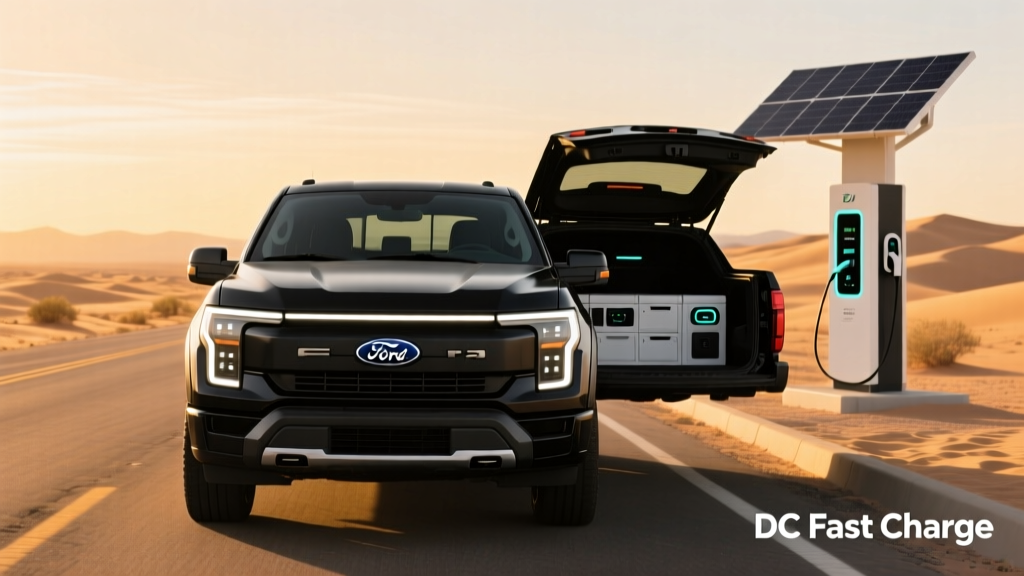
Charging curve reality: Ford quotes peak DC fast-charge rates (120 kW Standard, 130 kW Extended), but no EV sustains peak rate for the entire session. The Lightning charges fastest between 10-50% State of Charge, then progressively tapers to protect battery longevity. A 10-80% session takes roughly 38-41 minutes at a 150+ kW charger, but the last 20% (80-100%) can add another 30+ minutes. For road trips, plan to charge to 80% and move on — it's dramatically faster than waiting for a full charge.
Range Reality Check: EPA 230/320 miles. Real-world highway: ~190/270 miles. With heavy payload or towing: ~130-170 miles. In freezing weather: subtract 25-30%. Always plan road trips around 70% of the EPA figure for a safety margin.
F-150 Lightning vs Gas F-150: Cost and Capability Comparison
The decision between a new Ford electric truck and its gas counterpart isn't just about fuel savings — it's about where and how you drive, what you tow, and whether you can charge at home. Here's how the numbers stack up for a typical owner driving 15,000 miles per year.
| Factor | 2026 F-150 Lightning XLT (ER) | 2026 F-150 XLT SuperCrew 4x4 (3.5L EcoBoost) |
|---|---|---|
| Base MSRP | $64,995 | $52,500 |
| Fed. Tax Credit (§30D) | Up to $7,500 (eligibility varies) | $0 |
| Effective Price After Credit | ~$57,495 | $52,500 |
| Fuel/Energy Cost per Mile | $0.05 (home) / $0.14 (public DC) | $0.18 (at $3.50/gal, 19 mpg) |
| Annual Fuel Cost (15k mi) | $750 (home) / $2,100 (public DC) | $2,700 |
| Annual Maintenance | ~$300 (tires, cabin filter, fluid top-off) | ~$900 (oil, filters, brakes, plugs) |
| 5-Year Total Fuel + Maint. | $3,750 (home) / $10,500 (public) | $18,000 |
| Insurance (annual avg.) | ~$2,400 | ~$1,900 |
| Max Towing | 10,000 lbs | 14,000 lbs |
| Max Payload | 1,800 lbs | 3,325 lbs |
The Lightning's operating cost advantage is substantial if you charge primarily at home on residential electricity rates (national average ~$0.16/kWh). Over five years, home-charging Lightning owners can save $10,000-$14,000 in combined fuel and maintenance compared to a gas F-150. However, if you rely exclusively on public DC fast chargers at $0.40-$0.50/kWh, the fuel savings nearly evaporate — and you'll spend significantly more time stopped on road trips.
Where the gas F-150 still wins: Maximum towing drops to 10,000 lbs on the Lightning (vs. 14,000 on EcoBoost), and towing range collapses to roughly 100-130 miles on the Extended Range pack. If you tow a large camper or boat more than a few times per year over long distances, the gas F-150 remains the more practical tool. The Lightning excels as a daily driver that occasionally hauls or tows locally — not as a long-haul tow rig.
Home Charging Setup: What You Actually Need
Home charging is the make-or-break factor for Lightning ownership. Ford includes the Mobile Power Cord with every Lightning, which plugs into a standard 120V outlet (Level 1) for roughly 2-3 miles of range per hour — adequate only for low-mileage drivers who can leave the truck plugged in for 20+ hours between uses. For practical daily ownership, a Level 2 home charger is essentially mandatory.
| Item | Cost Range | Notes |
|---|---|---|
| Level 2 Charger (48A, hardwired) | $400-$700 | Ford Charge Station Pro or ChargePoint Home Flex |
| Electrical Panel Capacity Check | $0-$150 | Electrician assessment; many 200A panels have room |
| 60A Circuit Installation (typical) | $800-$2,500 | Depends on distance from panel to garage/driveway |
| Panel Upgrade (if needed) | $2,000-$4,500 | Required if existing panel is 100A or near capacity |
| Permit & Inspection | $100-$400 | Varies by municipality |
| Total (no panel upgrade) | $1,300-$3,750 | Most common scenario |
| Total (with panel upgrade) | $3,300-$8,250 | Older homes with 100A service |
The Ford Charge Station Pro delivers up to 80A (19.2 kW) on a 100A circuit, adding roughly 30 miles of range per hour — enough to fully replenish the Extended Range pack overnight. The more common 48A setup (11.5 kW, on a 60A circuit) adds about 18-20 miles per hour, still sufficient for most owners who plug in each evening. Always hire a licensed electrician and pull a permit — improper EV charger installation is a fire risk and may void home insurance coverage.
Apartment and street-parking reality: If you don't have access to a garage, driveway, or dedicated parking spot with electrical access, Lightning ownership becomes significantly harder. Public DC fast charging infrastructure continues to expand (Tesla Superchargers now serve NACS-equipped Lightnings via adapter, and Electrify America stations support CCS), but relying on public charging adds cost, time, and unpredictability to your routine. Be honest about your parking situation before committing.
Federal Tax Credit and Incentive Eligibility
The federal EV tax credit under IRS §30D can reduce the effective price of a new F-150 Lightning by up to $7,500, but qualification is not automatic. The rules involve multiple overlapping requirements that change periodically, so always verify current eligibility on IRS.gov before purchasing.
- MSRP Cap: Pickup trucks must have an MSRP at or below $80,000 to qualify. The Lightning Pro, XLT, and Lariat trims generally clear this threshold; the Platinum trim may exceed it depending on options.
- Buyer Income Limits: Modified adjusted gross income must not exceed $300,000 (joint filers), $225,000 (head of household), or $150,000 (single filers).
- Battery Sourcing Requirements: The credit is split into two halves — $3,750 for critical minerals and $3,750 for battery component assembly. Both have escalating domestic-content and free-trade-agreement sourcing thresholds that tighten annually. Check the DOE/FuelEconomy.gov tax credit lookup for the specific model year and trim.
- Point-of-Sale Transfer: As of 2024, buyers can transfer the credit to the dealer at purchase, reducing the sale price directly rather than waiting to claim it on their tax return. The dealer must be IRS-registered.
- One Credit per Vehicle: The credit applies once per VIN. If you buy a used Lightning, different rules and caps apply under the §25E used-EV credit (up to $4,000).
State and local incentives vary widely — some states offer additional rebates of $1,000-$5,000, while others provide none. Utility companies sometimes offer $250-$1,000 rebates for home charger installation or off-peak charging enrollment. Check your state energy office and local utility for current programs.
2026 Lightning Trim Breakdown and Pricing
Ford offers the Lightning across four main trims, each targeting different buyer profiles. Prices below are base MSRP before destination charges and before any tax credit application.
Pro ($54,995): The work-oriented base trim. Standard Range battery (230 mi), vinyl-adjacent cloth seats, 12-inch touchscreen, Pro Power Onboard (2.4 kW), basic BlueCruise capability. Best for fleet buyers and tradespeople who need a job-site truck with low operating costs.
XLT ($59,995): The volume trim and best value for most retail buyers. Adds cloth/leatherette seating, upgraded interior materials, available Extended Range battery (+$10,000), and more driver-assist features. The XLT Extended Range at ~$69,995 before credit is the sweet spot for daily-driver truck owners.
Lariat ($74,995): Premium comfort trim with leather, panoramic roof, 15.5-inch vertical touchscreen, B&O audio, and Extended Range battery standard. Competes with high-trim gas F-150s on luxury.
Platinum ($96,895): The flagship. Unique styling, premium leather massaging seats, advanced tech package. At this price, the federal tax credit's MSRP cap becomes a concern — verify eligibility before ordering. This trim competes with luxury pickups like the Rivian R1T and GMC Hummer EV.
All trims include Ford's 8-year/100,000-mile battery warranty (covering capacity loss below 70% of original) and 3-year/36,000-mile bumper-to-bumper coverage. The battery uses LFP (lithium iron phosphate) chemistry on Standard Range models — offering longer cycle life and less degradation over time, at the cost of lower energy density and heavier weight — and NMC (nickel manganese cobalt) on Extended Range models for maximum range.
Myths vs Facts: Common Lightning Misconceptions
| Myth | Fact |
|---|---|
| "Electric trucks can't tow anything" | The Lightning tows up to 10,000 lbs — but towing range drops to ~100-130 mi. It's a capable local tow rig, not a cross-country hauler. |
| "The battery will need replacing in 5 years" | Ford warranties the battery for 8 years/100,000 miles at 70% capacity. Real-world data from 2022-2024 Lightnings shows average degradation of 5-8% over the first 60,000 miles. |
| "Charging takes hours on road trips" | A 10-80% DC fast charge takes ~38-41 minutes. Combined with a meal or rest stop, it's manageable — but you will stop more often than in a gas truck. |
| "You need solar panels to make it worthwhile" | Residential grid electricity at $0.16/kWh already costs roughly 70% less per mile than gasoline. Solar further reduces costs but is not required. |
| "It's not a real truck" | 775 lb-ft of torque, available 4WD, 10,000-lb towing, and the largest front trunk (frunk) in the segment at 14.1 cu ft. It's a truck that happens to be electric. |
| "Pro Power Onboard replaces a generator" | The 2.4 kW system (9.6 kW available on higher trims) handles job-site power tools and tailgating, but it's not a full-home backup generator unless you invest in a bi-directional charging setup (Ford Intelligent Backup Power, ~$3,800+ for hardware and install). |
Decision Framework: Should You Buy the Lightning?
Buy the F-150 Lightning if:
- You have access to home Level 2 charging (garage, driveway, or dedicated spot with electrical access)
- Your daily driving is under 150 miles round-trip, with occasional longer road trips
- You value low operating costs and minimal maintenance over maximum towing range
- You want a comfortable daily driver that can handle weekend truck tasks (hauling mulch, towing a small boat, job-site power)
- You qualify for the federal tax credit, narrowing the price gap with gas F-150 trims
Stick with a gas or hybrid F-150 if:
- You regularly tow heavy loads (7,000+ lbs) over distances greater than 100 miles
- You lack reliable home or workplace charging access
- You frequently drive in extreme cold (below 10°F) with long distances between charging stops
- Your annual mileage is very low (under 8,000 miles) — the fuel savings won't offset the higher purchase price
- You need maximum payload capacity (3,000+ lbs) for commercial use
Consider the F-150 PowerBoost Hybrid instead if:
- You want truck versatility without charging logistics
- You tow frequently over long distances
- Your budget is under $55,000 and you don't qualify for the EV tax credit
Frequently Asked Questions
How long does the F-150 Lightning battery last?
Ford warranties the high-voltage battery for 8 years or 100,000 miles against capacity loss below 70%. Based on data from early 2022-2024 models, most Lightnings lose 5-8% of capacity in the first 60,000 miles, with degradation slowing significantly after the first year. The battery is not a wear item like brake pads — it should outlast the truck's useful life for most owners. A full battery replacement, if ever needed outside warranty, is estimated at $15,000-$22,000 depending on pack size.
Can I use Tesla Superchargers with the Lightning?
Yes. Starting with the 2025 model year, Ford transitioned the Lightning to the NACS (North American Charging Standard) connector, giving direct access to Tesla's Supercharger network. For 2022-2024 models with CCS connectors, Ford offers an approved NACS adapter. Tesla's network remains the most reliable and widespread DC fast-charging infrastructure in the U.S., with over 25,000 Supercharger stalls nationally.
What does it cost to charge the Lightning at home?
At the national average residential rate of ~$0.16/kWh, fully recharging the Standard Range (98 kWh) pack costs roughly $15.68, and the Extended Range (131 kWh) pack costs about $20.96. That translates to approximately $0.05-$0.06 per mile — roughly one-third the per-mile cost of gasoline in a comparable F-150. Time-of-use utility plans can lower this further if you schedule charging during off-peak overnight hours.
Is the Lightning good in snow and cold weather?
The Lightning's low center of gravity (battery pack under the floor) and available AWD make it competent in snow. However, cold weather reduces range by 20-30% due to battery chemistry limitations and cabin heating energy draw. Using the available heat pump (standard on Extended Range trims) and preconditioning the battery while plugged in can mitigate some of this loss. If you live in a region with sustained sub-20°F winters and long commutes, the Extended Range pack is strongly recommended.
Does the Lightning qualify for the $7,500 federal tax credit?
It can, but eligibility is not guaranteed. The truck must fall under the $80,000 MSRP cap for pickups, the buyer must meet income thresholds, and the battery must satisfy evolving critical-mineral and component sourcing requirements. The credit amount can be $0, $3,750, or $7,500 depending on how many sourcing criteria are met. Always check the current status on FuelEconomy.gov and consult a tax professional before relying on the credit in your purchase decision.