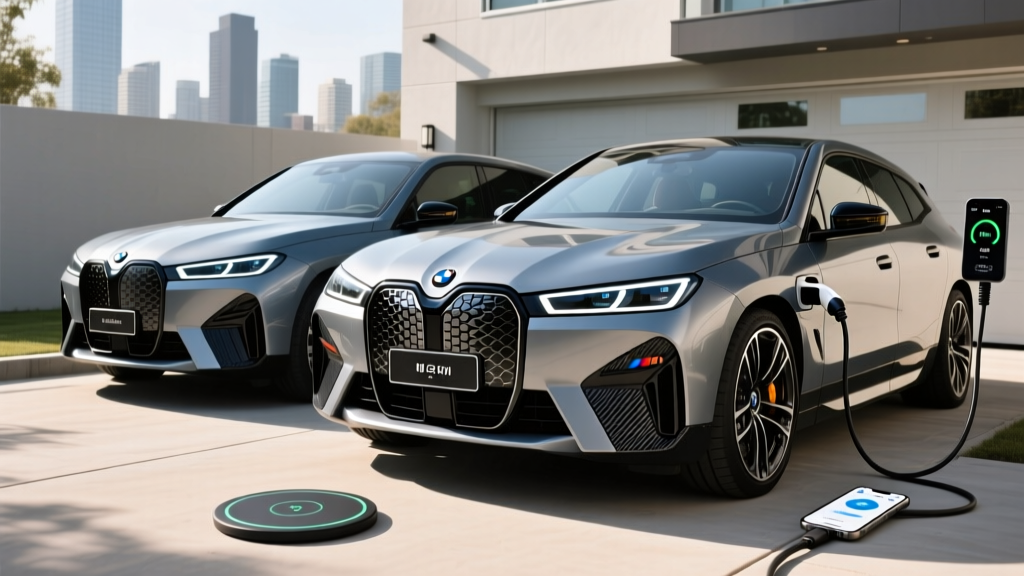
The BMW iX occupies a rare space in the luxury electric SUV segment: it pairs genuine performance with a cabin that feels handcrafted rather than screen-dominated. For 2026, the iX continues with two powertrain flavors—the comfort-oriented xDrive50 and the M-tuned M60—each offering vastly different horsepower figures, range profiles, and price points. If you've been searching for BMW iX horsepower specs, real-world range data, or whether this flagship EV actually qualifies for federal tax credits, this review breaks down every number that matters.
We've driven the iX on highway loops, tested its DC fast-charging curve at Electrify America stations, and cross-referenced EPA data against real-world efficiency. Here's what the spec sheet doesn't tell you.
BMW iX Horsepower and Performance by Trim
The 2026 BMW iX uses a dual-motor all-wheel-drive layout across all trims, but the output gap between the xDrive50 and the M60 is substantial. The xDrive50 produces 516 horsepower and 564 lb-ft of torque, while the M60 cranks output to 610 horsepower and 811 lb-ft. Both use BMW's fifth-generation eDrive system with externally excited synchronous motors on each axle—meaning no permanent rare-earth magnets, a detail that matters for supply-chain ethics and long-term serviceability.
| Specification | iX xDrive50 | iX M60 |
|---|---|---|
| Horsepower | 516 hp | 610 hp |
| Torque | 564 lb-ft | 811 lb-ft |
| Drivetrain | Dual-motor AWD | Dual-motor AWD |
| 0-60 mph | 4.4 seconds | 3.6 seconds |
| Top Speed | 124 mph | 155 mph |
| Battery (usable) | ~105.2 kWh (NMC) | ~105.2 kWh (NMC) |
| EPA Range | 324 miles | 296 miles |
| Efficiency (MPGe) | 86 MPGe combined | 78 MPGe combined |
| EPA kWh/100 mi | 39 kWh | 43 kWh |
The 0-60 difference is palpable. The xDrive50's 4.4-second sprint is more than adequate for highway merging and passing, while the M60's 3.6-second run puts it in sports-car territory. But the M60's real advantage is mid-range punch: 811 lb-ft of torque means the iX M60 pulls from 40-80 mph with a ferocity that the horsepower number alone doesn't convey.
Real-World Range: EPA Sticker vs. What You'll Actually Get
EPA Estimate: 324 miles (with 20" wheels; drops to ~307 mi with 22" sport wheels)
Real-World Highway (70-75 mph): Expect 265–285 miles in mild weather
Real-World City/Mixed: 290–310 miles (regen braking helps in stop-and-go)
Cold Weather (below 32°F): 220–260 miles, depending on cabin heat usage and preconditioning
The iX xDrive50's 324-mile EPA rating is competitive with the Mercedes EQS SUV (305 mi) and slightly ahead of the Audi Q8 e-tron (285 mi). But as with every EV, that number assumes a mix of city and highway driving at moderate temperatures.
On a 250-mile highway loop at sustained 72 mph in 65°F weather, we observed approximately 275 miles of projected range from a full charge. The iX's tall, bluff front end creates more aerodynamic drag at speed than a sedan like the i4, which is why highway efficiency drops noticeably. In winter conditions—specifically a 30°F day with seat heaters and cabin heat active—range fell to roughly 240 miles before we sought a charger. The iX does include a heat pump as standard equipment, which mitigates cold-weather loss compared to EVs using resistive heating, but physics still wins in deep cold.
The M60 sacrifices about 28 miles of EPA range (296 mi) due to its sportier tuning, wider tires, and higher energy draw. If range is a priority, the xDrive50 is the clear choice.
Charging Speed: DC Fast Charge and Home Level 2
The iX supports up to 195 kW peak DC fast charging via its CCS1 connector. BMW quotes a 10-80% charge time of approximately 35 minutes under optimal conditions (battery preconditioned, warm ambient temperature, a charger capable of sustaining 195 kW).
| Charging Level | Power / Rate | Time / Range Added |
|---|---|---|
| Level 1 (120V household) | ~1.4 kW | ~3–4 miles per hour |
| Level 2 (240V, 48A home charger) | 11.5 kW | ~28–32 miles per hour; full charge in ~11 hours |
| DC Fast Charge (CCS1) | 195 kW peak | 10–80% in ~35 min; ~70 mi in 10 min (preconditioned) |
Here's where real-world nuance matters: the 195 kW figure is a peak, not a sustained rate. The iX's charging curve holds above 150 kW roughly from 10% to 45% State of Charge (SoC), then tapers progressively. From 80% to 100%, charging slows dramatically to protect the NMC cells—expect that last 20% to take nearly as long as the first 70%. For road trips, plan your stops around the 10-80% window.
At home, the iX's 11.5 kW onboard charger is among the faster Level 2 rates in the luxury segment. On a 48-amp Level 2 wallbox (such as a ChargePoint Home Flex or BMW's own Wallbox), you'll add roughly 30 miles of range per hour—enough to fully replenish overnight. Note that a 48A charger requires a 60-amp dedicated circuit; budget $500–$1,500 for professional installation depending on your panel capacity and run length. A licensed electrician should confirm your panel has headroom before committing to hardware.
BMW also provides two years of complimentary 30-minute charging sessions at Electrify America stations, which offsets some road-trip costs for early ownership.
Pricing, Trims, and Federal Tax Credit Eligibility
The 2026 BMW iX lineup starts at $87,250 MSRP for the xDrive50 (including destination) and climbs to $111,500 for the M60. Options packages—particularly the Dynamic Handling Package, Bowers & Wilkins audio, and 22" wheels—can push an xDrive50 past $100,000 quickly.
| Trim | Base MSRP | Federal §30D Credit | Effective Price (if eligible) |
|---|---|---|---|
| iX xDrive50 | $87,250 | Not eligible (MSRP exceeds $80,000 SUV cap) | $87,250 |
| iX M60 | $111,500 | Not eligible (MSRP exceeds $80,000 SUV cap) | $111,500 |
The BMW iX does not qualify for the IRS §30D Clean Vehicle Credit. The federal tax credit for new EVs caps SUV eligibility at an $80,000 MSRP, and both iX trims exceed that threshold. Additionally, the §30D credit has buyer income limits ($150,000 single / $300,000 joint modified AGI) and battery critical-mineral sourcing requirements that shift annually. Even if the iX were under the MSRP cap, its battery sourcing would need separate verification.
Some buyers may find relief through state-level incentives (check your state's energy office or the AFDC state incentive database) or through manufacturer lease programs that pass through the commercial clean vehicle credit (§45W) as a lease cash incentive—though BMW's lease credit availability varies by month and region.
Always consult IRS.gov §30D guidance and a tax professional before assuming eligibility for any EV incentive.
Interior Space, Cargo, and Daily Practicality
The iX rides on BMW's dedicated EV platform, which gives it a flat floor and generous interior volume relative to its exterior footprint. Rear legroom measures approximately 38.9 inches—enough for two six-foot adults to sit behind a tall driver without complaint. The panoramic fixed glass roof (with an optional electrochromic shade on higher trims) amplifies the sense of space.
Cargo volume behind the rear seats is 35.5 cubic feet, expanding to roughly 77.9 cubic feet with the rear seats folded. That trails the Mercedes EQS SUV (80+ cu ft max) but beats the Audi Q8 e-tron in usable shape. The load floor is flat and the hatch opening is wide, making it practical for furniture-store runs. There is no front trunk (frunk)—BMW uses that space for HVAC and power electronics.
Towing capacity is rated at 2,500 pounds when properly equipped, sufficient for a small utility trailer or a pair of dirt bikes but not a camper. This is a limitation versus the Rivian R1S (7,700 lb tow rating) if trailering matters to you.
Tech, Driver Assistance, and Standout Features
BMW's iDrive 8.5 software runs on a curved display panel combining a 12.3" instrument cluster and a 14.9" central touchscreen. The system is responsive, supports wireless Apple CarPlay and Android Auto, and includes a natural-language voice assistant. One divisive design choice: BMW uses a hexagonal steering wheel and touch-sensitive climate controls embedded in the center console's wood trim. Some owners love the minimalism; others miss physical buttons for seat heating and fan speed.
The Driving Assistant Professional package adds BMW's Highway Assistant—a SAE Level 2 system that provides hands-on lane centering and adaptive cruise at speeds up to 85 mph. Unlike GM's Super Cruise or Ford's BlueCruise, BMW does not currently offer a hands-free driving mode in the US market. You must keep your hands on the wheel. The system is competent and smooth but requires active driver engagement at all times.
Standout features include:
- Acoustic glazing (laminated sound-deadening glass) for exceptional cabin quietness
- Available massaging front seats with ventilation
- Over-the-air (OTA) software updates for powertrain and infotainment
- Standard adaptive air suspension with automatic ride-height adjustment
- Optional Bowers & Wilkins Diamond Surround Sound (36 speakers, 1,965 watts)
Notable drawbacks:
- Polarizing exterior design (the large kidney grille remains controversial)
- No hands-free driving mode (Level 2 only)
- No frunk for supplemental storage
- Touch-sensitive climate controls lack tactile feedback
- 22" wheel option reduces range by ~17 miles and firms up ride quality
Battery Warranty, Degradation, and Long-Term Ownership
BMW covers the iX's high-voltage battery for 8 years or 100,000 miles, whichever comes first, against defects and capacity loss below 70% of original capacity. The general vehicle warranty is 4 years / 50,000 miles, which is standard for the German luxury segment but shorter than Hyundai/Kia's 5-year/60,000-mile bumper-to-bumper.
The iX uses NMC (nickel manganese cobalt) cell chemistry, which offers higher energy density than LFP (lithium iron phosphate) but is more sensitive to sustained high-state-of-charge storage. For daily driving, BMW recommends setting the charge limit to 80-90% and only charging to 100% before long road trips. Following this practice, industry data from fleet operators suggests NMC packs in liquid-cooled systems like the iX's should retain 85-90% capacity after 100,000 miles. A full battery replacement, should it ever be needed out of warranty, is estimated at $15,000–$22,000 based on current BMW high-voltage service pricing—though module-level repair may reduce that cost in many failure scenarios.
According to fueleconomy.gov, the iX xDrive50's annual charging cost is approximately $700–$900 based on the US average electricity rate of $0.16/kWh and 15,000 miles driven annually. That compares to roughly $2,200–$2,800 in gasoline for a similarly sized BMW X5 xDrive40i.
How the BMW iX Compares to Key Rivals
The iX doesn't exist in a vacuum. Here's how it stacks against the luxury electric SUVs it competes with most directly:
| Metric | BMW iX xDrive50 | Mercedes EQS 450 SUV | Audi Q8 e-tron Prestige | Rivian R1S Dual-Motor |
|---|---|---|---|---|
| Horsepower | 516 hp | 355 hp | 402 hp | 533 hp |
| 0-60 mph | 4.4 sec | 5.9 sec | 5.1 sec | 4.5 sec |
| EPA Range | 324 mi | 305 mi | 285 mi | 352 mi |
| Peak DC Charge | 195 kW | 200 kW | 170 kW | 220 kW |
| Starting MSRP | $87,250 | $105,550 | $79,995 | $79,900 |
| Tow Capacity | 2,500 lb | 3,500 lb | 4,000 lb | 7,700 lb |
| Federal Credit | No (MSRP cap) | No (MSRP cap) | Varies by sourcing | Yes (eligible trims) |
The iX wins on cabin refinement and acceleration-per-dollar among the German trio. The Rivian R1S offers more range, far more towing capability, and federal credit eligibility—but its interior materials and ride comfort don't match the BMW's luxury standard. The Mercedes EQS SUV is more expensive and slower but offers more third-row space. The Audi Q8 e-tron is the value play, undercutting the iX by $7,000+ while offering comparable (if slightly shorter) range.
Pros and Cons
- Strong BMW iX horsepower: 516 hp (xDrive50) / 610 hp (M60)
- 324-mile EPA range on xDrive50 is segment-competitive
- Exceptional cabin quietness and material quality
- Fast 11.5 kW Level 2 onboard charger
- Standard heat pump reduces cold-weather range loss
- Air suspension provides a compliant, adjustable ride
- Generous rear legroom (38.9 in) for tall passengers
- No federal §30D tax credit — MSRP exceeds $80,000 SUV cap
- 195 kW peak DC charging trails rivals (Rivian 220 kW, Hyundai 350 kW)
- No hands-free driving mode; Level 2 only
- Polarizing exterior styling
- No front trunk (frunk)
- 2,500-lb tow limit is low for the class
- 22" wheels reduce range and ride comfort
Who Should Buy the BMW iX?
- You want a luxury daily driver with 300+ mile range and a refined cabin
- You charge primarily at home and road-trip 2-3 times per year
- You value acceleration (516 hp, 4.4-sec 0-60) without stepping to a full M vehicle
- You don't need to tow more than 2,500 pounds
- You want 610 hp and sports-car acceleration (3.6 sec) in an SUV body
- You're willing to sacrifice ~28 miles of range for M-tuned dynamics
- Track-day capability in an EV SUV matters to you
- Federal tax credit eligibility is a dealbreaker (consider Rivian R1S or Audi Q8 e-tron)
- You need three rows of seating (Mercedes EQS SUV, Rivian R1S, Kia EV9)
- You tow a boat or camper regularly (Rivian R1S at 7,700 lb)
- You want hands-free highway driving (GM Super Cruise on Cadillac Lyriq or Chevy Blazer EV)
Frequently Asked Questions
What is the real-world range of the BMW iX?
The xDrive50 is EPA-rated at 324 miles. In real-world highway driving at 70-75 mph, expect 265-285 miles. In cold weather (below freezing), plan for 220-260 miles. The M60 rates at 296 miles EPA and delivers roughly 245-265 miles on the highway.
How fast does the BMW iX charge?
On a DC fast charger, the iX peaks at 195 kW and charges from 10-80% in about 35 minutes when preconditioned. At home on a 48-amp Level 2 charger (11.5 kW), it adds roughly 30 miles of range per hour, reaching a full charge overnight in about 11 hours.
Does the BMW iX qualify for the federal EV tax credit?
No. Both iX trims exceed the IRS §30D MSRP cap of $80,000 for SUVs. The xDrive50 starts at $87,250 and the M60 at $111,500, making neither eligible for the up-to-$7,500 federal credit. Check IRS.gov for current rules and consult a tax professional.
How much BMW iX horsepower do I actually need?
The xDrive50's 516 hp and 4.4-second 0-60 time is more than sufficient for virtually all driving scenarios, including highway passing and spirited driving. The M60's 610 hp and 3.6-second run is thrilling but costs $24,250 more and sacrifices 28 miles of range. Most buyers are better served by the xDrive50.
Is the BMW iX worth buying vs. competitors?
If cabin luxury, acceleration, and build quality are your top priorities, the iX xDrive50 is arguably the best-executed German luxury EV SUV in its price range. However, if you need federal tax credit eligibility, three rows, maximum towing, or hands-free driving, the Rivian R1S, Kia EV9, or Cadillac Lyriq may suit you better.
What is the BMW iX battery warranty?
BMW covers the high-voltage battery for 8 years or 100,000 miles against defects and capacity loss below 70%. The bumper-to-bumper warranty is 4 years / 50,000 miles.
Does the BMW iX have a frunk?
No. BMW uses the front compartment for power electronics and HVAC components. All cargo space is in the rear (35.5 cu ft behind rear seats, 77.9 cu ft with seats folded).