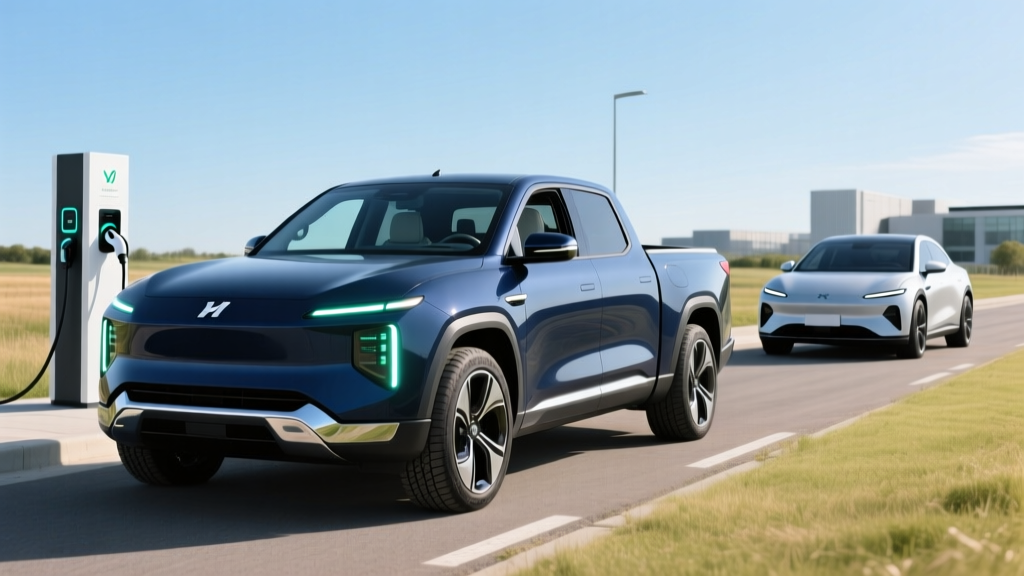
If you're researching a new electric pickup truck in 2026, here's the fast answer: expect EPA range between 270 and 400+ miles depending on battery size, peak DC fast-charging speeds from 190 to 350+ kW, and base MSRPs starting around $55,000 and climbing past $100,000 for fully loaded trims. Federal tax credits under IRS §30D can knock up to $7,500 off your purchase — but only if the truck meets MSRP caps, your income qualifies, and battery sourcing rules are satisfied. Real-world highway and cold-weather range typically runs 15–30% below the EPA sticker, and towing can cut range nearly in half. The trucks that lead the segment right now — the Ford F-150 Lightning, Rivian R1T, Chevrolet Silverado EV, and GMC Sierra EV — each optimize different priorities: work capability, adventure tech, or max range.
The 2026 Electric Pickup Truck Lineup: Spec Comparison
The electric truck market has matured significantly since the F-150 Lightning launched in 2022. Here's how the major contenders stack up on the numbers that matter most:
| Spec | Ford F-150 Lightning | Rivian R1T | Chevrolet Silverado EV | GMC Sierra EV |
|---|---|---|---|---|
| EPA Range | 240–320 mi | 270–420 mi | 390–450 mi | 390–440 mi |
| Battery (usable) | 98 / 131 kWh (NMC) | 95 / 141 kWh (NMC) | ~200 kWh (NMC) | ~200 kWh (NMC) |
| Peak DC Charge | ~195 kW | ~220 kW | ~350 kW | ~350 kW |
| 10–80% DC Time | ~41 min | ~30 min | ~20 min | ~20 min |
| Horsepower | 563–580 hp | 533–1,025 hp | 510–754 hp | 510–754 hp |
| 0–60 mph | ~3.8–4.4 sec | ~3.0–4.5 sec | ~4.5 sec | ~4.5 sec |
| Max Towing | 10,000 lb | 11,000 lb | 12,500 lb | 12,000 lb |
| Base MSRP | ~$55,000 | ~$69,900 | ~$57,000 | ~$58,000 |
| Battery Warranty | 8 yr / 100k mi | 8 yr / 120k mi | 8 yr / 100k mi | 8 yr / 100k mi |
| NACS Native? | Yes (2025+) | Yes | Yes | Yes |
Sources: fueleconomy.gov, manufacturer spec sheets. Range and pricing vary by trim and battery option. Always confirm with your dealer.
Electric Pickup vs. Gas Pickup: 5-Year Ownership Cost Breakdown
The purchase price of an electric truck is higher than a comparable gas model, but the operating cost gap is significant. Here's a realistic 5-year / 75,000-mile ownership comparison between a Ford F-150 Lightning Extended Range and a gas F-150 3.5L EcoBoost 4WD, assuming national averages:
| Cost Category | F-150 Lightning (EV) | F-150 Gas 3.5L EcoBoost |
|---|---|---|
| Purchase Price (MSRP) | $72,000 | $58,000 |
| Federal Tax Credit (§30D) | −$7,500 (if eligible) | $0 |
| Effective Purchase | $64,500 | $58,000 |
| Fuel / Electricity (75k mi) | $4,800 (home L2 @ $0.14/kWh) | $10,500 (@ $3.50/gal, 19 MPG) |
| Maintenance (5 yr) | $1,500 | $3,800 |
| Insurance (5 yr est.) | $9,500 | $7,500 |
| Home Charger Install | $1,200 (Level 2, 48A) | $0 |
| 5-Year Total Cost | $81,500 | $$79,800 |
The gap narrows to under $2,000 over five years when you factor in fuel and maintenance savings, and the EV pulls ahead in year six. If you charge primarily on cheaper overnight utility rates or have solar panels, the EV's operating cost drops further. But note: EV insurance premiums run 15–25% higher on average due to repair costs for battery and structural components.
Key variable: If you rely exclusively on public DC fast charging at $0.35–$0.50/kWh, your 75,000-mile fuel cost jumps to roughly $8,500–$12,000 — erasing much of the fuel savings advantage. Home charging access is the single biggest economic factor in EV truck ownership.
Charging a New Electric Pickup Truck: What You Actually Need
Electric pickup trucks have large batteries — 131 kWh on the F-150 Lightning Extended Range, up to ~200 kWh on the Silverado EV Max Range. That means charging logistics matter more than with a smaller EV sedan. Here's how each level breaks down:
| Level | Power (kW) | Miles Added/Hour | 0–100% Time (131 kWh) | Best For |
|---|---|---|---|---|
| Level 1 (120V) | ~1.4 kW | ~3–4 mi/hr | ~90+ hours | Emergency/top-up only |
| Level 2 (240V, 48A) | ~11.5 kW | ~28–35 mi/hr | ~12 hours | Daily home charging |
| Level 2 (240V, 80A) | ~19.2 kW | ~45–55 mi/hr | ~7 hours | High-use / fleet |
| DC Fast (150–350 kW) | 150–350 kW | ~300–800+ mi/hr | 10–80%: 20–41 min | Road trips |
Understanding kW vs. kWh: kWh (kilowatt-hours) measures battery capacity — the size of the "tank." kW (kilowatts) measures charging power — how fast you're filling the tank. A 131 kWh battery charged at 11.5 kW takes roughly 11.4 hours. Peak DC fast-charge rates (e.g., 350 kW) are only sustained at low states of charge; above 80% SoC, the charge curve tapers significantly to protect the battery.
Home charging installation cost: A 48-amp Level 2 home charger on a 240V circuit typically costs $500–$800 for the unit and $500–$1,500 for electrician installation, depending on panel proximity and whether your home's electrical panel needs an upgrade (200A service is recommended). Total: $1,000–$2,500. If you need a panel upgrade from 100A to 200A, add $1,500–$3,000.
For trucks with 200 kWh batteries like the Silverado EV, a 48A charger will take roughly 17+ hours for a full charge. An 80A circuit (requiring a 100A breaker and heavier gauge wire) cuts that to around 10 hours. Consult a licensed electrician for your specific setup.
Federal Tax Credits: Does a New Electric Pickup Truck Qualify?
The §30D Clean Vehicle Credit can provide up to $7,500 at the point of sale, but eligibility is a multi-factor test. Here's the checklist for 2026:
- MSRP Cap: Pickup trucks (classified as SUVs or trucks by the IRS) must have an MSRP ≤ $80,000. This eliminates many high-trim electric trucks.
- Buyer Income Cap: Modified AGI ≤ $150,000 (single), $225,000 (head of household), $300,000 (joint).
- Battery Sourcing: The battery must contain a required percentage of critical minerals sourced from the U.S. or FTA partners, and battery components must be manufactured or assembled in North America (percentages increase annually).
- Final Assembly: Vehicle must undergo final assembly in North America (check VIN at NHTSA.gov).
- Point-of-Sale Transfer: You can transfer the credit to the dealer at purchase, reducing your out-of-pocket cost immediately — or claim it on your tax return.
- Per-Manufacturer Cap: The old 200,000-vehicle cap per manufacturer has been removed.
Always verify current rules at IRS.gov and consult a tax professional. Sourcing requirements tighten each year, and a truck that qualifies in January may not in December.
Practical impact: The F-150 Lightning XLT (~$60K) and Silverado EV 4WT (~$57K) are most likely to clear the $80K MSRP cap. Rivian R1T and higher-trim Lightnings often exceed it. If your income is above the cap, consider the used-EV credit (§25E, up to $4,000 for vehicles under $25K) or look at leasing — the commercial credit (§45W) sometimes allows lessors to pass savings through.
Towing, Payload, and the Range Penalty Every Truck Buyer Must Know
Electric trucks deliver instant torque and impressive towing capacities — the Silverado EV tops 12,500 lbs, and the Rivian R1T pulls 11,000 lbs. But towing is the Achilles' heel of EV range. Here's why:
A gas truck towing at highway speeds might drop from 19 MPG to 10–12 MPG — a meaningful hit, but you can refill in 5 minutes at any gas station. An electric truck towing 7,000+ lbs at 65 mph faces aerodynamic drag from the trailer plus the rolling resistance of added weight. Real-world testing by multiple outlets shows range reductions of 40–55%. A Lightning Extended Range with a 320-mile EPA sticker might deliver only 150–180 miles while towing a camper at interstate speeds.
What this means practically:
- If you tow frequently on long highway trips, plan your route around DC fast chargers every 120–150 miles.
- Preconditioning the battery before fast-charging stops is critical — it brings the battery to optimal temperature and enables peak charge rates.
- The GM trucks (Silverado EV / Sierra EV) with 200 kWh batteries have a range buffer advantage under load, but charging a depleted 200 kWh battery at a 350 kW station still takes 25–35 minutes for 10–80%.
- Ford's Pro Power Onboard (up to 9.6 kW output) lets the Lightning power tools, appliances, or even your home during an outage — a feature gas trucks can't match without an aftermarket generator.
Common Electric Pickup Truck Myths — Addressed with Data
| Myth | Fact |
|---|---|
| "EV batteries need replacing every few years." | All major EV truck batteries carry 8-year/100,000+ mile warranties guaranteeing ≥70% capacity retention. Real-world degradation data from older EVs shows most NMC batteries retain 85–90% capacity after 100,000 miles. Full replacement costs $15,000–$25,000 but is rarely needed within the warranty period. |
| "Electric trucks can't tow anything useful." | The Silverado EV tows up to 12,500 lbs — competitive with many gas half-tons. The limitation isn't capability, it's range while towing. For short-haul towing (job sites, boat ramps within 80 miles), an EV truck works well. For cross-country towing, gas still wins on logistics. |
| "Charging takes too long." | At home on Level 2, you plug in overnight and wake up to a full battery — zero time spent at a "station." On road trips, 10–80% DC fast charging takes 20–41 minutes depending on the truck. That's longer than a gas fill-up, but it aligns with meal and rest stops on long drives. |
| "EVs are worse in cold weather." | Cold weather reduces range by 20–30% due to battery chemistry and cabin heating demands. But EVs start instantly in any temperature (no cold-cranking issues), and preconditioning while plugged in warms the battery and cabin using grid power, preserving range. Heat pumps on newer models reduce the heating penalty. |
| "The grid can't handle EV trucks." | A Level 2 home charger draws ~11.5 kW — similar to an electric dryer or oven. Most homes with 200A service handle this fine. Utility time-of-use rates and smart chargers that schedule charging for off-peak hours prevent grid strain. Fleet depot charging requires more planning, but utilities are actively building out infrastructure. |
Decision Framework: Which New Electric Pickup Truck Is Right for You?
Choose the Ford F-150 Lightning if:
- You want the most familiar truck form factor with proven fleet and work capability
- Pro Power Onboard (9.6 kW) matters for job sites or home backup power
- You need a sub-$60K trim that may qualify for the full §30D credit
- You accept slower DC charging (~195 kW peak) in exchange for a lower entry price
Choose the Rivian R1T if:
- You prioritize adventure and off-road capability with up to 1,025 hp (Tri-Motor)
- You want the most flexible bed system (Gear Tunnel, camp kitchen accessories)
- Range is critical — the Max Pack offers up to 420 miles EPA
- You're comfortable with a premium price ($70K–$100K+) and a smaller service network
Choose the Chevrolet Silverado EV / GMC Sierra EV if:
- Maximum range (400–450 miles EPA) is your top priority
- You need the highest towing capacity (12,500 lbs) in the segment
- Fastest DC charging (~350 kW peak, ~20 min 10–80%) matters for road trips
- You prefer GM's Ultium platform and dealer network for service
Wait or reconsider if:
- You don't have access to home or workplace Level 2 charging — public-only charging erodes savings and convenience
- You regularly tow heavy loads on routes with sparse DC fast-charging infrastructure
- Your budget is under $50K — consider a used Lightning or wait for more affordable models
- You live in a region with extreme cold and limited charging infrastructure — a PHEV or hybrid truck may be a better bridge
Frequently Asked Questions
How long do electric pickup truck batteries last?
EV truck batteries are warranted for 8 years and 100,000–120,000 miles with a guaranteed minimum of 70% capacity retention. Real-world data from earlier EVs suggests most NMC batteries retain 85–92% capacity at 100,000 miles when properly maintained — meaning avoiding frequent 100% charges, minimizing DC fast-charging in extreme heat, and using preconditioning. Full battery replacement costs $15,000–$25,000 but is uncommon within the first decade.
Can I charge an electric truck on a standard 120V outlet?
Technically yes, but Level 1 (120V) charging adds only 3–4 miles of range per hour. A 131 kWh battery would take over 90 hours for a full charge. This is adequate only for emergency top-ups or very low daily mileage. A 240V Level 2 home charger is effectively required for daily EV truck ownership.
Are electric trucks good for off-road use?
Yes, with caveats. Instant torque, low center of gravity (battery pack under the floor), and precise individual-wheel torque vectoring (especially on the Rivian R1T Quad-Motor) make EV trucks excellent off-road performers. The downside is weight — EV trucks are heavier than gas equivalents, which can increase the risk of getting stuck in deep sand or mud. Ground clearance is generally competitive (Rivian offers up to 14.9 inches with adjustable air suspension).
What happens if the battery runs out on the road?
The same thing as running out of gas: you need a tow to a charger. However, EV range estimation in modern trucks is highly accurate, and navigation systems route through charging stations automatically. Most EV truck owners report that range anxiety diminishes within the first month of ownership once they establish a home-charging routine and learn their vehicle's real-world range patterns.
Do electric pickup trucks qualify for the $7,500 tax credit?
Some do, but it depends on MSRP (must be ≤$80,000 for trucks/SUVs), your income (AGI caps apply), and battery sourcing requirements. The F-150 Lightning XLT and Silverado EV 4WT trims are most likely to qualify. Higher-trim and higher-price models often exceed the MSRP cap. Always verify on IRS.gov and confirm with your dealer before purchasing.
How does insurance cost compare for electric trucks?
EV truck insurance typically runs 15–25% higher than equivalent gas trucks. The reasons: higher repair costs for battery and structural components, more expensive replacement parts, and specialized labor requirements. Shop quotes from multiple insurers — some now offer EV-specific policies with better rates. Geico, Progressive, and State Farm all have EV insurance programs, and Tesla offers its own insurance in many states based on real-time driving data.
For the latest EPA range and efficiency data, check fueleconomy.gov. For safety ratings, visit NHTSA.gov and IIHS.org. Tax credit rules are subject to change — always confirm at IRS.gov before purchasing.