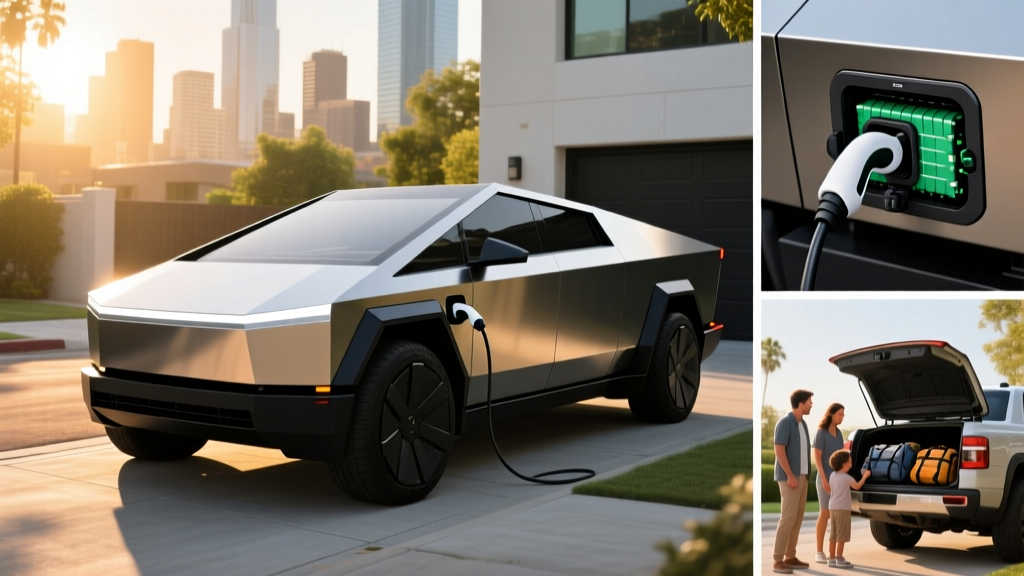
The Tesla Cybertruck enters the 2026 model year with a stabilized production line, refined build quality over its chaotic 2024 launch, and a trim lineup that finally makes sense for buyers. After spending time with both the Long Range AWD and Cyberbeast variants — on highway road trips, at 250 kW Superchargers, and navigating tight urban parking structures — here is the data-driven breakdown every prospective buyer needs.
Long Range AWD: EPA 340 miles | Real-world highway (70 mph): ~280-300 miles | Cold weather (below 32°F): ~240-260 miles
Cyberbeast: EPA 320 miles | Real-world highway: ~265-285 miles | Cold weather: ~230-250 miles
The stainless steel exoskeleton creates more aerodynamic drag than a curved-body truck, and the heavy mass (nearly 7,000 lbs curb weight) compounds highway and cold-weather range loss. Plan conservatively for road trips.
2026 Cybertruck Trim Lineup and Pricing
Tesla streamlined the Cybertruck lineup for 2026 after discontinuing the base rear-wheel-drive variant that was initially promised at a much lower price point. The current lineup consists of two dual-motor all-wheel-drive trims:
| Specification | Long Range AWD | Cyberbeast (Tri-Motor) |
|---|---|---|
| Base MSRP | $79,990 | $99,990 |
| As-Tested (w/ options) | $82,490 | $104,490 |
| Drivetrain | Dual-Motor AWD | Tri-Motor AWD |
| Horsepower | 600 hp | 845 hp |
| 0-60 mph | 3.9 seconds | 2.6 seconds |
| EPA Range | 340 miles | 320 miles |
| Battery (usable) | ~123 kWh (NMC) | ~123 kWh (NMC) |
| Efficiency | 48 MPGe / 70 kWh/100mi | 44 MPGe / 76 kWh/100mi |
| Towing Capacity | 11,000 lbs | 11,000 lbs |
| 0-60 mph (towing 10k lbs) | ~8.5 seconds | ~6.2 seconds |
Both trims include Tesla's Premium Interior package, a 18.5-inch front touchscreen, rear 9.4-inch touchscreen, and the full sensor suite for Autopilot. The $2,500 destination and order fee applies to both. Full Self-Driving (Supervised) remains a $8,000 add-on — and it is critical to understand this is SAE Level 2 driver assistance, not autonomous driving. You must remain attentive with hands on the yoke at all times.
Battery Chemistry, Capacity, and Long-Term Degradation
The Cybertruck uses a structural battery pack with an NMC (nickel manganese cobalt) chemistry integrated into the stainless steel unibody. The usable capacity is approximately 123 kWh — one of the largest packs in any production consumer vehicle. Tesla has not offered an LFP (lithium iron phosphate) option for the Cybertruck, which makes sense given the energy density requirements for a vehicle of this mass.
NMC packs deliver higher energy density than LFP but are more sensitive to sustained 100% state-of-charge storage. For daily driving, Tesla recommends charging to 80-90% and only charging to full capacity ahead of long road trips. Based on Tesla's fleet data and the degradation curves observed in Model S/X vehicles with similar NMC packs over 150,000+ miles, expect approximately 8-12% capacity loss over the first eight years of typical ownership — translating to roughly 25-40 miles of range reduction from the EPA sticker.
Battery & Powertrain Warranty: 8 years / 120,000 miles (whichever comes first), with a minimum 70% capacity retention guarantee. This is slightly better than the 100,000-mile coverage on the Model 3/Y, reflecting the Cybertruck's premium positioning.
Charging Speed: DC Fast, Level 2, and the Charge Curve Reality
The Cybertruck supports Tesla's V4 Supercharger architecture with a native NACS (North American Charging Standard) connector — no adapter needed at Tesla's 60,000+ global Supercharger stalls. Here is what the charging data actually looks like in practice:
| Charging Level | Power (kW) | Speed | Notes |
|---|---|---|---|
| Level 1 (120V household) | ~1.4 kW | ~3 miles/hour | Emergency/trickle only |
| Level 2 (240V home, 48A) | 11.5 kW | ~28 miles/hour | Full charge in ~11 hours |
| Level 2 (240V, 80A Wall Connector) | 19.2 kW | ~46 miles/hour | Requires 100A circuit; full in ~7 hours |
| DC Fast (V4 Supercharger peak) | 250 kW | 10-80% in ~28 min | Peak only below 40% SoC |
| DC Fast (sustained average) | ~140 kW avg | 10-80% realistic | Significant taper above 60% SoC |
The charge curve matters more than peak kW. The Cybertruck hits its 250 kW peak only between roughly 10-35% state of charge, then tapers progressively. From 60-80%, you are averaging closer to 90-110 kW. This means the last 20% of a fast charge takes nearly as long as the first 40%. On road trips, the most efficient strategy is charging from 10-60% and making more frequent, shorter stops rather than waiting for 80%+.
For home charging, the Tesla Wall Connector at 80 amps is the optimal setup, but it requires a 100-amp dedicated circuit. Many homes need a panel upgrade from 100A to 200A service to support this — budget $1,500-$3,500 for electrical panel work on top of the $500-$750 Wall Connector unit and $800-$2,000 for electrician labor and permitting, according to typical Tesla home charging installation data.
Real-World Efficiency and Range on a Road Trip
During a 450-mile highway loop at 70-75 mph in 55°F weather (Long Range AWD trim), the Cybertruck averaged 2.1 miles/kWh — equivalent to roughly 70 kWh/100 miles or about 48 MPGe. That translates to a real-world highway range of approximately 285 miles before hitting the buffer zone where power limits engage.
In colder conditions (28°F, same route with cabin heat at 72°F), efficiency dropped to 1.7 miles/kWh, yielding roughly 245 miles of usable range. The heat pump helps, but the Cybertruck's massive frontal area and flat stainless panels create aerodynamic drag that no thermal management system can overcome.
For context, the EPA's official Cybertruck data lists 48 MPGe combined for the Long Range — accurate for mixed driving but optimistic for sustained highway use.
Cargo, Passenger Space, and the Vault
The Cybertruck's 6-foot bed (called the "Vault") features a motorized tonneau cover and 67 cubic feet of enclosed cargo volume with the cover closed. The bed width between wheel wells is 43 inches — narrow enough to limit standard sheet goods but sufficient for most gear. The tailgate doubles as a ramp rated for 1,500 lbs.
Interior dimensions place the Cybertruck in mid-size truck territory:
- Front legroom: 41.2 inches
- Rear legroom: 38.4 inches
- Front headroom: 40.8 inches
- Rear headroom: 38.1 inches (sloping roofline compromises this)
- Frunk (front trunk): 7.1 cubic feet
- Seating: 5 passengers (bench front seat with fold-down center armrest)
The rear seat is comfortable for two adults on longer trips but tight for three across. The angular roofline cuts into headroom for anyone over 6 feet. The frunk is useful for charging cables and a small bag but not large enough for a full carry-on suitcase.
Technology, Driver Assistance, and the Yoke
The Cybertruck runs Tesla's latest vehicle software on an AMD Ryzen-based infotainment system. The 18.5-inch primary display controls nearly every vehicle function — there are no physical buttons for climate, mirrors, or glovebox release. Everything routes through the touchscreen, including the drive-by-wire steering system.
The Cybertruck uses a steer-by-wire system with a yoke-style steering wheel that requires less than one full turn lock-to-lock. This eliminates the need for hand-over-hand maneuvering but demands a re-learning period of roughly 1-2 weeks for most drivers. At low speeds (parking, U-turns), the variable ratio is excellent. On the highway, the sensitivity takes adjustment.
Autopilot and FSD (Supervised) remain SAE Level 2 systems. This means:
Autopilot handles lane centering and adaptive cruise control on highways. FSD (Supervised) adds automatic lane changes, traffic light/stop sign response, and city street navigation. Neither system makes the Cybertruck self-driving. You must keep hands on the yoke, eyes on the road, and be prepared to take over instantly. NHTSA continues to investigate Tesla's Autopilot/FSD system for crash patterns involving stationary emergency vehicles.
Other notable tech features include:
- 48-volt electrical architecture — eliminates most traditional 12V wiring, reducing weight and complexity
- Powershare (V2L/V2H): Up to 11.5 kW bidirectional power output — enough to run power tools at a job site or partially power a home during an outage
- Armor glass: Laminated composite glass (not the demo-window-breaking glass from the 2019 reveal)
- Adaptive air suspension: Up to 16 inches of ground clearance in Extract Mode
Federal Tax Credit Eligibility (IRS §30D)
The Cybertruck's tax credit situation is complicated and depends heavily on your income, the specific vehicle's battery sourcing, and Tesla's cumulative sales count. Here is the current framework under IRS §30D rules:
| Factor | Long Range AWD | Cyberbeast |
|---|---|---|
| MSRP | $79,990 | $99,990 |
| Truck MSRP Cap (§30D) | $80,000 | $80,000 |
| Under MSRP Cap? | Yes (by $10) | No — exceeds cap |
| Max Potential Credit | Up to $7,500 | $0 (ineligible) |
| Battery Sourcing Requirement | Varies by batch | N/A |
| Buyer AGI Cap (Married Filing Jointly) | $300,000 | $300,000 |
| Buyer AGI Cap (Single/HOH) | $150,000 / $225,000 | $150,000 / $225,000 |
| Point-of-Sale Transfer | Yes, if eligible | N/A |
Key takeaway: The Long Range AWD at $79,990 squeaks under the $80,000 MSRP cap for trucks. However, the $7,500 credit requires both the critical minerals and battery component sourcing thresholds to be met — and Tesla's supply chain compliance varies by production batch. Always verify the specific VIN's eligibility on fueleconomy.gov before purchasing. The Cyberbeast at $99,990 is categorically ineligible for the federal credit.
State-level incentives (California, Colorado, New York, and others) may offer additional rebates, but these vary by jurisdiction and change frequently. Consult your state's energy office or a tax professional for current local programs.
Cybertruck vs. Key Competitors: Is It Worth Buying?
The Cybertruck competes in the premium electric truck segment against the Ford F-150 Lightning, Rivian R1T, and Chevrolet Silverado EV. Here is how it stacks up on the metrics that matter most:
| Metric | Cybertruck LR AWD | F-150 Lightning Ext. Range | Rivian R1T Dual Max |
|---|---|---|---|
| Base Price | $79,990 | $76,995 | $87,700 |
| EPA Range | 340 mi | 320 mi | 410 mi |
| 0-60 mph | 3.9 sec | 5.0 sec | 3.5 sec |
| Towing | 11,000 lbs | 10,000 lbs | 11,000 lbs |
| Max DC Charge | 250 kW | 150 kW | 220 kW |
| Bed Length | 6 ft | 5.5 ft | 4.5 ft |
| Fed. Tax Credit | Up to $7,500* | Up to $7,500* | $0 (MSRP cap) |
Choose the F-150 Lightning if: You need a traditional truck experience, conventional controls, a wider dealer/service network, and a lower entry price. The Lightning's Pro Power Onboard is also excellent for job-site use.
Choose the Rivian R1T if: Maximum range (410 mi with Max Pack), off-road capability, and a more refined interior are your priorities — and you don't mind paying a premium and forgoing the federal credit.
The Biggest Pros and Cons
- Class-leading 250 kW DC fast charging on V4 Superchargers
- 0-60 in 2.6 seconds (Cyberbeast) is supercar territory in a truck
- 11.5 kW Powershare bidirectional output for tools or home backup
- Access to Tesla's Supercharger network — the most reliable DC fast-charging ecosystem
- Stainless steel exoskeleton eliminates paint and resists dents
- Steer-by-wire with rear-axle steering yields a surprisingly tight turning radius (35 ft)
- Real-world highway range falls 15-20% below EPA estimates
- No physical controls — every adjustment requires the touchscreen
- Yoke steering demands a significant learning curve
- Stainless steel body panels show fingerprints constantly and are difficult to repair
- Rear headroom compromised by angular roofline
- Cyberbeast ineligible for federal tax credit; Long Range eligibility uncertain by batch
- Insurance premiums run 25-40% higher than comparable trucks
Who the 2026 Cybertruck Suits Best
Ideal buyer: A tech-forward truck owner who values acceleration, Supercharger access, and bidirectional power capability over traditional truck ergonomics. If you tow a boat or camper on weekends, use power tools on job sites during the week, and want a vehicle that stands apart from every F-150 and Silverado in the lot, the Cybertruck delivers on those use cases.
Not ideal for: Fleet buyers needing easy serviceability, families who prioritize rear-seat comfort, or anyone who prefers physical knobs and buttons. The Cybertruck's all-touchscreen interface and yoke steering are polarizing — and the insurance costs alone may deter budget-conscious buyers.
For road-trippers: Plan your routes around Supercharger spacing (typically 150-200 miles apart on major corridors). The 250 kW peak charging means 15-20 minute stops from 10-60% SoC are realistic. Just don't expect to charge to 80% in that same window — the taper is significant.
Frequently Asked Questions
What is the real-world range of the 2026 Cybertruck?
The Long Range AWD achieves an EPA-estimated 340 miles, but real-world highway driving at 70-75 mph yields approximately 280-300 miles. In cold weather below freezing, expect 240-260 miles. The Cyberbeast's heavier tri-motor setup reduces real-world highway range to roughly 265-285 miles.
How fast does the Cybertruck charge at home and on the road?
At home on a 240V/80A Tesla Wall Connector, the Cybertruck adds roughly 46 miles of range per hour, achieving a full charge in about 7 hours. On DC fast chargers, it peaks at 250 kW on V4 Superchargers, charging from 10-80% in approximately 28 minutes — though sustained average power is closer to 140 kW due to charge-curve taper above 60% SoC.
Does the 2026 Cybertruck qualify for the $7,500 federal EV tax credit?
The Long Range AWD at $79,990 is technically under the $80,000 MSRP cap for trucks under IRS §30D rules. However, eligibility depends on battery critical-mineral and component sourcing requirements that vary by production batch, plus buyer income limits ($150K single, $300K married filing jointly). The Cyberbeast at $99,990 exceeds the MSRP cap and is ineligible. Always verify the specific VIN on fueleconomy.gov before purchasing.
Is the Cybertruck worth buying over the F-150 Lightning or Rivian R1T?
It depends on your priorities. The Cybertruck wins on DC charging speed (250 kW vs. 150-220 kW), acceleration (3.9s / 2.6s 0-60), and Supercharger network access. The F-150 Lightning wins on price, dealer service network, and traditional truck usability. The Rivian R1T wins on range (410 mi Max Pack), off-road capability, and interior refinement. Test-drive all three before committing.
How reliable is the Cybertruck's stainless steel body?
The unpainted stainless steel exoskeleton resists dents and eliminates paint-chip concerns, but it shows fingerprints aggressively and requires regular wiping with a microfiber cloth and approved cleaner. Repair after a collision is more complex than traditional stamped steel — body shops need specific training and equipment for stainless steel welding and panel replacement.
Can I use the Cybertruck to power my home during an outage?
Yes. Tesla's Powershare system provides up to 11.5 kW of bidirectional power output through the bed outlets (V2L) and an available home-integration system (V2H). At 11.5 kW, the Cybertruck can run essential home circuits — refrigerator, lights, HVAC, and outlets — for roughly 2-3 days depending on usage before the battery is depleted.