The Short Answer on New Chevy EVs for Sale
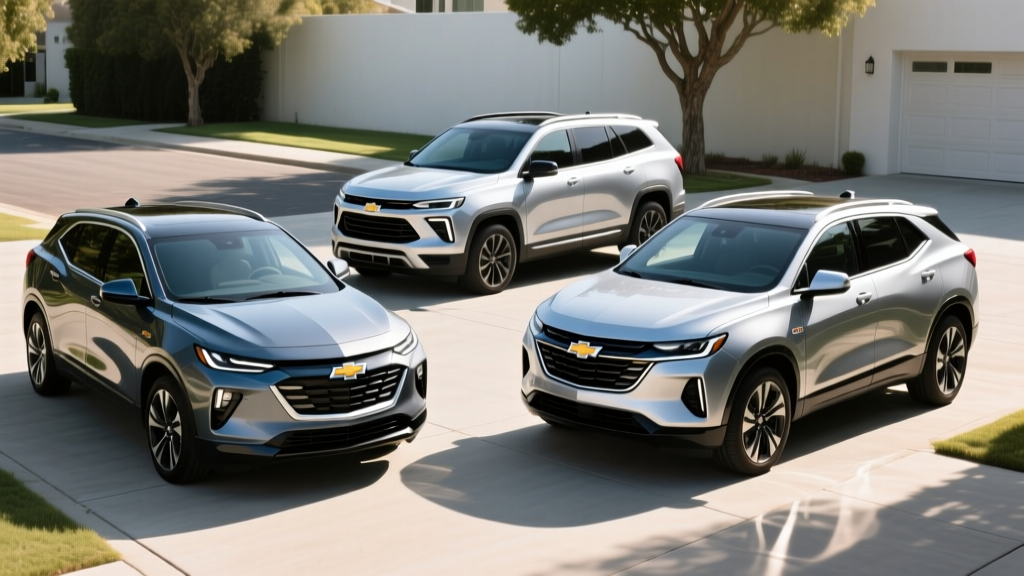
Chevrolet's 2026 EV lineup centers on three Ultium-platform models: the Equinox EV (up to 319 miles EPA, starting around $33,600), the midsize Blazer EV (up to 324 miles EPA, from ~$44,600), and the full-size Silverado EV (up to 440 miles EPA on Max Range trims, from ~$57,900). All three use GM's Ultium battery architecture with NMC chemistry and support DC fast charging up to 190–350 kW depending on the model. Federal §30D tax credit eligibility varies by trim and battery sourcing — always verify current-year rules at IRS.gov before purchase, as critical-mineral and component requirements shift annually.
2026 Chevy EV Lineup: Spec-by-Spec Breakdown
Chevrolet simplified its EV naming for 2026, dropping the short-range Blazer EV trim and consolidating the Equinox EV around its high-volume 2LT and RS trims. Here's how the three core models stack up on the numbers that matter most:
| Spec | 2026 Equinox EV | 2026 Blazer EV | 2026 Silverado EV |
|---|---|---|---|
| EPA Range (max) | 319 mi (3LT AWD) | 324 mi (RS AWD) | 440 mi (4WT Max Range) |
| Battery (usable) | ~85 kWh, NMC | ~102 kWh, NMC | ~200 kWh (Max Range), NMC |
| Peak DC Fast Charge | 190 kW | 190 kW | 350 kW (4WT/3WT) |
| 10–80% DC Charge | ~24 min | ~28 min | ~20 min (350 kW station) |
| Level 2 Home Charge | 11.5 kW (19.2 kW opt.) | 11.5 kW (19.2 kW opt.) | 11.5 kW (19.2 kW opt.) |
| Horsepower (max AWD) | 288 hp | 557 hp (SS) | 754 hp (4WT) |
| 0–60 mph | ~7.8 sec (AWD) | ~3.8 sec (SS) | ~4.5 sec (4WT) |
| Towing Capacity | 1,500 lb | 1,500 lb | 10,000 lb (WT) |
| Base MSRP | $33,600 | $44,600 | $57,900 |
| Battery/Powertrain Warranty | 8 yr / 100,000 mi | 8 yr / 100,000 mi | 8 yr / 100,000 mi |
Real-World Range Reality Check
EPA estimates are starting points, not guarantees. In real-world highway driving at 70–75 mph, expect the Equinox EV to deliver roughly 260–280 miles, the Blazer EV around 270–290 miles, and the Silverado EV Max Range closer to 350–380 miles. Cold weather (below 30°F) can reduce range by 20–30% due to battery heating demands and cabin climate load. Preconditioning the battery while plugged in mitigates some of this loss.
Charging Speed and the Ultium Platform Explained
All three Chevy EVs ride on GM's Ultium platform, which uses a flexible, modular battery design with pouch cells arranged horizontally. The key charging distinction is between the standard Ultium pack (Equinox, Blazer) and the larger pack in the Silverado EV:
- Equinox & Blazer EV: Peak at 190 kW on DC fast chargers. On a 350 kW Electrify America or EVgo stall, you'll see the full 190 kW — but the charge curve tapers significantly above 80% SoC. Plan your road-trip stops around 10–80% sessions of roughly 25 minutes.
- Silverado EV: The 4WT and 3WT trims with the larger pack support up to 350 kW, meaning a 10–80% session in roughly 20 minutes at a compatible station. This is competitive with the Tesla Cybertruck and Rivian R1T on charging speed, though real-world availability of 350 kW chargers remains limited outside major corridors.
At home, the standard 11.5 kW Level 2 onboard charger adds about 34 miles of range per hour for the Equinox EV. The optional 19.2 kW charger (requires a 100-amp circuit) bumps that to roughly 52 miles per hour — useful if you drive the Silverado EV with its massive battery and need overnight replenishment. A typical Level 2 home installation runs $800–$2,000 all-in, depending on panel capacity and run length to your garage.
Chevy EV vs. Gas and Hybrid: Total Cost of Ownership
The sticker price of a new Chevy EV often exceeds a comparable gas-powered Equinox, Blazer, or Silverado. But the total cost of ownership (TCO) equation shifts once you factor in fuel, maintenance, and potential tax credits. Here's a 5-year TCO comparison for the Equinox EV vs. the gas Equinox (assuming 15,000 miles/year, $0.14/kWh home charging, $3.50/gal gas, and 70% home / 30% public charging):
| Cost Category (5 Years) | 2026 Equinox EV 2LT | 2026 Equinox Gas AWD |
|---|---|---|
| Purchase Price (MSRP) | $35,400 | $31,200 |
| Estimated §30D Credit | Up to $7,500* | $0 |
| Net Purchase | $27,900 | $31,200 |
| Fuel / Energy (75k mi) | $3,675 | $8,100 |
| Maintenance | $1,200 | $3,500 |
| Insurance (avg) | $9,500 | $7,800 |
| 5-Year TCO (est.) | $42,275 | $50,600 |
*§30D credit eligibility depends on MSRP caps, buyer income limits, and battery-sourcing requirements. Verify at IRS.gov and consult a tax professional. Point-of-sale transfer is available for eligible buyers.
The EV wins on TCO primarily through fuel and maintenance savings — no oil changes, no transmission fluid, and regenerative braking extends pad life. However, EV insurance premiums run 15–25% higher on average due to repair cost structures. If you lack home charging access and rely entirely on public DC fast charging at $0.35–$0.50/kWh, the energy cost advantage narrows considerably.
Federal Tax Credit: What Actually Applies to 2026 Chevy EVs
The §30D clean vehicle credit offers up to $7,500, split into two halves — $3,750 for critical-mineral sourcing and $3,750 for battery-component manufacturing. For 2026, the sourcing requirements are stricter than in prior years, and GM's supply chain determines how much of the credit each model qualifies for.
§30D Eligibility Checklist (2026 Rules)
- MSRP Cap: SUVs and trucks (Equinox, Blazer, Silverado EV) must be under $80,000 MSRP
- Buyer Income Cap: AGI ≤ $150,000 (single), $225,000 (head of household), $300,000 (joint)
- Critical Minerals: Percentage threshold increases annually — verify current-year requirement
- Battery Components: Must meet North American manufacturing/assembly thresholds
- FEOC Restriction: Vehicles with battery components from a Foreign Entity of Concern are disqualified
- Point-of-Sale Transfer: Eligible buyers can apply the credit as a down-payment reduction at the dealer
Always check the latest eligibility list on fueleconomy.gov before committing to a purchase, as credit amounts can change mid-year based on supply-chain audits.
Real-World Ownership: What First-Time Chevy EV Buyers Should Know
If you're transitioning from a gas vehicle to a Chevy EV, here are the practical realities that spec sheets don't always surface:
Home Charging Is Non-Negotiable for Most Buyers
Public charging infrastructure has improved, but relying on it exclusively means paying $0.35–$0.50/kWh at DC fast chargers and dealing with broken stalls, occupied chargers, and 20-minute waits. If your home electrical panel has capacity for a 240V/48-amp circuit (NEMA 14-50 or hardwired), a Level 2 charger delivers the cheapest, most convenient fueling. Budget $1,200–$2,500 for a quality Level 2 unit plus professional installation. If your panel is maxed out at 100 amps, a panel upgrade to 200 amps can add $1,500–$3,000.
Route Planning on Road Trips
Chevy EVs use the GM Energy app for route planning and can access the Tesla Supercharger network via an included NACS adapter (standard on 2025+ models). This dramatically expanded the available fast-charging network. On a 500-mile trip, expect 1–2 charging stops of 20–30 minutes each. The key is preconditioning: the vehicle heats or cools the battery to optimal temperature before you arrive at a charger, enabling peak kW rates.
Cold Weather Is the Great Equalizer
NMC batteries in the Ultium platform lose efficiency in cold temperatures. At 20°F, expect 20–30% range reduction. The Equinox EV's heat pump (standard on higher trims) helps by efficiently warming the cabin without drawing heavily from the traction battery. If you live in a cold climate, size your range expectations down and charge to 90–100% before long winter drives.
| Common Misconception | Fact |
|---|---|
| "EV batteries need replacing every 5 years" | GM warrants the Ultium battery for 8 years / 100,000 miles with a minimum 70% capacity retention. Real-world degradation data from GM's fleet shows ~8–12% loss over 100k miles. |
| "Charging an EV takes hours" | Level 2 home charging replenishes overnight (6–10 hours for a full charge). DC fast charging adds 10–80% in 20–28 minutes. You only need 100% for road trips. |
| "The power grid can't handle EVs" | Most EV charging happens overnight during off-peak hours when grid capacity is underutilized. A single EV adds roughly the load of a central AC unit. |
| "EVs are worse for the environment" | Even on a coal-heavy grid, EVs produce fewer lifecycle emissions than gas cars. On the U.S. average grid mix, an Equinox EV emits roughly 60% less CO₂ per mile than a gas Equinox (EPA data). |
Which Chevy EV Should You Buy? A Decision Framework
Choose the Equinox EV if:
- Your budget is $30,000–$40,000 and you want the lowest entry cost
- You commute 30–60 miles daily and want 300+ mile range for weekend trips
- You don't need towing capacity above 1,500 lb
- You want to maximize §30D tax credit value relative to purchase price
Choose the Blazer EV if:
- You need a midsize crossover with more cargo room and rear-seat space
- Performance matters — the SS trim delivers 557 hp and a sub-4-second 0–60
- You want a sportier driving position and premium interior materials
- Your budget is $44,000–$58,000
Choose the Silverado EV if:
- You need serious towing (up to 10,000 lb) and a full-size truck bed
- You want the maximum available range (440 mi EPA on Max Range)
- Fast charging speed (350 kW) is a priority for work-related road trips
- Your budget is $55,000–$90,000+ depending on trim
Skip the EV and consider a PHEV or gas model if:
- You have no access to home or workplace Level 2 charging
- You regularly drive 400+ miles in rural areas with sparse DC fast-charging coverage
- Your budget is firmly under $30,000
- You tow heavy loads in extreme cold frequently (battery range loss compounds with towing drag)
Frequently Asked Questions
Do 2026 Chevy EVs qualify for the full $7,500 federal tax credit?
It depends on the specific trim, battery sourcing, and your income. GM's Ultium batteries have been progressively meeting more domestic-content and critical-mineral thresholds, but eligibility can shift. Check the current list on fueleconomy.gov and consult a tax professional. The point-of-sale transfer option lets you apply the credit directly at the dealership as a down-payment reduction.
Can Chevy EVs use Tesla Superchargers?
Yes. Starting with 2025 model-year vehicles, GM EVs include a NACS charge port or an adapter that enables access to Tesla's Supercharger network. This adds roughly 15,000+ additional fast-charging stalls to your available network, significantly improving road-trip flexibility in rural areas.
How long does the Ultium battery last before needing replacement?
GM warranties the battery for 8 years or 100,000 miles with a minimum 70% state-of-health (SoH) threshold. Based on degradation data from Bolt EV fleets and early Ultium vehicles, expect 8–12% capacity loss over 100,000 miles under normal use. Full battery replacement is rare and typically covered under warranty during the coverage period. Out-of-pocket replacement, if needed beyond warranty, is estimated at $12,000–$20,000 depending on pack size.
What's the real cost to charge a Chevy Equinox EV at home?
At the U.S. average residential rate of ~$0.16/kWh, fully charging the Equinox EV's 85 kWh battery costs about $13.60. That delivers roughly 280 real-world miles — equivalent to about $0.049 per mile. A comparable gas Equinox at 28 MPG combined and $3.50/gal costs $0.125 per mile. Over 15,000 annual miles, home charging saves roughly $1,140 per year in fuel costs.
Is the Chevy Silverado EV practical for daily driving?
For daily commutes under 100 miles, the Silverado EV is excellent — quiet, torque-rich, and cheap to fuel at home. The challenge is size: at over 233 inches long, it's difficult to park in tight urban spaces. If your daily driving is mostly highway or suburban, the ride quality and range make it a strong daily driver. For mixed city/highway use, the Equinox EV is far more practical.
How does Chevy's Super Cruise compare to Tesla Autopilot?
Both are SAE Level 2 driver-assistance systems — neither is self-driving, and both require active driver supervision. Super Cruise operates on over 750,000 miles of pre-mapped divided highways in North America and uses a driver-attention camera to confirm you're watching the road. Tesla Autopilot works on more road types but relies on steering-wheel torque for attention monitoring. IIHS research suggests camera-based attention monitoring (like Super Cruise) is more effective at preventing driver disengagement.