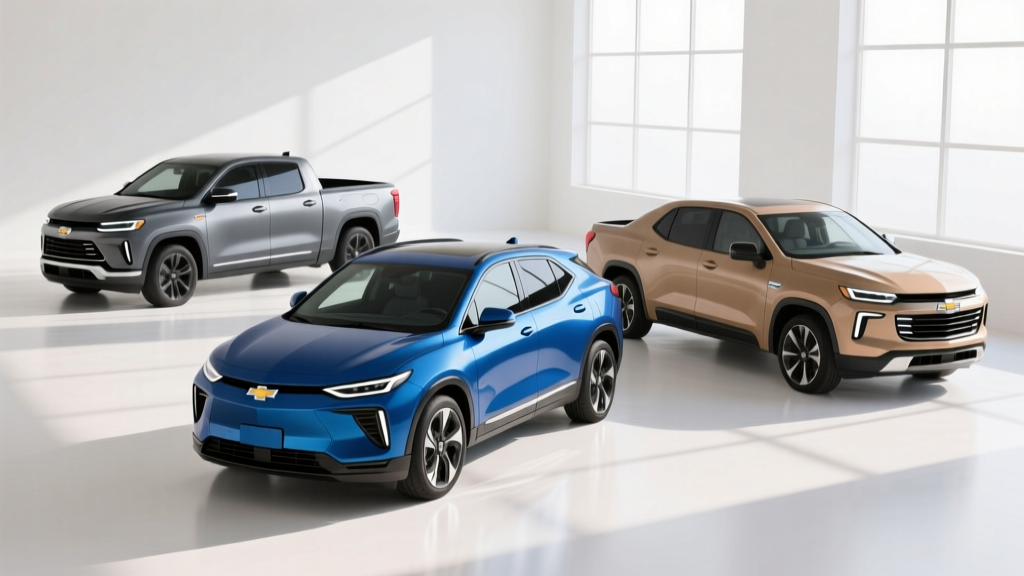
If you're shopping for a new Chevy electric vehicle in 2026, Chevrolet offers three distinct battery-electric models: the compact Equinox EV (up to 319 miles EPA, starting around $33,600), the midsize Blazer EV (up to 324 miles EPA, starting around $44,600), and the full-size Silverado EV (up to 492 miles EPA on the 4WT fleet trim, starting around $55,000 for retail trims). All three ride on GM's Ultium battery platform, use the NACS (Tesla-style) charge port natively, and are eligible for up to $7,500 in federal tax credits under IRS §30D — though eligibility depends on your income, the vehicle's MSRP, and battery-sourcing requirements. The Equinox EV is the clear value pick for most buyers; the Blazer EV adds space and performance; the Silverado EV targets truck buyers who need towing and range.
Quick Verdict: Which New Chevy Electric Should You Buy?
- Best value & daily commuter: Equinox EV LT (315 mi, ~$33,600 before credits)
- Best for families & road trips: Blazer EV RS AWD (279 mi, ~$52,400 before credits)
- Best for truck utility & max range: Silverado EV RST (440 mi, ~$87,300 before credits)
All three qualify for the $7,500 point-of-sale federal credit if you meet IRS §30D income and sourcing requirements.
2026 Chevy EV Lineup: Specs at a Glance
| Spec | Equinox EV LT FWD | Blazer EV RS AWD | Silverado EV RST |
|---|---|---|---|
| EPA Range | 315 mi | 279 mi | 440 mi |
| Battery (usable) | 85 kWh (NMC) | 102 kWh (NMC) | 200+ kWh (NMC) |
| Max DC Fast Charge | 150 kW | 190 kW | 350 kW |
| 10–80% DCFC Time | ~34 min | ~30 min | ~20 min |
| Level 2 (240V) Rate | 11.5 kW | 11.5 kW | 19.2 kW |
| Horsepower | 213 hp | 557 hp (SS: 615 hp) | 664 hp |
| 0–60 mph | ~7.8 sec | ~4.0 sec (SS) | ~4.5 sec |
| Max Towing | N/A | 1,500 lb | 12,500 lb |
| Cargo Volume | 26.4 cu ft (rear seats up) | 25.5 cu ft | ~60 cu ft (bed + frunk) |
| Base MSRP (2026) | $33,600 | $44,600 | $55,000 (WT); ~$87,300 (RST) |
| Battery/Powertrain Warranty | 8 yr / 100,000 mi | 8 yr / 100,000 mi | 8 yr / 100,000 mi |
Sources: fueleconomy.gov, Chevrolet press room specifications. Real-world range: expect 10–20% less than EPA on sustained highway driving above 70 mph, and 20–30% reduction in sub-freezing temperatures. Cold-weather range loss affects all lithium-ion EVs; preconditioning the battery while plugged in mitigates this.
Real-World Range vs. EPA Sticker: What to Actually Expect
EPA vs. Reality — Chevy EVs
- Equinox EV (315 mi EPA): Expect ~260–280 mi on a highway road trip at 75 mph; ~230–250 mi in cold weather (below 30°F).
- Blazer EV RS AWD (279 mi EPA): Expect ~230–250 mi highway; ~200–220 mi in cold weather.
- Silverado EV RST (440 mi EPA): Expect ~370–390 mi highway; significantly less when towing (often 50%+ reduction at max load).
The Ultium platform's NMC chemistry delivers strong energy density, but physics still governs real-world results. Highway speeds, headwinds, elevation changes, and HVAC use all cut into the EPA figure. The Silverado EV's massive battery provides a huge buffer, but towing a heavy trailer at highway speeds will compress range dramatically — plan charging stops accordingly.
Charging Speed and Infrastructure: NACS Advantage
All 2026 Chevy EVs come with the NACS (North American Charging Standard) port natively — no adapter needed. This gives you direct access to Tesla's Supercharger network, which remains the most reliable and widespread DC fast-charging network in the US, alongside Electrify America, EVgo, and ChargePoint stations.
| Charging Level | Power | Miles Added per Hour | Best For |
|---|---|---|---|
| Level 1 (120V outlet) | ~1.4 kW | ~4–5 mi/hr | Overnight top-ups, low-mileage drivers |
| Level 2 (240V home) | 11.5–19.2 kW | ~35–60 mi/hr | Daily home charging, full overnight refill |
| DC Fast Charge | 150–350 kW | ~500–1,200 mi/hr (peak) | Road trips, quick top-ups |
Charging curve reality check: Peak kW rates only apply at low state of charge (typically 10–40%). Above 80% SoC, charge speed tapers significantly to protect the battery. The 10–80% times in the spec table reflect real charging sessions, not marketing peak numbers.
Home charging setup: A Level 2 home charger (240V, 48-amp circuit) will fully recharge an Equinox EV overnight in about 8–9 hours. Budget $800–$2,500 for a quality Level 2 unit plus electrician installation, depending on whether your electrical panel needs an upgrade to 200 amps.
EV vs. Gas: 5-Year Cost of Ownership Comparison
| Cost Factor (5 years / 75,000 mi) | Equinox EV LT | Equinox Gas (1.5T FWD) | Difference |
|---|---|---|---|
| Purchase Price (after $7,500 credit) | ~$26,100 | ~$27,500 | EV saves ~$1,400 |
| Fuel / Electricity | ~$3,750 (home charging) | ~$9,375 (gas at $3.50/gal, 28 MPG) | EV saves ~$5,625 |
| Maintenance | ~$1,200 | ~$3,500 | EV saves ~$2,300 |
| Insurance (avg) | ~$9,500 | ~$7,500 | EV costs ~$2,000 more |
| Estimated 5-Year Total | ~$40,550 | ~$47,875 | EV saves ~$7,325 |
Assumptions: electricity at $0.14/kWh national average, home charging primarily, Equinox EV efficiency of 3.0 mi/kWh. Gas model based on 2026 Equinox 1.5T FWD at 28 MPG combined. Insurance premiums for EVs run 15–25% higher on average — get quotes before buying. fueleconomy.gov provides model-specific efficiency data.
Federal Tax Credit: Do You Qualify for $7,500?
The §30D Clean Vehicle Credit can reduce your effective purchase price by up to $7,500, and since 2024 it can be transferred to the dealer as a point-of-sale discount. But eligibility has strict requirements:
§30D Credit Requirements (2026)
- Income caps: Modified AGI ≤ $150,000 (single), $225,000 (head of household), $300,000 (joint)
- MSRP caps: ≤ $55,000 for SUVs/pickups (Equinox, Blazer, Silverado all qualify by body classification)
- Battery sourcing: Critical minerals and battery components must meet escalating US/free-trade-agreement thresholds — verify current-year compliance on IRS.gov
- Assembly: Vehicle must undergo final assembly in North America (all three Chevy EVs do)
- Point-of-sale transfer: You can apply the credit as a down-payment reduction at the dealer — no need to wait until tax filing
Important: Tax rules change, and battery-sourcing compliance shifts as supply chains evolve. Always confirm eligibility with your tax professional and the IRS before finalizing a purchase.
Common EV Misconceptions — Fact-Checked
| Myth | Fact |
|---|---|
| "EV batteries need replacing every few years." | GM's Ultium batteries carry an 8-year/100,000-mile warranty against dropping below 60% capacity. Real-world data from older EVs shows NMC packs typically retain 85–90% capacity after 100,000 miles. |
| "You can't take an EV on a road trip." | With 279–440 miles of range and 150–350 kW DC fast charging, Chevy EVs can road-trip with 20–35 minute stops every 3–4 hours. The NACS port gives access to 25,000+ Superchargers. |
| "EVs are worse in cold weather." | Range drops 20–30% in freezing temps — real, but manageable. Preconditioning (warming the battery while plugged in) recovers much of this loss. EVs start instantly in cold; no engine warm-up needed. |
| "Home charging is too expensive to install." | A basic Level 2 install on an existing 240V circuit can cost $500–$800. Panel upgrades add $1,500–$3,000, but many homes need none. The fuel savings typically recoup install costs within 2–3 years. |
| "Public charging is always broken." | Tesla Superchargers (now accessible to Chevy EVs via NACS) consistently report 99%+ uptime. Non-Tesla networks are improving but remain less reliable — plan around Superchargers for road trips. |
Decision Framework: Which New Chevy Electric Fits Your Life?
Choose the Equinox EV if:
- You commute under 60 miles round-trip and want the lowest purchase price
- You have (or can install) home Level 2 charging
- You prioritize value — the $7,500 credit brings the effective price under $27,000
- You don't need towing capability
Choose the Blazer EV if:
- You need more interior room for a family and cargo
- You want strong acceleration (SS trim: 615 hp, 0–60 in ~3.4 sec)
- You take regular road trips and want a balance of range and comfort
- You prefer a higher driving position and crossover styling
Choose the Silverado EV if:
- You need truck utility — bed, towing (up to 12,500 lb), and payload
- You want maximum range (440 mi on RST, 492 mi on 4WT fleet)
- Your budget accommodates a $55,000–$90,000+ truck
- You value V2L (vehicle-to-load) capability for job-site or camping power
Consider a Chevy PHEV or stick with gas if:
- You have zero access to home or workplace charging
- You regularly drive 400+ miles in rural areas with sparse DC fast-charging
- You live in an apartment without charging options and public infrastructure is poor
What First-Time Chevy EV Buyers Must Know
Home charging is the foundation. Over 80% of EV charging happens at home. Before you buy, confirm you can install a 240V Level 2 charger (consult a licensed electrician for your panel capacity). Without home charging, EV ownership is significantly less convenient and more expensive (public DC fast charging costs roughly 2–3× more per kWh than home rates).
Insurance costs more. EVs carry higher insurance premiums due to repair costs and battery replacement values. Get quotes from your insurer before committing — the difference can be $300–$600/year.
Regenerative braking changes how you drive. Chevy EVs offer regen settings including one-pedal driving mode, where lifting off the accelerator slows the car significantly without touching the brake pedal. Most owners adapt within a week and prefer it.
Maintenance is minimal. No oil changes, no spark plugs, no transmission fluid. You'll still rotate tires (EVs are heavier and wear tires faster), replace cabin air filters, and top off washer fluid. Brake pads last far longer thanks to regenerative braking doing most of the deceleration work.
The Super Cruise advantage. Available on the Blazer EV and Silverado EV, GM's Super Cruise is a Level 2 hands-free driver-assistance system (not self-driving — you must remain attentive) that works on 750,000+ miles of mapped North American highways. It's one of the most capable systems available and a genuine road-trip fatigue reducer.
Frequently Asked Questions
Does the Chevy Equinox EV qualify for the full $7,500 federal tax credit?
As of 2026, the Equinox EV meets the North American assembly requirement and MSRP cap. Eligibility for the full $7,500 depends on your income, the vehicle's battery-sourcing compliance for the current year, and whether you haven't exceeded the manufacturer credit phase-out. Always verify on IRS.gov and with your tax advisor.
How long does it take to charge a Chevy EV at home?
On a Level 2 (240V) charger at 11.5 kW, the Equinox EV charges from empty to full in about 9 hours — easily overnight. The Silverado EV with its 19.2 kW onboard charger and larger battery takes roughly 12–14 hours for a full charge.
Can I charge a Chevy EV at a Tesla Supercharger?
Yes. All 2026 Chevy EVs use the NACS connector natively, which is the same connector Tesla Superchargers use. No adapter is required. Simply use the Tesla app or your Chevy vehicle's built-in navigation to locate and initiate sessions.
What happens if the battery degrades?
GM warranties the Ultium battery for 8 years or 100,000 miles against dropping below 60% of original capacity. If degradation exceeds that threshold within the warranty period, GM will repair or replace the battery at no cost. Real-world data from similar NMC packs suggests most owners will retain 85–90% capacity at the 100,000-mile mark.
Is a Chevy EV practical without home charging?
It's possible but not ideal. You'll rely on public charging, which costs more ($0.30–$0.50/kWh at DC fast chargers vs. ~$0.14/kWh at home) and requires planning. If your workplace offers Level 2 charging, that can substitute. But for the best ownership experience, home charging access is strongly recommended.
How does towing affect the Silverado EV's range?
Towing near max capacity (12,500 lb) can reduce range by 50% or more. A 440-mile EPA range might drop to 200–220 miles with a heavy trailer at highway speeds. Plan charging stops accordingly and use the truck's trailering range estimator in the infotainment system.