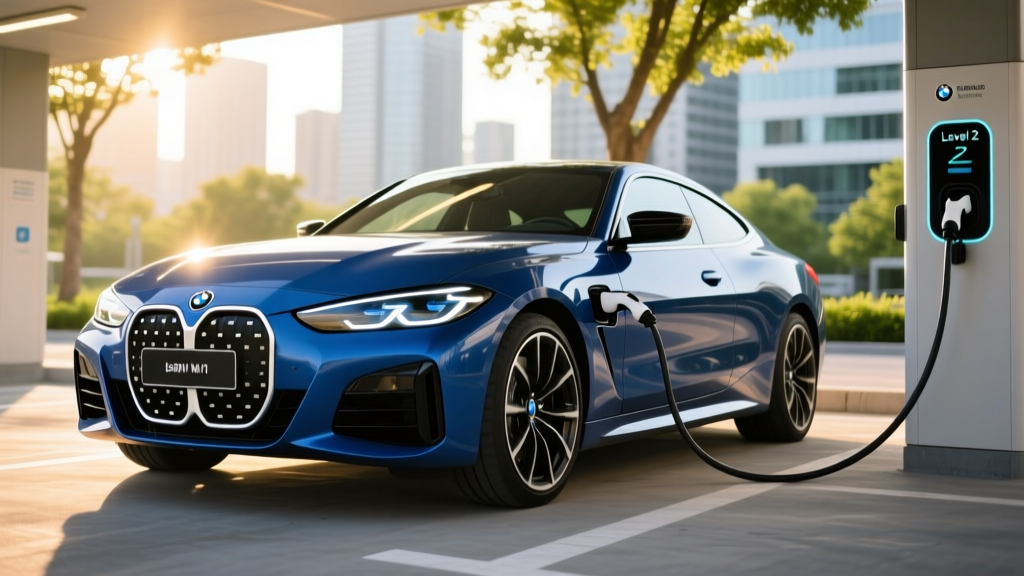
The BMW i4 has carved out a distinct niche in the luxury electric sedan segment by doing something few competitors attempt: it prioritizes driving dynamics over maximum range or crossover practicality. For 2026, the i4 lineup — spanning the efficient eDrive40, the dual-motor xDrive40, and the performance-focused M50 — receives subtle updates to its iDrive 8.5 infotainment system and revised pricing. But the core question remains the same for buyers cross-shopping the Tesla Model 3, Hyundai Ioniq 6, and Polestar 2: does the i4's blend of Bavarian chassis tuning and electric powertrain justify its premium?
After logging miles in multiple i4 variants across seasons and charging environments, here's what real ownership actually looks like — from cold-weather range loss to DC fast-charging curves to the tax credit math that determines whether this car fits your budget.
Range, Battery, and Real-World Efficiency
The 2026 BMW i4 is built on the brand's CLAR platform with a fifth-generation eDrive powertrain. All variants use an 83.9 kWh gross battery pack (approximately 81.5 kWh usable) with NMC (nickel-manganese-cobalt) cell chemistry — chosen for its higher energy density over LFP, which matters in a sedan packaging constraint.
| Trim | Drivetrain | EPA Range | MPGe (Combined) | kWh/100 mi |
|---|---|---|---|---|
| eDrive40 | RWD | 307 mi | 109 MPGe | 31 |
| xDrive40 | AWD | 282 mi | 100 MPGe | 34 |
| M50 | AWD | 269 mi | 91 MPGe | 37 |
Efficiency-wise, the eDrive40's 31 kWh/100 mi is competitive with the Hyundai Ioniq 6 (27–30 kWh/100 mi depending on trim) but trails the Tesla Model 3 Long Range RWD at approximately 25 kWh/100 mi. The M50's 37 kWh/100 mi reflects the cost of its 536 horsepower — acceptable for the performance, but you'll feel it at the charger on road trips.
According to EPA data at fueleconomy.gov, the eDrive40's combined MPGe of 109 places it mid-pack among luxury EVs — not class-leading, but strong enough for daily commuting without range stress.
Charging Speed: DC Fast and Level 2
Charging is where the i4's 400-volt architecture shows its age compared to 800-volt rivals like the Hyundai Ioniq 5/6 and Porsche Taycan. The i4 peaks at 205 kW on DC fast charging — respectable, but not best-in-class.
| Charging Level | Max Power | Speed / Time | Connector |
|---|---|---|---|
| DC Fast Charge | 205 kW peak | 10–80% in ~31 min | CCS1 (NACS adapter available) |
| Level 2 (Home/Public AC) | 11 kW | ~32 mi/hr added | J1772 (NACS adapter available) |
| Level 1 (120V outlet) | ~1.4 kW | ~3–4 mi/hr added | Standard household |
Charging curve reality: The 205 kW peak is achieved at low states of charge (roughly 10–30% SoC) under optimal battery temperature. By 50% SoC, power tapers to approximately 150 kW, and above 80% it drops sharply to protect the NMC cells. A 10–80% session takes about 31 minutes at a 350 kW Electrify America or Tesla Supercharger (with adapter) station — meaning you'll spend roughly 40–45 minutes total on a road-trip stop if you include plugging in, stretching, and getting back on the road.
At home on a Level 2 wallbox (48-amp, 11.5 kW circuit), a full overnight charge from 20% to 100% takes approximately 7–8 hours. This is standard for the segment and sufficient for any daily commute under 200 miles round-trip.
BMW provides a CCS1 charge port natively. For Tesla Supercharger access, BMW offers a NACS adapter, and the 2026 i4's iDrive system now includes Tesla Supercharger routing in its navigation — a practical improvement for road-trip planning. Expect the adapter to cost approximately $200–$250 if not included as a promotional item.
Performance and Driving Dynamics
| Trim | Horsepower | Torque (lb-ft) | 0–60 mph | Drivetrain | Top Speed |
|---|---|---|---|---|---|
| eDrive40 | 335 hp | 317 | 5.5 sec | RWD | 118 mph |
| xDrive40 | 396 hp | 443 | 4.9 sec | AWD (dual-motor) | 118 mph |
| M50 | 536 hp | 586 | 3.7 sec | AWD (dual-motor) | 130 mph |
The eDrive40's single rear motor and 335 hp deliver the kind of smooth, linear thrust that makes highway merging effortless. Where the i4 distinguishes itself from the Model 3 is chassis tuning: BMW's adaptive M suspension (standard on M50, optional on others) gives the car a composure in corners that feels closer to a 3 Series than a typical EV. The steering is heavier and more communicative than Tesla's, though some may find it overly weighted at parking-lot speeds.
The M50 is the performance flagship, and its 3.7-second 0–60 time puts it in serious sports-sedan territory. However, the 4,900+ lb curb weight is noticeable during aggressive direction changes — this is a fast grand tourer, not a track car. The xDrive40 splits the difference effectively: all-weather AWD capability with a sub-5-second sprint and only a modest range penalty.
Regenerative braking offers two modes: a high-regen setting that enables near one-pedal driving in city traffic, and a low/coast mode that maximizes efficiency on highways. BMW also includes an adaptive regen mode that uses radar and navigation data to automatically adjust regen intensity based on traffic and upcoming intersections — a thoughtful feature that reduces brake-pedal fatigue in stop-and-go conditions.
Pricing, Trims, and Federal Tax Credit Eligibility
| Trim | Base MSRP | As-Tested (Typical Options) | Est. After §30D Credit* |
|---|---|---|---|
| eDrive40 | $52,200 | $58,000–$62,000 | $44,700–$54,500 |
| xDrive40 | $56,200 | $62,000–$67,000 | $48,700–$59,500 |
| M50 | $67,300 | $74,000–$80,000 | $59,800–$72,500 |
*Tax credit estimates assume full $7,500 §30D credit eligibility. Actual credit depends on battery sourcing, buyer income, and MSRP caps — see details below.
- MSRP Cap: Sedars must have an MSRP at or below $55,000 to qualify. This means the eDrive40 at base MSRP qualifies, but adding options that push the sticker above $55,000 can disqualify the vehicle. The xDrive40 and M50 base MSRPs exceed the cap.
- Income Limits: Modified adjusted gross income (MAGI) must not exceed $150,000 (single), $225,000 (head of household), or $300,000 (joint filers).
- Battery Sourcing: The credit splits into two halves — $3,750 for critical minerals and $3,750 for battery component requirements. Sourcing rules tighten annually; verify current-year compliance on IRS.gov.
- Point-of-Sale Transfer: Eligible buyers can transfer the credit to the dealer at purchase, reducing the upfront cost immediately rather than waiting for a tax refund.
Always confirm eligibility with your tax professional and the dealer before purchase. Rules are subject to change.
For the eDrive40, the federal credit scenario is nuanced. The $52,200 base MSRP clears the $55,000 sedan cap — but the moment you add the Premium Package ($3,200), M Sport Package ($4,500), or the larger 19-inch wheels, you risk crossing the threshold. BMW dealers can confirm the as-built MSRP for §30D compliance. The xDrive40 and M50, unfortunately, start above the cap and do not qualify for the new-vehicle credit under current rules.
Leasing is a different calculus: the §30D credit flows to the lessor (BMW Financial Services), who may pass it through as a capitalized-cost reduction. BMW has historically offered lease credits on i4 models — check current promotions on BMWUSA.com.
Interior, Technology, and Daily Practicality
The i4's cabin follows BMW's current design language: a curved display merging a 12.3-inch instrument cluster with a 14.9-inch touchscreen running iDrive 8.5. The system is responsive, supports wireless Apple CarPlay and Android Auto, and includes a configurable head-up display. The i4 also retains physical climate controls — a practical choice that avoids the touchscreen-only frustration of some competitors.
Passenger and cargo dimensions:
- Front legroom: 41.5 inches
- Rear legroom: 35.2 inches (tight for tall passengers on long trips)
- Cargo volume: 16.6 cu ft (trunk) — the Gran Coupe liftback design provides a wider opening than a traditional sedan
- With rear seats folded: approximately 46 cu ft
The liftback-style rear hatch is one of the i4's most practical features, making it easier to load bulky items than the Model 3's conventional trunklid. However, there is no front trunk (frunk) — the CLAR platform's shared architecture with ICE models means that space is occupied by auxiliary electronics.
Driver assistance: The i4 comes standard with BMW's Driving Assistant, which includes adaptive cruise control, lane-keeping assist, blind-spot monitoring, and front collision warning with automatic braking. The optional Driving Assistant Professional adds lane-change assist and extended traffic-jam assist. This is an SAE Level 2 system — the driver must remain attentive with hands on or near the wheel at all times. It is not self-driving.
BMW's Highway Assistant (available with the Professional package) permits hands-off driving at speeds up to 85 mph on divided highways, but requires eye monitoring via the cabin camera. It works well in clearly marked highway conditions but disengages promptly in construction zones or faded lane markings — a responsible approach to Level 2 automation.
Warranty and Ownership Costs
| Coverage Type | Duration |
|---|---|
| Basic / Bumper-to-Bumper | 4 years / 50,000 miles |
| Battery & Electric Powertrain | 8 years / 100,000 miles |
| Corrosion Protection | 12 years / unlimited miles |
| Roadside Assistance | 4 years / unlimited miles |
The battery warranty guarantees that the high-voltage pack will retain at least 70% of its original capacity over the 8-year/100,000-mile period. Based on NMC chemistry degradation data from BMW's earlier iX3 fleet and industry-wide studies, most i4 owners should expect approximately 8–12% capacity loss over 8 years of typical use — well within the warranty threshold. Real-world NMC degradation tends to be front-loaded (faster loss in years 1–2) then linear and gradual.
Maintenance costs are lower than a comparable gas-powered 4 Series Gran Coupe: no oil changes, no spark plugs, and brake pad life is extended significantly by regenerative braking. BMW includes 3 years/36,000 miles of complimentary scheduled maintenance. Insurance premiums, however, tend to run 15–25% higher than equivalent ICE BMWs due to repair cost structures for EVs — get a quote before purchasing.
Pros, Cons, and Who the i4 Is For
- Class-leading ride quality and steering feel among EV sedans
- Liftback cargo versatility with 16.6 cu ft + fold-flat rear seats
- Standard heat pump minimizes cold-weather range loss
- iDrive 8.5 with physical climate controls is intuitive
- eDrive40 base price qualifies for §30D credit (with minimal options)
- Strong build quality and cabin materials
- 400V architecture limits DC fast-charge speed vs 800V rivals
- No frunk — lost cargo opportunity
- Rear legroom (35.2 in) is tight for adults on long trips
- xDrive40 and M50 MSRPs exceed $55,000 §30D sedan cap
- Efficiency (31–37 kWh/100 mi) trails Tesla Model 3 and Ioniq 6
- Highway range drops noticeably above 70 mph
- The driving enthusiast who wants an EV — if chassis balance and steering feel matter more to you than peak range or charge speed, the i4 delivers.
- Commuters with home charging — the eDrive40's 307-mile EPA range covers virtually any daily commute, and overnight Level 2 charging means you rarely need public fast chargers.
- Cold-climate buyers — the standard heat pump gives the i4 a real advantage in northern states where some competitors suffer severe range loss.
Who should look elsewhere: Road-trip-heavy drivers who prioritize the fastest possible DC charging (look at the Ioniq 6 or Model 3), families needing maximum rear-seat space (consider the iX or Model Y), and buyers whose income or option preferences push the eDrive40 above the $55,000 MSRP cap.
Frequently Asked Questions
What is the real-world range of the new BMW i4?
The eDrive40's EPA-rated 307 miles translates to roughly 255–275 miles on sustained highway driving at 70–75 mph, and approximately 220–245 miles in sub-freezing conditions. City driving with regenerative braking can yield 310+ miles. The xDrive40 and M50 will return 10–15% less in all scenarios.
How fast does the BMW i4 charge?
On DC fast charging, the i4 peaks at 205 kW and completes a 10–80% session in approximately 31 minutes. On a home Level 2 charger (11 kW), it adds about 32 miles of range per hour, achieving a full overnight charge in 7–8 hours. The 400V architecture means it can't match the sub-20-minute 10–80% times of 800V competitors like the Hyundai Ioniq 6.
Does the BMW i4 qualify for the federal EV tax credit?
The eDrive40, with a base MSRP of $52,200, falls under the $55,000 sedan cap and can qualify for up to $7,500 under IRS §30D — provided the buyer meets income limits (up to $150K single / $300K joint) and the vehicle's battery satisfies critical-mineral and component-sourcing requirements. The xDrive40 ($56,200 base) and M50 ($67,300 base) exceed the MSRP cap and do not qualify for the new-vehicle credit. Always verify on IRS.gov and with your tax advisor.
Is the BMW i4 worth buying over the Tesla Model 3 or Hyundai Ioniq 6?
It depends on your priorities. The Model 3 Long Range offers superior efficiency (~25 kWh/100 mi) and access to the Supercharger network natively, at a lower starting price. The Ioniq 6 charges faster (800V architecture, ~18 min 10–80%). The i4 wins on ride quality, steering feel, cabin material quality, and liftback practicality. If driving engagement and build quality are your top criteria, the i4 earns its premium. If efficiency and charge speed dominate, the Model 3 or Ioniq 6 are stronger choices.
What is the BMW i4's battery warranty?
BMW covers the high-voltage battery and electric powertrain for 8 years or 100,000 miles, whichever comes first. The warranty guarantees the battery will retain at least 70% of its original usable capacity during this period. NMC chemistry in the i4 typically shows 8–12% degradation over 8 years of normal use.
Does the BMW i4 have a frunk?
No. The CLAR platform architecture, shared with internal-combustion BMW models, uses the front compartment for auxiliary electronics. All cargo must go in the 16.6 cu ft rear trunk (expandable to ~46 cu ft with seats folded).