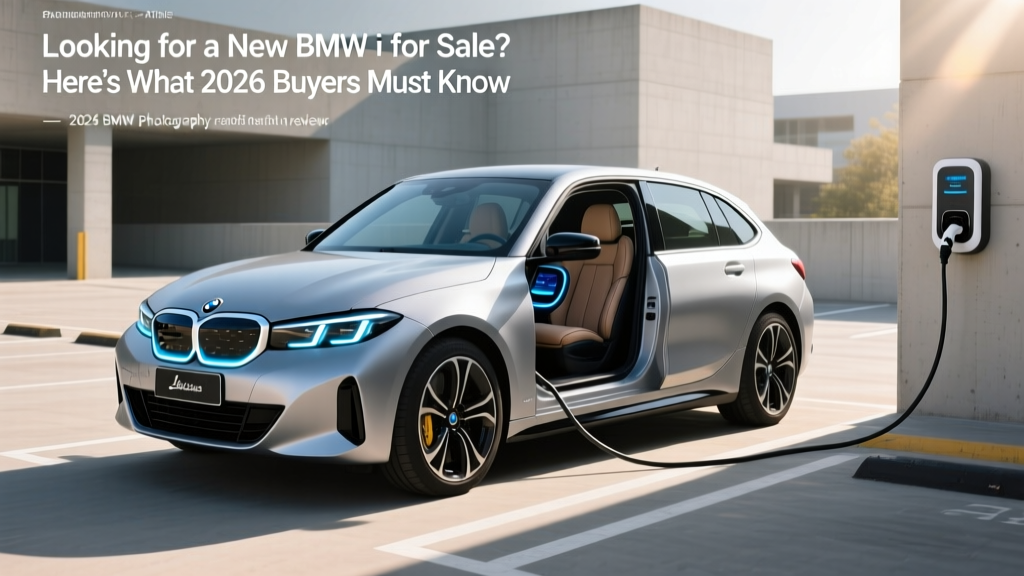
The BMW i3 Is Discontinued — Here's What That Means for Buyers
If you're searching for a new BMW i3 for sale, you've likely encountered a frustrating reality: BMW ended production of the i3 in July 2022 after an eight-year run. There is no 2025 or 2026 model year BMW i3. Dealerships cannot sell you a brand-new one, and BMW has not announced a direct successor wearing the i3 badge.
That doesn't mean the i3 story is over. The used and certified pre-owned (CPO) market still has inventory, and BMW's current EV lineup fills the gap the i3 left behind — often with dramatically better range, charging speed, and practicality. This guide breaks down exactly what the i3 offered in its final model year (2022), what to expect if you buy one today, and which new BMW EVs deserve your attention instead.
2022 BMW i3 Final Specs: Range, Battery, and Efficiency
The 2022 BMW i3 was offered in two variants: the standard i3 and the sportier i3s. Both used the same battery pack but differed in motor output and efficiency. Here's the full spec breakdown from the vehicle's final year:
| Specification | i3 (Standard) | i3s (Sport) |
|---|---|---|
| Battery Capacity | 42.2 kWh (gross) / 37.9 kWh (usable) | 42.2 kWh (gross) / 37.9 kWh (usable) |
| Battery Chemistry | NMC (Nickel Manganese Cobalt) | NMC (Nickel Manganese Cobalt) |
| EPA Range (BEV) | 153 miles | 141 miles |
| EPA Range w/ Range Extender (REx) | 126 mi EV + ~70 mi gas | 114 mi EV + ~70 mi gas |
| MPGe (Combined) | 113 MPGe | 102 MPGe |
| Efficiency | 30 kWh/100 mi | 33 kWh/100 mi |
| Motor Output | 170 hp / 184 lb-ft | 184 hp / 199 lb-ft |
| Drivetrain | Rear-Wheel Drive (RWD) | Rear-Wheel Drive (RWD) |
| 0–60 mph | 6.9 seconds | 6.2 seconds |
| Top Speed | 93 mph | 99 mph |
| DC Fast Charge (max) | 50 kW (CCS) | 50 kW (CCS) |
| Level 2 Charge Rate | 7.4 kW | 7.4 kW |
| Cargo Volume (rear seats up) | 15.1 cu ft | 15.1 cu ft |
| Cargo Volume (rear seats folded) | 36.0 cu ft | 36.0 cu ft |
| Rear Legroom | 31.9 inches | 31.9 inches |
| Base MSRP (when new) | $44,450 | $47,350 |
The EPA-rated 153 miles (i3) or 141 miles (i3s) assumed mixed driving in moderate conditions. In real-world highway driving at 70+ mph, expect roughly 120–135 miles from the standard i3. In cold weather (below 32°F), range drops further — owners commonly report 100–115 miles in winter conditions due to battery heating demands and cabin climate load. The i3's relatively small battery and lack of a standard heat pump (resistance heating was used) make it particularly susceptible to cold-weather range loss.
Charging Speed: The i3's Biggest Modern Limitation
Charging infrastructure has advanced dramatically since the i3's design era, and this is where the i3 shows its age most clearly.
| Charging Level | Power (kW) | Speed / Time | Connector |
|---|---|---|---|
| Level 1 (120V household) | ~1.4 kW | ~4–5 miles per hour | J1772 |
| Level 2 (240V home/public) | 7.4 kW | ~25 miles per hour; full charge in ~5.5 hours | J1772 |
| DC Fast Charge | 50 kW (peak) | 10–80% in ~40 minutes | CCS1 |
The 50 kW DC fast-charge ceiling is the critical number. Modern EVs routinely accept 150–250 kW on DC fast chargers, with the Hyundai Ioniq 5 and Tesla Model 3 peaking well above 200 kW. At 50 kW, the i3's small battery still takes roughly 40 minutes to reach 80% — and the charge curve tapers significantly above 80%, making the last 20% painfully slow.
For daily home charging on Level 2, the 7.4 kW onboard charger is adequate. A full overnight charge from empty takes about 5.5 hours, which works fine for a commuter car that starts each day at 100%. But on road trips, the 50 kW cap means longer stops and careful route planning around charging station availability.
Federal Tax Credit: What Applied and What Doesn't Now
When the i3 was in production, it qualified for up to $7,500 under the federal EV tax credit. However, BMW's credit allocation was exhausted well before production ended, meaning new i3 buyers in 2021–2022 generally did not receive the full federal credit.
If you're buying a used i3 today, different rules apply under the current IRS §25E used clean vehicle credit:
- Credit amount: 30% of the sale price, up to a maximum of $4,000
- Vehicle price cap: Sale price must be $25,000 or less
- Buyer income limits (2026): $75,000 single / $112,500 head of household / $150,000 joint filers (modified AGI)
- Vehicle age: Must be at least 2 model years old (2024 or older for 2026 purchases — all i3 model years qualify)
- Dealer requirement: Must purchase from a licensed dealer (private-party sales don't qualify)
- Point-of-sale transfer: The credit can be applied at the point of sale as a down payment reduction, per current IRS rules
Many used i3 models currently list between $18,000–$28,000 depending on mileage and condition, so the $25,000 sale-price cap means some listings will qualify and others won't. Always confirm the final negotiated price stays at or under $25,000 to preserve eligibility.
Who the BMW i3 Suits — and Who Should Look Elsewhere
The i3 was designed as an urban commuter and city runabout, and it excels in that role even today. Its carbon-fiber-reinforced plastic (CFRP) passenger cell keeps weight relatively low at ~2,900 lbs, giving it nimble handling and a tight 32.1-foot turning circle. The upright hatchback body provides surprising cargo versatility for its footprint.
Best use cases for a used i3:
- Daily commuting under 60 miles round-trip with home Level 2 charging
- Urban and suburban errands where parking is tight
- A second car in a two-EV household
- Drivers who value unique design and BMW build quality at a lower entry price
Who should skip the i3:
- Anyone needing 200+ miles of range for road trips or long commutes
- Families requiring rear-seat space for older children or car seats (31.9 inches of rear legroom is tight)
- Buyers in cold climates without a garage (cold-weather range drops below 110 miles)
- Drivers who want fast DC charging for highway travel
Better Alternatives: New BMW EVs and Competitors to Consider
If you're committed to buying new and want BMW's electric driving experience, here's where the brand's 2026 lineup stands — and which non-BMW competitors fill the i3's original mission:
| Model | EPA Range | DC Fast Charge | Starting MSRP | Key Advantage Over i3 |
|---|---|---|---|---|
| 2026 BMW i4 eDrive40 | 307 mi | 205 kW (10–80% in ~31 min) | ~$57,000 | Double the range; modern fast charging |
| 2026 BMW iX xDrive50 | 324 mi | 200 kW (10–80% in ~34 min) | ~$87,000 | Spacious SUV; AWD; premium luxury |
| 2026 Hyundai Ioniq 5 | 303 mi | 238 kW (10–80% in ~18 min) | ~$42,000 | Fastest charging in class; similar price to i3's MSRP |
| 2026 Tesla Model 3 RWD | 272 mi | 170 kW (10–80% in ~25 min) | ~$38,990 | Lower price; Supercharger network; OTA updates |
| 2026 Chevrolet Equinox EV | 319 mi | 150 kW (10–80% in ~30 min) | ~$33,000 | Most affordable long-range crossover option |
The BMW i4 is the closest spiritual successor to the i3 in BMW's current lineup — a compact, driver-focused electric car — but it starts roughly $12,000 higher than the i3's final MSRP. For buyers who want the BMW badge with modern range and charging, it's the logical step up. For those who simply want a practical commuter EV near the i3's original price point, the Hyundai Ioniq 5 and Tesla Model 3 offer vastly superior range and charging infrastructure.
Pros and Cons: The i3 in 2026 Context
Pros
- Unique, iconic design — nothing else looks like it
- CFRP construction keeps weight low; nimble city handling
- Tight turning radius ideal for urban parking
- BMW build quality and interior materials punch above its class
- Low used prices ($18K–$28K) make it an affordable EV entry point
- Available Range Extender (REx) adds ~70 miles of gas-powered backup
- Eligible for up to $4,000 used EV tax credit (with income/price caveats)
Cons
- 153-mile max EPA range is inadequate for road trips
- 50 kW DC fast charging is painfully slow by 2026 standards
- No heat pump — significant cold-weather range loss
- Tight rear seats (31.9" legroom) limit family utility
- Narrow 155/70R19 tires are expensive and hard to replace
- Discontinued — no warranty support for new production issues
- iDrive infotainment is a generation behind BMW's current iDrive 8.5
- CCS1 charging port (no NACS adapter included; aftermarket adapters available)
BMW i3 Battery Longevity and Warranty
BMW backed the i3's high-voltage battery with an 8-year / 100,000-mile warranty against defects and excessive capacity loss (below 70% of original capacity). For a 2022 model, that factory battery warranty remains active through approximately mid-2030, which provides meaningful coverage for used buyers.
Real-world battery degradation data from i3 owners has been generally positive. The 42.2 kWh (gross) Samsung SDI NMC pack has demonstrated roughly 10–15% capacity loss after 80,000–100,000 miles in moderate climates, based on community reporting from forums like BMW Blog and owner groups. However, vehicles in hot climates (Arizona, Texas) or those frequently DC fast-charged to 100% may see higher degradation.
If you're evaluating a used i3, request a battery health report from the dealer or use an OBD-II scanner with an EV-compatible app (such as BimmerCode or LeafSpy-equivalent tools for BMW) to check the current State of Health (SoH) before purchasing. A pack reading below 85% SoH on a vehicle with under 60,000 miles warrants caution.
Frequently Asked Questions
Can I still buy a new BMW i3 in 2026?
No. BMW ended i3 production in July 2022. You cannot purchase a new i3 from any BMW dealership. Your options are used, certified pre-owned (CPO), or choosing a different new BMW EV such as the i4 or iX.
What is the real-world range of the BMW i3?
The EPA rated the final 2022 i3 at 153 miles (standard) and 141 miles (i3s). In real-world mixed driving, expect 130–145 miles. On sustained highway driving at 70+ mph, plan for 120–135 miles. In freezing temperatures, range can drop to 100–115 miles. The REx (Range Extender) variant adds a small two-cylinder gasoline engine for approximately 70 additional miles of range once the battery depletes.
How fast does the BMW i3 charge?
On a DC fast charger, the i3 peaks at 50 kW, taking approximately 40 minutes from 10–80% SoC. On a Level 2 home charger (240V), it charges at 7.4 kW, adding roughly 25 miles per hour and reaching a full charge in about 5.5 hours. Level 1 (120V) trickle charging adds about 4–5 miles per hour.
Does a used BMW i3 qualify for a federal tax credit?
A used i3 can qualify for the IRS §25E used clean vehicle credit of up to $4,000 (30% of sale price), but only if: the sale price is $25,000 or less, you purchase from a licensed dealer, and your modified adjusted gross income falls below $75,000 (single), $112,500 (head of household), or $150,000 (joint). Check current rules at IRS.gov before purchasing.
Is the BMW i3 worth buying vs. a new EV?
It depends on your budget and needs. At $18,000–$28,000 used (potentially $14,000–$24,000 after the used EV credit), the i3 is one of the cheapest ways into a premium-brand EV. For a city commuter with home charging, it's a compelling deal. But if you need 200+ miles of range, fast road-trip charging, or modern driver-assistance features, a new Hyundai Ioniq 5, Tesla Model 3, or Chevrolet Equinox EV offers far more capability — at a higher upfront cost.
What should I check before buying a used i3?
Prioritize these items: (1) Battery State of Health via OBD-II scan — aim for 90%+ SoH. (2) Remaining battery warranty (8yr/100K mi from original in-service date). (3) Whether the car has the Range Extender (REx) if you need backup miles. (4) Tire condition — the i3's narrow 155/70R19 tires are specialty items costing $200–$300 each. (5) Service records for the coolant system and brake fluid flushes.