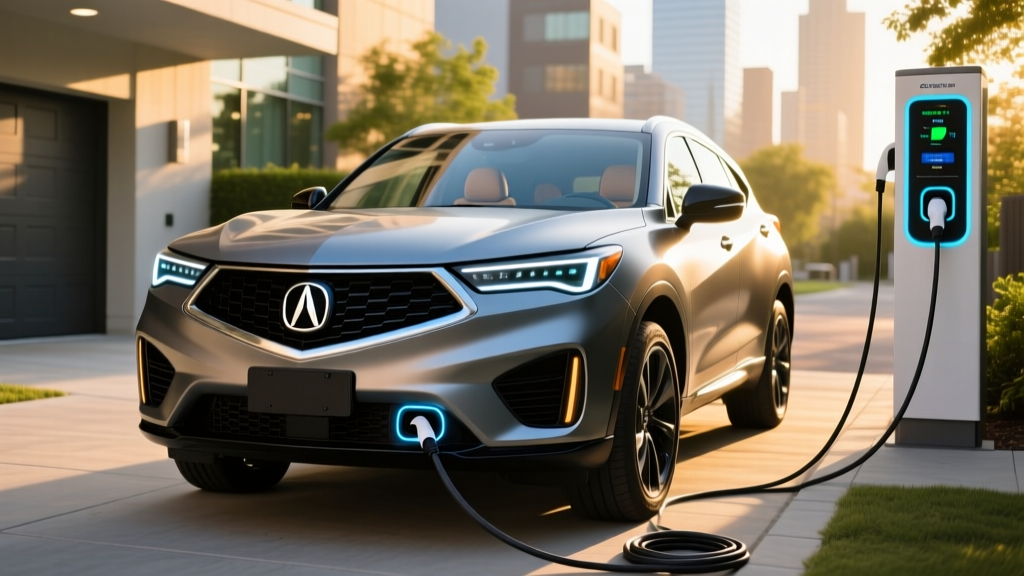
If you're researching the new Acura EV, you're likely looking at the upcoming all-electric model built on Honda's next-generation EV platform, expected to debut as part of Acura's electrified lineup expansion. As of early 2026, Acura has confirmed an electric SUV successor positioned in the RDX segment, built on the Honda 0 Series architecture. Here's what we know, what's preliminary, and how it stacks up against the competition and your current gas car.
Quick Answer: What Is the New Acura EV?
The new Acura EV is a compact luxury electric SUV built on Honda's dedicated EV platform (Honda 0 Series). Preliminary specs target a 300+ mile EPA range, 800V architecture for fast charging (up to 350 kW peak DC), and a starting MSRP in the $50,000–$55,000 range. It is expected to go on sale in late 2026 as a 2027 model year vehicle. Specs below are based on Honda/Acura announcements and platform capabilities — final EPA figures will be confirmed closer to launch.
Range, Battery, and Efficiency: What to Expect
The new Acura EV will ride on Honda's dedicated battery-electric platform, which the company has confirmed will use a thin, high-density battery pack designed for a low center of gravity. Based on Honda's published platform targets and competitive positioning against the BMW iX3, Genesis GV70 Electrified, and Tesla Model Y, here are the projected specifications:
| Specification | Projected / Preliminary |
|---|---|
| EPA Range (estimated) | 300–325 miles |
| Battery Capacity (usable) | ~85–100 kWh (NMC chemistry) |
| Platform Voltage | 800V architecture |
| Peak DC Fast Charge Rate | Up to 350 kW |
| 10–80% DC Fast Charge Time | ~12–18 minutes (estimated) |
| Level 2 AC Charge Rate | 11.5 kW (estimated) |
| Drivetrain | RWD standard / AWD available |
| Horsepower (AWD) | ~380–420 hp (estimated) |
| 0–60 mph | ~5.0–5.5 seconds (AWD) |
| Battery/Powertrain Warranty | 8 years / 100,000 miles (expected) |
Real-World Range Reality Check
EPA estimate: 300–325 miles (projected).
Real-world highway (70–75 mph): Expect ~250–280 miles. Aerodynamic drag at highway speeds reduces efficiency by 15–20% compared to combined driving.
Cold weather (below 32°F): Plan for 20–30% range loss, bringing effective range to ~210–260 miles. Battery chemistry and cabin heating are the primary factors. A heat pump (expected on this platform) helps mitigate this.
DC fast charging taper: Peak 350 kW rates only hold up to roughly 40–50% State of Charge. Above 80%, speeds drop significantly — expect 50 kW or less as the battery management system protects cell longevity.
The 800V architecture is the critical spec here. While peak kW numbers grab headlines, the 800V system enables sustained higher charge rates across a wider portion of the battery's State of Charge. In practice, this means the 10–80% time is what matters for road trips — and 12–18 minutes at a compatible 350 kW charger (like Electrify America's newest stations or Tesla Supercharger V4 with NACS adapter) puts it in the top tier of charging speed.
Pricing, Trims, and Federal Tax Credit Eligibility
Acura has not published final MSRP figures, but based on the current RDX pricing ladder ($44,350–$54,500 for 2025) and the typical EV premium, we project the following:
- Base (FWD/AWD): $50,000–$53,000
- Technology Package: $54,000–$57,000
- A-Spec / Advance: $58,000–$63,000
Will It Qualify for the §30D Federal Tax Credit?
The IRS §30D clean vehicle credit offers up to $7,500, but eligibility depends on several requirements that shift frequently. As of 2026, the key criteria include:
- MSRP cap: SUVs must be priced at or below $80,000 — the new Acura EV should clear this easily.
- Buyer income cap: Modified adjusted gross income must not exceed $150,000 (single), $225,000 (head of household), or $300,000 (joint).
- Battery sourcing: A percentage of critical minerals and battery components must be sourced from the U.S. or free-trade-agreement countries. This is the most volatile requirement and changes annually.
- Final assembly: Vehicle must undergo final assembly in North America. Honda's EV production plans for North America suggest this will be met, but confirmation is pending.
- Point-of-sale transfer: Eligible buyers can transfer the credit to the dealer at purchase, reducing the out-of-pocket price immediately.
Bottom line: The MSRP cap won't be an issue, but battery sourcing rules are the wildcard. Check the fueleconomy.gov tax credit tracker closer to launch for confirmed eligibility. Consult a tax professional for your specific situation.
EV vs. Gas RDX: The Real Cost Comparison
How does the new Acura EV compare to the gas-powered RDX you might be cross-shopping? Here's a 5-year ownership breakdown using projected figures for the EV and current EPA data for the 2025 RDX AWD (23 MPG combined):
| Cost Category (5 Years / 75,000 Miles) | New Acura EV (Projected) | 2025 Acura RDX AWD (Gas) |
|---|---|---|
| Purchase Price (base, before credit) | $52,000 | $46,350 |
| Federal Tax Credit (§30D) | −$7,500 (if eligible) | $0 |
| Effective Purchase Price | $44,500 | $46,350 |
| Fuel / Energy Cost | $3,750 (home L2 @ $0.14/kWh) | $11,739 ($3.60/gal, 23 MPG) |
| Maintenance (oil, filters, brakes) | $1,200 (tire rotations, cabin filter, fluid top-offs) | $3,800 (oil changes, brake pads, transmission fluid) |
| Insurance (estimated avg) | $9,500 | $8,000 |
| 5-Year Total Cost | $58,950 | $69,889 |
| Cost Per Mile | $0.79 | $0.93 |
Key takeaway: The EV saves roughly $10,900 over 5 years — primarily through fuel and maintenance savings — if you qualify for the full $7,500 credit and charge primarily at home. Insurance premiums for EVs tend to run 10–20% higher due to repair complexity and parts costs. If you rely entirely on public DC fast charging (averaging $0.35–$0.48/kWh), your energy costs rise to roughly $9,400–$12,800 over 5 years, narrowing the gap considerably.
Charging at Home and on the Road
The 800V architecture and projected 11.5 kW Level 2 onboard charger define the ownership experience. Here's what charging looks like in practice:
| Charging Level | Power (kW) | Miles Added Per Hour | Use Case |
|---|---|---|---|
| Level 1 (120V household outlet) | 1.4 kW | ~4–5 miles | Emergency / overnight trickle |
| Level 2 (240V home charger, 48A) | 11.5 kW | ~38–42 miles | Daily home charging — full charge in ~8–9 hours |
| DC Fast Charge (350 kW station) | Up to 350 kW peak | ~200+ miles in 10 min | Road trips — 10–80% in ~12–18 min |
Home Charging Installation Costs
Most EV buyers will want a Level 2 home charger. Budget for the following:
| Item | Cost Range |
|---|---|
| Level 2 Charger (hardwired, 48A) | $400–$750 |
| Electrician (240V/60A circuit install) | $800–$2,500 |
| Electrical permit | $50–$200 |
| Panel upgrade (if needed — 200A service) | $1,500–$4,000 |
| Total (no panel upgrade) | $1,250–$3,450 |
| Total (with panel upgrade) | $2,750–$7,450 |
If your home already has a 200-amp electrical panel with spare capacity, you'll land on the lower end. Older homes with 100-amp service will likely need an upgrade — get a quote from a licensed electrician before committing to the vehicle.
Connector Standard: NACS
Honda (and by extension Acura) has confirmed adoption of the North American Charging Standard (NACS) for its new EVs. This means native access to Tesla's Supercharger network — the largest and most reliable DC fast-charging network in the U.S. with over 25,000 stalls. No adapter needed. This is a significant advantage over CCS-only vehicles, which have more limited public charging options.
Common Misconceptions About the New Acura EV
| Myth | Fact |
|---|---|
| "EV batteries need replacing every 5 years." | Modern NMC and LFP batteries are designed for 15–20 year lifespans. Honda/Acura is expected to warrant the battery for 8 years/100,000 miles with a capacity retention threshold of 70% or better. Real-world data from similar platforms shows 10–15% degradation over 100,000 miles. |
| "I'll be stranded without a charger." | With 300+ miles of range and NACS access to 25,000+ Superchargers, route planning on road trips requires a 15-minute stop every 2.5–3 hours — roughly the same cadence as gas-car rest stops. |
| "EVs are worse in winter." | Range drops 20–30% in freezing temps — real and manageable. Preconditioning the battery while plugged in (a standard feature) recovers much of this loss and ensures fast-charging speeds in cold weather. |
| "The tax credit is guaranteed $7,500." | Eligibility depends on your income, the vehicle's battery sourcing, and MSRP. Rules change annually. Always verify on irs.gov before purchasing. |
| "Level 2 driver-assist means self-driving." | Acura's driver-assistance systems (AcuraWatch) are SAE Level 2 — the driver must remain fully engaged with hands on or near the wheel at all times. This is not autonomous driving. |
Decision Framework: Is the New Acura EV Right for You?
Choose the New Acura EV If:
- You have access to home Level 2 charging (garage or driveway with 240V outlet potential).
- Your daily commute is under 80 miles round-trip, meaning you'll almost never need public charging for daily use.
- You want luxury-brand refinement with EV performance and qualify for the §30D tax credit.
- You take 2–4 road trips per year and value NACS/Supercharger access for hassle-free long-distance travel.
- You plan to keep the vehicle 7+ years, maximizing fuel/maintenance savings over time.
Stick with the Gas RDX or Consider a PHEV If:
- You live in an apartment or condo without charging access and cannot install a Level 2 charger.
- You regularly drive 400+ miles in a single day in rural areas with sparse charging infrastructure.
- Your household income exceeds the §30D caps ($300,000 joint / $150,000 single), removing the $7,500 incentive.
- You need to minimize upfront cost and aren't ready to absorb the EV price premium (even after incentives).
- You live in an extreme cold climate (regularly below 0°F) and cannot garage the vehicle — a PHEV offers a gas backup for the worst days.
What First-Time EV Buyers Should Know
Transitioning from a gas car to the new Acura EV involves a few practical adjustments:
- Install your home charger before the car arrives. Schedule the electrician 4–6 weeks ahead. A 48-amp hardwired Level 2 unit on a dedicated 60-amp circuit is the sweet spot for this vehicle's 11.5 kW onboard charger.
- Charge to 80% daily, 100% only for road trips. NMC batteries last longest when kept between 20–80% State of Charge for daily use. The vehicle's software will let you set a charge limit.
- Download charging apps before your first road trip. Tesla Superchargers are accessible via the Tesla app (for non-Tesla NACS vehicles). Also install PlugShare and your preferred network app (Electrify America, EVgo) as backups.
- Precondition the battery before DC fast charging. Navigate to the charger using the car's built-in navigation — this warms the battery to optimal temperature, enabling peak charge rates. Without preconditioning, a cold battery may charge at half speed.
- Budget for higher insurance. Get quotes before purchasing. EV insurance averages 10–20% more than comparable gas vehicles. Some insurers offer EV-specific discounts.
Frequently Asked Questions
When will the new Acura EV be available to buy?
Acura has indicated a late-2026 on-sale date for its first dedicated EV SUV, likely as a 2027 model year vehicle. Exact timing depends on Honda's North American EV production ramp. Pre-orders may open mid-2026.
Will the new Acura EV have a frunk (front trunk)?
Honda's 0 Series platform is designed with a dedicated EV architecture (no engine bay), which typically enables a front trunk. Acura has not confirmed frunk volume, but competitive vehicles in this segment offer 1.5–3.0 cubic feet of front storage.
How does the Acura EV compare to the Tesla Model Y?
The Model Y currently offers 310–330 miles of EPA range, starts around $44,990, and charges at up to 250 kW (10–80% in ~20 minutes). The new Acura EV is projected to match or slightly exceed range, charge faster (350 kW / ~12–18 min 10–80%), and offer a more traditional luxury interior — but at a higher starting price. The Model Y also qualifies for the §30D credit (confirm current eligibility on fueleconomy.gov). The Acura targets buyers who want dealership service, Acura brand identity, and a more conventional luxury driving experience.
Can I use Tesla Superchargers with the new Acura EV?
Yes. Acura/Honda has adopted the NACS connector, meaning native compatibility with Tesla Supercharger stalls — no adapter required. This gives access to the largest fast-charging network in North America.
What happens to the battery after the warranty expires?
EV batteries degrade gradually, not catastrophically. Industry data from similar NMC packs shows 85–90% capacity retention at 100,000 miles. At 150,000–200,000 miles, you may see 75–80% capacity — still functional for daily driving with reduced range. Full battery replacement (rarely needed) typically costs $12,000–$20,000 depending on pack size, though prices continue to decline.
Is Acura's driver-assist system self-driving?
No. Acura's AcuraWatch suite and any available hands-on or limited hands-off highway assist features are classified as SAE Level 2 driver-assistance systems. You must remain alert, monitor the road, and be prepared to take over at any moment. This is fundamentally different from Level 4 robotaxi services like Waymo, which operate without a human driver in geofenced areas.