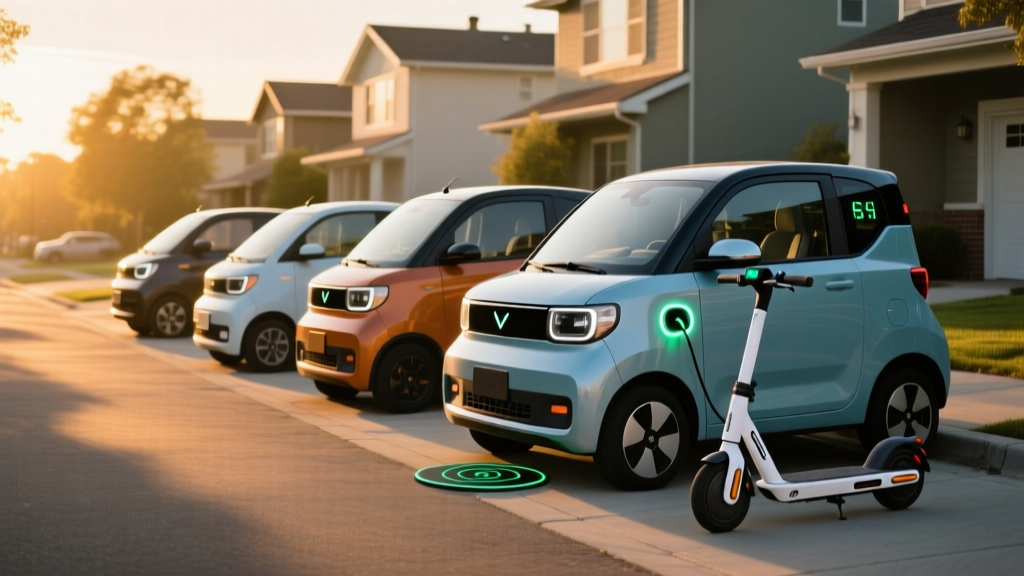
The short answer: A neighborhood electric vehicle (NEV) — also called a low-speed vehicle (LSV) — is a street-legal, federally regulated electric vehicle capped at 25 mph with a typical range of 30–60 miles on a full charge. NEVs cost between $8,000 and $20,000 new, run on standard 120V household outlets (no special charger needed), and cost roughly $0.03–$0.05 per mile to operate. They are best suited for planned communities, suburban errands, beach towns, and campuses — not highway commuting. If your daily trips stay under 20 miles at speeds under 35 mph, an NEV can replace a second car and save $1,500–$3,000 annually versus a gas vehicle.
What Exactly Is a Neighborhood Electric Vehicle?
A neighborhood electric vehicle is a battery-electric vehicle classified by the National Highway Traffic Safety Administration (NHTSA) as a Low-Speed Vehicle (LSV) under Federal Motor Vehicle Safety Standard (FMVSS) No. 500. By federal law, an LSV must:
- Have a top speed of at least 20 mph but not more than 25 mph
- Include headlamps, turn signals, stop lamps, tail lamps, reflex reflectors, exterior mirrors, a parking brake, a windshield (AS-1 or AS-5 glazing), a VIN, and seat belts
- Be operated only on roads with posted speed limits of 35 mph or less (states may allow crossing higher-speed roads at intersections)
NEVs are not golf carts. Golf carts are not federally regulated as motor vehicles and typically lack the safety equipment required for street-legal LSV operation. The distinction matters for insurance, registration, and where you can legally drive.
Popular 2025–2026 NEV models include the GEM e2/e4/e6 (Polaris), Arcimboldo BOLD, and various Chinese-manufactured LSVs sold through US dealerships. Tesla, Rivian, and legacy automakers do not produce NEVs — this segment is served by specialty manufacturers.
NEV Specs: Range, Battery, Charging & Performance
NEV specifications vary significantly by manufacturer, but here are the typical ranges you will encounter in the current market:
| Specification | Typical NEV Range | Full-Size EV (for comparison) |
|---|---|---|
| Top Speed | 25 mph (federally capped) | 100–163 mph |
| Battery Capacity | 8–18 kWh (lead-acid or lithium) | 50–120 kWh (NMC/LFP lithium) |
| EPA/Advertised Range | 30–60 miles | 230–402 miles |
| Real-World Range (hilly/cold) | 20–45 miles | 180–340 miles |
| Charging Method | Standard 120V outlet (Level 1) | 120V / 240V / DC fast charge |
| Charge Time (0–100%) | 6–10 hours (120V) | 8–12 hrs (L2); 18–45 min (DCFC) |
| Peak Charge Rate | ~1.2–1.4 kW | 11–350 kW |
| Motor Output | 4–15 HP | 150–1,020 HP |
| Cargo Capacity | 200–800 lbs payload | 800–1,500+ lbs payload |
Key ownership note on batteries: Many budget NEVs still ship with lead-acid batteries, which are heavier, offer less range, and degrade faster than lithium-ion packs. A lead-acid NEV battery pack typically lasts 2–4 years (300–500 charge cycles) and costs $1,500–$3,000 to replace. Lithium-equipped NEVs (increasingly common in 2025–2026 models) last 8–12 years (1,500+ cycles) but add $2,000–$5,000 to the purchase price. Always confirm battery chemistry before buying — it is the single biggest long-term cost variable.
NEV vs Gas Car vs Full EV: Cost Comparison
The core appeal of a neighborhood electric vehicle is operating cost. Here is how a typical NEV stacks up against a compact gas car and a full-size EV over five years of light-duty, low-speed driving (assumed 5,000 miles/year — realistic for NEV use patterns):
| Cost Factor | NEV (Lithium) | Gas Compact (e.g., Honda Civic) | Full-Size EV (e.g., Chevy Equinox EV) |
|---|---|---|---|
| Purchase Price (MSRP) | $12,000–$18,000 | $24,000–$28,000 | $33,000–$43,000 |
| Federal Tax Credit (§30D) | Not eligible (not highway-capable) | Not eligible | Up to $7,500 (subject to income/MSRP/sourcing rules per IRS §30D) |
| Fuel/Energy Cost per Mile | $0.03–$0.05 | $0.12–$0.16 | $0.04–$0.07 |
| Annual Fuel/Energy (5k mi) | $150–$250 | $600–$800 | $200–$350 |
| Annual Insurance | $300–$700 | $1,200–$1,800 | $1,400–$2,200 |
| Maintenance (Annual Avg) | $100–$250 | $500–$900 | $300–$500 |
| 5-Year Total Operating Cost | $2,750–$5,750 | $11,500–$16,500 | $9,500–$15,250 |
| Battery Replacement (if needed) | $1,500–$5,000 at yr 3–8 | N/A | Warranty-covered (8 yr/100k mi typical) |
The takeaway: An NEV saves $5,000–$10,000+ over five years compared to a gas car used for the same short-trip duty cycle. However, it cannot replace a primary vehicle for highway driving, road trips, or cold-climate commuting. Most NEV owners use them as a second or third household vehicle specifically for school runs, grocery trips, and neighborhood errands.
Real-World Ownership Considerations
Before purchasing an NEV, evaluate these practical factors honestly:
Where You Can Legally Drive
LSV regulations vary by state. According to NHTSA, federal law permits LSVs on roads posted at 35 mph or below, but states and municipalities can impose additional restrictions or allowances. Some states (Florida, Arizona, California) have extensive NEV-friendly infrastructure with designated LSV lanes and crossings. Others restrict NEVs to private roads or specific planned communities. Check your state DMV and local ordinances before buying.
Home Charging Access
NEVs charge on a standard 120V household outlet — no Level 2 charger or electrical panel upgrade needed. This is a major advantage over full-size EVs, which often require $500–$2,000 in electrical work for Level 2 home charging. If you have a garage or covered parking with a standard outlet within 25 feet of your parking spot, you can charge an NEV overnight with zero infrastructure investment.
Climate and Weather
NEVs offer minimal weather protection. Most have open or semi-enclosed cabins, and none have the crash structure, airbags, or climate control of a full-size vehicle. Lead-acid batteries lose 20–40% of their capacity in freezing temperatures — a 40-mile-range NEV may deliver only 24–32 miles in a 20°F winter. Lithium-equipped NEVs fare better (10–20% cold-weather loss) but still lack cabin heating in most models. NEVs are primarily a warm-climate, fair-weather solution.
Safety Limitations
NEVs are not crash-tested by NHTSA or IIHS the way passenger vehicles are. They lack airbags, crumple zones, stability control, and advanced driver-assistance systems. Sharing roads with full-size trucks and SUVs — even at 35 mph — carries real risk. NEVs are safest in communities with dedicated LSV paths, low traffic volumes, and speed-calmed streets.
Federal Tax Credits and Incentives for NEVs
This is one of the most common misconceptions in the NEV space. Neighborhood electric vehicles do not qualify for the federal §30D New Clean Vehicle Credit. The §30D credit applies to highway-capable vehicles with a gross vehicle weight rating under 14,000 lbs that meet specific battery component and critical mineral sourcing requirements. Because NEVs/LSVs are not designed for highway use, they fall outside the credit's scope.
§30D eligibility requires (per IRS.gov):
- Vehicle must be a qualified plug-in electric or fuel cell vehicle (highway-capable)
- MSRP under $55,000 (sedans) or $80,000 (SUVs/trucks/vans)
- Buyer AGI under $150,000 (single) / $300,000 (joint)
- Battery components and critical minerals must meet phased-in US/FATF sourcing requirements
- Vehicle must be assembled in North America
NEVs fail the first criterion — they are not highway-capable passenger vehicles.
Some state and local incentives may apply to NEVs. Certain utilities offer rebates for any plug-in electric vehicle, and a handful of states have offered registration fee waivers or HOV access. Check your state energy office and local utility for current programs — these vary by jurisdiction and change frequently.
Common NEV Misconceptions
| Myth | Fact |
|---|---|
| "NEVs qualify for the $7,500 federal tax credit." | False. NEVs/LSVs are not highway-capable and do not meet §30D eligibility. No federal purchase credit applies. |
| "An NEV is just a street-legal golf cart." | False. Golf carts are not federally regulated motor vehicles. LSVs must meet FMVSS No. 500 safety standards including seat belts, lighting, and VIN requirements. |
| "I can drive an NEV on any road." | False. Federal law limits LSVs to roads posted at 35 mph or below. States may allow intersection crossings at higher-speed roads, but highway driving is prohibited. |
| "NEVs need a special charger." | False. Nearly all NEVs charge on a standard 120V household outlet — no electrician or panel upgrade required. |
| "NEV batteries last as long as full EV batteries." | Misleading. Lead-acid NEV batteries last 2–4 years. Lithium NEV batteries last 8–12 years. Full EV batteries (NMC/LFP) are warrantied for 8 years/100,000 miles and typically last 15–20 years. |
| "NEVs are safe for families." | Context-dependent. NEVs lack airbags, crash structures, and ADAS. They are appropriate for low-speed, low-traffic environments but carry higher injury risk in collisions with full-size vehicles. |
Decision Framework: Is an NEV Right for You?
Choose a neighborhood electric vehicle if:
- Your daily trips are under 20 miles round-trip at speeds under 35 mph
- You live in a warm climate with minimal winter driving needs
- You already have a primary vehicle for highway driving and longer trips
- Your community has NEV-friendly roads, LSV lanes, or low-speed infrastructure
- You want to eliminate fuel costs for school runs, grocery trips, and local errands
- You have access to a standard 120V outlet for overnight charging
- You want a purchase price under $20,000 with minimal maintenance
Choose a full-size EV (or PHEV) instead if:
- You need to drive on roads posted above 35 mph regularly
- You commute more than 20 miles one-way
- You live in a cold climate and need year-round, all-weather transportation
- You need to carry more than 4 passengers or significant cargo
- You want federal tax credit eligibility (up to $7,500 under current §30D rules)
- You need crash-tested safety features, airbags, and driver-assistance technology
- You want a single vehicle that handles all driving needs — highway, road trips, and local
Choose a hybrid (HEV/PHEV) if:
- You want fuel efficiency (40–94 MPGe combined) without range limitations
- Your driving mix includes both short neighborhood trips and longer highway commutes
- You lack reliable home charging access for a full EV
- You want one vehicle that does everything with no compromise on speed or range
Frequently Asked Questions
Do I need a driver's license to operate an NEV?
Yes. In nearly all states, operating a street-legal LSV on public roads requires a valid driver's license, vehicle registration, and minimum liability insurance. NEVs are classified as motor vehicles, not recreational equipment.
How much does it cost to charge an NEV?
At the US average residential electricity rate of approximately $0.17/kWh (EIA, 2025), fully charging a 12 kWh NEV battery costs roughly $2.04. With a typical real-world range of 35 miles per charge, that works out to about $0.06 per mile — compared to $0.12–$0.16 per mile for a 30 MPG gas car at $3.50/gallon.
Can I drive an NEV in the rain or winter?
Technically yes, but it is not ideal. Most NEVs have minimal weather sealing, no cabin heating, and limited windshield wiper capability. Lead-acid batteries lose significant capacity below freezing. Lithium-equipped NEVs with enclosed cabins (like the GEM eSeries with optional weather package) are more practical in marginal weather, but an NEV should not be your primary winter vehicle in northern climates.
What happens when an NEV battery needs replacement?
Lead-acid battery replacement costs $1,500–$3,000 and is typically needed every 2–4 years depending on usage and maintenance. Lithium battery replacement (if needed) costs $3,000–$5,000 but should not be required for 8–12 years under normal use. Always factor battery replacement into your total cost of ownership calculation — it is the NEV equivalent of a timing belt or transmission service on a gas car.
Are there any NEVs with more than 60 miles of range?
A few 2025–2026 models with larger lithium packs advertise 70–100 miles under ideal conditions (flat terrain, warm weather, 20 mph cruising). Real-world range with hills, stops, and moderate temperatures typically comes in 20–30% lower than advertised. No current-production NEV reliably delivers more than 70 real-world miles on a single charge.
Can I modify a golf cart to make it street-legal as an NEV?
In some states, yes — a process sometimes called "converting" a golf cart to LSV status by adding required safety equipment (seat belts, lighting, mirrors, VIN). However, this process must meet your state's specific requirements, and the resulting vehicle still cannot exceed 25 mph. Consult your state DMV before attempting a conversion — improper modifications can result in fines and insurance denial.
Sources: NHTSA FMVSS No. 500 (Low-Speed Vehicle standards); IRS §30D New Clean Vehicle Credit; fueleconomy.gov for EV efficiency comparisons.