Why the Nashville Tesla Tunnel Changes the EV Equation for Music City Commuters
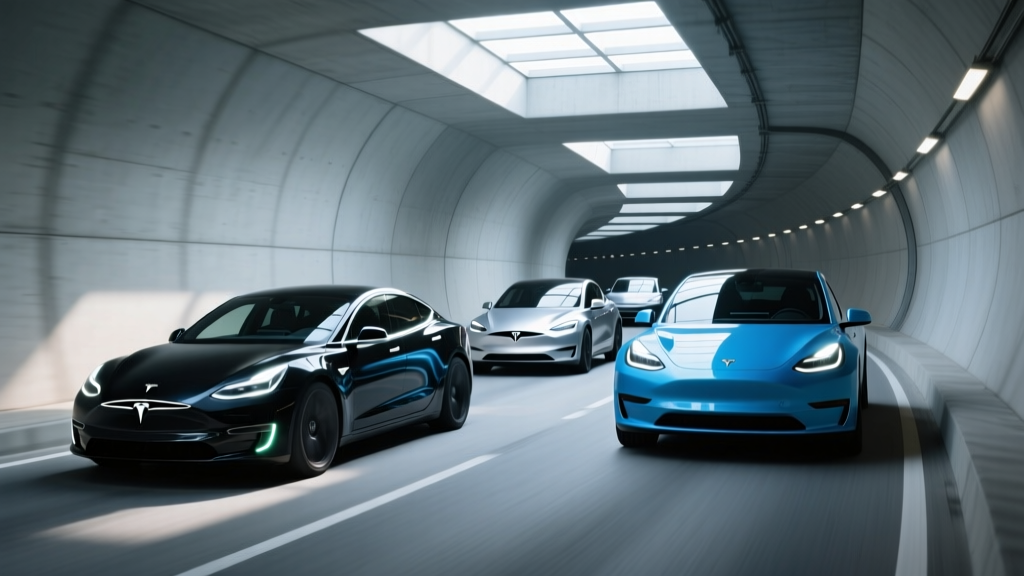
The Nashville Tesla Tunnel — officially part of The Boring Company's expanding underground transit network — has shifted from concept to operational reality in 2026. Designed to move Tesla vehicles through dedicated subsurface corridors beneath some of Nashville's most congested corridors, the tunnel system promises to shave minutes off downtown-to-airport and downtown-to-suburb commutes. But not every Tesla model is equally suited to tunnel driving, daily commuting, and the broader ownership experience that Nashville drivers demand.
This guide breaks down every current-production Tesla model available in the U.S. for the 2026 model year — the Model 3, Model Y, Model S, and Model X — with exact EPA range figures, charging speeds, battery chemistry, pricing after the §30D federal tax credit, and a practical verdict on which one makes the most sense if you're planning to use the Nashville Tesla Tunnel regularly.
2026 Tesla Lineup Spec Comparison: Model 3, Model Y, Model S, Model X
| Spec | Model 3 LR | Model Y LR | Model S LR | Model X LR |
|---|---|---|---|---|
| EPA Range | 341 mi | 320 mi | 402 mi | 335 mi |
| Battery (usable, est.) | ~75 kWh (NMC) | ~75 kWh (NMC) | ~95 kWh (NMC) | ~95 kWh (NMC) |
| Drivetrain | Dual-Motor AWD | Dual-Motor AWD | Dual-Motor AWD | Dual-Motor AWD |
| Horsepower | ~346 hp | ~384 hp | ~670 hp | ~670 hp |
| 0–60 mph | 4.2 sec | 4.8 sec | 3.1 sec | 3.8 sec |
| Peak DC Fast Charge | 250 kW | 250 kW | 250 kW | 250 kW |
| 10–80% DC Time | ~27 min | ~27 min | ~32 min | ~32 min |
| Level 2 Home Rate | 11.5 kW (~44 mi/hr) | 11.5 kW (~44 mi/hr) | 11.5 kW (~34 mi/hr) | 11.5 kW (~30 mi/hr) |
| MPGe (combined) | 132 MPGe | 122 MPGe | 120 MPGe | 104 MPGe |
| Cargo (rear seats up) | 23 cu ft | 30 cu ft | 28 cu ft | 15 cu ft (+frunk significant) |
| Base MSRP | $47,740 | $52,490 | $79,990 | $84,990 |
| Battery Warranty | 8 yr / 120,000 mi | 8 yr / 120,000 mi | 8 yr / 150,000 mi | 8 yr / 150,000 mi |
Sources: fueleconomy.gov, Tesla.com spec pages. Figures reflect 2026 model-year Long Range AWD trims. RWD Model 3 starts lower but sacrifices range and AWD.
Real-World Range: What Nashville Drivers Actually Get
For the Nashville Tesla Tunnel specifically, tunnel driving is low-speed, climate-controlled, and stop-and-go — conditions where Teslas actually exceed their EPA efficiency. Regenerative braking recaptures energy in tunnel traffic, and the absence of wind resistance at low speeds helps. Expect tunnel segments to return efficiency figures closer to city MPGe ratings, which are generally higher than highway for EVs.
The Model S Long Range at 402 miles EPA is the endurance king — enough to drive from Nashville to Atlanta (250 mi) and back without charging, even with a real-world buffer reduction. The Model 3 LR at 341 mi still handles a Nashville–Chattanooga round trip (270 mi round) with a comfortable margin, making it a practical commuter-plus-road-tripper.
Charging Speed: Supercharger Network and Home Setup
| Level | Power | Miles Added per Hour (approx.) | Best For |
|---|---|---|---|
| Level 1 (120V outlet) | ~1.4 kW | 3–5 mi/hr | Emergency / overnight trickle |
| Level 2 (240V home) | 11.5 kW (48A) | 30–44 mi/hr | Daily home charging |
| DC Fast (Supercharger V3) | Up to 250 kW | ~1,000 mi/hr (peak) | Road trips, quick top-ups |
| DC Fast (Supercharger V4) | Up to 350 kW (capable) | Varies by model | Newest corridor stations |
All 2026 Tesla models peak at 250 kW on V3 Superchargers, achieving a 10–80% charge in roughly 27 minutes (Model 3/Y) to 32 minutes (Model S/X). The larger battery packs in the S and X take longer despite similar peak rates because there's more total energy to replenish.
At home on a Level 2 Wall Connector (11.5 kW / 48 amps), the Model 3 and Model Y add approximately 44 miles of range per hour of charging — meaning a full overnight session (8 hours) restores 300+ miles. The heavier Model S and X add fewer miles per hour (~34 and ~30 mi/hr respectively) due to lower efficiency, even though the charge power in kW is identical.
Charge curve reality: Tesla's peak 250 kW rate only holds between roughly 10–30% state of charge. Above 50%, the rate tapers significantly — by 80%, you're pulling closer to 60–80 kW. This is why the 10–80% metric matters more than peak kW alone. For tunnel commuters who charge nightly at home and only use Superchargers for road trips, this taper is rarely an issue.
Federal Tax Credit Eligibility: §30D Rules for 2026
- Max credit: Up to $7,500 ($3,750 for battery minerals + $3,750 for battery assembly)
- MSRP caps: Sedans (Model 3, Model S) ≤ $55,000; SUVs/trucks/vans (Model Y, Model X) ≤ $80,000
- Buyer income caps (MAGI): $150K single / $225K head of household / $300K joint
- Battery sourcing: Critical minerals and battery components must meet escalating domestic/free-trade thresholds
- Point-of-sale transfer: Eligible buyers can apply the credit at purchase, reducing out-of-pocket cost immediately
- FEOC exclusion: Vehicles with battery components from Foreign Entities of Concern are disqualified
Source: IRS §30D Clean Vehicle Credit. Rules subject to change — confirm with a tax professional before purchase.
| Model / Trim | Base MSRP | Qualifies for §30D? | Effective Price (est.) |
|---|---|---|---|
| Model 3 RWD | $38,990 | Yes (sedan, under $55K cap) | ~$31,490 |
| Model 3 Long Range AWD | $47,740 | Yes | ~$40,240 |
| Model Y Long Range AWD | $52,490 | Yes (SUV, under $80K cap) | ~$44,990 |
| Model S Long Range | $79,990 | No (sedan over $55K cap) | $79,990 |
| Model X Long Range | $84,990 | No (SUV over $80K cap) | $84,990 |
Key takeaway: The Model 3 and Model Y are the only Teslas that can realistically capture the full $7,500 credit in 2026, and only if your income falls below the MAGI thresholds and the specific vehicle's battery sourcing meets requirements. The Model S and Model X exceed their respective MSRP caps and do not qualify — making them significantly more expensive propositions for Nashville tunnel commuters on a budget.
Tech, Driver Assists, and Tunnel-Specific Considerations
All 2026 Teslas ship with Tesla Autopilot (SAE Level 2 driver-assist) as standard, including Traffic-Aware Cruise Control and Autosteer. The optional Full Self-Driving (Supervised) package adds Navigate on Autopilot, Auto Lane Change, and traffic-light recognition — but this remains a Level 2 system requiring active driver supervision at all times. It is not autonomous driving.
Tunnel-specific tech notes:
- GPS loss: Underground tunnels block GPS. Tesla's navigation relies on dead reckoning (accelerometer + gyroscope) and map matching in GPS-denied environments. Navigation generally resumes seamlessly upon exiting.
- Climate control: All Teslas feature a HEPA filtration system (Bioweapon Defense Mode on Model S/X/Y). In enclosed tunnel environments, this keeps cabin air quality high.
- Regen braking: In slow tunnel traffic, one-pedal driving via regenerative braking reduces brake wear and recaptures energy efficiently.
- Connectivity: Tesla's built-in LTE/5G connectivity may experience brief signal drops underground. Offline navigation caches handle this, but streaming music may buffer.
The 15.4-inch center touchscreen (Model 3/Y) and 17-inch screen (Model S/X) serve as the primary interface for navigation, climate, and media. No physical buttons. This minimalist approach is a love-it-or-hate-it design choice, but for tunnel commuting, the simplicity means fewer distractions — once you're familiar with the UI.
Pros, Cons, and Verdict: Which Tesla for the Nashville Tunnel?
Pros (Tesla Lineup Strengths)
- Supercharger network: 50,000+ global stalls; Nashville has multiple urban and corridor stations
- OTA updates: Continuous feature additions without dealer visits
- Efficiency leadership: Tesla's kWh/mi remains among the best in the industry
- Tesla app & ecosystem: Remote preconditioning, charge monitoring, Sentry Mode
- Strong resale value (relative to most EVs)
- Tunnel-ready: Vision-based Autopilot handles enclosed corridors well
Cons (Ownership Drawbacks)
- Model S/X priced out of §30D credit eligibility
- Touchscreen-only controls frustrate some drivers
- Insurance premiums 15–30% higher than comparable ICE vehicles
- Repair costs and wait times can be significant post-collision
- No Apple CarPlay / Android Auto integration
- Panel gap and build-quality inconsistency still reported by some owners
Decision Framework: Choose Your Nashville Tunnel Tesla
Choose the Model 3 Long Range if: You're a solo commuter or couple who wants maximum efficiency (132 MPGe), the lowest effective price after tax credits (~$40K), and doesn't need cargo space. Best value proposition for daily tunnel use.
Choose the Model Y Long Range if: You need family-friendly cargo room (30 cu ft rear + frunk), easy car-seat installation, and still qualify for the $7,500 credit. The most versatile all-around pick.
Choose the Model S Long Range if: Budget is not your primary concern, you want 402 miles of EPA range for long Southeast road trips, and premium ride quality matters. No tax credit, but unmatched range.
Choose the Model X if: You need three rows (seats up to 7), falcon-wing doors for tight parking access, and can absorb the $85K+ price without a credit. Niche pick for large families.
Frequently Asked Questions
What is the real-world range of a Tesla in Nashville driving conditions?
For the Model 3 Long Range (341 mi EPA), expect 290–310 miles in mixed Nashville commuting and 250–275 miles on sustained highway driving at 70+ mph. In winter cold (below 40°F), reduce those figures by 8–12%. Tunnel driving, being low-speed and climate-controlled, tends to return efficiency at or slightly above EPA city ratings.
How fast does a Tesla charge at home and on the road?
On a home Level 2 Wall Connector at 11.5 kW, the Model 3/Y adds ~44 miles of range per hour — a full overnight charge restores 300+ miles. On a 250 kW V3 Supercharger, 10–80% takes about 27 minutes. Actual charge time depends on starting state of charge, battery temperature (preconditioning helps), and station load.
Does the Tesla Model 3 or Model Y qualify for the $7,500 federal tax credit in 2026?
Both the Model 3 (sedan, MSRP cap $55K) and Model Y (SUV, MSRP cap $80K) can qualify for up to $7,500 under IRS §30D, provided the buyer's modified adjusted gross income is below $150K (single) / $300K (joint), the vehicle's battery sourcing meets critical-mineral and assembly requirements, and no FEOC-sourced components are present. The credit can be transferred at point of sale. Always verify current eligibility on the IRS website and with a tax professional.
Is a Tesla worth buying vs. competitors for Nashville commuting?
Tesla's advantages are the Supercharger network, class-leading efficiency, and OTA updates. Competitors like the Hyundai Ioniq 6 (361 mi EPA, ~$39K) and BMW i4 eDrive40 (307 mi, ~$57K) offer compelling alternatives with more traditional interiors and (in some cases) Apple CarPlay. For tunnel-specific commuting, any EV with good regen braking works — but Tesla's integrated navigation and preconditioning give it a seamless edge if tunnel access is Tesla-exclusive.
Can Tesla Autopilot drive through the Nashville tunnel autonomously?
No. Tesla Autopilot and FSD (Supervised) are SAE Level 2 driver-assist systems. The driver must remain fully engaged — hands on wheel, eyes on road — at all times. Autopilot can handle lane-keeping and speed management in tunnel environments, but it is not self-driving. Only Level 4 services like Waymo operate without a human driver, and those are not available in Nashville tunnels.
What's the battery warranty on a 2026 Tesla?
Model 3 and Model Y: 8 years or 120,000 miles (whichever comes first), with a minimum 70% battery capacity retention guarantee. Model S and Model X: 8 years or 150,000 miles, same 70% threshold. If your battery degrades below 70% State of Health within the warranty period, Tesla will repair or replace it. Battery replacement outside warranty currently ranges from $12,000–$20,000 depending on the pack.
For the latest Nashville Tesla Tunnel access requirements, operating hours, and vehicle compatibility rules, check official Boring Company and Metro Nashville transit authority announcements. Tesla specifications and pricing are subject to change; verify at Tesla.com before ordering.