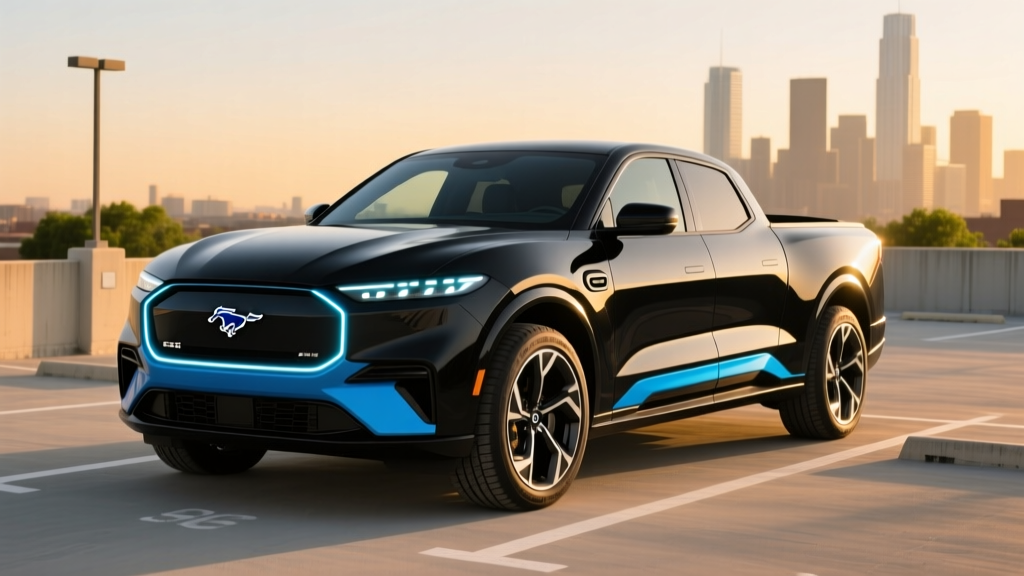
When shoppers search for a "Mustang truck electric," they're almost always looking for the Ford F-150 Lightning — Ford's all-electric full-size pickup that carries the Mustang moniker in its Lightning badge heritage and shares the Blue Oval's performance DNA. (The Mustang Mach-E is Ford's electric SUV, not a truck.) As of the 2026 model year, the F-150 Lightning remains one of the most capable electric pickups on the market, blending work-truck utility with EV efficiency.
Quick Answer: Is the F-150 Lightning the Right Electric Truck for You?
The 2026 F-150 Lightning starts around $54,995 (Pro trim, Standard Range) and offers up to 320 miles EPA range with the Extended Range battery. It delivers 563 horsepower, up to 2,000 lbs max payload, and can tow up to 10,000 lbs when properly equipped. It qualifies for partial or full federal tax credits under IRS §30D depending on battery sourcing and your income. If you need a full-size truck for work or family hauling and have access to Level 2 home charging, it's one of the strongest EV truck choices available. If you regularly tow heavy loads over 300 miles or live in a charging desert, a hybrid F-150 PowerBoost may serve you better.
F-150 Lightning Range, Battery, and Efficiency: The Real Numbers
The F-150 Lightning comes with two battery options. The Standard Range pack is a 98 kWh usable lithium-ion (NMC chemistry) battery delivering an EPA-estimated 240 miles. The Extended Range pack bumps capacity to 131 kWh usable (also NMC) for an EPA-estimated 320 miles on the XLT and Lariat trims.
Efficiency lands around 2.0–2.2 kWh/mile (roughly 48–50 kWh/100mi), which translates to approximately 68–70 MPGe combined per fueleconomy.gov. That's typical for a full-size electric truck — these are heavy, aerodynamically challenged vehicles.
Real-World Range vs. EPA Sticker
EPA: 320 miles (Extended Range) — but plan for reality:
- Highway driving at 75 mph: expect ~250–270 miles before needing a charge
- Cold weather (below 30°F): range drops 20–30%, so ~225–255 miles for Extended Range
- Towing a 5,000-lb trailer: range can halve to ~150–170 miles — towing is where EV trucks struggle most
- City/suburban mixed driving: you'll see close to or slightly above EPA thanks to regenerative braking
The Lightning's massive battery gives you a buffer, but physics doesn't bend for any truck.
| Spec | Standard Range | Extended Range |
|---|---|---|
| Battery (usable) | 98 kWh (NMC) | 131 kWh (NMC) |
| EPA Range | 240 mi | 320 mi |
| Horsepower | 563 HP | 563 HP |
| Torque | 775 lb-ft | 775 lb-ft |
| 0–60 mph | ~4.5 sec | ~3.8 sec |
| Max Payload | 2,000 lbs | 1,800 lbs |
| Max Towing | 7,700 lbs | 10,000 lbs |
| MPGe (combined) | 68 MPGe | 70 MPGe |
| Base MSRP (Pro) | $54,995 | $69,995 |
Charging Speed and Infrastructure: What to Expect
Charging an electric truck with a 131 kWh battery takes serious infrastructure. Here's how the Lightning handles each level:
| Charging Level | Power | Miles Added/Hour | 10–80% Time |
|---|---|---|---|
| Level 1 (120V household) | ~1.4 kW | ~3 mi/hr | ~60+ hours (full charge) |
| Level 2 (240V, 48A home) | ~11.5 kW | ~25 mi/hr | ~10–12 hours (full charge) |
| Level 2 (80A Ford Charge Station Pro) | ~19.2 kW | ~42 mi/hr | ~6–8 hours (full charge) |
| DC Fast Charge (peak) | ~150 kW (Std) / ~155 kW (Ext) | N/A | ~41 min (15–80%) |
The charging-curve reality: The Lightning peaks at around 150–155 kW on DC fast chargers, but like all EVs, it doesn't sustain that rate. The charge curve tapers significantly above 80% SoC to protect battery health. A 15–80% session takes roughly 41 minutes at a 150+ kW station, but 80–100% can add another 30+ minutes. Plan road-trip stops around the 15–80% window for efficiency.
kW vs kWh reminder: kW (kilowatts) is the rate of charging — like water flow from a hose. kWh (kilowatt-hours) is the total energy stored — like the size of the tank. The Lightning's 131 kWh battery charged at 150 kW doesn't fill in under an hour because the rate tapers.
For home charging, the Ford Charge Station Pro (80A) requires a 100-amp dedicated circuit and a 200-amp (minimum) electrical panel. Many homes need a panel upgrade, which adds $1,500–$3,500 to installation costs. Budget $500–$1,500 for the charger unit itself and $800–$2,500 for licensed electrician labor and permits, depending on your panel's proximity to the garage.
F-150 Lightning vs. Gas F-150 vs. F-150 PowerBoost Hybrid
How does the electric Lightning stack up against its gas and hybrid siblings? Here's a data-driven comparison for the 2026 model year:
| Attribute | F-150 Lightning (EV) | F-150 PowerBoost (Hybrid) | F-150 3.5L EcoBoost (Gas) |
|---|---|---|---|
| Base MSRP | $54,995 | $56,495 | $42,495 |
| EPA Range / Tank | 240–320 mi | ~650 mi (25 MPG) | ~500 mi (20 MPG) |
| Horsepower | 563 HP | 430 HP | 400 HP |
| Max Towing | 10,000 lbs | 12,700 lbs | 14,000 lbs |
| Fuel/Energy Cost per Mile | ~$0.04–$0.06 (home charging) | ~$0.14 (gas at $3.50/gal) | ~$0.18 (gas at $3.50/gal) |
| Maintenance (5-yr est.) | ~$1,800 | ~$3,500 | ~$4,200 |
| Fed. Tax Credit (§30D) | Up to $7,500* | None | None |
| ProPower Onboard | Up to 9.6 kW | Up to 7.2 kW | Up to 2.0 kW |
Key takeaway: The Lightning wins on acceleration (3.8-sec 0–60), per-mile fuel cost, and onboard power output. The gas and hybrid F-150 win on maximum towing capacity, total range per fill-up, and lower upfront cost. If you regularly tow over 7,000 lbs long distances, the hybrid PowerBoost is a pragmatic middle ground — you get some electric efficiency without range loss while towing.
Total Cost of Ownership: Purchase, Charging, Insurance, and Maintenance
EV ownership economics go beyond the sticker price. Here's a realistic 5-year cost projection for the F-150 Lightning Extended Range XLT (MSRP ~$74,995) versus a comparable gas F-150 XLT 3.5L EcoBoost (~$55,000):
| Cost Category | F-150 Lightning Ext. Range | F-150 Gas 3.5L EcoBoost |
|---|---|---|
| Purchase Price (MSRP) | $74,995 | $55,000 |
| Federal Tax Credit (§30D)* | –$7,500 | $0 |
| Home Charger Install | $2,500 | $0 |
| Fuel/Energy (60K mi) | $3,000 | $10,500 |
| Maintenance (5 yr) | $1,800 | $4,200 |
| Insurance (5 yr est.) | $12,500 | $9,000 |
| Estimated Depreciation | $30,000 | $22,000 |
| 5-Year Net Cost | ~$87,295 | ~$78,700 |
What the numbers tell us: The Lightning costs roughly $8,500–$9,000 more over five years, primarily due to higher purchase price, steeper depreciation (EV trucks are still normalizing in the used market), and higher insurance premiums. However, you save approximately $10,200 in fuel and maintenance combined. As gas prices rise or if you drive more than 12,000 miles/year, the Lightning's economics improve.
Insurance note: EV trucks typically carry 15–25% higher premiums than gas equivalents due to higher repair costs and parts pricing. Get quotes before committing — insurers like GEICO, Progressive, and State Farm vary widely on the Lightning.
Federal Tax Credit Eligibility: What You Actually Qualify For
The IRS §30D Clean Vehicle Credit offers up to $7,500 for qualifying new EVs, but eligibility depends on several factors that change regularly:
- MSRP cap: Trucks/vans/SUVs must be under $80,000 MSRP. Most Lightning trims qualify, but high-end Platinum trims may exceed the cap — verify the exact window sticker.
- Buyer income limits: Modified AGI must not exceed $300,000 (joint), $225,000 (head of household), or $150,000 (single).
- Battery sourcing requirements: The $7,500 credit splits into two halves — $3,750 for critical minerals sourcing and $3,750 for battery component manufacturing. As of 2026, the Lightning qualifies for at least partial credit; full $7,500 depends on Ford's evolving supply chain compliance. Check the DOE/Fuel Economy tax credit list for current status.
- Point-of-sale transfer: You can now transfer the credit to the dealer at purchase, reducing your out-of-pocket cost immediately rather than waiting for a tax refund.
- VIN verification: The dealer must report the sale and your VIN to the IRS within 3 days.
Disclaimer: Tax credit rules shift with policy changes. Consult a tax professional and verify current eligibility on irs.gov before purchasing.
Battery Longevity, Warranty, and Replacement Costs
The F-150 Lightning's NMC battery is covered by Ford's 8-year/100,000-mile battery warranty, which guarantees the pack will retain at least 70% of original capacity during that period. Real-world data from early 2022–2024 Lightning owners suggests degradation of roughly 5–8% over the first 60,000 miles, which is normal for liquid-cooled NMC packs.
If you charge primarily at home on Level 2 and avoid daily DC fast charging, the battery should comfortably outlast the warranty period with 85–90% capacity retention at 100,000 miles. Ford's thermal management system actively cools and heats the pack, which helps longevity in both hot (Arizona) and cold (Minnesota) climates.
Replacement cost reality: Out of warranty, a full Lightning battery replacement is estimated at $20,000–$30,000 including labor. This is a worst-case scenario — most packs are lasting well, and individual module replacement (if available) would cost significantly less.
Common Misconceptions About the F-150 Lightning
| Myth | Fact |
|---|---|
| "The Lightning can't tow anything useful." | It tows up to 10,000 lbs — but towing halves range. For frequent heavy towing over distance, a hybrid is better. |
| "You'll be stranded without charging." | With 240–320 mi range and a growing NACS/Supercharger network (Ford gained Tesla Supercharger access in 2024), trip planning is manageable for most routes. |
| "The battery will die in 5 years." | NMC packs with active thermal management are showing 5–8% degradation at 60K miles. The 8-year/100K warranty backs this up. |
| "It costs more to charge than fueling with gas." | At the national average electricity rate (~$0.16/kWh), a full Extended Range charge costs ~$21 for 320 miles. That's $0.065/mile vs. $0.175/mile for a 20-MPG gas truck at $3.50/gal. |
| "I need a special charger to own one." | A standard 240V Level 2 home charger (like any EV) works fine overnight. The 80A Ford station is optional for faster home charging. |
Decision Framework: Should You Buy the F-150 Lightning?
If-This-Then-That: Is the Lightning Your Truck?
Choose the F-150 Lightning if:
- You have access to Level 2 home charging (garage or driveway with 240V outlet)
- Your daily commute and errands are under 200 miles round-trip
- You value instant torque, quiet operation, and ProPower Onboard for job-site or camping use
- You want to reduce per-mile fuel costs and don't mind a higher upfront price
- You qualify for the §30D tax credit (income and MSRP requirements met)
- You tow occasionally and under 200 miles per trip
Choose the F-150 PowerBoost Hybrid instead if:
- You regularly tow 7,000+ lbs over distances exceeding 200 miles
- You live in a rural area with sparse DC fast-charging infrastructure
- You lack reliable home charging access (apartment, street parking)
- Your budget is under $50,000 and you need maximum utility per dollar
- You drive in extreme cold frequently and can't tolerate 25–30% range loss
Choose the gas F-150 EcoBoost if:
- You need maximum towing capacity (14,000 lbs) and longest range per fill-up
- You're in a region with no reliable charging options and long-distance work demands
- Lowest possible purchase price is your top priority
Frequently Asked Questions
Is the F-150 Lightning the same as a "Mustang truck"?
Not exactly. The F-150 Lightning nameplate references Ford's SVT Lightning performance trucks from the 1990s–2000s, not the Mustang car line. However, Ford also sells the Mustang Mach-E (an electric SUV). If you're searching for a "Mustang truck electric," the F-150 Lightning is the vehicle you want — it's Ford's electric full-size pickup.
Can the F-150 Lightning power my house during an outage?
Yes. With Ford's Intelligent Backup Power system and the 80A Charge Station Pro, the Lightning's Extended Range battery (131 kWh) can supply up to 9.6 kW to your home via a transfer switch. That's enough to run essential circuits (lights, fridge, HVAC blower, internet) for roughly 3–7 days depending on usage. This is a genuine advantage over gas trucks — a 131 kWh rolling battery is a serious home backup asset. Installation of the home integration system (transfer switch) typically costs $2,000–$4,000 additional.
How does the Lightning handle in snow and cold weather?
The Lightning's dual-motor AWD provides strong traction, and its low center of gravity (battery pack under the floor) helps stability. However, expect 20–30% range loss in sustained sub-freezing temperatures due to cabin heating demands and reduced battery efficiency. The heat pump (standard on Extended Range) mitigates this somewhat. Preconditioning the battery while plugged in before departure helps preserve range and enables faster DC charging in cold weather.
What connector does the F-150 Lightning use?
Starting with the 2025 model year, Ford transitioned the Lightning to the NACS (North American Charging Standard) connector — the Tesla-style plug. This gives Lightning owners native access to the Tesla Supercharger network (15,000+ stations) without an adapter. Earlier 2022–2024 models use CCS1 and require Ford's provided adapter for Supercharger access.
What's the frunk like on the Lightning?
The Mega Power Frunk (front trunk) offers 14.1 cubic feet of lockable, weather-sealed storage with 400 lbs of payload capacity. It includes four 120V outlets, two USB-C ports, and a drain plug for use as a cooler. This is one of the Lightning's most practical differentiators — it replaces the engine bay with genuinely useful, secure cargo space.
How does insurance compare to a gas F-150?
Expect to pay 15–25% more for insurance on the Lightning versus a comparably equipped gas F-150. Average annual premiums run $2,200–$2,800 depending on your state, driving record, and coverage level. Higher repair costs for EV-specific components (battery, power electronics) drive the premium. Shop quotes from multiple carriers — some insurers now offer EV-specific discounts.
Sources: EPA Fuel Economy — F-150 Lightning, IRS §30D Clean Vehicle Credit, Ford Motor Company official specifications.