Why Mustang Mach-E Weight Matters for Your EV Purchase
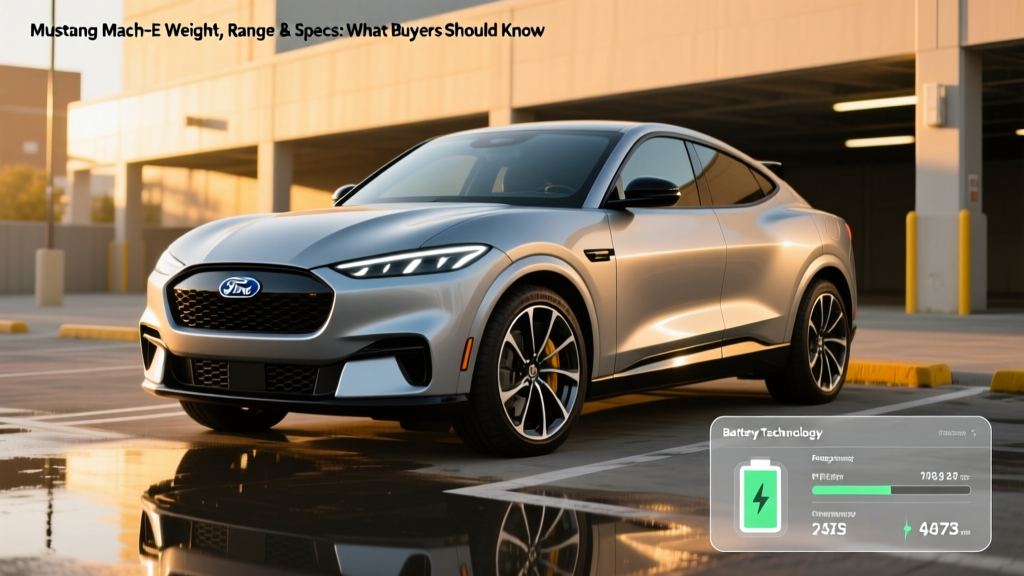
When you're researching the Mustang Mach-E weight, you're really asking a cluster of related questions: How does curb weight affect range? Does the heavier AWD dual-motor setup trade efficiency for traction? And how does the Mach-E's mass compare to rivals like the Tesla Model Y or Hyundai Ioniq 5?
Ford's electric crossover has evolved significantly since its 2021 launch, and the 2025 model year brings updated battery packs, revised pricing, and a shift to the NACS charging connector. Weight remains a critical variable across the lineup, influencing everything from tire wear to braking distances to real-world highway efficiency. Let's break down the numbers trim by trim and translate those specs into ownership realities.
Mustang Mach-E Weight by Trim: The Full Breakdown
The Mach-E's curb weight varies meaningfully depending on battery size and drivetrain configuration. Here's how the 2025 lineup stacks up, alongside the key specs that weight influences:
| Trim | Drivetrain | Battery (usable kWh) | Curb Weight (lbs) | EPA Range (mi) | Horsepower | 0-60 mph (sec) |
|---|---|---|---|---|---|---|
| Select RWD | Rear-Wheel Drive | 70 kWh (LFP) | ~4,370 | 250 | 266 | 6.3 |
| Premium RWD (Std Range) | Rear-Wheel Drive | 70 kWh (LFP) | ~4,410 | 250 | 266 | 6.3 |
| Premium RWD (Ext Range) | Rear-Wheel Drive | 91 kWh (NMC) | ~4,680 | 320 | 290 | 6.1 |
| Premium AWD (Ext Range) | Dual-Motor AWD | 91 kWh (NMC) | ~4,920 | 290 | 346 | 5.1 |
| GT (AWD) | Dual-Motor AWD | 91 kWh (NMC) | ~4,980 | 280 | 480 | 3.8 |
| Rally (AWD) | Dual-Motor AWD | 91 kWh (NMC) | ~5,020 | 275 | 480 | 3.9 |
Key takeaway: The lightest Mach-E (Select RWD) tips the scales at roughly 4,370 lbs, while the heaviest (Rally) pushes past 5,000 lbs. That ~650-lb spread between base and top trims is driven by battery chemistry, dual-motor hardware, and the Rally's reinforced suspension and skid plates.
Real-World Range vs. EPA Estimates
EPA vs. Reality: The Premium RWD Extended Range carries an EPA-estimated 320 miles of range. In real-world highway driving at 70-75 mph, expect approximately 265-285 miles in mild temperatures. In cold weather (below 30°F), that figure drops to roughly 220-250 miles due to battery resistance and cabin heating demands. The LFP-equipped Standard Range models (EPA 250 mi) typically deliver 210-230 miles on the highway in temperate conditions.
The Mach-E's weight directly impacts highway efficiency. Heavier AWD trims require more energy to maintain speed, and the GT's performance-oriented tires increase rolling resistance. According to fueleconomy.gov, the Premium RWD Extended Range achieves 98 MPGe combined (34 kWh/100 mi), while the GT AWD drops to 84 MPGe combined (40 kWh/100 mi).
For context, the Tesla Model Y Long Range AWD achieves 111 MPGe combined while weighing approximately 4,400 lbs — roughly 500 lbs less than the Mach-E Premium AWD. That weight advantage translates directly into efficiency gains.
Battery Chemistry: LFP vs. NMC in the Mach-E Lineup
Ford made a significant powertrain decision for the current Mach-E generation: the Standard Range battery uses lithium iron phosphate (LFP) chemistry, while Extended Range models retain nickel manganese cobalt (NMC) cells.
| Factor | LFP (Standard Range — 70 kWh) | NMC (Extended Range — 91 kWh) |
|---|---|---|
| Energy Density | Lower (heavier per kWh) | Higher (lighter per kWh) |
| Cycle Life | ~3,000+ cycles | ~1,500-2,000 cycles |
| Daily Charging to 100% | Recommended — no degradation concern | Limit to 80-90% for longevity |
| Cold-Weather Performance | Greater range loss in freezing temps | Better cold-weather retention |
| Cost | Lower — contributes to lower trim pricing | Higher — premium for added range |
| Cobalt Content | None | Contains cobalt |
The LFP pack's lower energy density partly explains why the Standard Range RWD still weighs over 4,300 lbs despite carrying 21 fewer kWh than the Extended Range. LFP cells are inherently heavier per unit of stored energy, but they offer exceptional longevity — Ford's software allows and even encourages 100% daily charging on LFP trims, which is a genuine ownership advantage for commuters who want maximum daily range without babying the battery.
Charging Speed: DC Fast Charge and Home Level 2
Charging performance is where the Mach-E's weight and battery size intersect with daily practicality. Here's what to expect across charging scenarios:
| Charging Level | Standard Range (70 kWh LFP) | Extended Range (91 kWh NMC) |
|---|---|---|
| Max DC Fast Charge Rate | ~135 kW peak | ~150 kW peak |
| 10-80% DCFC Time | ~34 minutes | ~36 minutes |
| Level 2 (240V, 48A) | ~11.5 kW / ~28 mi/hr | ~11.5 kW / ~30 mi/hr |
| Level 1 (120V, 12A) | ~1.4 kW / ~3 mi/hr | ~1.4 kW / ~3 mi/hr |
| Charge Port (2025+) | NACS (native Tesla Supercharger access) | NACS (native Tesla Supercharger access) |
Charging curve reality: The Mach-E's peak DC charge rate is not sustained across the full session. On Extended Range models, you'll see ~150 kW from roughly 10-30% State of Charge, tapering to ~100 kW by 50%, and dropping below 50 kW past 80%. This is normal lithium-ion behavior, but it means a 10-90% session takes closer to 50-55 minutes — plan road trips accordingly.
For 2025, Ford has transitioned the Mach-E to the NACS (North American Charging Standard) connector, granting native access to Tesla's Supercharger network without an adapter. This is a significant practical upgrade — Tesla's network remains the most reliable and widespread DC fast-charging infrastructure in the U.S., with over 20,000 stalls nationally.
At home on a Level 2 charger (Ford's recommended 48-amp Wall Connector or equivalent), either battery refills fully overnight. A typical commute of 40-60 miles requires only 1.5-2 hours of Level 2 charging, making the Mach-E effortless for daily use if you have home charging access.
Pricing, Trims, and Federal Tax Credit Eligibility
The Mach-E lineup spans a wide price range. Here's the 2025 MSRP structure along with the tax-credit-adjusted effective price:
| Trim | Base MSRP | Est. §30D Credit | Effective Price (if eligible) |
|---|---|---|---|
| Select RWD | $39,995 | Up to $7,500 | ~$32,495 |
| Premium RWD (Std Range) | $43,495 | Up to $7,500 | ~$35,995 |
| Premium RWD (Ext Range) | $48,995 | Up to $7,500 | ~$41,495 |
| Premium AWD (Ext Range) | $51,995 | Up to $7,500 | ~$44,495 |
| GT | $54,995 | Up to $7,500 | ~$47,495 |
| Rally | $58,995 | Up to $7,500 | ~$51,495 |
§30D Tax Credit Eligibility Checklist (2025 Rules):
- MSRP Cap: SUVs/crossovers must be below $80,000 — all Mach-E trims qualify.
- Buyer Income Cap: Modified AGI must not exceed $150,000 (single), $225,000 (head of household), or $300,000 (joint filers).
- Battery Sourcing: The credit splits into two halves ($3,750 + $3,750) based on critical-mineral sourcing and battery-component manufacturing requirements. Per IRS guidance, the Mach-E's eligibility for the full $7,500 has varied by model year and production batch — verify your specific VIN at the IRS clean vehicle tool before purchasing.
- Point-of-Sale Transfer: As of 2024, you can transfer the credit to the dealer at purchase, reducing your out-of-pocket cost immediately rather than waiting for tax filing.
- Assembly: Must be assembled in North America — the Mach-E is built in Cuautitlán, Mexico, which qualifies.
Consult a tax professional to confirm your personal eligibility. Rules are subject to legislative change.
Interior Space, Cargo, and Daily Practicality
The Mach-E's footprint is competitive in the midsize electric crossover segment. Here's how the interior dimensions break down:
- Front headroom: 40.4 inches
- Front legroom: 43.3 inches
- Rear headroom: 38.9 inches
- Rear legroom: 38.1 inches
- Cargo behind rear seats: 29.7 cu ft
- Cargo with rear seats folded: 59.7 cu ft
- Front trunk (frunk): 4.7 cu ft (drainable — useful for ice or wet gear)
The drainable frunk is a genuinely clever feature that competitors like the Model Y lack. Rear passenger space is adequate for adults on longer trips, though the Tesla Model Y offers slightly more rear legroom (41.6 in) thanks to its skateboard platform packaging. The Mach-E's sloping roofline cuts into rear headroom for taller passengers — a trade-off for its sportier silhouette.
On the technology front, the Mach-E's 15.5-inch vertical touchscreen running Ford's SYNC 4A system is responsive and feature-rich, with wireless Apple CarPlay and Android Auto. The available BlueCruise hands-free driving system (SAE Level 2) works on over 130,000 miles of pre-mapped divided highways — but it is not autonomous driving. You must remain attentive, and the system monitors your eyes via an infrared camera.
Warranty and Long-Term Ownership
Ford backs the Mach-E with the following warranty coverage:
- Battery warranty: 8 years / 100,000 miles (retains at least 70% of original capacity)
- Electric powertrain: 8 years / 100,000 miles
- Bumper-to-bumper: 3 years / 36,000 miles
- Roadside assistance: 5 years / 60,000 miles
The 70% capacity retention threshold is industry-standard and matches what most competitors offer. Real-world degradation data from early 2021-2022 Mach-E owners suggests that NMC Extended Range packs lose approximately 5-8% capacity over the first 60,000 miles before the degradation curve flattens. LFP packs show even slower degradation, which aligns with their chemistry advantage.
If you're concerned about out-of-warranty battery replacement, Ford has quoted approximately $15,000-$20,000 for a full pack replacement depending on the battery size — though individual module replacement may be possible at lower cost. This is comparable to industry norms for packs in the 70-91 kWh range.
Pros, Cons, and the Verdict
Pros
- Native NACS connector — direct Supercharger access
- LFP battery option allows daily 100% charging
- Drainable frunk adds genuine utility
- BlueCruise is among the best Level 2 systems available
- Comfortable ride quality; quieter cabin than many rivals
- Competitive pricing after tax credit
Cons
- Heavier than key competitors (hurts efficiency)
- DC fast charging slower than Hyundai/Kia E-GMP models
- Rear headroom limited by roofline slope
- Extended Range trims priced above $48K before credit
- No third-row option for larger families
- Real-world range falls notably short of EPA on highway
Who Should Buy the Mustang Mach-E?
Choose the Mach-E if:
- You want native Tesla Supercharger access without carrying an adapter
- You prefer a traditional automotive brand with a large dealer network
- You value BlueCruise for highway commuting on mapped routes
- You want an LFP battery for worry-free daily 100% charging
- You prioritize ride comfort over razor-sharp efficiency
Look elsewhere if:
- Maximum DC fast-charge speed is your top priority (consider the Ioniq 5 or EV6 at ~240 kW)
- You need a third row (consider the Kia EV9)
- You want the lightest, most efficient crossover in the segment (the Model Y wins on weight and MPGe)
- You regularly drive in extreme cold and need maximum range retention
Frequently Asked Questions
How much does the Mustang Mach-E weigh?
The 2025 Mustang Mach-E ranges from approximately 4,370 lbs (Select RWD with Standard Range LFP battery) to approximately 5,020 lbs (Rally AWD with Extended Range NMC battery). The GT weighs roughly 4,980 lbs. This is 300-600 lbs heavier than comparable Tesla Model Y trims.
Does the Mustang Mach-E qualify for the $7,500 federal tax credit?
All Mach-E trims fall under the $80,000 SUV MSRP cap, and the vehicle is assembled in North America (Mexico). However, full $7,500 credit eligibility depends on battery-component and critical-mineral sourcing requirements that vary by production batch. Check your specific VIN on the IRS clean vehicle tool and confirm your income falls within §30D limits.
What is the real-world highway range of the Mach-E?
The Extended Range RWD (EPA 320 mi) typically delivers 265-285 miles on the highway in mild weather and 220-250 miles in freezing temperatures. Standard Range LFP models (EPA 250 mi) deliver approximately 210-230 miles highway in temperate conditions. Heavier AWD trims see 10-15 fewer real-world miles than their RWD counterparts.
How fast does the Mach-E charge at home and on the road?
On a Level 2 home charger (48A/240V), the Mach-E adds roughly 28-30 miles of range per hour, fully recharging overnight. On DC fast chargers, Extended Range models peak at ~150 kW with a 10-80% time of approximately 36 minutes. Standard Range models peak at ~135 kW with a 10-80% time of ~34 minutes. Charging slows significantly above 80% SoC — avoid charging past 80% on road trips unless necessary.
Is the Mach-E better than the Tesla Model Y?
It depends on your priorities. The Model Y is lighter (~4,400 lbs for Long Range AWD), more efficient (111 MPGe vs. 98 MPGe), charges faster at V3 Superchargers, and offers slightly more rear legroom. The Mach-E counters with a more comfortable ride, a drainable frunk, BlueCruise hands-free driving, a traditional dealer service network, and the LFP battery option on lower trims. Both now share NACS connector compatibility, so Supercharger access is no longer a Tesla-exclusive advantage.
What is the Mach-E's towing capacity?
The 2025 Mustang Mach-E is rated for up to 1,500 lbs when properly equipped with the optional tow package (available on select trims). This is modest — suitable for a small utility trailer or a pair of dirt bikes, but not for a camping trailer or boat. If you need serious towing, consider the Ford F-150 Lightning or Rivian R1S.