Quick Verdict: Does the Mach-E's Cargo Space Match Its Style?
The Ford Mustang Mach-E has spent years defending two reputations at once: it's an EV wearing a pony-car badge, and it's a crossover that needs to swallow real life. For 2026, the Mach-E continues with its refreshed styling, updated BlueCruise capabilities, and the same 91 kWh usable NMC battery pack on Extended Range trims. But buyers searching for Mustang Mach-E trunk dimensions usually have a specific question: will it actually hold my gear, stroller, or Costco haul?
The short answer: yes, for most daily needs. The Mach-E offers 29.7 cubic feet behind the second row and 59.7 cubic feet with the rear seats folded. Add the 4.7 cu-ft front trunk (frunk) with a drain plug, and you get a practical package — though it falls short of the Tesla Model Y's class-leading cargo volume. Below, we break down every number that matters, from the trunk to the tax credit.
2026 Mustang Mach-E Full Specs at a Glance
| Spec | Select (Std Range RWD) | Premium (Ext Range AWD) | GT (Ext Range AWD) |
|---|---|---|---|
| EPA Range | 250 mi | 320 mi | 290 mi |
| Battery (Usable) | 72 kWh, NMC | 91 kWh, NMC | 91 kWh, NMC |
| Horsepower | 266 hp | 365 hp | 480 hp |
| 0-60 mph | 5.8 sec | 4.8 sec | 3.5 sec |
| Drivetrain | RWD (single motor) | AWD (dual motor) | AWD (dual motor) |
| DC Fast Charge (peak) | 115 kW | 150 kW | 150 kW |
| 10-80% DC Time | ~36 min | ~41 min | ~41 min |
| Level 2 Home Charge | 10.5 kW (~30 mi/hr) | 10.5 kW (~30 mi/hr) | 10.5 kW (~30 mi/hr) |
| MPGe (combined) | 101 MPGe | 98 MPGe | 86 MPGe |
| Efficiency | 33 kWh/100 mi | 34 kWh/100 mi | 39 kWh/100 mi |
| Trunk (behind 2nd row) | 29.7 cu ft | ||
| Cargo (seats folded) | 59.7 cu ft | ||
| Frunk | 4.7 cu ft (drainable) | ||
| Base MSRP | $40,495 | $49,875 | $59,995 |
Sources: EPA / fueleconomy.gov, Ford Motor Company 2026 spec sheets.
Mustang Mach-E Trunk & Cargo: The Numbers That Matter
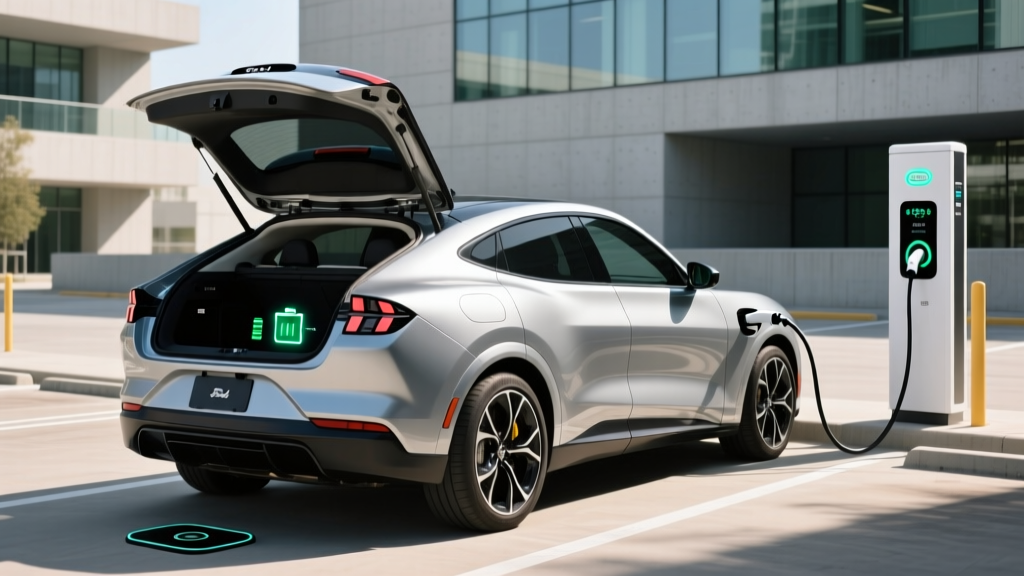
The 2026 Mach-E's cargo area hasn't changed from the 2024 refresh. Behind the 60/40 split-folding rear bench, you get 29.7 cubic feet — enough for two large suitcases, a week of groceries, or a full-size stroller with room to spare. Fold the rear seats flat and the space expands to 59.7 cubic feet, which handles furniture-box-sized loads or camping gear for a weekend trip.
The 4.7 cu-ft frunk sits under the hood and includes a drainable compartment — a practical spot for wet gym clothes, charging cables, or a cooler on a tailgate. It locks independently from the rear hatch, which is handy for secure storage when the main trunk is loaded.
How the Mach-E Trunk Stacks Up
| Vehicle | Cargo (2nd row up) | Cargo (seats folded) | Frunk |
|---|---|---|---|
| Ford Mustang Mach-E | 29.7 cu ft | 59.7 cu ft | 4.7 cu ft |
| Tesla Model Y | 30.2 cu ft | 72.1 cu ft | 4.1 cu ft |
| Hyundai Ioniq 5 | 27.2 cu ft | 59.3 cu ft | 0.85 cu ft |
| Kia EV6 | 24.4 cu ft | 50.2 cu ft | 0.7 cu ft |
| VW ID.4 | 30.3 cu ft | 64.2 cu ft | None |
The Mach-E lands in the middle of this competitive set. It beats the EV6 and Ioniq 5 on raw volume but can't match the Model Y's cavernous folded-flat space or the ID.4's slightly wider opening. For most families, the 29.7 cu-ft trunk is sufficient — but if you regularly haul large items, the Model Y's 72.1 cu-ft maximum is hard to ignore.
Real-World Range: What to Expect Beyond the EPA Sticker
- City / moderate driving: ~310-330 mi (regen-friendly, can exceed EPA)
- Highway at 70-75 mph: ~260-280 mi (aerodynamic drag dominates)
- Cold weather (below 32°F): ~220-250 mi (battery resistance + cabin heat)
- Worst case (cold + highway + hills): ~200-220 mi
The Extended Range AWD Premium trim carries a 91 kWh usable NMC pack and earns an EPA-rated 320 miles. That number assumes a mix of city and highway driving at moderate temperatures. In real-world testing, highway-heavy road trips at sustained 70-75 mph speeds typically yield 260-280 miles before you'll want to find a charger. Cold weather is the bigger variable: below freezing, expect a 20-30% reduction, putting the practical winter range around 220-250 miles.
The Standard Range RWD Select trim's 72 kWh battery delivers 250 miles EPA, which drops to roughly 200-215 miles on the highway and 170-190 miles in deep cold. If your commute is under 40 miles round-trip and you charge at home nightly, this is still very manageable. But for road-trip-heavy buyers, the Extended Range pack is the clear choice.
The Mach-E does offer a heat pump on all trims for 2026, which mitigates cold-weather range loss compared to resistive heating. Preconditioning the battery while plugged in (via the FordPass app) further reduces the winter penalty.
Charging Speed: DC Fast and Home Level 2
Charging speed remains one of the Mach-E's weaker competitive points. Extended Range models peak at 150 kW on a DC fast charger, while Standard Range trims are limited to 115 kW. Ford quotes a 10-80% charge time of approximately 41 minutes for the 91 kWh pack and 36 minutes for the 72 kWh pack.
| Charging Level | Power | Speed (Miles/Hour) | Notes |
|---|---|---|---|
| Level 1 (120V outlet) | ~1.4 kW | ~3-4 mi/hr | Emergency/trickle only |
| Level 2 (240V, 48A) | 10.5 kW | ~30 mi/hr | Full charge overnight (~10 hrs for ER) |
| DC Fast Charge (Std Range) | 115 kW peak | ~170 mi in 30 min | 10-80% in ~36 min |
| DC Fast Charge (Ext Range) | 150 kW peak | ~185 mi in 30 min | 10-80% in ~41 min |
The Mach-E's charge curve tapers noticeably above 80% state of charge — a common NMC battery behavior. On a road trip, plan to charge from 10-80% and then move on rather than waiting for a slow top-off to 100%.
For home charging, the onboard 10.5 kW charger means a full Level 2 session (using a 48-amp hardwired station on a 60-amp circuit) adds roughly 30 miles of range per hour. Most owners who plug in overnight start each morning with a full battery. Home Level 2 installation typically costs $500-$2,000 depending on panel capacity and run length — budget for a licensed electrician to assess your 200-amp panel headroom.
The Mach-E uses the Tesla North American Charging Standard (NACS) port for 2026, giving it native access to the Tesla Supercharger network — a major advantage for road trips in areas where Electrify America or EVgo coverage is sparse.
Pricing, Trims, and Federal Tax Credit Eligibility
The 2026 Mustang Mach-E lineup starts at $40,495 for the Select RWD with Standard Range and climbs to $59,995 for the GT. A well-equipped Premium Extended Range AWD — the volume trim — lands around $49,875 before options.
| Trim | Base MSRP | Federal Credit Potential | Effective Price |
|---|---|---|---|
| Select (Std Range RWD) | $40,495 | Up to $7,500 | ~$32,995 |
| Premium (Ext Range RWD) | $45,875 | Up to $7,500 | ~$38,375 |
| Premium (Ext Range AWD) | $49,875 | Up to $7,500 | ~$42,375 |
| GT (Ext Range AWD) | $59,995 | Up to $7,500 | ~$52,495 |
| Rally (Ext Range AWD) | $61,995 | Up to $7,500 | ~$54,495 |
Do You Actually Qualify for the §30D Credit?
The IRS §30D federal EV tax credit can reduce your effective price by up to $7,500, but eligibility depends on several factors that change periodically:
- MSRP cap: SUVs/crossovers must be under $80,000 — all Mach-E trims qualify.
- Income cap: Modified AGI must not exceed $150,000 (single), $225,000 (head of household), or $300,000 (joint filing).
- Battery sourcing: A percentage of critical minerals and battery components must be sourced from the US or FTA partners — this threshold increases annually. Check Ford's current battery-sourcing disclosures for the specific model year.
- Point-of-sale transfer: As of 2024+, you can transfer the credit to the dealer at purchase for an immediate price reduction rather than waiting to claim it on your tax return.
The Mach-E's eligibility for the full $7,500 has fluctuated based on battery-sourcing rule changes. Always verify the current status on the fueleconomy.gov tax credit page before finalizing a purchase, and consult a tax professional for your specific situation.
Performance, Tech, and Daily Ownership
The Mach-E GT's 480 hp and 3.5-second 0-60 mph time makes it genuinely quick — a performance EV that can surprise at stoplights. But the Premium AWD's 365 hp and 4.8-second sprint is more than adequate for most buyers and comes with better range. Even the base Select RWD at 266 hp and 5.8 seconds feels responsive thanks to instant electric torque.
Inside, the 15.5-inch vertical touchscreen running SYNC 4A dominates the dash. Wireless Apple CarPlay and Android Auto are standard. The Mach-E supports over-the-air updates, and Ford's BlueCruise 1.5 (SAE Level 2) enables hands-free driving on pre-mapped divided highways — but you must keep your eyes on the road at all times. This is not self-driving; it's a supervised driver-assist system.
Notable drawbacks include road noise at highway speeds (the Mach-E is louder than the Ioniq 5 or Model Y), a firm ride on the GT's sport suspension, and the aforementioned middling DC fast-charge speed compared to the Hyundai/Kia E-GMP platform's 240+ kW capability.
Battery Warranty & Longevity
Ford covers the Mach-E's high-voltage battery for 8 years or 100,000 miles (whichever comes first), with a capacity-retention threshold of 70%. The electric powertrain (motors, inverters) carries the same 8-year/100,000-mile warranty. The vehicle limited warranty is 3 years/36,000 miles. NMC chemistry in the Mach-E has shown modest degradation in real-world fleet data — most owners report 5-8% capacity loss over the first 100,000 miles, which is within industry norms.
Who Is the Mustang Mach-E Best For?
The Mach-E fits buyers who want a sporty-driving electric crossover with a recognizable badge, decent cargo practicality, and access to the Supercharger network via NACS. It works well as a daily commuter (especially with home Level 2 charging), a small family hauler (two kids + gear fits comfortably), and a road-trip vehicle if you plan charging stops around the 150 kW charge rate.
It's less ideal for buyers who need maximum cargo space (the Model Y wins there), the fastest possible DC charging (look at the Ioniq 5 or EV6), or a third row (consider the Kia EV9 or Rivian R1S).
Pros and Cons
- NACS port = native Tesla Supercharger access
- Sporty handling and strong acceleration (especially GT)
- Drainable frunk adds practical versatility
- BlueCruise hands-free on mapped highways
- Heat pump standard on all trims
- Competitive pricing after tax credit
- DC fast-charge speed lags Hyundai/Kia rivals (150 vs 240 kW)
- More road noise than competitors at highway speed
- Cargo volume trails Model Y significantly with seats folded
- GT trim sacrifices range for performance (290 mi EPA)
- BlueCruise requires subscription after trial period
- Tax credit eligibility subject to sourcing-rule changes
Frequently Asked Questions
What is the real-world range of the Mustang Mach-E?
The Extended Range AWD Premium trim earns a 320-mile EPA rating, but expect roughly 260-280 miles on highway road trips and 220-250 miles in freezing weather. City driving with regenerative braking can meet or slightly exceed the EPA number.
How much trunk space does the Mustang Mach-E have?
The 2026 Mach-E offers 29.7 cubic feet behind the second row, 59.7 cubic feet with seats folded, and a 4.7 cubic-foot drainable frunk. That's competitive with the Ioniq 5 but less than the Model Y's 72.1 cu-ft maximum.
How fast does the Mach-E charge at home and on the road?
On a Level 2 home charger (10.5 kW), the Mach-E adds about 30 miles of range per hour, fully recharging overnight. DC fast charging peaks at 150 kW on Extended Range trims, reaching 10-80% in roughly 41 minutes. Standard Range models peak at 115 kW with a 36-minute 10-80% time.
Does the 2026 Mustang Mach-E qualify for the $7,500 federal EV tax credit?
All Mach-E trims fall under the $80,000 MSRP cap for SUVs. Buyer eligibility depends on income limits ($150K single / $300K joint) and current battery-sourcing requirements, which change annually. Check fueleconomy.gov and consult a tax professional before relying on the credit.
Is the Mustang Mach-E worth buying over the Tesla Model Y or Hyundai Ioniq 5?
Choose the Mach-E if you value sporty driving dynamics, a drainable frunk, and Ford dealer service proximity. Choose the Model Y for maximum cargo space and Supercharger infrastructure (though the Mach-E now has NACS access too). Choose the Ioniq 5 if DC fast-charge speed is your priority — its 240 kW peak significantly outpaces the Mach-E's 150 kW on road trips.
What connector does the 2026 Mach-E use?
The 2026 Mach-E comes with a native NACS (North American Charging Standard) port, compatible with Tesla Superchargers and the growing NACS public-charging network without adapters.
Pricing and tax-credit information reflects 2026 model-year data as of publication. Verify current eligibility at irs.gov and fueleconomy.gov.