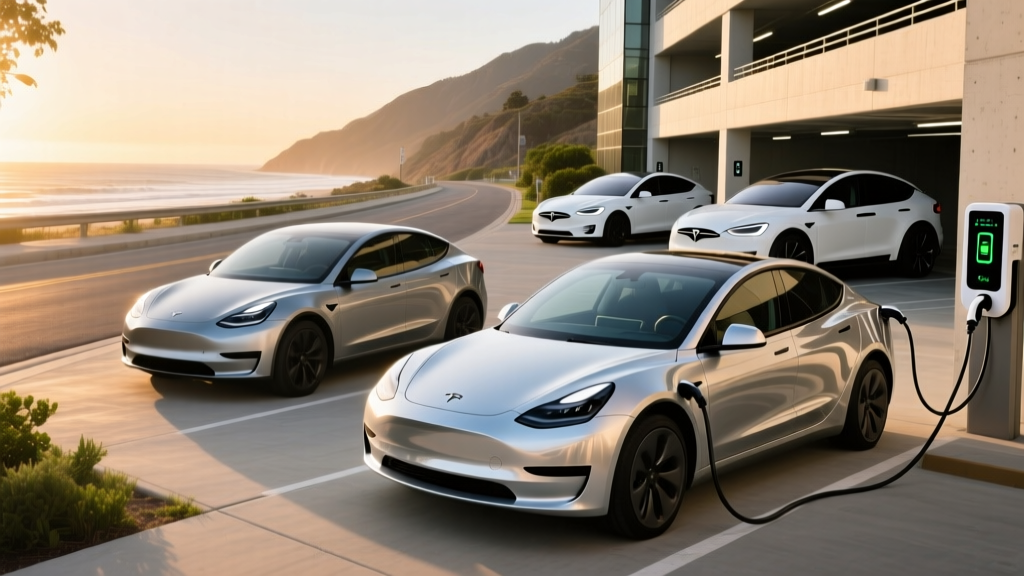
Tesla's dual-motor, all-wheel-drive (AWD) lineup spans four vehicles, from the mass-market Model 3 to the flagship Model X. But "AWD" at Tesla means very different things depending on which car you pick: different battery chemistries, different charge speeds, and vastly different real-world range. This guide cuts through the marketing to give you the exact numbers you need — EPA range, kWh capacity, peak and sustained DC fast-charge rates, pricing after federal credits, and the ownership realities that spec sheets don't show.
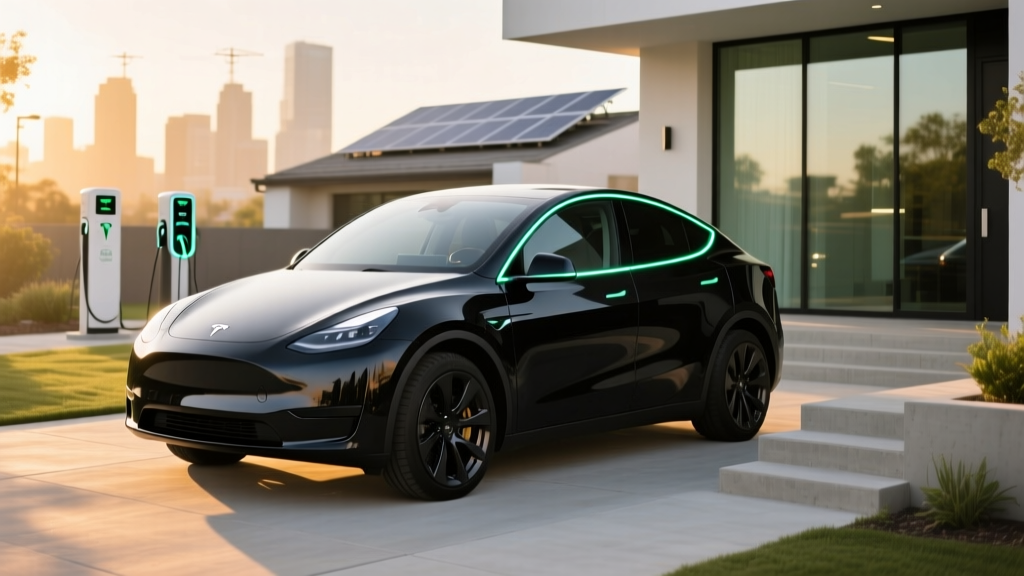
Tesla Model Y Long Range AWD: The Volume Leader
The Model Y Long Range AWD remains Tesla's best-selling vehicle globally, and for good reason: crossover utility, strong range, and access to the Supercharger network. For 2025, Tesla refreshed the Model Y (internally called "Juniper") with updated styling, a quieter cabin, rear-seat ventilation, and a revised suspension.
| Spec | Value |
|---|---|
| EPA Range | 320 miles |
| Battery (usable) | ~75 kWh, NMC (nickel manganese cobalt) |
| Drivetrain | Dual-motor AWD |
| Horsepower | 384 hp (combined) |
| 0-60 mph | 4.8 seconds |
| Efficiency | 117 MPGe combined / 29 kWh/100mi |
| Max DC Fast Charge | 250 kW peak (CCS/NACS) |
| 10-80% DC Charge Time | ~25 minutes |
| Level 2 Home Charge | 11.5 kW (~44 mi/hr) |
| Cargo (rear seats up/down) | 30.2 / 72.0 cu ft |
| Base MSRP | $47,990 (before destination) |
| Battery Warranty | 8 years / 120,000 miles (70% retention) |
Charging Curve Reality
The Model Y Long Range AWD peaks at 250 kW at a V3 Supercharger, but only between roughly 10-30% state of charge (SoC). Above 50%, the rate tapers to ~100 kW, and above 80% it drops further to protect the NMC battery. Plan road-trip stops around 10-80% for the fastest sessions. With battery preconditioning enabled via navigation routing to a Supercharger, you'll hit peak rates more reliably — skip preconditioning and cold-soak the battery, and you may see peak rates closer to 150 kW.
Real-World Range Expectations
The 320-mile EPA figure is achievable in mixed suburban driving at 45-55 mph in mild weather. On a 75-mph highway trip in summer, expect roughly 270-285 miles. In winter at 20°F with cabin heat running, that drops to approximately 225-250 miles. The Model Y's heat pump (standard on Juniper) helps significantly compared to resistive heating, but physics still applies.
Tesla Model 3 Long Range AWD: The Efficiency Champion
The refreshed "Highland" Model 3 Long Range AWD is Tesla's most aerodynamically efficient sedan and delivers the best range-per-kWh in the lineup. It's lower, lighter, and more refined than the outgoing generation, with ventilated seats, ambient lighting, and improved NVH (noise, vibration, harshness).
| Spec | Value |
|---|---|
| EPA Range | 341 miles |
| Battery (usable) | ~75 kWh, NMC |
| Drivetrain | Dual-motor AWD |
| Horsepower | 346 hp (combined) |
| 0-60 mph | 4.2 seconds |
| Efficiency | 131 MPGe combined / 26 kWh/100mi |
| Max DC Fast Charge | 250 kW peak |
| 10-80% DC Charge Time | ~25 minutes |
| Level 2 Home Charge | 11.5 kW (~50 mi/hr) |
| Cargo (trunk + frunk) | 23.0 cu ft (trunk) + 3.1 cu ft (frunk) |
| Base MSRP | $47,740 (before destination) |
| Battery Warranty | 8 years / 120,000 miles (70% retention) |
The Model 3 LR AWD's 131 MPGe combined makes it one of the most efficient dual-motor EVs on the market, per fueleconomy.gov. On a road trip, the sedan's lower frontal area means less wind resistance at highway speed — expect 295-310 miles at 75 mph in fair weather, and around 245-265 miles in freezing temperatures.
Tesla Model S Dual Motor AWD: The Flagship Sedan
The Model S received incremental updates rather than a full redesign, but it still posts remarkable numbers. The standard Dual Motor AWD version (not Plaid) offers the most range in the Tesla sedan lineup, while the Plaid AWD variant trades some range for 1,020 hp.
| Spec | Long Range AWD | Plaid AWD |
|---|---|---|
| EPA Range | 402 miles | 359 miles |
| Battery | ~95 kWh, NMC | ~95 kWh, NMC |
| Horsepower | 670 hp | 1,020 hp |
| 0-60 mph | 3.1 seconds | 1.99 seconds |
| Max DC Charge | 250 kW peak | 250 kW peak |
| 10-80% Time | ~30 minutes | ~30 minutes |
| Base MSRP | $79,990 | $94,990 |
The Model S uses a larger ~95 kWh pack, giving the Long Range version its 402-mile EPA rating. However, the larger battery also means longer 10-80% charge times despite the same 250 kW peak rate. Real-world highway range for the Long Range AWD at 75 mph: approximately 340-360 miles in mild weather. The Model S's air suspension and adaptive damping make it the most comfortable Tesla for long-distance touring.
Tesla Model X Dual Motor AWD: Family Hauler With Falcon Wings
The Model X remains the only electric three-row SUV with falcon-wing rear doors and a genuine 6- or 7-seat layout. It's the heaviest and least efficient Tesla, but it offers towing capacity and passenger volume no other Tesla can match.
| Spec | Long Range AWD | Plaid AWD |
|---|---|---|
| EPA Range | 335 miles | 311 miles |
| Battery | ~95 kWh, NMC | ~95 kWh, NMC |
| Horsepower | 670 hp | 1,020 hp |
| 0-60 mph | 3.8 seconds | 2.5 seconds |
| Towing Capacity | 5,000 lbs | 5,000 lbs |
| Cargo (behind 3rd / 2nd / max) | 15.1 / 42.5 / 85.1 cu ft | 15.1 / 42.5 / 85.1 cu ft |
| Base MSRP | $84,990 | $99,990 |
| Battery Warranty | 8 yr / 150,000 mi | 8 yr / 150,000 mi |
With a 5,000-lb tow rating, the Model X can handle a small camper or boat trailer — but expect range to drop by 30-50% while towing at highway speeds. Real-world unloaded highway range for the Long Range AWD: approximately 280-300 miles at 75 mph.
Charging at Home and on the Road: What AWD Tesla Owners Need to Know
Every current Tesla AWD model uses the North American Charging Standard (NACS) connector natively — no adapter needed at Superchargers. For non-Tesla DC fast chargers (Electrify America, EVgo, Ionity), Tesla now includes a NACS-to-CCS adapter or you can purchase one. Level 2 home charging uses the J1772-to-NACS adapter (included with the car) or a native NACS wall connector.
| Level | Power | Model Y LR | Model 3 LR | Model S/X |
|---|---|---|---|---|
| Level 1 (120V) | ~1.4 kW | ~5 mi/hr | ~5 mi/hr | ~4 mi/hr |
| Level 2 (240V, 48A) | 11.5 kW | ~44 mi/hr | ~50 mi/hr | ~35 mi/hr |
| DC Fast (V3 Supercharger) | 250 kW peak | 10-80% ~25 min | 10-80% ~25 min | 10-80% ~30 min |
| DC Fast (V4 Supercharger) | Up to 350 kW* | Vehicle-limited to 250 kW | Vehicle-limited to 250 kW | Vehicle-limited to 250 kW |
*V4 Supercharger cabinets can deliver up to 350 kW, but current Tesla vehicles are limited by their onboard charge architecture to 250 kW. Future hardware revisions may unlock higher rates.
Home Charging Setup
The Tesla Wall Connector ($420) delivers up to 11.5 kW on a 60-amp circuit (48A continuous). A typical installation runs $500-$2,000 depending on panel proximity and whether a panel upgrade (to 200A service) is needed. For a 250-mile daily driving pattern, Level 2 at 11.5 kW replenishes a full Model Y battery in roughly 7 hours — easily overnight. Always consult a licensed electrician for final installation specs.
Pricing, Tax Credits, and Total Cost for Tesla AWD Models
Federal EV tax credit eligibility under IRS §30D depends on three moving targets: buyer income caps, vehicle MSRP caps, and battery critical-mineral/battery-component sourcing requirements. These rules shift frequently.
| Model / Trim | Base MSRP | Under MSRP Cap? | Max §30D Credit* | Effective Price* |
|---|---|---|---|---|
| Model 3 LR AWD | $47,740 | Yes (sedan cap: $55K) | Up to $7,500 | ~$40,240 |
| Model Y LR AWD | $47,990 | Yes (SUV cap: $80K) | Up to $7,500 | ~$40,490 |
| Model S LR AWD | $79,990 | Yes (sedan cap: $55K) — NO | Not eligible | $79,990 |
| Model X LR AWD | $84,990 | No (SUV cap: $80K) — NO | Not eligible | $84,990 |
*Effective price assumes full $7,500 credit eligibility. Actual credit depends on your MAGI (modified adjusted gross income): $150K single / $225K head of household / $300K joint filers. Battery sourcing rules also apply — check fueleconomy.gov for current qualified vehicles. Point-of-sale transfer is available at participating dealers.
Autopilot and FSD: What Tesla AWD Buyers Should Know
Every Tesla AWD model ships with Basic Autopilot (lane centering + adaptive cruise). Enhanced Autopilot ($6,000) adds auto lane change, Navigate on Autopilot, and Smart Summon. FSD (Supervised) costs $8,000 upfront or $99/month and adds traffic-light/stop-sign recognition and city-street autosteer. FSD capability varies significantly by region and remains a supervised system requiring constant driver attention.
Pros and Cons: Tesla All Wheel Drive Ownership
Pros
- Supercharger network: 60,000+ stalls globally, industry-leading reliability
- Class-leading efficiency (Model 3: 131 MPGe combined)
- Over-the-air updates continuously add features
- Strong resale value relative to other EVs
- Instant AWD traction — no mechanical linkage lag
- Heat pump standard on all current models (better cold-weather range)
Cons
- No Apple CarPlay or Android Auto
- Model S/X exceed federal tax credit MSRP caps
- Service center wait times can be long in some regions
- Phantom braking reports with Autopilot on certain roads
- Insurance premiums 15-30% higher than comparable ICE vehicles
- Model 3/Y rear-seat legroom is tighter than some competitors (35.2" rear legroom)
Who Should Buy a Tesla AWD — And Who Should Look Elsewhere
Decision Framework
Choose Model 3 LR AWD if: You prioritize efficiency and range, commute 30-60 miles daily, and want the lowest cost per mile. Best for singles and couples without bulky cargo needs.
Choose Model Y LR AWD if: You need crossover cargo space, have a family of 3-4, and want the best balance of range, utility, and price. This is the default pick for most buyers.
Choose Model S LR AWD if: Budget is flexible, you want 400+ mile range with air-suspension comfort, and you regularly take 300+ mile road trips. Best for executive commuters.
Choose Model X LR AWD if: You need three rows, tow a trailer, or want falcon-wing door drama. Best for families of 5-7 who need electric towing capability.
Look elsewhere if: You need Apple CarPlay, prefer a traditional dealer service experience, live in an area with no Supercharger coverage, or need a truck bed (consider the Cybertruck AWD or Rivian R1T).
Competitor Check: How Tesla AWD Compares
The Model Y LR AWD competes directly with the Hyundai Ioniq 5 AWD (305 mi EPA, 350 kW charging), Ford Mustang Mach-E Extended Range AWD (290 mi EPA), and BMW iX xDrive50 (324 mi EPA). The Model Y's advantages are Supercharger access and efficiency; its weaknesses are interior material quality and rear-seat space versus the Ioniq 5.
The Model 3 LR AWD faces the Hyundai Ioniq 6 AWD (316 mi EPA, ultra-fast 800V charging), BMW i4 xDrive40 (282 mi EPA), and Polestar 2 Long Range Dual Motor (276 mi EPA). The Tesla wins on range and Supercharger infrastructure; the Ioniq 6 wins on 10-80% charge speed (~18 min at 350 kW).
Frequently Asked Questions
What is the real-world range of a Tesla all wheel drive Model Y?
The EPA rates the 2025 Model Y Long Range AWD at 320 miles. In real-world highway driving at 75 mph, expect 270-285 miles. In cold weather (below 30°F), that drops to 225-250 miles. City driving with frequent regenerative braking can match or slightly exceed the EPA number.
How fast does a Tesla AWD charge at home and on the road?
At home on a Level 2 Tesla Wall Connector (11.5 kW / 48A), you'll add roughly 44 miles of range per hour in the Model Y, or about 50 mi/hr in the Model 3. A full overnight charge easily covers most daily needs. On a V3 Supercharger at 250 kW peak, 10-80% takes approximately 25 minutes for Model 3/Y and about 30 minutes for Model S/X due to larger batteries.
Does the Tesla Model Y AWD qualify for the federal EV tax credit?
It can. The Model Y Long Range AWD at $47,990 is under the $80,000 SUV MSRP cap for §30D. However, you must also meet income limits ($300K joint / $150K single) and the vehicle must satisfy battery critical-mineral and component sourcing requirements. The credit can be transferred at point of sale for an immediate price reduction. Always verify current eligibility on fueleconomy.gov and consult a tax professional.
Is a Tesla AWD worth it versus competitors?
If Supercharger network access, software updates, and efficiency are top priorities, yes — Tesla's AWD vehicles remain benchmarks. If you value faster DC charging (800V architecture), Apple CarPlay, or a traditional dealership experience, the Hyundai Ioniq 5/6 or Ford Mach-E may be better fits. Test-drive at least two competitors before committing.
What are the biggest drawbacks of Tesla AWD ownership?
Insurance costs run 15-30% higher than equivalent gas cars. Service center availability varies by region, with some owners reporting multi-week wait times for non-emergency repairs. The lack of Apple CarPlay/Android Auto is a dealbreaker for some. And while the Supercharger network is excellent, Tesla's panel gaps and interior material quality still lag behind German competitors at similar price points.
What battery chemistry do Tesla AWD models use?
All current Long Range and Performance AWD Teslas use NMC (nickel manganese cobalt) chemistry, which offers higher energy density than LFP but is more sensitive to sustained 100% charges. Tesla recommends daily charging to 80% for NMC packs and 100% only before long trips. The standard-range RWD Model 3 uses LFP chemistry, which tolerates regular 100% charges — but that trim is not available with AWD.
How long does a Tesla AWD battery last?
Tesla warranties the Model 3/Y battery for 8 years or 120,000 miles (whichever comes first) with at least 70% capacity retention. Model S/X batteries are covered for 8 years or 150,000 miles. Real-world data from high-mileage owners shows NMC packs typically retaining 85-90% capacity at 100,000 miles when following the 80% daily charge recommendation. Full battery replacement (rare) costs approximately $12,000-$16,000 out of warranty depending on the model.