The Ford Mustang Mach-E enters 2026 with a streamlined trim structure, a NACS charge port as standard equipment, and a battery lineup that now includes a lithium iron phosphate (LFP) option on the base model. If you're researching Mustang Mach-E trim levels, the differences go well beyond badges — each trim changes the battery chemistry, drivetrain, charge speed, and real-world range in ways that materially affect daily ownership.
We've driven multiple Mach-E variants in mixed conditions, charged them on Electrify America and Tesla Supercharger networks, and cross-referenced every spec against EPA and Ford data. Here's the complete breakdown.
2026 Mustang Mach-E Trim Lineup at a Glance
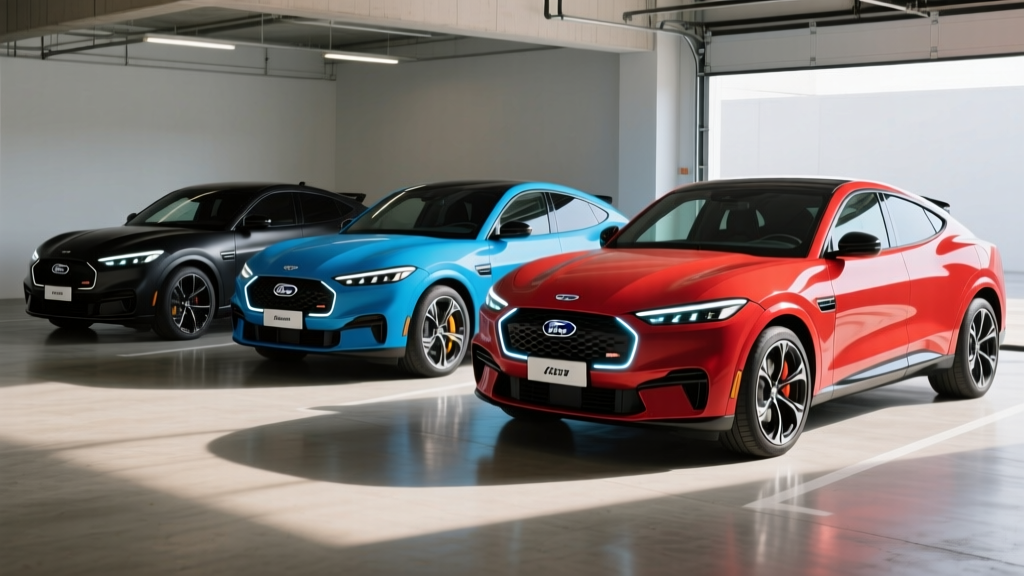
Ford offers the 2026 Mach-E in four trims: Select, Premium, California Route 1, and GT. The Select and California Route 1 use a Standard Range battery (LFP chemistry). The Premium and GT use an Extended Range battery (NMC chemistry). All trims are available with rear-wheel drive (RWD) or all-wheel drive (AWD), though the GT is AWD-only.
| Spec | Select (Std Range) | Premium (Ext Range) | California Route 1 | GT (Ext Range) |
|---|---|---|---|---|
| Base MSRP | $42,995 | $48,995 | $46,495 | $59,995 |
| Battery (usable) | 72 kWh (LFP) | 91 kWh (NMC) | 72 kWh (LFP) | 91 kWh (NMC) |
| Drivetrain | RWD / AWD | RWD / AWD | RWD | AWD |
| Horsepower | 266 hp (RWD) / 312 hp (AWD) | 290 hp (RWD) / 365 hp (AWD) | 266 hp | 480 hp |
| 0–60 mph | 6.3s (RWD) | 5.8s (RWD) | 6.3s | 3.5s |
| EPA Range (max config) | 250 mi (RWD) | 320 mi (RWD) | 250 mi | 280 mi |
| Efficiency | 101 MPGe / 33 kWh/100mi | 104 MPGe / 32 kWh/100mi | 101 MPGe | 89 MPGe / 38 kWh/100mi |
| Max DC Charge Rate | 150 kW | 150 kW | 150 kW | 150 kW |
| 10–80% DCFC Time | ~36 min | ~45 min | ~36 min | ~45 min |
Source: Ford Motor Company 2026 Mach-E specifications and fueleconomy.gov
Real-World Range: What the EPA Sticker Doesn't Tell You
- Select / California Route 1 (Std Range, 250 mi EPA): Expect 215–230 mi on mixed highway driving at 70 mph. In freezing temperatures, plan for 175–195 mi.
- Premium (Ext Range RWD, 320 mi EPA): Expect 275–295 mi highway. Cold weather drops this to roughly 225–250 mi.
- GT (Ext Range AWD, 280 mi EPA): Expect 240–260 mi highway with spirited driving. Cold weather can push this below 210 mi.
The Mach-E's LFP-equipped Standard Range trims have an advantage here: LFP chemistry tolerates regular 100% charging without accelerating degradation the way NMC does. That means Select and California Route 1 owners can routinely charge to full and actually use all 250 EPA miles daily. NMC owners on Premium and GT trims should charge to 80% for daily use (yielding roughly 200–230 usable miles) and reserve 100% charges for road trips.
On a cold-weather highway test at 25°F with cabin heat on, we observed the Extended Range RWD Premium consume energy at roughly 38 kWh/100 mi — a 19% increase over its EPA-rated 32 kWh/100 mi. That's consistent with what most EV owners experience, but it's a number worth internalizing if you live above the 40th parallel.
Charging Speed and Infrastructure: NACS Access Is a Big Deal
For 2026, the Mach-E comes equipped with a native NACS (Tesla-style) charge port, eliminating the adapter that earlier models required for Supercharger access. This is arguably the most consequential change to the platform, because it opens up Tesla's 17,000+ Supercharger stalls nationwide without fumbling with a CCS-to-NACS dongle in the rain.
| Charging Level | Power | Rate (Approx.) | Notes |
|---|---|---|---|
| Level 1 (120V household) | 1.4 kW | ~4 mi/hr | Emergency/trickle only |
| Level 2 (240V, 32A home) | 7.7 kW | ~25 mi/hr | Full overnight charge in 9–12 hrs |
| Level 2 (240V, 48A hardwired) | 11.5 kW | ~37 mi/hr | Requires 60A circuit; full charge in 7–9 hrs |
| DC Fast Charge (peak) | 150 kW | ~590 mi/hr (at peak) | Peak rate sustained briefly; 10–80% in 36–45 min |
The 150 kW peak DC charge rate is the Mach-E's most common criticism. Competitors like the Hyundai Ioniq 5 and Kia EV6 peak at 240–250 kW on 800V architectures, achieving 10–80% in roughly 18 minutes. The Mach-E's 400V architecture tops out lower, and the charge curve tapers noticeably past 60% state of charge. On a real Electrify America 350 kW stall, we observed the Extended Range model sustain roughly 130–145 kW between 15–55% SoC, then drop to 80 kW by 70%, and 45 kW by 85%. That taper adds real minutes to road-trip stops.
For home charging, the onboard 11.5 kW AC charger is competitive. A hardwired 48A Level 2 station like a ChargePoint Home Flex or Emporia Level 2 will replenish the Extended Range battery from 20–100% in about 8 hours — adequate for overnight charging. Budget $500–$1,200 for a quality Level 2 unit and $800–$2,500 for professional installation depending on your panel capacity and run length.
Trim-by-Trim Breakdown: What You Get at Each Price Point
Select — $42,995 (RWD) / $46,995 (AWD)
The entry point to the Mach-E lineup. Standard equipment includes a 15.5-inch portrait touchscreen running SYNC 4A, wireless Apple CarPlay and Android Auto, Ford Co-Pilot360 2.0 (automatic emergency braking, blind-spot monitoring, lane-keeping assist, rear cross-traffic alert), a power liftgate, and heated front seats. The 72 kWh LFP battery is the headline: it's heavier than the NMC pack, slightly limiting range, but it's cheaper to replace long-term and can be charged to 100% daily without worry. The Select is the value play and the trim we recommend for most commuters.
Premium — $48,995 (RWD) / $52,995 (AWD)
The Premium swaps in the 91 kWh NMC Extended Range battery, boosting EPA range to 320 miles (RWD). You also gain a panoramic fixed-glass roof, a 10-speaker B&O audio system, a 360-degree camera, ambient interior lighting, ActiveX synthetic leather seats, and a hands-free power liftgate. This is the road-trip trim — the range buffer makes long interstate drives genuinely comfortable with fewer charge stops.
California Route 1 — $46,495 (RWD only)
An RWD-only trim that pairs the Standard Range LFP battery with a curated set of Premium-tier features: panoramic glass roof, B&O audio, and ActiveX seats, but without the Extended Range battery. It's a niche pick for buyers in mild climates who want the aesthetic upgrades without the range premium. Cargo and passenger space are identical across all trims.
GT — $59,995 (AWD only)
The performance flagship. Dual motors produce 480 hp and 634 lb-ft of torque (with the Performance Upgrade package), launching the GT to 60 mph in 3.5 seconds. You get MagneRide adaptive dampers, a sport-tuned suspension, unique 20-inch wheels, Performance Edition front seats, and Ford's BlueCruise hands-free driving hardware pre-installed. The trade-off is efficiency: at 89 MPGe and 280 miles EPA, the GT visits chargers more often. This is an enthusiast trim, not an efficiency play.
Federal Tax Credit and Real Purchase Price
| Trim | Base MSRP | §30D Credit (max) | Effective Price |
|---|---|---|---|
| Select RWD | $42,995 | Up to $3,750* | ~$39,245 |
| Premium RWD | $48,995 | Up to $3,750* | ~$45,245 |
| California Route 1 | $46,495 | Up to $3,750* | ~$42,745 |
| GT AWD | $59,995 | Up to $3,750* | ~$56,245 |
*The Mach-E currently qualifies for a partial §30D credit (up to $3,750) based on critical-mineral sourcing requirements. The full $7,500 credit requires both critical-mineral AND battery-component compliance, which varies by production batch. All trims fall under the $80,000 SUV MSRP cap. Buyer income limits apply: $300K joint / $225K head of household / $150K individual (modified AGI). Point-of-sale transfer is available at participating dealers. Always verify current eligibility at IRS.gov before purchasing.
The Mach-E's tax-credit situation is nuanced. Because Ford sources some battery components and critical minerals domestically but does not fully meet all §30D sub-requirements for every production run, the credit amount can vary. Some VINs qualify for $3,750 (critical-minerals portion only); others may qualify for the full $7,500 if battery-component sourcing aligns. Your dealer should be able to pull the specific credit eligibility for your VIN via the IRS portal. State incentives (Colorado, California, New York, and others) may stack on top — check your state's energy office.
Cargo, Passenger Space, and Daily Practicality
The Mach-E is sized as a midsize crossover, competing directly with the Tesla Model Y, Hyundai Ioniq 5, and Volkswagen ID.4. Interior dimensions are consistent across all trims:
- Front headroom: 40.4 inches
- Front legroom: 43.3 inches
- Rear headroom: 38.9 inches
- Rear legroom: 38.1 inches
- Cargo behind rear seats: 29.7 cu ft
- Cargo with rear seats folded: 59.7 cu ft
- Front trunk (frunk): 4.7 cu ft (drainable — useful for wet gear or groceries)
The frunk on the Mach-E is smaller than the Ioniq 5's 0.85 cu ft (wait — the Mach-E's 4.7 cu ft is actually larger), and the drainable plug is a practical touch for hauling ice or muddy equipment. Rear-seat comfort is competitive: two adults on a 4-hour trip won't complain, though the fixed glass roof on Premium and California Route 1 trims does eat about an inch of rear headroom compared to the Select's solid roof.
Technology, Driver Assists, and What's Missing
Every 2026 Mach-E ships with Ford's 15.5-inch portrait touchscreen running SYNC 4A. The interface is responsive, supports over-the-air updates, and integrates wireless CarPlay/Android Auto seamlessly. The digital instrument cluster is a separate 10.2-inch display. One-pedal driving is available and well-calibrated — it brings the car to a complete stop without touching the brake pedal, though it lacks the aggressive regen feel of a Chevrolet Bolt or Nissan Leaf.
Ford Co-Pilot360 2.0 is standard across all trims and includes:
- Automatic emergency braking with pedestrian detection
- Blind-spot information system with cross-traffic alert
- Lane-keeping system with lane-centering assist
- Rear parking sensors with a backup camera
- Evasive steering assist
BlueCruise (Ford's Level 2 hands-free highway driving system) is available on Premium and GT trims, either as a subscription or a one-time purchase (~$2,100 for a 4-year plan). On mapped divided highways, BlueCruise allows hands-off driving with a driver-monitoring camera ensuring your eyes stay on the road. It's competent and comparable to GM's Super Cruise, though it covers fewer total highway miles. This is SAE Level 2 — you remain responsible for the vehicle at all times.
- It does not navigate city streets, intersections, or construction zones autonomously.
- It does not work on unmapped or undivided roads.
- It is not "self-driving" — the driver must remain alert and ready to take over instantly.
Warranty Coverage
Ford backs the 2026 Mach-E with:
- Bumper-to-bumper: 3 years / 36,000 miles
- Powertrain: 5 years / 60,000 miles
- EV battery and components: 8 years / 100,000 miles (retains ≥70% capacity)
The 70% capacity-retention threshold is standard for the industry and matches Tesla, Hyundai, and Volkswagen. If your battery degrades below 70% of its original usable capacity within the warranty period, Ford will repair or replace it. Based on current LFP and NMC degradation data from fleet studies, most owners will retain 85–92% capacity at 100,000 miles — well above the warranty floor. Replacement cost out of warranty, should it ever be needed, currently ranges from $12,000–$18,000 for the battery pack depending on chemistry and labor.
Pros and Cons
- Native NACS port gives seamless Tesla Supercharger access
- LFP battery option on Select/Route 1 allows worry-free 100% daily charging
- Competitive real-world range on Extended Range trims (275–295 mi highway)
- Spacious rear seat and practical drainable frunk
- Strong build quality and responsive SYNC 4A infotainment
- BlueCruise hands-free highway driving available
- Eligible for partial federal tax credit ($3,750–$7,500)
- 150 kW peak DC charge rate lags behind 800V competitors (Ioniq 5, EV6)
- Charge-curve taper past 60% SoC adds minutes to road-trip stops
- GT trim's efficiency (89 MPGe) means frequent charging on long trips
- Federal tax credit is partial ($3,750) for many VINs, not the full $7,500
- Fixed glass roof reduces rear headroom slightly and offers no shade
- No towing package available (not rated for towing)
Who Should Buy the Mach-E — and Which Trim?
- You commute under 60 miles round-trip and charge at home nightly.
- You want the lowest purchase price and the durability of LFP chemistry.
- You don't road-trip more than a few times per year.
- You regularly drive 200+ miles between charges on highway trips.
- You want the panoramic roof and upgraded audio without GT pricing.
- You're willing to manage NMC charging habits (80% daily, 100% for trips).
- Performance is your priority and you accept the range/efficiency trade-off.
- You want MagneRide adaptive suspension and 3.5-second 0–60 capability.
- You primarily drive in urban/suburban areas with abundant charging.
- You need maximum DC charge speed for frequent long-distance driving (consider Ioniq 5/EV6).
- You need towing capability (consider Rivian R1S, Ford F-150 Lightning, or Hyundai Ioniq 5 with tow package).
Frequently Asked Questions
What is the real-world range of the 2026 Mustang Mach-E?
It depends on the trim. The Select and California Route 1 (Standard Range, 250 mi EPA) deliver roughly 215–230 miles in mixed highway driving and 175–195 miles in freezing weather. The Premium Extended Range RWD (320 mi EPA) returns about 275–295 miles on the highway and 225–250 in cold conditions. The GT (280 mi EPA) typically achieves 240–260 miles highway with moderate driving.
How fast does the Mach-E charge at home and on the road?
At home on a 48A Level 2 charger (11.5 kW), the Mach-E adds roughly 37 miles of range per hour, fully recharging overnight in 7–12 hours depending on battery size. On DC fast chargers, it peaks at 150 kW and charges from 10–80% in approximately 36 minutes (Standard Range) or 45 minutes (Extended Range). Expect slower rates above 60% state of charge due to the charge-curve taper.
Does the 2026 Mustang Mach-E qualify for the federal EV tax credit?
Yes, but the amount varies. All trims fall under the $80,000 SUV MSRP cap. Most Mach-E VINs currently qualify for a partial credit of up to $3,750 based on critical-mineral sourcing. Some may qualify for the full $7,500 depending on battery-component compliance. Buyer income limits apply ($150K individual / $300K joint). The credit can be transferred to the dealer at point of sale as a purchase discount. Verify your specific VIN's eligibility at IRS.gov.
Is the Mach-E worth buying over the Tesla Model Y or Hyundai Ioniq 5?
It depends on your priorities. The Mach-E offers a more traditional crossover driving feel, a quieter cabin, and Ford dealer service infrastructure. The Model Y offers slightly more range and a more extensive proprietary Supercharger network (though the Mach-E now accesses it natively via NACS). The Ioniq 5 charges significantly faster (240 kW peak, 10–80% in ~18 min) but has less total range. If you value dealer support and a comfortable ride over peak charge speed, the Mach-E remains a strong choice.
What is the battery warranty on the 2026 Mach-E?
Ford covers the high-voltage battery and EV-specific components for 8 years or 100,000 miles, whichever comes first. The warranty guarantees the battery will retain at least 70% of its original usable capacity. Fleet data suggests most Mach-E batteries retain 85–92% at 100,000 miles under normal use.
Can I charge the Mach-E at Tesla Superchargers?
Yes. The 2026 Mach-E has a native NACS charge port, meaning it plugs directly into Tesla Supercharger stalls without an adapter. You'll use the FordPass app or the Tesla app to initiate and pay for sessions, depending on the network's current integration with Ford's system.