Can the Mustang Mach-E Actually Tow? The Quick Verdict
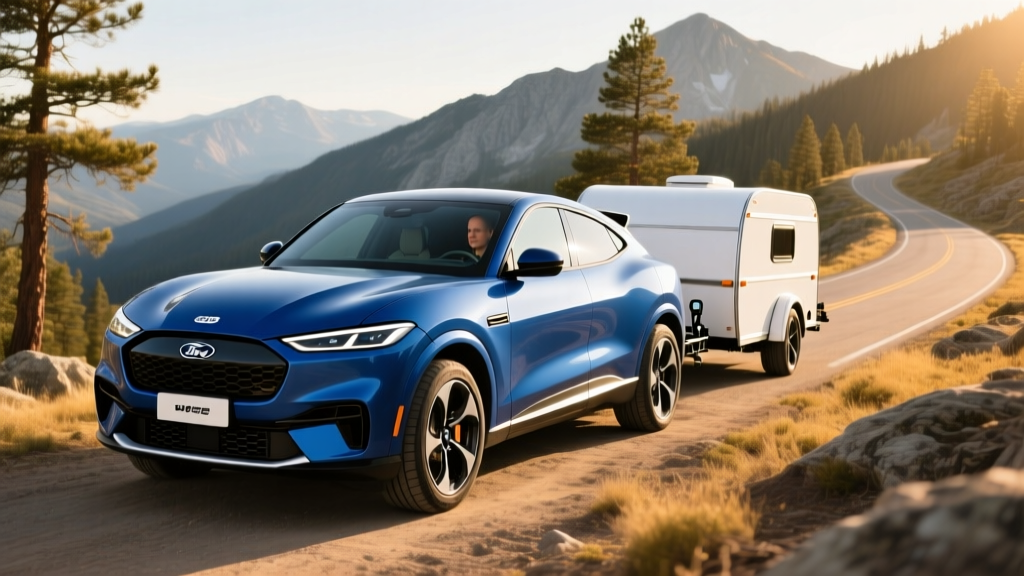
The 2026 Ford Mustang Mach-E is one of the most popular electric crossovers on the road, but buyers who need to pull a small camper, utility trailer, or pair of jet skis have a specific question: what is the real Mustang Mach-E towing capacity? The short answer is up to 3,500 pounds when properly equipped with the factory tow package on Select and Premium AWD trims with the Extended Range battery. That's competitive with the Hyundai Ioniq 5 and Volkswagen ID.4, though it falls short of the Tesla Model Y's 3,500-pound rating and well behind body-on-frame EV trucks.
Towing is only part of the ownership equation, though. This profile covers every number that matters — EPA range, charging speeds, battery chemistry, pricing after the federal tax credit, and the real-world trade-offs you'll face when hitching up a trailer to Ford's electric pony.
Mustang Mach-E Towing Capacity by Trim (2026)
Not every Mach-E can tow, and not every Mach-E that can tow shares the same limit. Ford restricts the tow package to all-wheel-drive models with the larger battery pack. Here is the exact breakdown:
| Trim | Drivetrain | Battery | Max Tow Rating | Tow Package Required |
|---|---|---|---|---|
| Select RWD | RWD | Standard Range | Not rated | N/A |
| Select AWD | Dual-Motor AWD | Extended Range | 3,500 lbs | Yes (dealer-installed) |
| Premium AWD | Dual-Motor AWD | Extended Range | 3,500 lbs | Yes (dealer-installed) |
| GT | Dual-Motor AWD | Extended Range | 3,500 lbs | Yes (dealer-installed) |
| Rally | Dual-Motor AWD | Extended Range | Not rated | N/A |
The tow package includes a Class II hitch receiver, a 4-pin wiring harness, and a software calibration that enables trailer-sway control and adjusts the regenerative braking profile. Expect to pay roughly $1,200–$1,500 installed at the dealer. Ford does not offer a factory-installed tow package from the assembly line; it is a port- or dealer-add.
Key limitation: The 3,500-pound rating assumes a properly distributed load, a brake controller for trailers over 1,500 lbs, and adherence to Ford's owner's manual weight-distribution requirements. Exceeding these limits voids the powertrain warranty for tow-related claims.
Range, Efficiency, and What Happens When You Tow
The 2026 Mach-E Extended Range AWD uses an NMC (nickel manganese cobalt) lithium-ion battery with approximately 91 kWh of usable capacity (98 kWh gross). The EPA publishes the following range figures for the non-towing configuration:
Real-World Expectation: 260–280 miles on mixed highway driving; 220–240 miles in sustained cold weather (below 32°F); 140–170 miles when towing a 2,500–3,500 lb trailer at highway speeds.
EPA Efficiency: 98 MPGe combined / 34 kWh per 100 miles
The range penalty from towing is the single biggest shock for new EV truck and SUV owners. Aerodynamic drag scales with the square of speed, and a boxy travel trailer at 70 mph can cut your range nearly in half. If your typical tow route is 80 miles each way, the Mach-E can handle it — but you will need a charging stop on the return leg or a destination charger at your campsite. Plan around 2.0–2.5 kWh per mile when towing a loaded trailer at highway speeds, versus roughly 0.34 kWh per mile unloaded.
For comparison, the Hyundai Ioniq 5 AWD (320-mile EPA) drops to a similar 150–180-mile real-world tow range, and the Tesla Model Y Long Range (310-mile EPA) performs comparably. No unibody electric crossover has solved the towing-range problem; physics is physics.
Charging Speed: DC Fast Charging and Home Level 2
When you are towing, charging speed determines whether your road-trip stop takes 20 minutes or 45. The 2026 Mach-E Extended Range supports the following charge rates:
| Charging Level | Power / Rate | Time or Miles Added | Connector |
|---|---|---|---|
| Level 1 (120V household) | ~1.4 kW | ~3–4 miles per hour | NACS (native) |
| Level 2 (240V home, 48A) | 11.5 kW | ~30 miles per hour / ~9 hours 10–80% | NACS (native) |
| DC Fast Charge (peak) | 150 kW | 10–80% in ~36 minutes | NACS (native) |
Ford transitioned the Mach-E to the NACS (North American Charging Standard) port starting with the 2025 model year, meaning 2026 models charge natively at Tesla Superchargers without an adapter. This is a major practical advantage over the prior CCS1-equipped models, which required a Ford-provided adapter for Supercharger access.
The 150 kW peak DC rate is the Mach-E's most criticized spec. Competitors like the Hyundai Ioniq 5 (peak 240 kW, 10–80% in ~18 minutes) and Kia EV6 (peak 240 kW on 800V architecture) charge significantly faster. The Mach-E's charge curve holds near peak only between roughly 15% and 45% state of charge, then tapers progressively. On a long tow trip, this means each charging stop will take roughly 35–40 minutes to add enough range for the next 120–140 miles of towing.
For home charging, a 48-amp Level 2 wall connector on a 60-amp circuit adds about 30 miles of range per hour. An overnight charge from 20% to 80% takes roughly 7–8 hours, which is standard for the segment. Ford recommends charging to 90% for daily use on the NMC battery and only hitting 100% before long trips to minimize long-term degradation.
Performance, Drivetrain, and Towing Dynamics
The AWD Extended Range powertrain that enables the 3,500-pound tow rating also delivers strong everyday performance:
| Spec | Value |
|---|---|
| Horsepower (AWD Ext. Range) | 365 hp |
| Torque | 430 lb-ft |
| 0–60 mph (unloaded) | 4.8 seconds |
| Drivetrain | Dual-motor eAWD |
| GT Trim Horsepower | 480 hp |
| GT 0–60 mph | 3.5 seconds |
| Towing Mode | Yes (adjusts regen, throttle mapping, stability control) |
When towing, the dual-motor AWD system provides strong low-end torque for getting a trailer moving from a stop, and the tow mode recalibrates regenerative braking to avoid abrupt deceleration that could induce trailer sway. The instant torque delivery of an EV is genuinely advantageous for merging onto highways with a load compared to a turbocharged gas engine waiting for boost.
However, the Mach-E's unibody car-based platform and relatively low ground clearance (5.7 inches) mean it is not suited for off-road trailer access or rough boat ramps. If your towing involves gravel forest-service roads or steep, unpaved launches, a body-on-frame EV like the Ford F-150 Lightning or Rivian R1S is a better tool.
Pricing, Trims, and Federal Tax Credit Eligibility
The 2026 Mustang Mach-E lineup starts below $40,000, but the trims capable of towing cost more. Here is the current pricing and tax credit landscape:
| Trim | Base MSRP | Tow-Capable? | Est. As-Tested with Tow Pkg | §30D Credit Eligibility |
|---|---|---|---|---|
| Select RWD (Std Range) | $39,995 | No | — | Up to $7,500* |
| Select AWD (Ext Range) | $48,495 | Yes | ~$49,995 | Up to $7,500* |
| Premium AWD (Ext Range) | $53,995 | Yes | ~$55,495 | Up to $7,500* |
| GT (Ext Range) | $62,995 | Yes | ~$64,495 | Up to $7,500* |
*Federal tax credit eligibility under IRS §30D is subject to multiple requirements for 2026:
- MSRP cap: SUVs/crossovers must have an MSRP at or below $80,000 (all Mach-E trims qualify).
- Buyer income cap: Modified AGI must not exceed $150,000 (single), $225,000 (head of household), or $300,000 (joint).
- Battery sourcing: A percentage of critical minerals and battery components must be sourced from the U.S. or free-trade-agreement countries. The Mach-E's battery is assembled in Mexico with globally sourced cells; qualifying credit amounts may be partial ($3,750) or full ($7,500) depending on the latest supply-chain certifications.
- Point-of-sale transfer: Buyers can elect to transfer the credit to the dealer at purchase, reducing the out-of-pocket price immediately rather than waiting for tax filing.
Always verify current eligibility on the fueleconomy.gov tax credit tracker and consult a tax professional before relying on a specific credit amount. Rules have shifted annually since the Inflation Reduction Act took effect.
Cargo, Passenger Space, and Practicality
The Mach-E is a midsize crossover, and its interior dimensions reflect that positioning:
- Cargo (behind rear seats): 29.7 cu ft
- Cargo (rear seats folded): 59.7 cu ft
- Front trunk (frunk): 4.7 cu ft with drain — useful for wet gear or ice
- Rear legroom: 38.9 inches
- Front headroom: 40.4 inches (panoramic glass roof)
- Seating: 5 passengers
For towing use cases, the frunk is a practical advantage over gas vehicles — store hitch accessories, trailer straps, or a brake controller in the front without eating into rear cargo. The 29.7 cu ft behind the rear seats accommodates two large suitcases and camping gear for a weekend trip, though it trails the Tesla Model Y (30.2 cu ft) and Hyundai Ioniq 5 (27.2 cu ft) only marginally.
Technology, Driver Assists, and Towing-Specific Features
The 2026 Mach-E runs Ford's SYNC 4A infotainment system on a 15.5-inch vertical touchscreen. Notable tech includes:
- Ford BlueCruise 1.5: Hands-free highway driving on pre-mapped divided highways (SAE Level 2 — driver must remain attentive and eyes on road). Covers over 130,000 miles of Hands-Free Blue Zone roads.
- Pro Trailer Backup Assist: Available with the tow package; uses a dashboard knob to steer the trailer in reverse, eliminating the counterintuitive steering inputs that frustrate novice trailer operators.
- Trailer Sway Control: Applies individual wheel braking and reduces motor torque when trailer oscillation is detected.
- Intelligent Range: Factors in trailer weight, terrain, weather, and driving style to display a more accurate remaining range estimate — critical when towing.
- Over-the-air updates: Ford continues to push software improvements for battery management, BlueCruise coverage, and infotainment features.
Warranty, Battery Longevity, and Ownership Costs
Ford backs the 2026 Mach-E with the following coverage:
- Bumper-to-bumper: 3 years / 36,000 miles
- Powertrain: 5 years / 60,000 miles
- High-voltage battery: 8 years / 100,000 miles (retains at least 70% of original capacity)
- Corrosion perforation: 5 years / unlimited miles
The 70% capacity retention threshold at 8 years / 100,000 miles is standard for the industry and matches Hyundai, Tesla, and Volkswagen. Real-world data from early 2021–2022 Mach-E owners suggests NMC degradation of approximately 5–8% over the first 60,000 miles under normal use. Frequent DC fast charging and regular 100% charges accelerate degradation slightly; Ford's recommended 20–90% daily window helps maximize long-term State of Health.
If the battery falls below the 70% threshold within the warranty period, Ford will repair or replace modules to restore capacity above that line — not necessarily a full pack replacement. Out-of-warranty battery replacement for the Extended Range pack has been estimated at $18,000–$24,000 including labor, though prices are expected to decline as the supply chain matures.
Pros and Cons: The Honest Scorecard
Pros
- 3,500-lb tow rating (best in class for unibody EV crossovers)
- Native NACS port — direct Tesla Supercharger access
- Pro Trailer Backup Assist simplifies hitching and reversing
- Strong dual-motor torque for confident highway merging with a load
- Spacious, well-finished interior with practical frunk
- BlueCruise hands-free driving reduces fatigue on long tow trips
- Competitive starting price; all trims under the $80K MSRP cap
Cons
- DC fast charging peaks at only 150 kW — slowest in its price class
- Towing cuts range by 45–55%, requiring careful trip planning
- Tow package is dealer-installed, adding cost and delivery complexity
- No tow rating on RWD or Rally trims limits configuration flexibility
- 5.7 inches of ground clearance — not suited for rough trailer access
- NMC battery requires 20–90% discipline for optimal longevity
- Insurance premiums run 15–25% higher than comparable gas crossovers
Who Should Buy the Mach-E for Towing?
Choose the Mustang Mach-E if: You need to tow a small travel trailer (under 3,000 lbs loaded), a pair of personal watercraft, or a lightweight utility trailer on paved roads; you have reliable home Level 2 charging; your tow trips are under 150 miles one-way or have destination charging; and you want a daily-driver EV that can occasionally pull a load without buying a full-size truck.
Look elsewhere if: You regularly tow over 3,500 lbs, need off-road trailer access, take cross-country tow trips where 150 kW charging will frustrate you, or want a vehicle that maintains most of its range under load. Consider the Ford F-150 Lightning (up to 7,700 lbs, 320-mile range), Rivian R1S (up to 7,700 lbs), or a plug-in hybrid like the Toyota Grand Highlander Hybrid for unlimited range flexibility with a trailer.
Frequently Asked Questions
What is the real-world range of the Mustang Mach-E when towing?
Expect 140–170 miles of real-world range when towing a 2,500–3,500 lb trailer at 65–70 mph in moderate temperatures. Cold weather and hilly terrain will push that lower. Without a trailer, real-world highway range is approximately 260–280 miles versus the 312-mile EPA sticker.
How fast does the Mach-E charge at home and on the road?
At home on a 48-amp Level 2 charger, the Extended Range battery adds about 30 miles of range per hour, reaching a full charge overnight. On DC fast chargers, it peaks at 150 kW and charges from 10% to 80% in approximately 36 minutes — adequate but slower than the Hyundai Ioniq 5's 18-minute 10–80% time at 240 kW.
Does the 2026 Mustang Mach-E qualify for the $7,500 federal tax credit?
It can, but eligibility depends on your income (under $150K single / $300K joint), the vehicle's MSRP (all trims are under the $80K SUV cap), and battery-sourcing compliance. The Mach-E's battery assembly in Mexico and cell sourcing may qualify for the full $7,500 or a partial $3,750 depending on 2026 critical-mineral and component rules. Check fueleconomy.gov for the latest determination and consult a tax professional.
Is the Mach-E worth buying over the Tesla Model Y or Hyundai Ioniq 5 for towing?
All three share a 3,500-lb tow rating. The Mach-E wins on trailer-assist technology (Pro Trailer Backup Assist) and BlueCruise for hands-free highway driving. The Ioniq 5 wins decisively on DC fast-charge speed (240 kW vs 150 kW). The Model Y has the largest Supercharger network advantage, though the Mach-E's native NACS port now accesses the same stations. If charge speed is your top priority, the Ioniq 5 is the stronger pick. If trailer-specific tech and a more traditional dealership experience matter, the Mach-E has the edge.
Can I install an aftermarket hitch if my Mach-E didn't come with the tow package?
Aftermarket Class II hitches (Curt, Draw-Tite) are available and typically cost $200–$350 for the hardware plus $150–$250 for installation. However, without Ford's factory tow-package software calibration, you will not have trailer-sway control, the adjusted regen profile, or Pro Trailer Backup Assist. More importantly, Ford may deny powertrain warranty claims related to towing if the vehicle was not equipped with the OEM tow package. We recommend the factory package for anyone who plans to tow regularly.
How does the Mach-E's tow rating compare to gas crossovers?
The 3,500-lb rating matches or exceeds many gas-powered midsize crossovers: the Toyota RAV4 is rated for 1,500–3,500 lbs depending on trim, the Honda CR-V for 1,500 lbs, and the Subaru Outback for 2,700–3,500 lbs. The Mach-E is competitive in its class, though dedicated tow vehicles like the Ford Explorer (5,600 lbs gas) or Jeep Grand Cherokee (6,200–7,200 lbs) remain in a different category.