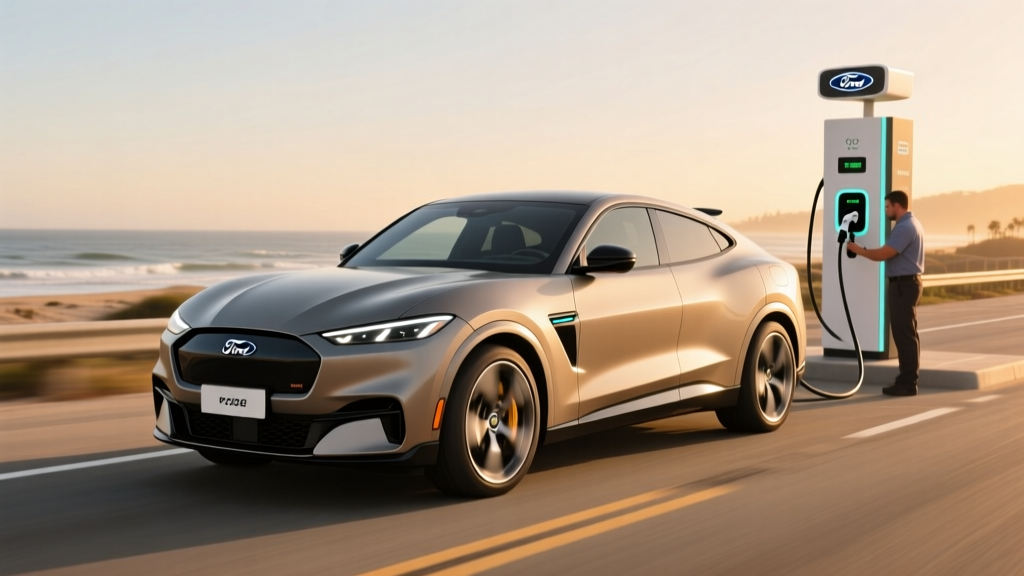
The 2026 Ford Mustang Mach-E San Carlos Edition slots into the mid-tier of Ford's all-electric crossover lineup as a California-inspired appearance and comfort package built on the proven Premium AWD platform. Named after the upscale San Carlos peninsula neighborhood in the Bay Area — a region dense with EV adopters — this trim bundles exclusive coastal-themed styling with the extended-range battery and dual-motor all-wheel-drive powertrain that have made the Mach-E a top seller since its 2021 debut.
But the San Carlos Edition is more than a paint-and-sticker job. It carries the latest version of Ford's BlueCruise hands-free driving system, a refreshed SYNC 4A infotainment stack, and the same 91-kWh (usable) NMC lithium-ion pack that delivers up to 310 miles of EPA-estimated range. Below, we break down every number that matters — from real-world highway range to DC fast-charge taper — so you can decide whether this coastal cruiser earns a spot in your driveway.
Mustang Mach-E San Carlos Edition: Spec Snapshot
| Attribute | 2026 Mach-E San Carlos Edition |
|---|---|
| EPA Range | 310 miles (AWD, Extended Range) |
| Usable Battery | 91 kWh, NMC (nickel-manganese-cobalt) |
| Drivetrain | Dual-motor AWD |
| Horsepower / Torque | 365 hp / 428 lb-ft |
| 0–60 mph | 5.1 seconds |
| Peak DC Fast Charge | 150 kW (CCS1) |
| 10–80% DC Charge Time | ~36 minutes |
| Level 2 Home Charge Rate | 10.5 kW (~30 mi/hr) |
| MPGe (Combined) | 101 MPGe |
| Efficiency | 34 kWh / 100 mi |
| Cargo (behind rear seats) | 29.7 cu ft |
| Cargo (rear seats folded) | 59.7 cu ft |
| Front Trunk (Frunk) | 4.7 cu ft |
| Rear Legroom | 38.1 in |
| Battery Warranty | 8 years / 100,000 miles |
| Base MSRP | $51,495 (before incentives) |
Real-World Range: What the EPA Sticker Doesn't Tell You
Real-World Highway (70 mph, mild weather): ~265–280 miles
Real-World City / Suburban Mix: ~290–305 miles
Cold Weather (below 32°F, highway): ~220–245 miles
The EPA rates the 2026 Mach-E AWD Extended Range at 310 miles, a figure achieved under the agency's standardized multi-cycle test. In practice, the Mach-E's real-world range depends heavily on driving style, ambient temperature, and terrain.
On a 70-mph highway cruise in 65–75°F conditions, expect approximately 265–280 miles before the battery buffer engages. The Mach-E's relatively tall crossover profile creates more aerodynamic drag at highway speed than a sedan like the Tesla Model 3, which accounts for the 10–15% drop from the EPA combined figure. In stop-and-go suburban driving, regenerative braking recaptures significant energy, pushing real-world results closer to the 310-mile sticker — and occasionally slightly above it in mild weather.
Cold weather is the Mach-E's Achilles' heel, as it is for most NMC-equipped EVs without a dedicated heat pump. Ford uses a resistive cabin heater supplemented by battery thermal conditioning. In sustained sub-freezing temperatures, expect a 20–30% range reduction, putting real-world highway range in the 220–245 mile window. Preconditioning the cabin and battery while still plugged in at home is essential for preserving range on cold mornings.
Charging Speeds: DC Fast, Level 2, and the Taper Reality
| Charging Level | Power | Speed | Notes |
|---|---|---|---|
| Level 1 (120V household) | ~1.4 kW | ~4 mi/hr | Emergency/trickle only |
| Level 2 (240V home) | 10.5 kW | ~30 mi/hr | Full charge in ~9 hours |
| DC Fast (public, CCS1) | Peak 150 kW | 10–80% in ~36 min | Tapers sharply above 80% |
| DC Fast (350 kW station) | Limited to 150 kW | Same as above | No benefit from ultra-fast chargers |
The Mach-E San Carlos Edition peaks at 150 kW on DC fast charging via its CCS1 port. At a Electrify America or EVgo station delivering sufficient power, the 10–80% session takes approximately 36 minutes. However, the charge curve is not linear. The Mach-E sustains close to its 150 kW peak only between roughly 15% and 50% State of Charge (SoC). From 50–80%, power tapers progressively — often dropping to 60–80 kW — which is why the final 30 percentage points take nearly as long as the first 60.
Charging from 80–100% on DC is painfully slow (often under 20 kW) and generates excess heat. Ford recommends limiting routine DC sessions to 80% and completing the final top-up on Level 2 at home for optimal battery longevity.
At home on a 240V Level 2 charger (such as the Ford Connected Charge Station or a third-party 48-amp unit), the onboard 10.5 kW charger adds roughly 30 miles of range per hour. A depleted-to-full charge takes about 9 hours, making overnight charging the practical standard for daily use. Most San Carlos Edition buyers in the Bay Area will pair this with a solar-equipped home system to minimize per-mile energy cost.
Performance and Driving Dynamics
The dual-motor AWD powertrain in the San Carlos Edition produces 365 horsepower and 428 lb-ft of torque, launching the 4,900-lb crossover from 0–60 mph in 5.1 seconds. That's brisk enough for confident freeway merging and passing, though it trails the GT trim (480 hp, 3.5-sec 0–60) by a wide margin.
Where the San Carlos Edition distinguishes itself is ride quality. Ford tunes this trim with a slightly softer damper calibration than the GT, prioritizing comfort on the kind of imperfect coastal roads its namesake neighborhood is known for. Steering is precise but light — this is a grand-touring EV, not a track weapon. The low center of gravity from the floor-mounted battery pack keeps body roll minimal through corners, and the 225/55R19 all-season tires provide adequate grip without excessive road noise.
Three drive modes — Whisper, Engage, and Unbridled — adjust throttle response, steering weight, and regenerative braking intensity. In Whisper mode with one-pedal driving enabled, the Mach-E can be driven almost entirely without the brake pedal in city traffic, recapturing energy on every deceleration.
Tech, Interior, and Driver Assistance
The San Carlos Edition's cabin is anchored by a 15.5-inch portrait-oriented SYNC 4A touchscreen that handles navigation, media, climate, and vehicle settings. Wireless Apple CarPlay and Android Auto are standard. The digital instrument cluster is a 10.2-inch display behind the steering wheel, configurable with range, navigation, and driver-assist information.
Standard driver-assistance features include:
- BlueCruise 1.5 — hands-free driving on over 130,000 miles of pre-mapped divided highways (SAE Level 2; driver must remain attentive with eyes-on monitoring via interior camera)
- Adaptive cruise control with stop-and-go
- Lane centering and lane-keeping assist
- Blind-spot monitoring with cross-traffic alert
- Automatic emergency braking with pedestrian detection
- Evasive steering assist
San Carlos Edition–specific touches include Ocean Breeze premium synthetic leather upholstery in a unique coastal-blue and sand tone, real open-pore wood trim, a panoramic fixed glass roof with UV-blocking tint, and embroidered San Carlos badging on the front seatbacks. A 10-speaker B&O sound system rounds out the package.
Notable drawbacks: the rear seat is slightly less spacious than a Hyundai Ioniq 5 (38.1 vs 39.4 inches of legroom), the frunk is small at 4.7 cu ft and lacks a drain plug for use as a cooler, and the absence of a physical volume knob (volume is controlled via a slider on the touchscreen or steering wheel) frustrates some users.
Pricing, Trims, and Federal Tax Credit Eligibility
| Trim / Configuration | MSRP | Est. Price After §30D Credit* |
|---|---|---|
| Mach-E Select RWD Standard Range | $42,995 | Varies by eligibility |
| Mach-E Premium AWD Extended Range | $48,995 | Varies by eligibility |
| Mach-E San Carlos Edition AWD ER | $51,495 | Varies by eligibility |
| Mach-E GT AWD | $59,995 | Varies by eligibility |
The 2026 Mustang Mach-E San Carlos Edition starts at $51,495 (including destination). Fully loaded with the optional panoramic roof delete credit and no additional packages, the as-tested price typically lands around $52,200–$53,000.
Federal tax credit (§30D) eligibility is nuanced. Under current IRS rules, the Mach-E may qualify for up to $7,500 — but only if the buyer meets all of the following criteria:
- Income cap: Modified AGI must not exceed $150,000 (single), $225,000 (head of household), or $300,000 (joint filers)
- MSRP cap: The vehicle's MSRP must be at or below $80,000 for SUVs/crossovers (Mach-E qualifies at $51,495)
- Battery sourcing: A percentage of critical minerals and battery components must be sourced from the U.S. or free-trade-agreement partners — this requirement tightens annually, and IRS guidance should be checked for the specific build date
- Final assembly: Vehicle must undergo final assembly in North America (Mach-E is assembled in Cuautitlán, Mexico — this has disqualified it in some prior years; verify current status on fueleconomy.gov)
- Point-of-sale transfer: As of 2024+, eligible buyers can transfer the credit to the dealer at purchase, reducing the out-of-pocket price immediately rather than waiting to claim it on their tax return
Important: The Mach-E's Mexico assembly location has been a point of contention under §30D. Ford has worked to reshore battery sourcing, but buyers should verify the current-year eligibility status on fueleconomy.gov before assuming the full $7,500 credit applies. State incentives (such as California's CVRP or local utility rebates) may offer additional savings independent of federal rules.
Efficiency and Operating Costs
The EPA rates the 2026 Mach-E AWD Extended Range at 101 MPGe combined (108 city / 94 highway), translating to approximately 34 kWh per 100 miles. At the national average residential electricity rate of ~$0.16/kWh, that works out to roughly $0.054 per mile — compared to about $0.14–$0.17 per mile for a similarly sized gas crossover averaging 25 MPG at $3.50/gallon.
Over 15,000 miles of annual driving, the Mach-E's home-charging fuel cost is approximately $810, versus $2,100–$2,550 for a gas equivalent. Public DC fast charging is more expensive (often $0.35–$0.50/kWh), which can push per-mile costs above gas if you rely on it exclusively — making home charging access a critical ownership factor.
Cargo, Passenger Space, and Practicality
The Mach-E offers 29.7 cubic feet of cargo space behind the rear seats and 59.7 cu ft with the 60/40 rear seatback folded. The front trunk (frunk) adds 4.7 cu ft — enough for a charging cable bag and a small grocery run, but not a full suitcase. Rear-seat legroom is 38.1 inches, adequate for adults but tighter than the Hyundai Ioniq 5 (39.4 in) or Tesla Model Y (41.6 in).
For Bay Area families, the Mach-E comfortably handles two child seats in the outboard positions (LATCH equipped), with enough center space for a narrow booster. The flat load floor and wide hatch opening make loading strollers and gear straightforward. Towing is limited to 1,500 lbs with the factory hitch — sufficient for a small utility trailer or a pair of dirt bikes, but not a camping trailer.
Warranty and Long-Term Ownership
Ford backs the Mach-E's high-voltage battery with an 8-year / 100,000-mile warranty against defects and excessive capacity loss (defined as dropping below 70% of original capacity). The electric powertrain components (motors, inverter, onboard charger) carry the same 8/100k coverage. The basic bumper-to-bumper warranty is 3 years / 36,000 miles.
NMC batteries in the Mach-E have shown moderate degradation in real-world fleet data — typically losing 5–8% capacity over the first 100,000 miles. Ford's battery thermal management system (liquid cooling and heating) helps mitigate extreme-temperature degradation. To maximize longevity, Ford recommends:
- Limiting routine charging to 80–90% SoC for daily use
- Avoiding frequent DC fast charging when Level 2 is available
- Using preconditioning in extreme cold or heat
- Avoiding prolonged storage above 90% or below 20% SoC
Out-of-warranty battery replacement for the 91-kWh pack is estimated at $12,000–$18,000 depending on labor, though prices continue to decline as the supply chain matures.
How the San Carlos Edition Stacks Up Against Rivals
| Spec | Mach-E San Carlos AWD ER | Tesla Model Y LR AWD | Hyundai Ioniq 5 AWD LR |
|---|---|---|---|
| EPA Range | 310 mi | 320 mi | 290 mi |
| Battery (usable) | 91 kWh NMC | 75 kWh NMC | 77.4 kWh NMC |
| Peak DC Charge | 150 kW | 250 kW | 240 kW (350 kW capable) |
| 10–80% Time | ~36 min | ~25 min | ~18 min (350 kW station) |
| 0–60 mph | 5.1 sec | 4.8 sec | 5.1 sec |
| HP | 365 | 384 | 320 |
| Cargo (rear up) | 29.7 cu ft | 30.2 cu ft | 27.2 cu ft |
| Base MSRP | $51,495 | $47,990 | $50,100 |
| Hands-Free Assist | BlueCruise 1.5 | FSD (Supervised) | Highway Driving Assist 2 |
The Mach-E San Carlos Edition trades some charging speed and range efficiency for ride comfort, interior material quality, and a more traditional dealership purchase experience. The Tesla Model Y charges significantly faster (250 kW peak, ~25-min 10–80%) and offers a slightly longer range at a lower base price, but its interior materials are sparser and its service model is entirely direct-to-consumer. The Hyundai Ioniq 5 is the fastest charger in this group (18 minutes on a 350 kW station) but sacrifices 20 miles of range and some cargo space.
Choose the Tesla Model Y if: You want the fastest Supercharger network access, the longest real-world range, and the lowest base price in this segment.
Choose the Hyundai Ioniq 5 if: Ultra-fast DC charging (18-min 10–80%) and distinctive retro-futurist styling are your top priorities.
Pros and Cons at a Glance
- Comfortable, well-damped ride quality
- Premium interior with San Carlos–exclusive materials
- BlueCruise 1.5 hands-free on 130k+ highway miles
- 310-mile EPA range covers most daily and weekend needs
- Strong regenerative braking enables one-pedal city driving
- Quiet cabin at highway speeds
- 150 kW DC peak is slow vs. Hyundai/Tesla rivals
- Real-world highway range drops to ~265–280 mi
- No heat pump — cold-weather range loss is significant
- Mexico assembly may affect §30D credit eligibility
- Rear legroom tighter than Model Y and Ioniq 5
- Small 4.7 cu ft frunk with limited utility
Who the Mustang Mach-E San Carlos Edition Suits Best
This trim is ideal for suburban commuters and weekend road-trippers who value a premium cabin and hands-free highway assist over bleeding-edge charge speeds. Bay Area and West Coast buyers will appreciate the coastal design theme, and those with home Level 2 charging will find the 310-mile range more than adequate for daily driving plus weekend trips to Tahoe or Big Sur (with one DC stop each way).
It's less ideal for buyers who regularly tow, frequently drive in extreme cold, or rely exclusively on public DC fast charging and need the fastest possible sessions. Those buyers should consider the Ioniq 5 (faster charging) or the Rivian R1S (towing and cold-weather capability).
Frequently Asked Questions
What is the real-world range of the 2026 Mustang Mach-E San Carlos Edition?
The EPA rates it at 310 miles combined. In real-world highway driving at 70 mph in mild weather, expect 265–280 miles. City and suburban driving with regenerative braking yields results closer to the EPA sticker. In cold weather (below 32°F), highway range can drop to 220–245 miles due to the lack of a heat pump.
How fast does the Mach-E San Carlos Edition charge?
On DC fast charging, it peaks at 150 kW and charges from 10–80% in approximately 36 minutes. At home on a 240V Level 2 charger (10.5 kW), it adds about 30 miles of range per hour, with a full charge taking roughly 9 hours. Charging above 80% on DC slows dramatically and is not recommended for routine use.
Does the 2026 Mach-E qualify for the federal EV tax credit?
It may qualify for up to $7,500 under IRS §30D, but eligibility depends on the buyer's income (AGI caps apply), the vehicle's battery sourcing compliance (which tightens annually), and final assembly location. The Mach-E is assembled in Mexico, which has affected eligibility in prior years. Verify current-year status on fueleconomy.gov and consult a tax professional before relying on the credit.
How much does the Mach-E San Carlos Edition cost after incentives?
The base MSRP is $51,495. If you qualify for the full $7,500 federal credit (via point-of-sale transfer), the effective price drops to approximately $43,995. California buyers may also qualify for state and local utility rebates. Final pricing depends on your specific tax situation and current incentive availability — always verify before purchase.
Is the Mustang Mach-E worth buying vs. the Tesla Model Y or Hyundai Ioniq 5?
The Mach-E excels in ride comfort, interior quality, and BlueCruise hands-free driving. However, the Tesla Model Y charges faster (250 kW), offers slightly more range (320 mi), and costs less at the base level. The Hyundai Ioniq 5 charges even faster (18-min 10–80% on 350 kW stations). If charging speed and maximum range are your top priorities, the Model Y or Ioniq 5 are stronger choices. If comfort, premium materials, and traditional dealership support matter more, the Mach-E San Carlos Edition holds its own.
What are the biggest pros and cons?
Pros: comfortable ride, premium interior, 310-mile EPA range, BlueCruise hands-free assist, strong regenerative braking. Cons: 150 kW DC charging is slower than key rivals, no heat pump means significant cold-weather range loss, rear legroom is tighter than competitors, and Mexico assembly may complicate federal tax credit eligibility.