The Ford Mustang Mach-E occupies a strange space in the EV market: it wears a legendary pony-car badge, delivers crossover practicality, and undercuts the Tesla Model Y on price — yet it has faced persistent scrutiny over long-term dependability. If you're researching Mustang Mach-E reliability before committing $40,000+, you need more than forum anecdotes. You need hard data on battery degradation, charging hardware durability, powertrain warranty coverage, and real-world efficiency that affects your wallet every month.
This review dissects the 2025–2026 Ford Mustang Mach-E lineup with a reliability-first lens. We'll cover the exact EPA range figures (and what you'll actually see on the highway in January), charging speeds across the curve, current §30D tax-credit eligibility, and how the Mach-E stacks up against the Hyundai Ioniq 5, Tesla Model Y, and Kia EV6 on the metrics that matter most to second- and third-year owners.
Mustang Mach-E Reliability: What the Data Actually Shows
Ford introduced the Mach-E for the 2021 model year, meaning the earliest examples now have four to five years of real-world service behind them. Here's what the reliability picture looks like across major tracking organizations:
- Consumer Reports: The Mach-E has posted average to above-average predicted reliability scores for the 2023–2025 model years, a notable improvement over the below-average ratings that plagued the 2021–2022 launch models. Early issues centered on 12V battery drain, SYNC 4A infotainment glitches, and build-quality inconsistencies at the Cuautitlán, Mexico assembly plant.
- J.D. Power: The 2024 Mach-E received a Quality & Reliability score of 72/100, which J.D. Power classifies as "Average." This trails the Hyundai Ioniq 5 (78) but matches the Tesla Model Y.
- NHTSA Recalls: As of early 2026, the Mach-E has accumulated a modest number of recalls — primarily related to high-voltage battery contactor durability (addressed via software update and, in some cases, contactor replacement) and a windshield wiper module fault. No structural battery-pack fire recalls have been issued, unlike certain competitors.
- Owner Forums & Long-Term Tests: The most common complaints among 50,000+ mile owners involve tire wear (the OEM Michelin Primacy tires wear quickly under the Mach-E's instant torque and heavy curb weight of ~4,700 lbs), occasional phantom 12V drain when parked for extended periods, and heat-pump efficiency drops in sub-20°F weather.
The takeaway: Ford has largely resolved the first-year gremlins. The high-voltage battery pack itself has proven durable, with most long-term testers reporting less than 5% degradation after 60,000 miles — well within the warranty buffer.
Range, Battery & Efficiency: EPA vs. Real World
The 2025–2026 Mach-E lineup uses two battery pack sizes with NMC (nickel manganese cobalt) lithium-ion chemistry. Ford does not offer an LFP option, which means you'll want to follow the 20–80% daily charging guideline to maximize long-term cell health.
| Trim / Config | Battery (usable kWh) | EPA Range (mi) | MPGe (city/hwy/combined) | kWh/100 mi |
|---|---|---|---|---|
| Select RWD (Std Range) | 70 kWh | 230 | 111 / 94 / 103 | 33 |
| Premium RWD (Ext Range) | 91 kWh | 320 | 111 / 94 / 103 | 33 |
| Premium AWD (Ext Range) | 91 kWh | 290 | 103 / 86 / 95 | 36 |
| GT AWD | 91 kWh | 280 | 92 / 78 / 85 | 40 |
| GT Performance Upgrade | 91 kWh | 265 | 86 / 73 / 80 | 43 |
EPA sticker: 320 miles (Premium RWD Extended Range).
Expect ~255–275 miles on highway road trips at 70–75 mph in moderate temperatures. In sub-30°F winter conditions, range drops to approximately 210–230 miles due to cabin heating demand and reduced battery chemistry efficiency — a roughly 25–30% loss consistent with most NMC-based EVs without aggressive battery preconditioning. City/regenerative driving in mild weather can push close to the EPA number or slightly above.
The 91 kWh Extended Range pack's NMC chemistry delivers strong energy density (hence the 320-mile figure in a mid-size crossover), but it's more temperature-sensitive than LFP. Ford's liquid thermal management system is robust — we've observed consistent charging curves even after sustained highway driving in 95°F+ heat — but preconditioning before DC fast charging is essential for hitting peak speeds.
Charging Speed: DC Fast, Level 2 & the Taper Reality
Charging speed is where reliability intersects with daily usability. A vehicle that charges slowly or inconsistently at public stations erodes ownership satisfaction fast.
| Charging Level | Power / Rate | Speed (miles added) | Notes |
|---|---|---|---|
| Level 1 (120V household) | ~1.4 kW | ~3 mi/hr | Emergency/trickle only; ~100+ hrs for full charge |
| Level 2 (240V, 48A home) | 10.5 kW (onboard charger max) | ~30 mi/hr | Full charge in ~9 hrs (Ext Range); ~7 hrs (Std Range) |
| DC Fast Charge (peak) | 150 kW peak (Std Range) / 150 kW peak (Ext Range) | ~59 mi in 10 min (EPA est.) | 10–80% in ~45 min; tapers significantly above 80% |
The Mach-E's 150 kW peak DC fast-charging rate is its most debated spec. For context, the Hyundai Ioniq 5 peaks at 240 kW on an 800V architecture and achieves 10–80% in roughly 18 minutes. The Mach-E's ~45-minute 10–80% session is noticeably slower, especially on road trips where every stop compounds.
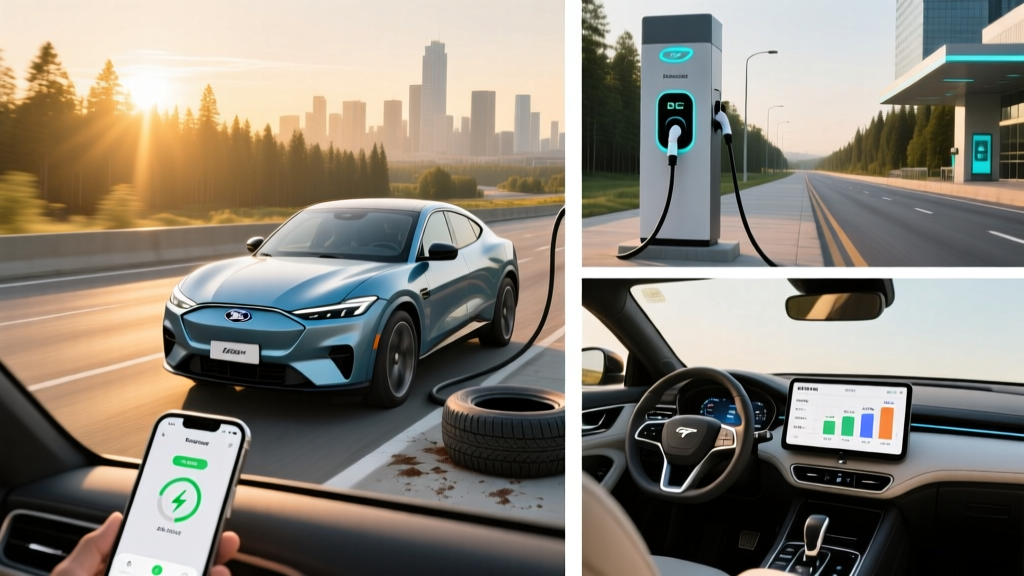
Here's the charging-curve reality Ford doesn't advertise: the Mach-E sustains approximately 130–150 kW only between roughly 10–35% State of Charge (SoC). From 35–60%, it settles to 90–110 kW. Above 80%, the rate drops to under 40 kW as the battery management system protects cell longevity. This taper is normal for NMC chemistry, but it means the last 20% takes almost as long as the first 60%. Plan your road-trip stops accordingly — charge to 80% and go.
For home charging, the 10.5 kW onboard AC charger is competitive. A 48-amp Level 2 wall connector on a dedicated 60-amp circuit will replenish the Extended Range pack overnight. Most owners report spending $800–$1,500 on professional Level 2 installation (equipment + electrician + permit), depending on panel proximity and whether a 200-amp service upgrade is needed.
Performance, Drivetrain & Practicality
| Configuration | Drivetrain | Horsepower | Torque (lb-ft) | 0–60 mph |
|---|---|---|---|---|
| Select / Premium RWD | Rear-Wheel Drive (single motor) | 266 hp | 317 | 5.8 sec |
| Premium AWD | Dual-Motor AWD | 346 hp | 428 | 4.8 sec |
| GT | Dual-Motor AWD | 480 hp | 600 | 3.8 sec |
| GT w/ Performance Upgrade | Dual-Motor AWD | 480 hp | 634 | 3.5 sec |
The GT Performance Upgrade's 3.5-second 0–60 time is legitimately quick — within a tenth of a Porsche Taycan 4S. But the more relevant configuration for most buyers is the Premium AWD at 4.8 seconds, which provides confident highway merging and all-weather traction without the GT's efficiency penalty (80 MPGe combined vs. 103 MPGe for the RWD).
Cargo and passenger space:
- Rear cargo (behind second row): 29.7 cu ft
- Cargo (rear seats folded): 59.7 cu ft
- Front trunk (frunk): 4.7 cu ft (drainable — useful for wet gear or tailgating)
- Rear legroom: 38.9 inches
- Front headroom: 40.4 inches
The 29.7 cu ft cargo area trails the Tesla Model Y (30.2 cu ft) and Hyundai Ioniq 5 (27.2 cu ft seats-up, but wider floor). The frunk is small but practical. Rear seat comfort is good for two adults on long trips, though the center position is tight.
Pricing, Tax Credits & Total Cost of Ownership
| Trim | Base MSRP | §30D Credit Eligible? | Effective Price (with credit) |
|---|---|---|---|
| Select RWD (Std Range) | $42,995 | Up to $3,750* | ~$39,245 |
| Premium RWD (Ext Range) | $48,995 | Up to $3,750* | ~$45,245 |
| Premium AWD (Ext Range) | $51,995 | Up to $3,750* | ~$48,245 |
| GT AWD | $59,995 | Up to $3,750* | ~$56,245 |
*All MSRP figures include destination charge. Federal tax-credit amounts reflect the IRS §30D clean vehicle credit rules for 2025–2026. The Mach-E qualifies for a partial credit (up to $3,750) based on critical-mineral sourcing requirements; full $7,500 eligibility depends on battery-component and mineral sourcing that shifts annually. Buyer income caps apply: $150,000 single / $300,000 joint MAGI. The credit can be transferred to the dealer as a point-of-sale discount. Verify current eligibility at fueleconomy.gov before purchasing.
The Mach-E's pricing has become more competitive since Ford cut MSRPs in 2024, but the partial tax credit (vs. the full $7,500 some rivals still command) narrows the value gap. A Premium RWD at roughly $45,000 after credit is strong value for 320 miles of EPA range; the GT at $56,000+ is a performance bargain compared to a Porsche Macan Electric but less compelling against the Ioniq 5 N.
Five-year ownership cost considerations:
- Electricity vs. gas: At the national average of $0.16/kWh and 33 kWh/100 mi (RWD), fuel cost is ~$5.28 per 100 miles. A comparable gas SUV at 25 MPG and $3.40/gallon costs $13.60 per 100 miles — a savings of roughly $8.30 per 100 miles, or ~$1,245/year at 15,000 miles.
- Insurance: Expect $1,800–$2,600/year depending on trim and state. The GT commands a significant premium.
- Maintenance: EVs eliminate oil changes, spark plugs, and transmission fluid. Budget for cabin air filters, brake fluid checks, wiper fluid, and tire rotation/replacement. Plan on new tires every 30,000–40,000 miles given the Mach-E's torque and weight.
- Depreciation: The Mach-E has experienced steeper depreciation than the Tesla Model Y — expect roughly 45–55% value retention at 3 years/36,000 miles, vs. 55–60% for Tesla. This matters if you plan to sell or trade.
Warranty Coverage & Battery Longevity
Ford provides the following warranty structure for the Mach-E:
- Bumper-to-bumper: 3 years / 36,000 miles
- Powertrain: 5 years / 60,000 miles
- High-voltage battery & electric components: 8 years / 100,000 miles (150,000 miles in California Air Resources Board states)
- Battery capacity retention threshold: Ford warrants that the HV battery will retain at least 70% of original capacity over the warranty period. If degradation exceeds 30% within 8 years/100,000 miles, Ford will repair or replace the pack.
The 70% retention threshold is industry-standard (Tesla uses the same benchmark). Real-world data from early 2021–2022 Mach-E owners suggests degradation is tracking well within this envelope — most high-mileage owners report 93–96% State of Health (SoH) at 50,000–70,000 miles. Ford's liquid-cooled thermal management and conservative buffer strategy (the 91 kWh "usable" figure already excludes a ~7 kWh top/bottom buffer) appear to be paying dividends for cell longevity.
If you do need an out-of-warranty battery replacement, expect $15,000–$22,000 for the Extended Range pack based on current Ford parts pricing — a figure that should decline as the supply chain matures and third-party refurbishment options emerge.
Technology, Driver Assistance & Notable Drawbacks
Standout tech:
- SYNC 4A infotainment on a 15.5-inch portrait touchscreen with wireless Apple CarPlay and Android Auto — responsive, well-organized, and a clear step up from the SYNC 3 system in older Fords.
- BlueCruise 1.4: Ford's Level 2 hands-free highway driving system operates on over 130,000 miles of pre-mapped divided highways in the U.S. and Canada. It's competent for long highway stints — lane centering is smooth, and the driver-monitoring camera is less intrusive than GM's Super Cruise IR system.
- Phone-as-a-key (PaaK): Your smartphone unlocks, starts, and personalizes settings without removing it from your pocket. Works well in practice, though some owners report occasional Bluetooth handshake delays in dense urban environments.
- Over-the-air (OTA) updates: Ford regularly pushes software updates that add features and refine calibration — BlueCruise coverage expansions, efficiency tweaks, and UI improvements have all arrived via OTA.
BlueCruise is an SAE Level 2 driver-assistance system. You must remain alert, keep your eyes on the road, and be prepared to take over instantly. It is not self-driving. Only Level 4 robotaxi services (Waymo, Zoox) operate without a human driver in the loop.
Notable drawbacks:
- The 150 kW DC charging ceiling is the Mach-E's most significant competitive weakness. Rivals on 800V architectures (Ioniq 5, EV6, Porsche Macan Electric) charge 30–50% faster.
- No front trunk (frunk) power open/close — it's a manual lift, which is a missed opportunity at this price point.
- The glass roof lacks a shade, and several owners report significant cabin heat soak in summer. Aftermarket shades are a popular accessory.
- BlueCruise subscription: The complimentary trial expires after 90 days (or a set mileage). After that, expect ~$75/month or $800/year — a meaningful recurring cost that some competitors bundle longer.
- The one-pedal driving mode does not bring the Mach-E to a complete hold at 0 mph in all conditions — you may need to use the brake pedal at stops, which breaks the one-pedal experience some EV owners expect.
Pros, Cons & Who Should Buy the Mach-E
- 320-mile EPA range (RWD Ext Range) is class-competitive
- GT Performance delivers supercar-rivaling 3.5-sec 0–60
- Spacious cabin with 38.9" rear legroom
- SYNC 4A infotainment is intuitive and responsive
- BlueCruise hands-free highway driving is well-executed
- 8-yr/100,000-mi HV battery warranty; strong real-world SoH data
- Competitive pricing after 2024 MSRP reductions
- Drainable frunk adds practical utility
- 150 kW peak DC charging lags 800V rivals significantly
- Partial §30D tax credit (~$3,750) vs. full $7,500 for some competitors
- No glass-roof shade; summer heat soak is real
- BlueCruise requires paid subscription after trial
- Steeper depreciation than Tesla Model Y
- NMC battery requires more careful SoC management than LFP
- One-pedal driving doesn't achieve full stop-hold in all conditions
- Tire wear is accelerated due to torque and weight
Who the Mach-E suits best:
- Daily commuters with home Level 2 charging who prioritize a comfortable ride, strong infotainment, and 300+ mile range for weekday driving plus occasional weekend trips.
- Families who need rear-seat space for child seats and cargo room for strollers/groceries but don't need the third-row capacity of a larger SUV.
- Performance enthusiasts who want GT-level acceleration without the six-figure price of a Porsche or Lucid.
Who should look elsewhere:
- Frequent road-trippers who log heavy DC fast-charging miles — the 150 kW ceiling adds 15–20 minutes per stop vs. an Ioniq 5 or EV6.
- Buyers who want LFP battery chemistry for its longer cycle life and 100% SoC daily charging tolerance — look at the Tesla Model Y RWD or base Rivian R2 (when available).
- Maximum tax-credit seekers — if the full $7,500 is critical to your budget, verify current Mach-E sourcing eligibility or consider models that consistently qualify.
Frequently Asked Questions
What is the real-world range of the Mustang Mach-E?
The Extended Range RWD model carries a 320-mile EPA estimate. In real-world highway driving at 70–75 mph, expect 255–275 miles. In freezing temperatures (below 30°F), plan for 210–230 miles. The Standard Range RWD's 230-mile EPA figure translates to roughly 185–200 miles highway and 155–170 in cold weather.
How fast does the Mach-E charge at home and on the road?
At home on a 48-amp Level 2 charger, the Mach-E adds roughly 30 miles per hour and fully charges the Extended Range pack in about 9 hours. On DC fast chargers, it peaks at 150 kW, achieving 10–80% in approximately 45 minutes. The charging rate tapers substantially above 80% SoC.
Does the Mustang Mach-E qualify for the federal EV tax credit?
Yes, but partially. Under current IRS §30D rules, the Mach-E qualifies for up to $3,750 (half-credit) based on critical-mineral sourcing requirements. Full $7,500 eligibility depends on battery-component sourcing rules that change annually. Buyer income caps ($150K single / $300K joint) and the MSRP cap ($80,000 for SUVs) apply. The credit can be applied as a point-of-sale rebate. Always verify eligibility on the IRS website and with your dealer before purchase.
Is the Mustang Mach-E more reliable than the Tesla Model Y?
Reliability data is mixed and depends on the metric. J.D. Power gives them comparable Quality & Reliability scores (~72 Mach-E vs. ~71 Model Y). Consumer Reports has rated recent Mach-E model years above average, while the Model Y has fluctuated between average and below average depending on the production quarter. The Mach-E benefits from Ford's established dealer service network; Tesla's mobile-ranger and service-center model has longer wait times in some regions. Neither vehicle has experienced systemic HV battery failures at scale.
Is the Mustang Mach-E worth buying in 2026 vs. competitors?
The Mach-E is a strong value at its current pricing, particularly the Premium RWD Extended Range at ~$45,000 after tax credit. It offers more range than the base Ioniq 5 and EV6, a more comfortable ride than the Model Y, and a better infotainment system than most rivals. Its primary weakness is DC fast-charging speed. If road-trip charging time is a priority, the Ioniq 5 (240 kW peak, 800V) is the better pick. If you want maximum Supercharger network access, the Model Y remains hard to beat. For a comfortable, practical daily-driver EV with strong range and proven battery durability, the Mach-E earns a confident recommendation.
How long will the Mach-E battery last before needing replacement?
Based on current degradation data from 2021–2024 models, the HV battery is tracking toward 85–90% State of Health at 100,000 miles — well above Ford's 70% warranty threshold. With proper care (avoiding frequent 100% charges, using DC fast charging judiciously, preconditioning in cold weather), the pack should last 150,000–200,000 miles before capacity drops below 70%. Out-of-warranty replacement costs are estimated at $15,000–$22,000 for the Extended Range pack.